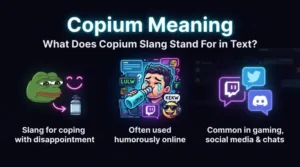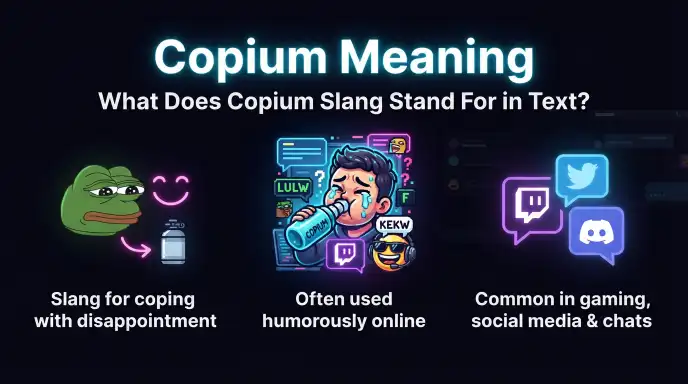
Copium is internet slang combining “cope” and “opium,” used sarcastically to describe someone using unrealistic hope, denial, or excuses to deal with disappointment or a bad situation.
If you’ve spent time on Reddit, Twitter, or gaming forums, chances are you’ve come across the word “copium.” It’s one of those internet-born terms that spread fast and now shows up everywhere online
The word is a playful blend of “cope” and “opium,” suggesting someone is metaphorically “high” on unrealistic hope or denial. It’s usually used to mock people who refuse to accept an obvious or disappointing truth.
Copium is often used sarcastically in memes and comment sections, especially after a team loses, a prediction fails, or an argument falls apart. Saying someone is “on copium” basically means they’re coping in a delusional or exaggerated way.
In this article, we’ll explain exactly where copium came from, how it’s used in different online communities, and give you real examples to help you use it correctly. By the end, you’ll fully understand this viral slang term and its true meaning.
Quick Answer:
Copium is internet slang for a person’s emotional or mental attempt to cope with disappointment, especially by making optimistic excuses or holding onto unlikely hope.
What Does Copium Mean in Text?
Copium meaning in text refers to a humorous way of describing denial, unrealistic optimism, or an attempt to cope with an unpleasant result.
The word is commonly used when someone has experienced a loss, failure, rejection, bad news, or disappointing outcome but continues to believe that things will somehow turn out well.
For example:
“Our team lost 4–0, but I still think we can win the tournament. I’m on copium.”
The speaker knows the situation looks bad but is joking about continuing to believe.
Another example is:
“He says the game isn’t delayed; he’s just on copium.”
Here, “copium” suggests that the person is trying to convince themselves of something because accepting reality is disappointing.
In simple terms, copium means comforting yourself with hope, excuses, or optimistic thinking after something goes wrong.
Copium Full Form and Definition
A common question is “what does copium stand for?”
Copium does not have a traditional full form like a normal abbreviation. Instead, it is a blend of “cope” and “opium.”
The word “cope” refers to dealing with a difficult situation. “Opium” is used as part of the joke because the slang imagines unrealistic hope or denial as something emotionally comforting or addictive.
So, the basic idea is:
Cope + Opium = Copium
The word is usually not meant literally. When someone says, “I need copium,” they are generally joking that they need something to help them emotionally handle a disappointing situation.
Simple Definition
Copium: Internet slang describing unrealistic optimism, denial, excuses, or emotional comfort used to deal with disappointment.
Is Copium Rude, Offensive, or Neutral?
Copium is generally informal and humorous, rather than a serious offensive term.
However, its meaning depends heavily on context.
If you tell a friend:
“We’re definitely winning next week. Pass me the copium.”
it can be funny and harmless.
But if someone has experienced a serious disappointment and you respond:
“You’re just on copium.”
the phrase may sound dismissive or insulting.
Copium can imply that someone is not accepting reality. Because of that, it may be used as a mild insult during arguments.
| Context | Tone of “Copium” | Example |
| Friends joking | Playful | “Pass the copium.” |
| Gaming chat | Humorous | “You’re on copium after that loss.” |
| Online argument | Mocking | “That’s pure copium.” |
| Professional conversation | Unprofessional | “Your plan is just copium.” |
| Serious personal situation | Potentially insensitive | “Stop using copium.” |
The safest approach is to use the word casually with people who understand internet slang.
Where Is Copium Commonly Used?
Copium is especially common in online communities.
You may encounter it on:
- Gaming chats
- YouTube comments
- Reddit discussions
- Discord servers
- Social media
- Sports communities
- Esports discussions
- Meme pages
- Online forums
- Fan communities
Gaming and sports are particularly strong environments for the term because fans frequently experience wins, losses, predictions, and disappointments.
For example, after a football team loses an important match, fans might jokingly say:
“Don’t worry, we’ll win the next one. I’m high on copium.”
The phrase turns disappointment into humor.
Copium in Gaming and Social Media
Gaming culture has helped make copium meaning slang especially recognizable online.
Imagine a player loses a competitive match and says:
“The opponent only won because my internet lagged.”
Someone else might reply:
“Bro is on copium.”
The response suggests that the player is using an excuse to avoid admitting they played badly.
Another common situation happens before a game is released. A player might say:
“The developers will definitely fix everything before launch.”
If there is little evidence for that belief, another person may comment:
“That’s some serious copium.”
On social media, copium can also be used as a meme. People often exaggerate their optimism for comedic effect.
Real-Life Examples of Copium
Here are several examples showing how the slang changes depending on the situation.
Friendly Example
Person A: “We lost the match, but we’re still making the playoffs.”
Person B: “That’s some strong copium 😂”
This is friendly teasing.
Casual Example
“I’m on copium that my favorite show gets another season.”
The person is hoping for something that may not happen.
Argumentative Example
Person A: “The product failed because customers didn’t understand it.”
Person B: “That’s just copium. The reviews clearly explain the problem.”
Here, copium is being used more critically.
Gaming Example
“I missed every shot because my mouse was broken. Pure copium.”
The speaker is joking about making excuses.
Sports Example
“We lost three games in a row, but the championship is still ours. I’m running on copium.”
This uses exaggerated optimism for humor.
Social Media Example
“They’re definitely getting back together.”
Reply: “Copium is strong today.”
The commenter believes the prediction is unrealistic.
Origin and Background of Copium
The origin of copium is closely associated with internet meme culture.
The word is constructed as a humorous combination of “cope” and “opium.” The concept became popular online as a way to describe people using comforting beliefs to deal with failure or disappointment.
Internet communities often create new slang by combining existing words. Copium fits this pattern perfectly because it turns the idea of “coping” into a fictional substance.
The joke is essentially:
Something disappointing happened → You need emotional comfort → You are metaphorically using “copium.”
The term became especially recognizable through online memes, gaming culture, political discussions, sports communities, and other internet spaces.
It is important to remember that the slang is normally metaphorical. Someone saying “I need copium” is generally not talking about an actual substance.
Copium vs. Coping
Although the words are related, coping and copium are not exactly the same.
Coping is a normal English word describing how someone deals with stress, problems, disappointment, or difficult emotions.
Copium is internet slang that usually adds a humorous or mocking idea of unrealistic optimism.
| Term | Meaning | Tone | Example |
| Coping | Dealing with a difficult situation | Neutral | “I’m coping with the loss.” |
| Copium | Humorously coping through hope or denial | Informal | “I’m using copium after that loss.” |
| Denial | Refusing to accept reality | Usually negative | “He’s in denial.” |
| Optimism | Expecting a positive outcome | Usually positive | “She remains optimistic.” |
| Hopium | Excessive or unrealistic hope | Informal | “He’s full of hopium.” |
This comparison shows why copium is often humorous rather than purely negative.
Copium vs. Hopium
Copium and hopium are closely related internet slang terms.
Both are used when someone has unrealistic expectations or strong hope.
The difference is mainly emphasis.
Copium focuses more on dealing with disappointment.
Hopium focuses more on hope for a positive future outcome.
For example:
“We lost, but I’m still saying we can win next week. That’s copium.”
This focuses on coping with the loss.
Meanwhile:
“The developers haven’t announced anything, but I know the update is coming.”
Someone might call that “hopium” because the person is holding onto hope without much evidence.
Similar Slang Terms Compared
Several internet expressions have meanings that overlap with copium.
| Slang | Basic Meaning | Common Use |
| Copium | Unrealistic coping after disappointment | Gaming, sports, arguments |
| Hopium | Unrealistic or excessive hope | Predictions and future events |
| Cope | Deal with a disappointing reality | Online arguments |
| Delulu | Being unrealistically confident or imaginative | Social media and relationships |
| Denial | Refusing to accept reality | General conversation |
| Excuse | Reason given to explain failure | Everyday situations |
These words are not always interchangeable.
For example, delulu can describe unrealistic beliefs in many situations, while copium is particularly associated with coping after something disappointing.
When Do People Use Copium?
People often use the slang when one of these situations happens:
After Losing
“We lost, but next game will be different. Copium.”
After a Failed Prediction
“I said the update was coming this month. I was on copium.”
When Defending a Favorite Team
“Our team played badly because of the referee. Copium.”
When Supporting a Favorite Character
“The character isn’t really dead. They’ll bring them back.”
Someone might respond:
“Maximum copium.”
During Online Arguments
People sometimes use copium to dismiss another person’s argument.
“That’s not an explanation. That’s copium.”
In these cases, the word can become more confrontational.
Why Do People Use This Slang?
There are several reasons internet users enjoy the term.
1. It Makes Disappointment Funny
Instead of seriously saying, “I’m disappointed,” someone can joke:
“I need copium.”
Humor makes an unpleasant situation easier to discuss.
2. It Creates a Shared Internet Language
Online communities often develop their own vocabulary. Copium is immediately understandable to many people familiar with gaming and meme culture.
3. It Makes Arguments Shorter
Instead of explaining that someone is making unrealistic excuses, a person might simply say:
“That’s copium.”
The slang compresses a larger idea into one word.
4. It Encourages Self-Deprecating Humor
People also use copium against themselves.
“I’m definitely getting the job. Ignore the fact that I failed the interview. Copium.”
This can make the speaker’s optimism intentionally funny.
When Should You Avoid Using Copium?
Although copium is generally harmless slang, there are situations where it may not be appropriate.
Avoid it when:
- Discussing serious grief
- Talking about someone’s major personal loss
- Communicating professionally
- Speaking with someone unfamiliar with internet slang
- Giving serious emotional support
- Discussing sensitive failures
- Writing formal documents
For example, telling someone who has experienced a serious personal setback that they are “on copium” could come across as insensitive.
In professional writing, clearer words such as unrealistic optimism, denial, or wishful thinking are usually better.
Polite Alternatives to Copium
If you want to communicate the same general idea without using slang, choose a phrase based on your intended tone.
| Informal Expression | More Neutral Alternative |
| “You’re on copium.” | “You may be overly optimistic.” |
| “That’s pure copium.” | “That seems unrealistic.” |
| “I need copium.” | “I need to stay hopeful.” |
| “Maximum copium.” | “That’s a very optimistic view.” |
| “He’s coping hard.” | “He’s having trouble accepting the result.” |
These alternatives work better in professional, academic, or sensitive conversations.
Impact of Copium on Communication
Internet slang can make communication faster and more entertaining, but it can also create misunderstandings.
When both people understand meme culture, “copium” can be funny and expressive.
However, someone unfamiliar with the term may not understand what you mean.
There is also a difference between self-directed and other-directed use.
Saying:
“I’m on copium.”
usually sounds humorous and self-aware.
Saying:
“You’re on copium.”
can sound like an accusation that another person is irrational.
That small difference can significantly change the tone.
Is Copium Safe for Social Media?
Generally, copium is safe as ordinary internet slang. It is commonly used in memes, comments, gaming discussions, and casual conversations.
However, context still matters.
Social media platforms contain people from different cultures, age groups, and language backgrounds. Not everyone will understand internet slang in the same way.
For safer communication:
- Use copium casually.
- Avoid using it to mock serious personal problems.
- Explain the meaning if your audience may not know it.
- Avoid relying on slang in professional posts.
- Remember that tone can be difficult to understand online.
The word itself is usually not offensive, but using it aggressively can make a comment feel insulting.
Common Mistakes When Using Copium
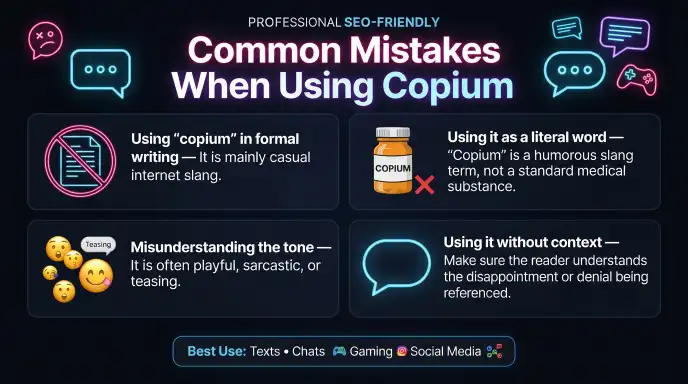
Mistake 1: Treating It as a Literal Substance
Copium is normally a metaphorical internet slang term.
Mistake 2: Assuming It Always Means Lying
Someone using copium may simply be jokingly optimistic. The term does not automatically mean the person is deliberately lying.
Mistake 3: Using It in Formal Writing
Copium is informal. Avoid it in academic papers, business reports, and official documents unless you are specifically discussing internet slang.
Mistake 4: Ignoring Tone
“I’m on copium” and “you’re on copium” can have very different emotional effects.
Mistake 5: Confusing Copium With Coping
Coping is a standard English word. Copium is an internet slang expression derived from the idea of coping.
Copium Meaning in Different Contexts
The meaning can become clearer when you consider the setting.
| Context | Example | Intended Meaning |
| Gaming | “We’re still winning this round. Copium.” | Joking optimism |
| Sports | “Our team can still qualify. I’m on copium.” | Hope after disappointment |
| Relationships | “She’ll text me back. Copium.” | Unrealistic or uncertain hope |
| Movies | “The character is definitely coming back.” | Hope without evidence |
| Work | “The boss will love this failed project. Copium.” | Self-aware optimism |
| Social media | “This rumor has to be true. Copium.” | Humorous belief |
How to Understand Copium in a Text Message
If you receive a message containing copium, look at the surrounding conversation.
Ask yourself:
- Did something disappointing happen?
- Is the person making an optimistic prediction?
- Are they joking about themselves?
- Is someone mocking another person’s argument?
- Is the conversation about gaming, sports, memes, or online culture?
For example:
“There is no way they cancel the show. Copium.”
This probably means:
“I know cancellation is possible, but I’m jokingly staying hopeful.”
Another message:
“Bro thinks he played well. Copium.”
This is more mocking and means:
“He is making excuses rather than accepting that he played badly.”
Context is therefore essential.
FAQs :
Q1: What does copium mean in slang?
Copium is internet slang blending “cope” and “opium,” used to describe someone dealing with disappointment through unrealistic hope, denial, or excuses. It’s typically used sarcastically to mock people who refuse to accept a clear or obvious truth.
Q2: Is copium a real word?
Copium isn’t a dictionary-recognized word, but it’s a widely used internet slang term born from online communities like Reddit and gaming forums. Its popularity has made it common enough to appear in slang dictionaries and everyday online conversations.
Q3: How do you use copium in a sentence?
You can use copium like this: “He said his team was going to win even after losing three games straight : that’s pure copium.” It’s often paired with phrases like “on copium” or “coping with copium” to emphasize denial.
Q4: Is copium positive or negative?
Copium is mostly used in a negative or mocking way, pointing out someone’s denial or unrealistic optimism. That said, it can also be used jokingly among friends, giving it a lighter, less serious tone depending on the context.
Q5: Is copium an insult?
Copium can function as a mild insult, especially when used to mock someone’s refusal to accept reality. However, it’s often more teasing than truly offensive, and its impact largely depends on the tone and relationship between the people using it.
Q6: What does “cope” mean in slang?
In slang, “cope” means dealing with a difficult, disappointing, or embarrassing situation, often in a way that seems forced or unconvincing. It’s frequently used online to call out someone who’s clearly struggling to accept an unwanted outcome.
Conclusion
Understanding copium meaning slang is useful if you spend time on gaming platforms, social media, forums, or meme communities. The term describes a humorous form of coping, especially when someone responds to disappointment by holding onto unrealistic hope, making excuses, or refusing to accept an unfavorable result.
The word is a playful combination of “cope” and “opium,” and it is normally used metaphorically rather than literally. It can be self-directed, as in “I’m on copium,” or directed toward another person, as in “You’re on copium.” The first often sounds humorous, while the second can sound mocking.
Copium is generally casual rather than offensive, but context and tone matter. It works well in gaming chats, sports discussions, memes, and social media. For professional or sensitive situations, clearer phrases such as “wishful thinking,” “unrealistic optimism,” or “having difficulty accepting the result” are more appropriate.
Ultimately, copium meaning in text is best understood as humorous internet language for trying to cope with disappointment through hope, excuses, or optimism.
Further Reading!

I am Ann Raimes, an applied linguist and English language educator. I am widely recognized for my contributions to writing pedagogy and research in ESL writing. I have authored several well-known books, including Techniques in Teaching Writing, Keys for Writers, and How English Works: A Grammar Handbook with Readings. Throughout my career, I have worked to promote communicative writing and the process-based approach to teaching writing, helping both teachers and learners develop effective writing skills.