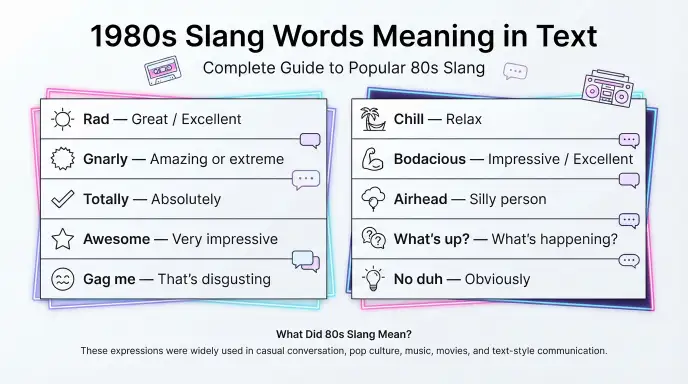
1980s slang words are casual expressions from that decade, like “rad,” “gnarly,” and “tubular,” used to describe things as cool or exciting.
The 1980s introduced a wave of unique slang that reflected the era’s pop culture, movies, and music trends. Many of these words are still recognized today, even if rarely used.
Words like “radical,” “totally,” and “bogus” became everyday expressions among teenagers and young adults. Surfer culture and valley girl trends heavily influenced this decade’s vocabulary.
MTV, teen movies, and music videos played a huge role in spreading these slang terms across the country. Phrases that started in California quickly became popular nationwide.
If you’re curious about what these classic 80s slang words mean and how they were used in conversations, this guide breaks down the most popular terms with clear definitions and examples.
Quick Answer:
1980 slang words are informal expressions popular during the 1980s. Many described something exciting, impressive, strange, unpleasant, or simply cool, and several are still recognized today.
What Do 1980 Slang Words Mean in Text?
When people ask about 1980 slang words meaning in text, they are usually looking for the meaning of expressions used in casual conversations during the 1980s.
Unlike formal English, slang is heavily influenced by culture and social groups. A word could have a completely different feeling depending on who said it and how it was used.
For example, if someone called something “rad,” they usually meant it was excellent, exciting, or impressive. If someone said “that’s bogus,” they were saying something was fake, unfair, disappointing, or unacceptable.
Some common 1980s expressions include:
- Rad: excellent or impressive
- Awesome : extremely good or impressive
- Gnarly : intense, difficult, dangerous, or impressive
- Bogus:fake, unfair, or disappointing
- Dude : a casual way to address someone
- Totally :completely or strongly
- Tubular : excellent or exciting
- Bodacious : impressive, attractive, or remarkable
- Gag me : an expression of disgust
- No way! :an expression of disbelief or surprise
- Psych! : used to reveal that someone was joking or teasing
- Airhead : someone considered unintelligent or silly
- Wicked : very good or impressive in some regional usage
1980 Slang Words Full Form and Definitions
Slang usually does not have a “full form” in the same way an abbreviation does. Instead, individual slang words have meanings that developed through popular culture and everyday speech.
For example, “rad” is commonly understood as a shortened form of “radical.” Over time, its meaning moved from the idea of something radical or extreme toward something excellent or cool.
Similarly, “dude” became a widely used informal word for a man or person. It was especially common in youth culture and later became popular across many different groups.
Here are some popular 1980 slang words and their meanings:
| 1980s Slang | Meaning | Example |
| Rad | Very cool or excellent | “That skateboard is rad.” |
| Bogus | Fake, unfair, or bad | “That excuse is bogus.” |
| Gnarly | Extreme, difficult, or impressive | “That was a gnarly wave.” |
| Tubular | Very cool or exciting | “Your new bike is tubular.” |
| Bodacious | Remarkable or impressive | “That was a bodacious performance.” |
| Gag me | Disgust or strong dislike | “Gag me, that smells awful.” |
| Psych! | Just kidding or fooled you | “You believed me? Psych!” |
| Airhead | A silly or unintelligent person | “Don’t be an airhead.” |
Are 1980s Slang Words Rude or Offensive?
Most popular 1980s slang words were informal rather than offensive. However, their appropriateness depended on the word, situation, and person being addressed.
Words such as rad, awesome, tubular, dude, and totally are generally harmless. Other expressions could be insulting when directed at a person.
For example, calling someone an “airhead” could be considered rude because it suggests that the person is unintelligent. Similarly, some slang expressions from the period may now sound disrespectful or outdated.
When using old slang today, context matters. A word can be funny in a nostalgic conversation but inappropriate in a professional setting.
Where Were 1980s Slang Words Commonly Used?
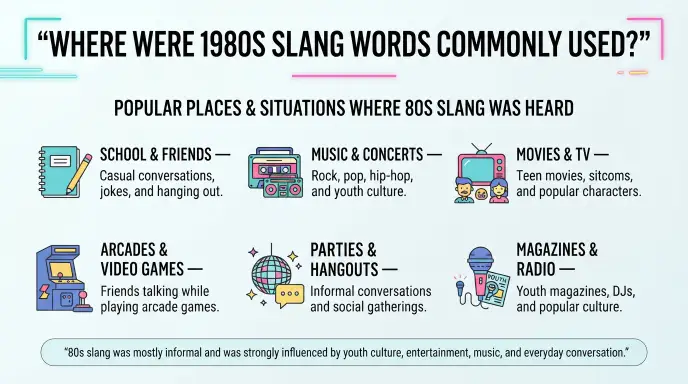
The popularity of 1980s slang was strongly connected to entertainment and youth culture.
Movies and Television
Teen movies and television shows helped spread expressions across different parts of the English-speaking world. Characters often used casual slang to sound youthful and fashionable.
Music
Rock, pop, punk, hip-hop, and other musical movements introduced new expressions to large audiences. Music fans often copied the language used by their favorite performers.
Skateboarding and Surf Culture
Words such as rad, gnarly, tubular, and bodacious were strongly associated with surfing and skateboarding culture. Their meanings often related to exciting, difficult, or impressive experiences.
Schools and Friend Groups
Teenagers frequently created and shared their own expressions. Some stayed within small social groups, while others became mainstream through television, movies, and music.
Popular 1980 Slang Words and Their Background
The 1980s did not create every slang term that became popular during the decade. Some expressions existed earlier but became much more widespread during the 1980s.
“Awesome,” for example, is much older than the decade, but its casual meaning of something extremely good became increasingly common in modern speech.
“Rad” came from “radical” and became associated with something exciting or excellent.
“Gnarly” had connections to difficult or rough experiences, especially in surfing and skateboarding culture. It could describe something dangerous, complicated, or surprisingly impressive.
“Bogus” was another important informal expression. It was often used when someone believed that something was fake, dishonest, unfair, or disappointing.
This combination of older expressions and newly popular youth language helped create the recognizable sound of 1980s conversation.
1980s Slang Compared With Modern Slang
Slang changes constantly. A word that sounds fashionable in one decade can sound old-fashioned in another.
| 1980s Slang | Meaning | Similar Modern Expression |
| Rad | Excellent or cool | Fire |
| Awesome | Very good | Amazing |
| Bogus | Fake or unfair | Fake / Not cool |
| Gnarly | Extreme or intense | Wild |
| Dude | Person or friend | Bro |
| Totally | Completely | Absolutely |
| Psych! | Just kidding | Just kidding / Got you |
| Gag me | Strong dislike | Gross / No thanks |
Modern slang can spread extremely quickly through social media, while much of the slang of the 1980s spread through television, music, movies, schools, and local communities.
Real-Life Examples of 1980s Slang
Understanding a slang word becomes easier when you see it in a natural sentence.
Friendly Examples
“Dude, your new car is totally rad!”
Here, “dude” is a friendly way of addressing someone, while “rad” means very cool.
“That concert was awesome!”
The speaker is saying that the concert was extremely enjoyable.
Casual Examples
“Want to go skating later?”
“Totally!”
In this situation, “totally” means yes or absolutely.
“That was a gnarly ride.”
The speaker means the ride was intense, difficult, exciting, or possibly dangerous.
Argumentative Examples
“That’s bogus, and you know it!”
Here, “bogus” suggests that something is unfair, false, or unacceptable.
“No way! You can’t be serious.”
“No way” expresses strong disbelief or disagreement.
Gaming and Social Context
Although modern gaming slang is very different, older expressions can still be used humorously in retro gaming communities.
For example:
“That boss fight was gnarly!”
A player could use “gnarly” to describe a particularly difficult or intense game level.
“Dude, that was totally awesome!”
This works as a nostalgic way to react positively to an impressive gaming moment.
1980s Slang: Casual vs. Stronger Expressions
Not every slang term had the same tone. Some were positive, some negative, and others simply expressed surprise.
| Slang Word | Tone | Typical Use |
| Rad | Positive | Praising something |
| Awesome | Positive | Showing excitement |
| Tubular | Positive | Calling something cool |
| Gnarly | Positive or negative | Describing something extreme |
| Bogus | Negative | Calling something unfair or fake |
| Airhead | Insulting | Describing someone as unintelligent |
| Gag me | Negative | Showing disgust |
| Psych! | Playful | Teasing someone |
This is why the 1980 slang words meaning slang can sometimes be difficult to understand without context.
When Should You Avoid Using 1980s Slang?
Using retro slang can be fun, but it is not suitable for every situation.
Avoid heavy slang when writing:
- Formal business emails
- Academic assignments
- Legal documents
- Professional applications
- Official announcements
- Serious workplace communication
For example, saying “That presentation was totally tubular!” may be funny among friends, but it would sound unusual in a formal business report.
Slang works best when the audience understands the reference and the situation is informal.
Polite Alternatives to Potentially Rude Slang
Some 1980s expressions can sound insulting. If you want to communicate the same idea politely, choose a neutral alternative.
| 1980s Expression | Possible Issue | Polite Alternative |
| Airhead | Can insult intelligence | Careless / Unfocused |
| Gag me | Sounds dismissive | I don’t like that |
| Bogus | Can sound confrontational | Unfair / Incorrect |
| No way! | Can sound argumentative | I don’t think so |
| Gnarly | Informal | Difficult / Intense |
The goal is not to eliminate slang completely. It is to understand when a particular expression fits the conversation.
Why Did People Use 1980s Slang?
People use slang because language helps groups express identity and belonging.
In the 1980s, young people were heavily influenced by:
- MTV and music videos
- Hollywood movies
- Television sitcoms
- Rock and pop music
- Hip-hop culture
- Skateboarding
- Surfing
- Arcade gaming
- High school culture
- Youth fashion
Using the same words as friends or favorite celebrities could make people feel connected to a particular culture.
Slang also made conversations shorter, more emotional, and more expressive. Saying “That was rad!” communicated excitement in a quick and memorable way.
What Does 1980 Slang Stand For?
If you are wondering “what does 1980 slang stand for?”, there is no single definition because “1980 slang” refers to many different expressions rather than one abbreviation.
For example:
- Rad generally means cool or excellent.
- Bogus means fake, unfair, or disappointing.
- Gnarly can mean extreme, difficult, or impressive.
- Dude is an informal form of address.
- Tubular means excellent or exciting.
- Psych! means the speaker was joking or tricking someone.
The exact meaning can change according to context.
Impact of 1980s Slang on Modern Communication
Many expressions that became popular decades ago are still recognizable today.
Words such as awesome, dude, totally, and wicked have survived in different forms. Others, including tubular and psych, are now more strongly associated with retro culture.
The influence of 1980s slang can still be seen in:
- Retro movies and television
- Social media captions
- Memes
- Nostalgia content
- Costume parties
- Retro gaming communities
- Music discussions
- Pop-culture references
Using these words today can create a humorous, nostalgic, or intentionally old-school tone.
Is 1980s Slang Safe for Social Media?
Generally, harmless 1980s slang such as rad, awesome, dude, totally, and gnarly can be used on social media without a problem.
However, users should remember that some older expressions may be insulting, culturally insensitive, or inappropriate depending on the context.
For social media, positive and recognizable terms are usually the safest choices.
For example:
“That movie was totally rad!”
sounds playful and nostalgic.
By contrast, using an insult toward another person can turn a harmless retro reference into an offensive comment.
1980s Slang vs. Other Decades
Every decade develops its own recognizable language.
| Era | Common Style | Examples |
| 1970s | Groovy and disco culture | Groovy, far out |
| 1980s | Youth, pop, skate, and movie culture | Rad, bogus, gnarly |
| 1990s | Teen, hip-hop, and pop culture | Whatever, da bomb |
| 2000s | Internet and texting culture | LOL, epic, cool |
| 2010s–2020s | Social media-driven slang | Lit, fire, sus |
This comparison shows why 1980 slang words remain interesting. They represent a specific period when television, music, movies, and youth culture had a powerful influence on everyday language.
FAQs About 1980 Slang Words
Are 1980s slang words still used today?
Yes. Words such as awesome, dude, totally, and wicked are still used. Other terms are mainly used today for humor, nostalgia, or retro references.
What were popular 1980s slang terms?
Popular 1980s slang terms included words like “radical,” “gnarly,” “tubular,” “bogus,” “rad,” “gag me with a spoon,” and “totally.” These words were widely used to express excitement, approval, or disbelief throughout the decade.
What is 80s slang for “so cool”?
In the 1980s, “radical,” “rad,” “tubular,” and “gnarly” were the most popular slang terms for something that was “so cool.” These words were commonly used by teenagers to describe anything impressive or exciting.
What words were used in the 80s?
Common 80s slang words included “rad,” “gnarly,” “tubular,” “bogus,” “wicked,” “psych,” “totally,” “dude,” and “gag me with a spoon.” These terms were heavily influenced by surfer, valley girl, and pop culture trends of the decade.
What generation is 1980s slang from?
1980s slang mainly originated from Generation X, who were teenagers and young adults during that decade. Much of this slang was also shaped by surfer culture, valley girl trends, and MTV’s influence.
Is 80s slang still used today?
Some 80s slang, like “rad” and “totally,” is still used today, often with a nostalgic or ironic tone. However, most 80s slang has faded from everyday use and is now mainly seen in retro or pop-culture references
Conclusion
1980 slang words provide an interesting look at how language changes with culture. Expressions such as rad, bogus, gnarly, tubular, dude, awesome, and totally became recognizable parts of 1980s youth and pop culture.
Understanding the 1980 slang words meaning in text is mostly about looking at the situation and tone. Some words were positive, some expressed disbelief or disgust, and others were simply informal ways of talking with friends.
Although many of these expressions are less common today, they have not completely disappeared. Movies, music, memes, retro gaming, and social media continue to bring them back.
If you want to use 1980s slang today, context is the key. Words such as “rad” and “awesome” can sound fun and nostalgic, while more insulting expressions should be used carefully. Ultimately, these old-school expressions remain popular because they capture the distinctive personality, humor, and creativity of the 1980s.

I am Ann Raimes, an applied linguist and English language educator. I am widely recognized for my contributions to writing pedagogy and research in ESL writing. I have authored several well-known books, including Techniques in Teaching Writing, Keys for Writers, and How English Works: A Grammar Handbook with Readings. Throughout my career, I have worked to promote communicative writing and the process-based approach to teaching writing, helping both teachers and learners develop effective writing skills.