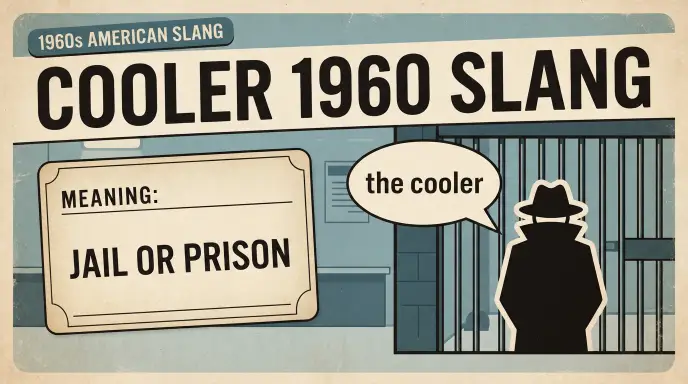
In 1960s slang, “cooler” often referred to jail or prison, though it could also describe someone or something impressively stylish and appealing.
The word “cooler” carried more than one meaning in 1960s American slang, making it a versatile term in everyday conversation. Depending on context, it could describe a place, a person, or even an object.
Most commonly, “cooler” was used as slang for jail or prison, often heard in crime films, detective novels, and casual conversation of the era. Phrases like “he’s in the cooler” simply meant someone was locked up.
At the same time, “cooler” was also used to describe something or someone considered impressive, calm, or stylish : similar to how “cool” was used generally in 1960s slang. This dual usage made the word flexible across different social settings.
This guide explores both meanings of “cooler” in 1960s slang, breaking down its origin, common usage, and the cultural context that shaped how people used this term during that era.
Quick Answer:
In 1960s slang, “the cooler” meant jail, prison, or sometimes a jail cell. It was informal American slang and was especially associated with criminal, police, and street-language contexts.
What Does Cooler Mean in 1960 Slang?
Cooler 1960 Slang Definition
In historical American slang, “the cooler” meant jail or prison.
For example, if someone said:
“He spent the night in the cooler.”
They meant that the person spent the night in jail.
The phrase was informal rather than a standard legal term. Someone would normally say “jail,” “prison,” or “cell” in formal communication.
Historical slang references show that cooler meaning jail dates back to the 19th century, so it would be inaccurate to say that the expression was invented in the 1960s. Instead, the 1960s were one period when the expression remained recognizable in American slang.
What Does “The Cooler” Stand For?
Is Cooler an Acronym?
No. “Cooler” is not an acronym, so it does not have a traditional full form.
The phrase developed as slang rather than being created from the first letters of several words.
| Term | Meaning |
| Cooler | Jail or prison in historical slang |
| The cooler | A jail, prison, or holding place |
| Cooler 1960 slang | Historical slang for jail |
| Modern cooler | Container or device used to keep things cold |
This distinction is important because the modern meaning of cooler is completely different from its historical slang meaning.
Is “The Cooler” Rude or Offensive?
Understanding Its Tone
“The cooler” was informal slang, but it was not necessarily an offensive insult.
Its tone depended on the situation. Someone discussing an arrest might use the expression casually instead of saying “jail.”
For example:
“He ended up in the cooler.”
This sounds informal and old-fashioned rather than formally offensive.
Today, however, the expression may sound dated or historical. Younger speakers are more likely to say “jail” or “prison.”
Where Was Cooler Slang Commonly Used?
American Slang and Popular Culture
“The cooler” was primarily associated with American English slang.
It could appear in contexts involving:
- Police
- Arrests
- Jail
- Criminal activity
- Prison stories
- Crime fiction
- Street conversations
- Older novels and movies
- Historical discussions
The word is particularly useful when reading older American literature because a modern reader may otherwise interpret “cooler” as a refrigerator or drink container.
Historical slang sources record “cooler” as an American term for a calaboose or police station, while later dictionaries continue to define “the cooler” as jail.
Real-Life Examples of Cooler 1960 Slang
Friendly or Casual Example
“He got into trouble and spent a night in the cooler.”
Here, “cooler” simply means jail.
Historical Example
“The detective threatened to send him to the cooler.”
This means the detective threatened to have him arrested or jailed.
Argumentative Context
“Keep causing trouble and you’ll land in the cooler.”
The speaker is warning someone that their behavior could result in imprisonment.
Social Media or Online Discussion
“I saw ‘the cooler’ in an old movie. Does it mean jail?”
Here, the phrase is being discussed rather than used as ordinary modern slang.
Cooler vs. Jail vs. Prison
How Are They Different?
Although “the cooler” can refer to jail or prison, the terms are not exactly interchangeable in every context.
| Term | Basic Meaning | Tone |
| Cooler | Jail or prison in slang | Informal, historical |
| Jail | Place where people may be held, often before trial or for shorter sentences | Standard |
| Prison | Institution for longer-term incarceration | Standard/formal |
The safest modern word depends on what you mean. If you are talking about the historical slang itself, “the cooler” is appropriate. If you are describing a modern legal situation, “jail” or “prison” is usually clearer.
Origin and Background of Cooler Slang
Where Did “The Cooler” Come From?
The exact development of the slang expression is older than the 1960s.
A major historical slang dictionary records cooler as a U.S. slang term for jail or prison as early as 1872. It also records a related meaning involving a cell used for solitary confinement.
This means that “cooler” should be understood as older American slang that remained in use during the 20th century, rather than as a phrase created specifically during the 1960s.
The word’s connection with “cooling” may have helped make the metaphor memorable, although the exact origin of the slang sense is not completely certain.
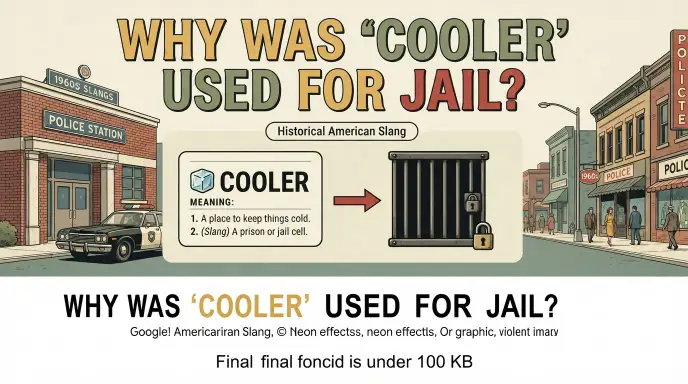
Why Was “Cooler” Used for Jail?
The Idea Behind the Expression
Slang often gives ordinary words new meanings through metaphor.
A “cooler” normally relates to something that makes or keeps things cool. In slang, “the cooler” became associated with being put away, isolated, or kept apart from society.
The expression also fit naturally into the short, colorful style of American slang.
Instead of saying:
“He was taken to jail.”
A speaker could say:
“He was taken to the cooler.”
That made the sentence sound more informal and characteristic of older street or crime-related language.
Cooler in 1960s Literature
The Outsiders Connection
One reason people searching for cooler 1960 slang may recognize the expression is S. E. Hinton’s The Outsiders, a novel published in 1967 and set in an earlier 1960s environment.
In the book’s slang vocabulary, “the cooler” is used to mean jail. Study guides and slang references commonly identify the expression this way.
This makes the term especially useful for readers trying to understand the language of the novel.
When a character talks about someone being “out of the cooler,” the intended meaning is that the person has been released from jail.
Cooler vs. Other 1960s Slang
Comparing Historical Slang
“The cooler” was only one of many expressions associated with the language of the 1960s.
| 1960s Slang | Meaning | General Context |
| The cooler | Jail | Police/crime |
| The fuzz | Police | Authority |
| Rumble | Gang fight | Street/youth culture |
| Savvy | Understand | Everyday speech |
| Pad | Home or apartment | Social life |
| Outta sight | Excellent or impressive | Positive reaction |
Several sources discussing The Outsiders identify “the cooler” alongside terms such as “the fuzz,” “heater,” “rumble,” and “savvy.”
Cooler vs. Modern Slang for Jail
How Would People Say It Today?
Modern speakers have many ways to talk about incarceration, but “the cooler” sounds noticeably old-fashioned.
| Expression | Meaning | Modern Use |
| The cooler | Jail/prison | Mostly historical or stylistic |
| Jail | Place of detention | Very common |
| Prison | Correctional institution | Very common |
| Locked up | Incarcerated | Common informal expression |
| Behind bars | In prison | Figurative/informal |
If you are writing a historical story set in the 1960s, “the cooler” can help create an authentic period feel.
For ordinary modern communication, jail or prison is usually clearer.
Is Cooler Still Used Today?
Historical vs. Modern Usage
The word “cooler” still exists today, but its most common meanings are completely different.
Modern dictionaries list meanings including a container for keeping things cold, a cold drink, and the slang expression “the cooler” for jail.
Because the jail meaning is much less common in everyday modern conversation, context is extremely important.
If someone says:
“Put the drinks in the cooler.”
They almost certainly mean a container.
If someone says:
“He spent the weekend in the cooler.”
They may be using the older slang meaning of jail.
When Should You Use “Cooler” as Slang?
Best Situations for the Historical Expression
Use “the cooler” mainly when:
- Discussing historical slang
- Explaining a 1960s novel
- Writing historical fiction
- Talking about old movies
- Analyzing American slang
- Explaining vintage vocabulary
Avoid using it if your audience may misunderstand the intended meaning.
For modern legal or professional writing, jail, prison, detention center, or correctional facility will normally be more precise.
Common Mistakes About Cooler 1960 Slang
Mistake 1: Thinking Cooler Was Created in 1960
The term existed well before the 1960s. Historical sources date the jail meaning to at least the 19th century.
Mistake 2: Assuming It Means Refrigerator
In modern English, “cooler” usually suggests a container for keeping things cold. Historical context can change the meaning.
Mistake 3: Thinking It Is an Acronym
“Cooler” does not stand for a series of words. It is a slang noun.
Mistake 4: Using It as Modern Everyday Slang
While the expression is understandable, it can sound old-fashioned today.
Is Cooler Safe for Social Media?
Using Historical Slang Online
Yes, discussing cooler 1960 slang as a historical language topic is generally straightforward.
For example, a post explaining that “the cooler” meant jail in older American slang is simply educational content.
However, context still matters. If you are discussing crime, incarceration, or historical literature, explain the term clearly so readers do not confuse it with the modern meaning of “cooler.”
FAQs:
What did “cooler” mean in 1960s slang?
In 1960s slang, “the cooler” meant jail or prison. The expression was older than the 1960s but remained part of American informal language during that period.
Is “the cooler” still used today?
It is still recognized as slang for jail, but the expression is much less common in ordinary modern conversation. Today, people usually say “jail” or “prison.”
Is cooler a 1960s slang word?
It can be described as 1960s-era slang, but it was not invented during the 1960s. Historical references trace its jail meaning back to the 1800s.
What does “out of the cooler” mean?
“Out of the cooler” means released from jail or prison. This usage appears in discussions of 1960s slang, including language associated with The Outsiders.
Does cooler mean jail or prison?
In the slang expression “the cooler,” it can refer to jail or prison. The exact meaning depends on the historical context.
What is a modern alternative to “the cooler”?
The clearest modern alternatives are jail, prison, locked up, or behind bars, depending on the sentence and intended meaning.
Conclusion:
Cooler 1960 slang refers to the historical use of “the cooler” as an informal word for jail or prison. Although the expression was already established before the 1960s, it continued to appear in American slang and popular culture during that decade.
The word can be confusing because cooler has several modern meanings, especially a container used to keep food and drinks cold. That is why context is essential when reading older books, watching vintage movies, or studying 1960s slang.
If you encounter “the cooler” in a historical story or discussion of 1960s American language, jail or prison is usually the intended meaning.
Understanding expressions like this gives readers a better view of how American English changed over time:and why slang from one generation can sound completely different to another.
Explore More!

I am Ann Raimes, an applied linguist and English language educator. I am widely recognized for my contributions to writing pedagogy and research in ESL writing. I have authored several well-known books, including Techniques in Teaching Writing, Keys for Writers, and How English Works: A Grammar Handbook with Readings. Throughout my career, I have worked to promote communicative writing and the process-based approach to teaching writing, helping both teachers and learners develop effective writing skills.