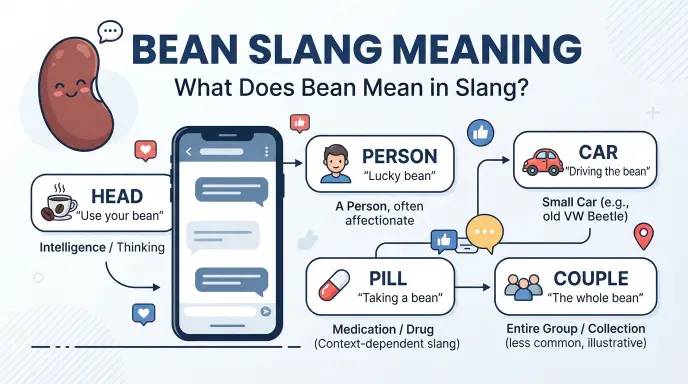
“Bean” is slang with several meanings : it can refer to a person’s head, money (dollars), hitting someone, or being full of energy (“full of beans”), depending on the context.
The word “bean” seems harmless at first, but it’s packed with slang meanings that go way beyond the vegetable. Different generations and communities use it in surprisingly different ways.
In older slang, “bean” often referred to someone’s head : as in getting “beaned” by a ball. It’s also long been used as a casual term for money, especially in phrases like “I don’t have a bean.”
On social media today, “bean” pops up in memes, viral trends, and casual conversation with even more playful, shifting meanings tied to internet culture. Context always decides which meaning applies.
This guide breaks down every major meaning of “bean” : from classic slang to modern internet usage : so you’ll know exactly what someone means the next time you hear it.
Quick Answer:
In slang, “bean” can mean a person’s head, a small or cute person, or an affectionate nickname, depending on context. In some specific contexts, it can also have adult slang meanings.
What Does Bean Mean in Slang?
The word bean does not have one universal slang definition. Its meaning depends on how it is being used.
One common informal meaning is “head.” This use is particularly associated with British and informal English. For example, someone might jokingly say, “I bumped my bean,” meaning they bumped their head.
Another use is as a cute nickname. Someone may call a friend, child, pet, or loved one “bean” because it sounds small, friendly, or affectionate.
On social media, bean can also describe someone who is cute, small, funny, or endearing. This is usually playful rather than insulting.
The surrounding words are the best clue to the intended meaning.
Bean Slang Full Meaning and Definition
When people search for the bean slang full form, they may expect an abbreviation. However, “bean” is generally not a shortened form of a longer phrase.
Instead, it is an ordinary English word that has developed several informal meanings.
Common slang or informal uses include:
- Head – especially in British informal speech.
- Cute nickname – used affectionately for a person or pet.
- Small person or thing – often playful.
- Person or individual – in some informal expressions.
- Secret or information – in the phrase “spill the beans.”
- Adult slang – in certain contexts, referring to female anatomy.
Because these meanings are quite different, reading the complete sentence is important.
Is Bean Slang Rude, Offensive, or Neutral?
Most uses of bean are neutral, playful, or affectionate.
For example, calling a pet “my little bean” is normally sweet and harmless. Similarly, saying “I hit my bean” to mean “I hit my head” is informal but not necessarily offensive.
However, slang can become inappropriate when bean is used with an adult or sexual meaning. In that situation, the word may not be suitable for professional, educational, or public conversations.
| Use of “bean” | Tone | Usually offensive? |
| Bean = head | Informal | No |
| “Little bean” = cute nickname | Affectionate | No |
| Bean = small person/thing | Playful | Usually no |
| “Spill the beans” | Casual idiom | No |
| Adult slang meaning | Vulgar/informal | Potentially |
The safest interpretation always comes from context.
Where Is Bean Slang Commonly Used?
Text Messages
“Bean” is often used as a nickname in private messages.
For example:
“Good morning, bean!”
Here, the word is probably being used affectionately rather than literally.
Social Media
On social media, people frequently use food-related words as cute nicknames. “Bean” can describe a person, child, animal, or even a character.
Someone might post:
“Look at this little bean!”
The speaker is usually expressing affection or saying that someone looks cute.
British English
In British informal speech, bean can refer to the head.
For example:
“I nearly hit my bean.”
The meaning is understood from the surrounding context and is similar to saying “I nearly hit my head.”
Gaming and Online Communities
Gaming communities often create playful nicknames and unusual slang. “Bean” may be used for a small character, funny avatar, teammate, or adorable game character.
Because online communities develop their own vocabulary, the meaning may be specific to a particular game or group.
Bean Slang Examples in Real Conversations
Friendly Example
“You’re such a cute little bean!”
Here, bean is an affectionate nickname.
Casual Example
“I hit my bean on the cupboard.”
In this British-style informal use, bean means head.
Cute Social Media Example
“My dog is the happiest little bean.”
The speaker is using “bean” as a playful term of affection.
Gaming Example
“That tiny bean character is hilarious.”
Here, “bean” describes something small, cute, or amusing.
Argumentative Example
“Use your bean and think about it.”
In this context, bean can refer informally to the head or brain. The phrase may sound teasing or slightly insulting depending on the speaker’s tone.
Idiomatic Example
“Come on, spill the beans!”
Here, “spill the beans” means reveal the secret or information.
The individual word “bean” does not literally mean “secret” by itself. The meaning comes from the complete idiom.
Why Does “Bean” Mean Head?
The connection between bean and head comes from the idea that the human head can resemble the shape of a bean.
Informal English has a long history of using ordinary objects as playful names for body parts. “Bean” became one such humorous expression.
This is similar to the way people use words such as “noggin” or “bonce” in informal English to refer to the head.
The expression is not normally used in formal writing. It works better in casual speech, humor, or friendly conversation.
Bean vs. Other Slang Words for Head
If you are researching bean slang meaning, it helps to compare it with similar informal words.
| Slang term | Meaning | Tone |
| Bean | Head | Playful/informal |
| Noggin | Head | Casual/playful |
| Bonce | Head | British informal |
| Noodle | Head/brain | Humorous |
| Melon | Head | Informal/humorous |
These words are not interchangeable in every sentence, but they share a similar informal style.
Bean vs. Cute Nicknames
“Bean” has become especially popular as an affectionate nickname.
People may use it for:
- Babies
- Children
- Pets
- Partners
- Friends
- Small animals
- Cute fictional characters
- Small objects
The reason is simple: bean sounds small, soft, and harmless.
Expressions such as “little bean,” “tiny bean,” and “sweet bean” are often intended to show affection.
| Expression | Likely meaning | Tone |
| Little bean | Cute person or animal | Affectionate |
| Tiny bean | Very small/cute person or thing | Playful |
| Sweet bean | Someone lovable | Affectionate |
| Silly bean | Someone behaving humorously | Playful |
| My bean | Nickname for someone close | Affectionate |
What Does “Spill the Beans” Mean?
One of the most famous expressions involving bean is “spill the beans.”
It means to reveal secret or confidential information.
For example:
“Who planned the surprise party? Spill the beans!”
The person is asking someone to reveal the secret.
Another example is:
“I wasn’t going to tell anyone, but Jake spilled the beans.”
Here, Jake revealed information that was supposed to remain secret.
This is an idiom rather than a direct example of bean slang.
Bean Slang and Adult Contexts:
In some online and adult-oriented conversations, bean can be used as informal slang for the clitoris.
This meaning is highly context-dependent and is not what most people mean when they casually use “bean” as a nickname.
For example, a conversation about anatomy or sexual topics may use “bean” as a euphemistic term. Outside that context, “bean” is much more likely to mean a cute nickname, a head, or something related to an idiom.
This is an important distinction when interpreting messages because the same word can have a completely different meaning depending on the conversation.
Comparison of the Main Bean Meanings:
| Context | Meaning of “bean” | Example |
| British informal speech | Head | “I hurt my bean.” |
| Friendly conversation | Cute nickname | “You little bean!” |
| Social media | Cute/small person or animal | “Look at this bean!” |
| Idiom | Secret/information | “Spill the beans.” |
| Adult slang | Clitoris | Context-specific |
| Food | Actual bean | “I cooked some beans.” |
This comparison demonstrates why bean slang meaning in text cannot be determined from the word alone.
When Should You Avoid Using Bean Slang?
Although most uses are harmless, you should consider your audience.
Avoid unusual slang when:
- Writing a formal email
- Preparing an academic assignment
- Speaking in a professional meeting
- Communicating with someone unfamiliar with the expression
- Discussing sensitive subjects
- Writing content for a broad international audience
If you mean head, simply saying “head” is clearer.
If you mean a person’s anatomy, use the appropriate neutral anatomical terminology rather than relying on slang.
Why Do People Use “Bean” as Slang?
There are several reasons.
It Sounds Cute
Food-related words often sound friendly and playful. “Bean” is short and easy to say.
It Creates Familiarity
Calling someone “bean” can make a conversation feel warmer and more personal.
It Adds Humor
Using “bean” instead of “head” can make a sentence sound funny.
Internet Culture
Social media has helped affectionate nicknames spread rapidly. Words such as “bean,” “potato,” and “goofball” can become popular ways of describing cute or funny people and animals.
Regional Language
Some meanings, especially “bean” for head, are connected to informal regional English.
How Context Changes Bean Slang Meaning
Context is the most important factor.
Consider these three sentences:
“I love this little bean.”
This probably describes someone or something cute.
“I bumped my bean.”
This can mean “I bumped my head.”
“Spill the beans.”
This means “reveal the secret.”
The spelling is identical, but the meanings are completely different.
This is why searching for what does bean stand for in slang without looking at the complete sentence can sometimes produce the wrong interpretation.
Bean Slang in Different Communication Styles
| Communication style | Likely use of “bean” | Example |
| Formal | Rare | Usually avoid slang |
| Friendly | Nickname | “Hey, bean!” |
| Family | Affectionate | “My little bean.” |
| British casual | Head | “Use your bean.” |
| Gaming | Cute/funny character | “That bean is OP.” |
| Social media | Cute person/animal | “Such a tiny bean!” |
| Adult conversation | Euphemistic anatomy | Context-specific |
Is Bean Slang Safe for Social Media?
The word bean itself is generally harmless. The risk comes from the particular meaning being used.
A post such as:
“My cat is such a tiny bean!”
is normally innocent.
However, when the word is used with an adult or sexual meaning, the surrounding content may become more sensitive.
For public social media, it is best to consider your audience and make sure the intended meaning is clear.
If you’re writing educational content about slang, explaining the different meanings in a neutral way can help readers understand the word without encouraging inappropriate use.
Common Mistakes When Understanding Bean Slang
Assuming Bean Always Means Head
This is one of the most common mistakes. “Bean” can also be a nickname or part of an idiom.
Assuming It Always Means Something Cute
Although “little bean” is often affectionate, the word can have completely different meanings.
Translating “Spill the Beans” Literally
The phrase is an idiom. It does not mean physically spilling beans.
Ignoring Regional English
Some meanings are more common in British English than in American English.
Forgetting the Conversation Topic
A food discussion, gaming conversation, friendly chat, and adult conversation can all give “bean” different meanings.
FAQs:
What does bean mean in slang?
Bean can mean a head, a cute nickname, a small person or thing, or part of an expression such as “spill the beans.” Its meaning depends on context.
Is bean a slang word for head?
Yes. In informal English, especially British usage, bean can refer to someone’s head. It is playful rather than formal.
Is calling someone bean a compliment?
Usually, yes. When someone says “little bean” or “cute bean,” they are generally using it as an affectionate or playful nickname.
What does “spill the beans” mean?
“Spill the beans” means to reveal a secret or disclose information that was previously being kept private.
Can bean have an adult slang meaning?
Yes. In some adult contexts, bean can be used as an informal euphemism for the clitoris. The meaning is highly dependent on the conversation.
Is bean slang rude?
Usually not. Most common uses are playful or affectionate. However, its adult slang meaning may be inappropriate in formal or public settings.
Final Thoughts :
The meaning of bean slang depends almost entirely on context. In informal British English, bean can mean “head.” On social media and in friendly conversations, it is often an affectionate nickname for a cute, small, or lovable person or animal. In the well-known expression “spill the beans,” it relates to revealing a secret rather than referring literally to a bean.
There is also a more adult slang meaning in certain conversations, which is why understanding the surrounding text is important.
If you encounter bean in a text message, comment, meme, or conversation, don’t assume that it has only one definition. Look at the sentence, the speaker’s tone, and the subject being discussed. In most everyday situations, “bean” is simply a playful or affectionate word, making it one of those slang terms where context matters more than the dictionary definition.
Find Out More!

I am Ann Raimes, an applied linguist and English language educator. I am widely recognized for my contributions to writing pedagogy and research in ESL writing. I have authored several well-known books, including Techniques in Teaching Writing, Keys for Writers, and How English Works: A Grammar Handbook with Readings. Throughout my career, I have worked to promote communicative writing and the process-based approach to teaching writing, helping both teachers and learners develop effective writing skills.