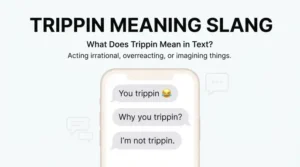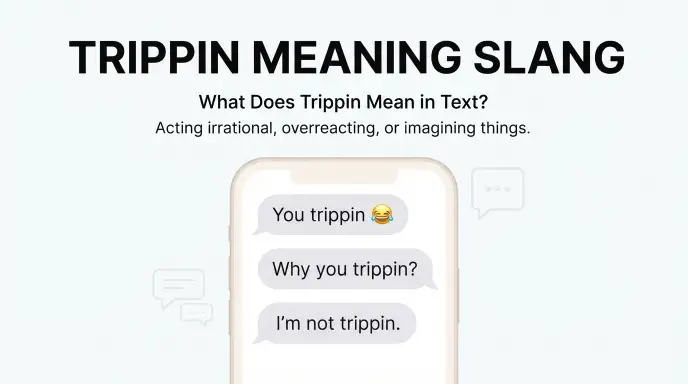
“Trippin” in slang means acting irrational, overreacting, or being out of touch with reality, often used when someone is overly upset about something minor.
The term comes from the word “tripping,” originally associated with hallucinogenic drug experiences, but its slang usage has evolved far beyond that context. Today, it’s commonly used in everyday conversations.
When someone says “you’re trippin,” they usually mean the other person is overreacting, being unreasonable, or making a big deal out of nothing. It’s often used to call out exaggerated behavior.
“Trippin” can also be used playfully among friends, without any serious meaning, simply to tease someone for being silly or dramatic. Context and tone usually determine how serious the comment is.
If you’ve heard someone say “trippin” in a text or conversation and wondered what it means, this guide breaks down its meaning, origin, and common usage with examples.
Quick Answer:
“Trippin” in slang usually means acting irrationally, overreacting, misunderstanding something, or worrying unnecessarily. For example, “You’re trippin” can mean “You’re overreacting” or “You’re not thinking clearly.”
What Does Trippin Mean in Text?
The most common trippin meaning in text is that someone is acting strangely, overreacting, or thinking about a situation in an unreasonable way.
For example:
“You’re trippin if you think I’m paying that much.”
Here, “trippin” means the speaker thinks the other person is being unreasonable.
Another example is:
“Bro, you’re trippin. I never said that.”
In this sentence, trippin suggests that the other person has misunderstood the situation.
The word is informal and is especially common in conversations between friends, online communities, and social media users.
Trippin Slang Full Form and Definition
What Does Trippin Stand For?
Unlike an acronym, trippin does not have a traditional “full form.” It is an informal spelling of “tripping,” with the final g commonly dropped in casual speech and writing.
In slang, its meaning can include:
- Overreacting
- Acting irrationally
- Worrying too much
- Misunderstanding something
- Acting strangely
- Being overly suspicious
- Making an unreasonable statement
The meaning can shift according to context.
| Expression | Common Meaning |
| You’re trippin | You’re overreacting or being unreasonable |
| Stop trippin | Stop worrying or overreacting |
| I’m not trippin | I’m not worried or bothered |
| He’s trippin | He is acting strangely or irrationally |
| Why are you trippin? | Why are you reacting this way? |
Is Trippin Rude, Offensive, or Neutral?
Is Trippin a Bad Word?
Trippin is not automatically offensive. In casual conversations, it is often playful or mildly critical.
For example:
“You’re trippin 😂. That movie was actually good.”
This can sound like friendly teasing.
However, the expression can become rude when it is directed at someone during an argument.
For example:
“You’re trippin. Nobody agrees with you.”
Here, the speaker is dismissing the other person’s opinion.
So, the word itself is generally informal rather than inherently offensive, but tone and context determine how it is received.
Where Is Trippin Commonly Used?
Text Messages
Friends often use “trippin” in short text conversations.
Example:
“Why are you trippin over a small mistake?”
It is quicker and more natural in casual messaging than a formal phrase such as “Why are you overreacting?”
Social Media
The word appears frequently in social media comments, captions, memes, and replies.
For example:
“People are trippin in these comments.”
This means people are reacting excessively or behaving in a way the speaker considers unreasonable.
Music and Pop Culture
“Trippin” has also become familiar through informal speech and popular culture. Its meaning can vary depending on the specific song, artist, or conversation, so the surrounding words should always be considered.
Gaming Chats
Gamers may use trippin when another player is making an unusual claim or reacting strongly.
Example:
“You’re trippin if you think that was a fair match.”
Here, the speaker is saying that the other player has an unreasonable opinion.
Real-Life Examples of Trippin Slang
Friendly Example
Friend 1: “You took the last slice!”
Friend 2: “You’re trippin 😂. You said you didn’t want it.”
In this context, trippin is playful.
Casual Example
Person A: “I think this phone is too expensive.”
Person B: “Nah, you’re trippin. It’s worth it.”
Here, trippin means “I think you’re being unreasonable.”
Argumentative Example
Person A: “You were ignoring me all day.”
Person B: “You’re trippin. I was working.”
The expression is more defensive here and may sound confrontational.
Gaming Example
Player A: “That player is cheating!”
Player B: “You’re trippin. They just played well.”
In this example, the speaker believes the accusation is unreasonable.
Social Media Example
“Y’all are trippin over that new update.”
This means the speaker thinks people are overreacting to the update.
Trippin vs Tripping: What’s the Difference?
Trippin
“Trippin” is the casual slang spelling commonly used in informal communication.
Example:
“You’re trippin if you think I’m doing that.”
Tripping
“Tripping” is the standard spelling and can have several meanings depending on context.
It can refer to:
- Physically stumbling
- Traveling
- Experiencing a psychedelic drug effect
- Acting irrationally in informal speech
| Word | Typical Context | Example |
| Trippin | Casual slang | “You’re trippin.” |
| Tripping | Standard English | “I was tripping over the stairs.” |
| Trip | Standard noun/verb | “We went on a trip.” |
The spelling “trippin” is particularly associated with casual speech and informal writing.
Trippin vs Overreacting vs Bugging
These expressions can overlap, but they are not always identical.
| Expression | Common Slang Meaning | Example |
| Trippin | Acting irrationally or overreacting | “You’re trippin over nothing.” |
| Overreacting | Reacting too strongly | “You’re overreacting to the situation.” |
| Bugging | Acting strangely or being overly concerned | “You’re bugging if you believe that.” |
Trippin is broader than “overreacting.” Someone can be described as trippin because they are suspicious, confused, unreasonable, or simply behaving strangely.
Origin and Background of Trippin Slang
Where Did Trippin Come From?
The slang use of tripping developed from the broader meanings associated with the word “trip.”
Historically, “trip” referred to stumbling or making a mistake. Informal English later developed additional figurative meanings, including being confused, behaving strangely, or experiencing an altered state.
In modern casual speech, “trippin” is often used without any literal reference to physically falling or traveling.
The shortened spelling reflects a common feature of informal English: speakers may drop the final g sound in words ending in “-ing.” This produces forms such as:
- Going → goin
- Talking → talkin
- Nothing → nothin
- Tripping → trippin
The slang meaning has become especially recognizable in casual American English and online communication.
When Should You Avoid Using Trippin?
Formal Writing
Avoid “trippin” in:
- Academic essays
- Business reports
- Formal emails
- Professional documents
- Official applications
Use clearer standard English instead.
For example:
Informal:
“You’re trippin.”
Formal:
“I think you’re overreacting.”
Sensitive Conversations
If someone is genuinely upset, saying “You’re trippin” may make them feel dismissed.
Instead, consider:
“I think we may be seeing the situation differently.”
This communicates disagreement without immediately labeling the other person’s reaction as unreasonable.
Professional Communication
Using slang with a client, manager, teacher, or unfamiliar professional contact can create unnecessary confusion.
The informal nature of “trippin” makes it better suited to relaxed conversations.
Polite Alternatives to Trippin
If you want to communicate the same general idea without slang, you can say:
- You’re overreacting.
- I think you’re worrying too much.
- I think you misunderstood.
- I don’t think it’s that serious.
- We may be seeing this differently.
- I think you’re mistaken.
- Let’s look at it another way.
- I don’t think that’s what happened.
The best alternative depends on what you actually mean.
For example, if someone is worried, “I think you’re worrying too much” is more appropriate than “You’re trippin.”
Why Do People Use Trippin Slang?
It Is Short and Natural
Slang makes everyday communication quicker.
Instead of writing:
“I think you’re overreacting about this situation.”
someone might simply say:
“You’re trippin.”
It Adds Personality
Slang can make conversations sound more relaxed and expressive.
Words such as “trippin,” “chillin,” and “goin” can reflect casual speech patterns.
It Can Make Teasing Easier
Friends sometimes use trippin humorously.
For example:
“You’re trippin 😂. There’s no way you actually believe that.”
The expression can create a playful tone when both people understand the relationship and context.
Impact of Trippin on Communication
Positive Impact
In the right setting, trippin can:
- Make conversations sound natural
- Express disagreement quickly
- Add humor
- Show familiarity between friends
- Fit social media communication
Negative Impact
It can also cause misunderstandings.
A person unfamiliar with the slang may not understand what “trippin” means. Even someone who knows the meaning may interpret it as insulting if the message is written during an argument.
For this reason, context and tone are important.
Is Trippin Safe for Social Media?
Can You Use Trippin Online?
Yes, “trippin” is generally a harmless slang expression when used in its ordinary sense of “overreacting,” “acting irrationally,” or “being unreasonable.”
It is not inherently offensive.
However, the way you use it matters. Directing the word at another person in a hostile argument can make a comment sound insulting or dismissive.
For public posts, consider your audience. Casual slang is generally better suited to informal communities than professional or official pages.
Common Mistakes About Trippin
Mistake 1: Thinking It Always Means Traveling
“Trippin” can relate to travel in some contexts, but in slang, “you’re trippin” usually has a different meaning.
Mistake 2: Assuming It Always Means Drug Use
The word “tripping” can have a drug-related meaning in certain contexts, but “you’re trippin” in everyday slang commonly means you’re overreacting or being unreasonable.
Context determines the intended meaning.
Mistake 3: Treating It as Formal English
“Trippin” is informal slang. It should not normally replace standard wording in professional or academic writing.
Mistake 4: Ignoring Tone
“Trippin 😂” and “You’re trippin.” can feel very different.
Emojis, punctuation, and the relationship between speakers can influence interpretation.
FAQs:
What does trippin mean in slang?
Trippin usually means acting irrationally, overreacting, worrying unnecessarily, or misunderstanding a situation.
What does “you’re trippin” mean?
“You’re trippin” commonly means “You’re overreacting,” “You’re being unreasonable,” or “You’re not seeing this situation clearly.”
Is trippin the same as tripping?
They can be related, but trippin is an informal slang spelling. “Tripping” is the standard spelling and has several literal and figurative meanings.
Is trippin a bad word?
No. Trippin is generally not a swear word or inherently offensive. However, it can sound rude or dismissive when used aggressively.
Can trippin be used positively?
Yes. In some friendly conversations, it can be playful rather than seriously critical. The exact tone depends on the situation and relationship.
What does “stop trippin” mean?
“Stop trippin” generally means “stop overreacting,” “stop worrying,” or “stop acting irrationally.”
Trippin Meaning Slang: Final Comparison
| Phrase | Meaning | Tone | Best Setting |
| You’re trippin | You’re being unreasonable/overreacting | Informal | Friends, chats |
| Stop trippin | Stop overreacting or worrying | Informal | Casual conversation |
| I’m not trippin | I’m not worried or bothered | Casual | Texting |
| You’re overreacting | Your reaction is too strong | Neutral | General conversation |
| I think you’re mistaken | I believe you’re incorrect | Polite/neutral | Formal or sensitive situations |
This comparison shows why context matters when interpreting trippin slang. The same expression can sound humorous between friends but confrontational during an argument.
Conclusion
Trippin meaning slang usually refers to overreacting, acting irrationally, worrying unnecessarily, or misunderstanding a situation. The expression is especially common in texting, social media, gaming chats, and casual conversations.
When someone says “You’re trippin,” they usually mean that they think the other person is not reacting reasonably or is making too much of something. Similarly, “I’m not trippin” can mean “I’m not worried” or “I’m not bothered.”
The word is generally informal rather than offensive, but tone can change its effect. It may be friendly and humorous among friends, while it can sound dismissive during an argument.
If you were wondering what does trippin stand for, remember that it is not an acronym. It is an informal form of “tripping,” and its slang meaning depends on context. For formal communication, clearer alternatives such as “overreacting,” “worrying too much,” or “I think you misunderstood” are usually better choices.
Related Articles!

I am Ann Raimes, an applied linguist and English language educator. I am widely recognized for my contributions to writing pedagogy and research in ESL writing. I have authored several well-known books, including Techniques in Teaching Writing, Keys for Writers, and How English Works: A Grammar Handbook with Readings. Throughout my career, I have worked to promote communicative writing and the process-based approach to teaching writing, helping both teachers and learners develop effective writing skills.