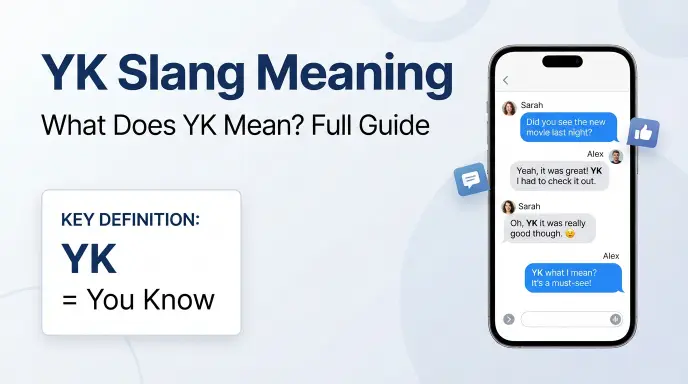
YK is internet slang that stands for “You Know,” commonly used in texting and social media to add emphasis or casually check in with the listener.
If you’ve come across “YK” in a text message or comment and wondered what it means, you’re not alone. This short abbreviation has become a staple in casual online conversations.
YK is widely used across platforms like TikTok, Instagram, and Snapchat, especially among younger generations. It’s part of a growing list of internet slang that keeps evolving every year.
Understanding YK slang meaning helps you stay updated with modern digital communication and avoid confusion while texting or scrolling through social media. It’s simple, but its usage can vary slightly depending on context.
In this article, we’ll break down exactly what YK means, how it’s used in different situations, and share examples so you can start using it confidently in your own conversations.
Want me to also add FAQs (like “What does YK mean in Snapchat?” or “Is YK the same as IYKYK?”) to boost your article’s ranking further?
Quick Answer:
YK slang meaning is usually “you know.” It is an informal texting abbreviation used to express shared understanding, agreement, emphasis, or a casual conversational tone.
What Does YK Mean in Text?
The most common YK meaning in text is “you know.” It is a shortened form of a phrase people already use frequently in everyday speech.
Instead of typing:
“It was a really strange day, you know?”
Someone may simply write:
“It was a really strange day, yk?”
The meaning stays almost exactly the same. The difference is that “yk” makes the message shorter and more informal.
YK can appear at the beginning, middle, or end of a sentence. Its position does not necessarily change its basic meaning.
For example:
- “YK what I mean?” = You know what I mean?
- “I was tired, yk?” = I was tired, you know?
- “YK, sometimes people just need space.” = You know, sometimes people just need space.
- “That place is expensive, yk.” = That place is expensive, you know.
In casual conversations, YK often acts like a spoken filler. It can make a message feel more relaxed and personal.
YK Full Form and Definition
What Does YK Stand For?
The most common YK full form in texting is:
YK = You Know
It is formed from the first letters of You and Know.
This type of shortening is very common in digital communication. People regularly shorten phrases because typing a complete sentence can take more time.
Some examples of similar abbreviations include:
- IDK = I Don’t Know
- TBH = To Be Honest
- IMO = In My Opinion
- BTW = By The Way
- IKR = I Know, Right?
- YKW = You Know What
- IYKYK = If You Know, You Know
YK is especially simple because it does not introduce a completely new expression. It simply shortens the familiar phrase “you know.”
Is YK Slang Rude, Offensive, or Neutral?
YK is generally neutral and harmless.
It is not normally considered a rude, offensive, or inappropriate expression. Its tone depends more on the sentence surrounding it than on the abbreviation itself.
For example:
“That was such a good day, yk?”
This sounds friendly and relaxed.
But:
“You should know better, yk?”
could sound slightly annoyed or critical.
The difference comes from the overall sentence, not from YK itself.
YK Tone at a Glance
| Tone | Example | Feeling |
| Friendly | “That was fun, yk?” | Warm and casual |
| Casual | “I was tired, yk.” | Relaxed |
| Emotional | “I just miss those days, yk?” | Reflective |
| Annoyed | “You knew the rules, yk?” | Slightly critical |
| Formal | “The results were positive, yk.” | Usually inappropriate |
So, YK itself is not offensive, but the words around it can make the complete message sound friendly, emotional, sarcastic, or argumentative.
Where Is YK Commonly Used?
YK is primarily used in informal digital communication.
You may see it in:
- Text messages
- WhatsApp chats
- Instagram DMs
- TikTok comments
- Snapchat
- Discord
- Facebook Messenger
- Gaming chats
- Group conversations
- Online communities
It is particularly useful when people are having quick conversations and do not want to type every word.
YK on Social Media
On platforms such as TikTok and Instagram, people often use short expressions to make comments sound conversational.
For example:
“This song hits different at night, yk?”
The writer is not introducing a new idea with YK. Instead, it gives the sentence a feeling of shared understanding.
YK in Gaming
In gaming chats, players may use YK in the same way they would use it in normal conversation.
For example:
“We should defend this side, yk?”
Here, YK basically means:
“We should defend this side, you know?”
It keeps the message short without changing the main idea.
How Is YK Used in Real Conversations?
The easiest way to understand YK is to replace it with “you know.”
If the sentence still sounds natural, YK probably has its common meaning.
Example 1
Text:
“I was really nervous before the exam, yk?”
Meaning:
“I was really nervous before the exam, you know?”
Example 2
Text:
“YK that restaurant near the mall?”
Meaning:
“You know that restaurant near the mall?”
Example 3
Text:
“Sometimes you just need a break, yk?”
Meaning:
“Sometimes you just need a break, you know?”
Example 4
Text:
“I thought you understood, yk?”
Meaning:
“I thought you understood, you know?”
These examples show that YK can work naturally in different positions.
YK Slang Meaning in Different Tones
One reason YK can be confusing is that the same two letters can feel different depending on the message.
Friendly Use
“We had such a good time yesterday, yk?”
Here, YK creates a sense of shared experience.
Casual Use
“I’ll probably stay home tonight, yk.”
This simply makes the sentence sound informal.
Emotional Use
“I still think about those days, yk?”
The abbreviation can make the statement feel more personal or reflective.
Argumentative Use
“You were supposed to tell me, yk?”
Here, YK may add emphasis to an already frustrated statement.
Gaming Use
“YK we need better defense if we want to win.”
The phrase sounds like a quick suggestion between teammates.
Social Media Use
“That outfit was actually perfect, yk?”
The abbreviation makes the comment sound more conversational.
YK Meaning in Snapchat, TikTok, Instagram, and WhatsApp
Although the platform can influence how people communicate, the basic meaning of YK generally stays the same.
| Platform | Common YK Meaning | Typical Use |
| Snapchat | You know | Casual conversations |
| TikTok | You know | Comments and reactions |
| You know | DMs and comments | |
| You know | Personal chats | |
| Discord | You know | Group and gaming chats |
| Text Messages | You know | Everyday conversations |
The surrounding words should always be considered before deciding what an abbreviation means.
For example, “yk?” after a normal statement will usually suggest “you know?” or “you understand?” But a strange or unexpected message can sometimes give the abbreviation a different interpretation.
YK vs. Similar Texting Abbreviations
YK is sometimes confused with other short forms because many texting abbreviations use only a few letters.
| Slang | Full Form | Main Meaning |
| YK | You Know | Assumes or checks shared understanding |
| YKW | You Know What | Introduces or refers to something |
| IDK | I Don’t Know | Shows uncertainty |
| IKR | I Know, Right? | Shows agreement |
| IYKYK | If You Know, You Know | Refers to shared or insider knowledge |
| TBH | To Be Honest | Introduces an honest opinion |
Understanding these differences can prevent common texting mistakes.
For instance:
IDK what happened.
means:
“I don’t know what happened.”
But:
YK what happened?
usually means:
“You know what happened?”
Those two messages communicate completely different ideas.
YK vs. IYKYK vs. YKW
These three abbreviations look similar, but they are not interchangeable.
| Abbreviation | Meaning | Example |
| YK | You know | “It was awkward, yk?” |
| YKW | You know what | “YKW? I changed my mind.” |
| IYKYK | If you know, you know | “That late-night food spot, IYKYK.” |
YK is generally used as a conversational phrase.
YKW often introduces a thought or announcement.
IYKYK usually suggests that only people familiar with a particular experience will understand the reference.
Can YK Have Other Meanings?
Yes, but context matters.
While “you know” is the dominant meaning in ordinary texting, YK can occasionally be interpreted differently. Some sources also mention uses such as “you’re kidding” in particular contexts.
For example:
“YK??? That actually happened?”
Depending on the conversation, someone could interpret this as a surprised reaction such as “You’re kidding?”
However, this is much less dependable than the standard “you know” interpretation.
How to Identify the Correct Meaning
Use these clues:
- Read the complete sentence.
- Look at the previous message.
- Consider the punctuation.
- Check whether the conversation is casual or serious.
- Look at how the sender normally texts.
Never decide the meaning of an abbreviation from the two letters alone when the surrounding conversation is available.
Origin and Background of YK
YK does not have a single famous invention date. It developed naturally from the broader culture of internet and text-message abbreviations.
As texting became popular, people began shortening common expressions to save time and space. Phrases such as “you know” were easy candidates for abbreviation because they occur frequently in everyday speech.
The result was a simple pattern:
You Know → YK
This is similar to how many other digital abbreviations developed.
The growth of smartphones, instant messaging, social media, and online communities helped these shortened forms become common.
YK is therefore better understood as texting shorthand rather than a completely separate word.
Why Do People Use YK?
There are several reasons someone might choose YK instead of writing “you know.”
1. It Saves Time
Typing two letters is quicker than typing two complete words.
2. It Sounds Casual
YK can make a message sound more like natural conversation.
3. It Creates Shared Understanding
A person may use YK when they believe the other person already understands the situation.
4. It Adds Emphasis
Sometimes YK reinforces the emotion behind a statement.
5. It Matches Online Communication
Short abbreviations are normal in informal chats, so YK fits naturally into that environment.
6. It Can Make Messages Feel Personal
A sentence ending with “yk?” can sound like the sender is inviting the other person to relate to what they are saying.
When Should You Avoid Using YK?
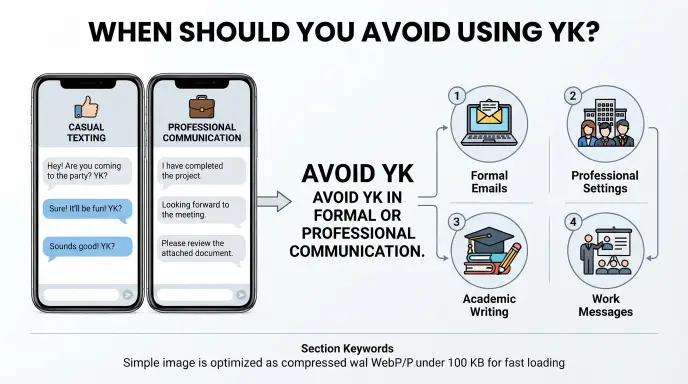
Although YK is harmless, it is not appropriate for every situation.
Avoid it in formal communication such as:
- Job applications
- Academic assignments
- Official reports
- Business proposals
- Professional emails
- Legal documents
- Formal customer communication
For example, instead of writing:
“The project was successful, yk.”
in a professional email, write:
“The project was successful.”
The complete phrase is clearer and more professional.
Formal vs. Informal
| Situation | YK Appropriate? | Better Choice |
| Texting a friend | Yes | YK |
| Gaming chat | Yes | YK |
| Instagram DM | Yes | YK |
| TikTok comment | Yes | YK |
| School assignment | No | “You know” or rewrite |
| Business email | Usually no | Complete wording |
| Job application | No | Formal English |
| Official document | No | Standard English |
The basic rule is simple: use YK when the conversation is clearly informal.
Polite Alternatives to YK
YK is already neutral, so you do not necessarily need to replace it in casual conversations.
However, clearer alternatives include:
- You know
- You know what I mean
- You understand
- Right?
- You get me?
- If you know what I mean
- As you know
The best choice depends on your relationship with the person and the type of conversation.
For example:
Casual:
“It was weird, yk?”
Clearer:
“It was weird, you know?”
More formal:
“As you know, the situation was unusual.”
How to Reply When Someone Says YK
Usually, you do not need a special response to YK.
Simply respond to the main point of the message.
For example:
Friend:
“That movie was so emotional, yk?”
Reply:
“Yeah, especially the ending!”
Or:
Friend:
“YK how stressful work has been?”
Reply:
“Yeah, I completely understand.”
If the meaning is unclear, you can ask:
“What do you mean?”
or:
“You know what?”
This is better than guessing when the conversation is important.
Common Mistakes With YK
Mistake 1: Assuming It Is Always “You’re Kidding”
Some people immediately interpret YK as “you’re kidding.” That is not the safest default.
In everyday texting, “you know” is much more common.
Mistake 2: Using It in Formal Writing
Even though YK is understandable online, it can make formal writing look too casual.
Mistake 3: Ignoring Context
Always read the complete message before interpreting slang.
Mistake 4: Treating YK as a Strong Slang Insult
YK is generally neutral. It does not automatically contain an insult, offensive meaning, or hidden message.
Is YK Safe for Social Media?
Yes. YK is generally safe for social media because its standard meaning, “you know,” is harmless.
It is commonly used in casual online conversations, comments, DMs, and group chats.
However, remember that social-media communication can be misunderstood because people cannot always hear your voice or see your facial expression.
For example:
“You should know that, yk?”
could sound playful between close friends but slightly rude to someone unfamiliar with your communication style.
Therefore, the issue is usually not the abbreviation itself. Tone and context matter more.
If you are communicating with a professional audience or strangers, writing “you know” or rewriting the sentence completely may be clearer.
YK Slang Meaning: Quick Examples
Here are some natural examples you can use to understand the term quickly:
- “I was exhausted, yk?” → I was exhausted, you know?
- “YK what I mean?” → You know what I mean?
- “That was baffling, yk!” → That was out of control, you know!
- “Sometimes things just happen, yk.” → Sometimes things just happen, you know.
- “YK how difficult this is?” → You know how difficult this is?
- “I miss those days, yk?” → I miss those days, you know?
- “We need to move faster, yk?” → We need to move faster, you know?
- “This game is hard, yk.” → This game is hard, you know.
FAQs :
Q1: What does “YK” mean in texting?
In texting, “YK” is a shorthand abbreviation for “You Know.” It’s commonly used to add casual emphasis to a sentence or to check if the other person understands what’s being said, without typing the full phrase.
Q2: What does YK mean in Gen Z?
Among Gen Z, “YK” is widely used in texts and social media captions as a quick, casual way to say “you know,” often used at the end of a sentence for emphasis, like “That outfit was fire, YK?” It reflects the generation’s preference for fast, informal digital communication.
Q3: Is IYKYK a Gen Z slang?
Yes, “IYKYK” (short for “If You Know, You Know”) is a popular Gen Z slang phrase used to reference something that only a specific group of people will understand : often an inside joke, niche experience, or shared moment. It’s frequently used on social media platforms like TikTok and Instagram.
Q4: What does “YK” stand for?
“YK” stands for “You Know.” It’s an internet and texting abbreviation used to keep messages short while still conveying a casual, conversational tone.
Conclusion:
The most important thing to remember about YK slang meaning is that it usually stands for “you know.” It is a short, informal expression used to make digital conversations quicker, more relaxed, and more conversational.
You might see it in a message such as “That was a strange day, yk?” In that sentence, the sender is simply saying, “That was a strange day, you know?”
YK is generally neutral, harmless, and safe for casual social media use. Its exact tone can change depending on the sentence, punctuation, relationship between the speakers, and overall conversation.
There are occasional alternative interpretations, such as “you’re kidding,” but these are much less common and should only be considered when the context clearly supports them.
For everyday texting, the easiest rule is:
YK = You Know
Use it naturally with friends and in casual online conversations, but choose complete words and clearer language when writing professional, academic, or formal content.
Knowledge Hub!

I am Ann Raimes, an applied linguist and English language educator. I am widely recognized for my contributions to writing pedagogy and research in ESL writing. I have authored several well-known books, including Techniques in Teaching Writing, Keys for Writers, and How English Works: A Grammar Handbook with Readings. Throughout my career, I have worked to promote communicative writing and the process-based approach to teaching writing, helping both teachers and learners develop effective writing skills.