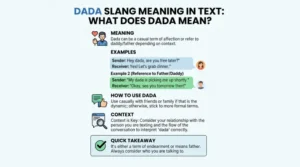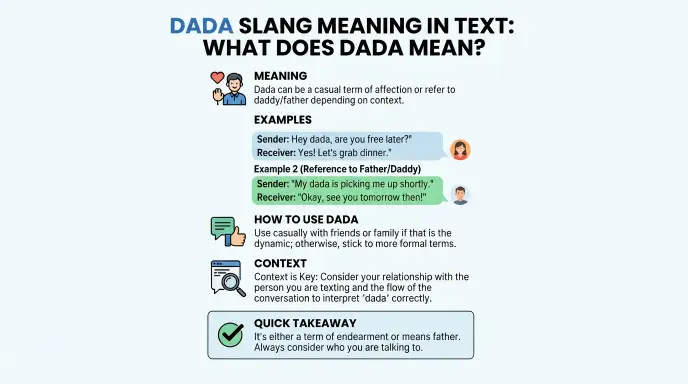
Dada slang means “dad,” “daddy,” an older brother, or a respected older man, depending on the context and culture.
The word “dada” is one of the oldest family terms and is used in many languages around the world. In casual speech, it often means a father or a father-like figure. Many people also use it as a warm nickname for a grandfather.
In South Asian culture, “dada” is a common way to address an older brother or a respected elder. It carries a tone of respect, closeness, and affection. Friends and neighbors may also use it for an older man they look up to.
In some slang and street expressions, “dada” can refer to a boss or an influential person in a group or area. In this sense, it suggests power, authority, and a strong personality. The exact meaning always depends on who is speaking and where.
In this guide, you will learn the exact dada slang meaning, how people use it in texts and daily conversations, and what its common variations are. You will also find real examples, similar slang terms, and answers to frequently asked questions to help you use it correctly.
Quick Answer
Dada slang can mean “dad,” “daddy,” an older brother or respected older man, depending on context. In some slang and cultural expressions, it can also refer to a boss or influential person.
What Does Dada Slang Mean in Text?
Understanding the basic meaning
The most familiar use of dada is an informal, affectionate word for father or dad. It is especially associated with the way young children refer to their fathers. Dictionaries also recognize “dada” as another word for “daddy” or “papa.”
For example:
“Dada is picking me up after school.”
Here, “dada” simply means the person’s father.
However, dada slang meaning is not limited to family conversations. In Indian English, Oxford lists “dada” as a term for an older brother or male cousin and also as a polite way to address an older man.
| Context | Meaning of “Dada” | Tone |
| Family | Dad or father | Affectionate |
| Indian English | Older brother/cousin | Respectful |
| Addressing an older man | Older/respected male | Polite |
| Online slang | Depends on context | Casual |
| Cultural slang | May indicate authority or status | Informal |
Dada Full Form and Definition
What does Dada stand for?
Unlike abbreviations such as “LOL” or “BRB,” dada usually does not have one universal slang full form.
When someone searches for “dada full form,” they may actually be asking what the word represents. In everyday English, it generally represents a familiar or childlike form of “dad” or “father.”
There are also completely different meanings for the capitalized word Dada. It is the name of an early 20th-century art movement associated with absurdity, humor, and rejection of conventional artistic ideas.
So, do not automatically assume that every use of “DADA” is slang.
Dada can mean different things
The meaning can include:
- Dad or father
- Older brother or male cousin in Indian English
- A respectful term for an older man
- A cultural slang expression
- A nickname
- Dada, the historical art movement
- An acronym in certain fictional or specialized contexts
This is why the surrounding sentence is important.
Is Dada Rude, Offensive, or Neutral?
The tone depends on context
In most everyday uses, dada is neutral, affectionate, or respectful. Calling your father “dada” is not normally offensive.
Likewise, using “dada” for an older brother or older man in the appropriate cultural setting can communicate familiarity or respect. Oxford specifically records these uses in Indian English.
However, slang can become uncomfortable when it is used sarcastically or without understanding its cultural meaning.
For example:
“Okay, dada, you’re the boss.”
This could be friendly teasing between friends, but the exact tone depends on the relationship.
A simple tone guide
| Use | Tone |
| “Good morning, Dada.” | Respectful |
| “Love you, Dada.” | Affectionate |
| “Dada is coming home.” | Family/casual |
| “Okay, dada, calm down.” | Teasing |
| “Who made you the dada here?” | Potentially sarcastic |
Where Is Dada Commonly Used?
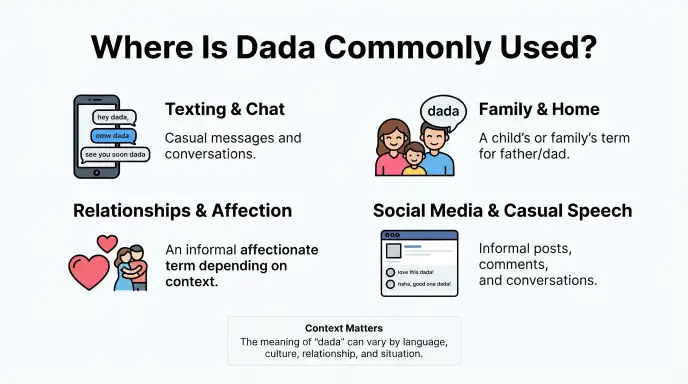
Different cultures use the word differently
One reason dada slang meaning can be confusing is that the word exists in several cultural and linguistic contexts.
In English-speaking families, it may simply be a child’s word for their father. In Indian English, “dada” can mean an older brother or male cousin and can also be used respectfully for an older man.
There is another regional use in Nigerian Pidgin. A Nigerian language reference describes dada as a term for dreadlocks and connects it with a Yoruba term associated with a child born with dreadlocks.
This means a reader should not assume that one definition works everywhere.
Online and social-media usage
On social platforms, people sometimes use “dada” as a playful nickname or as part of a larger phrase. The meaning can be influenced by memes, music, regional speech, and internet trends.
If you see only the word “dada”, check:
- Who wrote it?
- What country or culture are they from?
- What words appear before and after it?
- Is the conversation about family, friendship, music, or fashion?
- Is “Dada” capitalized as a proper name or artistic term?
Real-Life Examples of Dada Slang
Friendly examples
Example 1:
“Dada, can you pick me up at 7?”
Here, “dada” means father and has a warm family tone.
Example 2:
“Thanks, Dada! You always help me when I need you.”
Again, the meaning is father or father figure.
Casual examples
Example 3:
“Hey Dada, what are you doing today?”
This can be a casual way of addressing a father or someone who has been given that nickname.
Example 4:
“Dada knows everybody around here.”
Depending on the culture and conversation, “dada” could suggest an older or respected person.
Teasing or argumentative example
Example 5:
“Relax, dada. Nobody asked you to run the meeting.”
Here, the speaker may be jokingly treating the other person like a boss or authority figure.
The same word can therefore sound affectionate in one message and sarcastic in another.
Dada Slang vs Similar Terms
How is Dada different from Dad, Daddy, and Pops?
These words overlap, but they are not always interchangeable.
| Term | Typical meaning | Common tone |
| Dada | Dad/father or culturally specific older male | Childlike, affectionate, respectful |
| Dad | Father | Normal, casual |
| Daddy | Father | Affectionate or informal |
| Pops | Father | Friendly, casual |
| Father | Male parent | Formal/neutral |
| Papa | Father | Warm, traditional, family-oriented |
Dada often sounds more playful or childlike than “dad.” However, in Indian English, its meaning can be completely different because it may refer to an older brother or respected older male.
Dada vs Don Dada
These expressions should not be confused
You may also encounter the phrase “don dada.” This is different from simply saying “dada.”
“Don dada” is associated with Jamaican Patois and is used for a highly respected or influential person, particularly someone regarded as a boss or top figure. Some slang references describe it as a term for a top-ranking or highly respected person.
| Expression | General sense | Context |
| Dada | Dad/father or older male | Family/cultural |
| Don | Boss or respected leader | Jamaican/cultural slang |
| Don dada | Top boss/influential person | Jamaican Patois/slang |
| Dada man | Context-dependent online expression | Internet/social media |
Because these expressions have cultural roots, it is better to understand their context rather than use them simply because they appear trendy online.
Where Does Dada Come From?
Historical and linguistic background
The word dada has more than one history.
As a word for father, “dada” resembles the repetitive sounds commonly produced by babies. Dictionary sources describe it as a childlike term for “daddy” or “papa.”
The historical art term Dada, however, has a separate story. The Dada movement developed in the early 20th century and deliberately challenged traditional ideas about art, often using absurdity and humor. Cambridge describes Dada as a movement in art, literature, music, and film that opposed accepted ideas about what art should be.
There are also regional meanings. For example, Oxford records “dada” in Indian English as an older brother or male cousin and as a respectful form of address for an older man.
So, the word has developed different meanings across languages, cultures, and communities.
When Should You Avoid Using Dada?
Context matters
Although dada slang is usually harmless, using a cultural term without understanding it can sound unnatural.
Avoid using it when:
- You are writing a formal business email.
- You are addressing someone you do not know.
- You are unsure about the cultural meaning.
- The person has not used the term themselves.
- You are trying to imitate a dialect or culture.
- The phrase could be interpreted as mocking someone.
For formal communication, use the person’s name or an appropriate title instead.
For example, instead of:
“Hey dada, please send the report.”
A professional message would be:
“Hello, could you please send the report?”
This removes ambiguity and sounds more appropriate in a workplace.
Polite Alternatives to Dada
Choosing the right word
The best alternative depends on what you mean.
If you mean father, use:
- Dad
- Father
- Daddy
- Papa
- Pops
for an older brother, you could simply say:
- Older brother
- Brother
- His name
When referring to a respected older person, you can use:
- Mr. + surname
- Sir
- Their name
- An appropriate local title
The important point is not to replace “dada” mechanically. First identify which meaning the speaker intended.
Why Do People Use Dada Slang?
Familiarity and cultural identity
People use informal words because they can make communication feel warmer and more personal.
“Dada” may communicate:
- Family closeness
- Affection
- Respect
- Cultural identity
- Humor
- Familiarity
- Playfulness
Slang also makes conversations feel less formal. A short word can communicate a relationship or attitude that a formal word does not capture.
For example, “father” sounds more formal than “dada.” Similarly, a culturally familiar form of address can show respect in ways that a person’s first name may not.
Impact of Dada in Communication
Tone can change the meaning
The biggest communication issue with dada slang meaning is that the word itself does not always tell you the speaker’s intention.
Compare:
“Dada, I missed you.”
with:
“Okay, dada, you win.”
The first sounds affectionate. The second may be playful or sarcastic.
This is why tone, relationship, and context matter when interpreting slang.
Text messages can make this even harder because readers cannot hear the speaker’s voice or see facial expressions. Emojis and surrounding words may provide additional clues, but they do not guarantee the intended meaning.
Is Dada Safe for Social Media?
Generally, yes, but context still matters
In its ordinary family or cultural uses, dada is generally not an inherently offensive term. However, social-media users should understand the cultural context before using regional slang.
A safe approach is to use the word naturally when you understand its meaning rather than copying it from a meme or trend.
Also remember that Dada may refer to the historical art movement, while dada may refer to family or regional slang. Capitalization and context can sometimes help distinguish them, although capitalization alone is not enough.
FAQs:
Q1: What is dada in slang?
In slang, dada means “dad,” “daddy,” an older brother, or a respected older man, depending on the context. In some street and cultural expressions, it also refers to a boss or an influential person in a group or neighborhood. The word is used in many languages, so its exact meaning depends on who is speaking and where. It can sound affectionate, respectful, or powerful, but it is almost always informal.
Q2: When a girl calls you dada, what does it mean?
When a girl calls you dada, she usually sees you as an older brother or a respected elder. In South Asian culture, it is a polite and caring way to address a man, and it shows trust and respect rather than romantic interest. In some cases, it can be a playful nickname among close friends. If you are unsure, her tone and the situation will tell you whether she means it in a brotherly, friendly, or joking way.
Q3: What is dada in Urdu?
In Urdu, “dada” (دادا) most commonly means a paternal grandfather, the father of one’s father. Families use it as a loving and respectful title for the eldest male relative. In everyday speech across South Asia, people also use “dada” for an older brother or an older people man they respect. The meaning changes slightly by region and by the language of the speaker, such as Urdu, Hindi, or Bengali.
Q4: What does dada mean in a relationship?
In a relationship, dada is not a typical romantic term. When someone calls their partner dada, it is usually meant as a playful, affectionate nickname, and the tone matters a lot. Outside a couple, if someone calls you dada, it often signals a brotherly or respectful bond, not romance. If you are unsure what a person means, a simple and honest question is the best way to avoid confusion.
Conclusion:
Dada slang meaning is not limited to one definition. In everyday family conversations, it commonly means dad, daddy, or father. In Indian English, it can refer to an older brother, male cousin, or respected older man.
Other cultural and regional uses exist as well, including Nigerian Pidgin, where “dada” can refer to dreadlocks.
So, if someone sends you “dada” in a text, do not assume there is only one meaning. Look at the surrounding words, the relationship between the speakers, and the cultural setting.
In short, dada is usually friendly, affectionate, or respectful rather than offensive, but its exact meaning comes from context.
Deep dive!

I am Ann Raimes, an applied linguist and English language educator. I am widely recognized for my contributions to writing pedagogy and research in ESL writing. I have authored several well-known books, including Techniques in Teaching Writing, Keys for Writers, and How English Works: A Grammar Handbook with Readings. Throughout my career, I have worked to promote communicative writing and the process-based approach to teaching writing, helping both teachers and learners develop effective writing skills.