“MO” in slang commonly stands for “moment,” used casually to ask someone to wait briefly, as in “give me a mo.”
The term is short for “moment” and is widely used in casual, everyday conversation, especially in British and Australian English. It’s a quick, informal way to ask for a short pause.
For example, saying “hang on a mo” simply means “wait a moment” or “give me a second.” It’s commonly heard in both spoken conversation and texting.
In some contexts, “MO” can also stand for “modus operandi” (a person’s usual method of doing something) or be used informally to refer to money, depending on the situation. The correct meaning is usually clear from context.
Quick Answer:
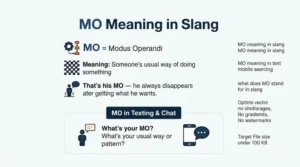
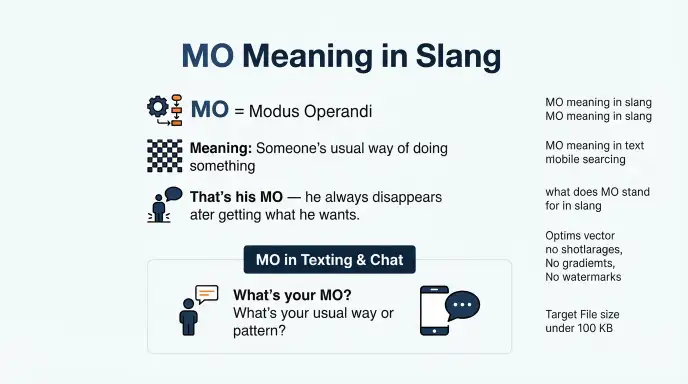
In slang and casual communication, MO most commonly means “modus operandi,” meaning a person’s usual method, pattern, or way of doing something.
What Does MO Stand for in Slang?
When people ask what does mo stand for in slang, they are often referring to “modus operandi.”
“Modus operandi” is a Latin phrase that literally relates to a method of operating or working. In everyday English, MO is commonly used to describe someone’s usual behavior, routine, strategy, or recognizable way of doing something.
For example:
“Being late is his MO.”
This means that being late is something the person regularly does or is known for.
Another example is:
“Her MO is to stay quiet and observe first.”
Here, MO describes her usual approach to situations.
The abbreviation is especially useful because it turns a longer phrase into just two letters.
MO Full Form and Definition
The most common MO full form in this slang context is “modus operandi.”
It can be understood as:
- Usual method
- Typical approach
- Regular pattern
- Characteristic behavior
- Way of operating
- Common strategy
Although “modus operandi” can sound formal, MO is frequently used casually.
| Term | Full Form | Simple Meaning |
| MO | Modus operandi | Usual way of doing something |
| M.O. | Modus operandi | Same meaning, written with periods |
| Method | — | A way of doing something |
| Pattern | — | Something that happens repeatedly |
For example, if someone always waits until the last minute to complete assignments, a friend might jokingly say:
“Last-minute work is your MO.”
The statement means that this is the person’s usual approach.
What Does MO Mean in a Text Message?
In text messages, MO can mean different things depending on context.
When the conversation is about someone’s habits or behavior, it commonly means modus operandi.
For example:
“Ignoring messages is his MO.”
The sender means that ignoring messages is his usual behavior.
However, abbreviations can have multiple meanings in texting. In another conversation, MO might represent a completely different phrase, abbreviation, place, or subject.
That is why it is important not to interpret two letters in isolation.
How Context Changes the Meaning
Consider these examples:
“That’s her MO.”
This probably refers to her usual behavior or method.
“I moved to MO last year.”
Here, MO could refer to the U.S. state abbreviation for Missouri rather than slang.
“MO of the month”
In a different context, the abbreviation may have another intended meaning.
The surrounding words are therefore the best clue.
Is MO Rude, Offensive, or Neutral?
MO itself is generally neutral.
It is not inherently a rude, vulgar, or offensive slang expression. People can use it to describe ordinary habits, professional methods, strategies, or repeated behavior.
For example:
“Planning everything ahead is her MO.”
This is completely neutral.
However, MO can sometimes sound negative when it is used to criticize someone’s repeated behavior.
For example:
“Making excuses is your MO.”
The abbreviation itself is still neutral, but the sentence is critical because it describes a behavior negatively.
So, the tone comes mainly from the context, not from the abbreviation MO itself.
Where Is MO Commonly Used?
The expression appears in several types of casual communication.
Text Messages
Friends may use MO when talking about someone’s habits.
“Being late is basically your MO 😂.”
Social Media
People may use MO in comments, captions, or discussions about recognizable behavior.
“Posting food pictures is definitely her MO.”
Everyday Conversation
Someone might say:
“What’s your MO when you’re stressed?”
This asks about the person’s usual way of handling a situation.
Online Discussions
MO can also appear when people describe recurring patterns.
“That seems to be their MO whenever there’s a problem.”
Crime and Mystery Discussions
The phrase is particularly common when discussing a repeated method of committing an action, especially in crime-related writing or conversations.
For example:
“The investigators noticed a similar MO in the cases.”
In this context, MO refers to a repeated method or pattern.
Real-Life Examples of MO in Slang
Seeing the abbreviation in different situations makes the MO meaning slang easier to understand.
Friendly Example
“Helping everyone out is basically your MO.”
This describes a person’s usual positive behavior.
Casual Example
“Ordering pizza on Friday is our MO.”
This means ordering pizza is their usual Friday routine.
Playful Example
“Your MO is disappearing whenever it’s time to clean.”
This is a humorous way of pointing out a repeated habit.
Argumentative Example
“Blaming everyone else is your MO.”
Here, the speaker is criticizing someone’s repeated behavior.
Social Media Example
“Posting gym selfies is his MO now.”
The speaker is describing a recognizable online habit.
Gaming Example
“Sneak attacks are basically his MO.”
In gaming, MO can describe a player’s usual strategy.
MO Examples by Tone
| Tone | Example | What It Suggests |
| Friendly | “Helping people is her MO.” | Positive habit |
| Casual | “Coffee first is my MO.” | Personal routine |
| Funny | “Avoiding chores is his MO.” | Playful criticism |
| Negative | “Making excuses is their MO.” | Strong criticism |
| Gaming | “Stealth is his MO.” | Usual strategy |
| Social Media | “Posting daily is her MO.” | Online habit |
This shows that MO meaning in text depends heavily on how the abbreviation is used.
Origin and Background of MO
The abbreviation MO comes from the Latin phrase modus operandi.
“Modus” refers to a method or manner, while “operandi” relates to operating or working. The phrase became established in English as a way to describe a characteristic method of doing something.
Over time, the abbreviation M.O. became widely recognized.
Although the phrase has a formal origin, its shortened form is now used in everyday English. People do not necessarily use MO in a serious or professional way. It can also be used jokingly when describing ordinary habits.
For example:
“Chocolate after dinner is my MO.”
There is nothing serious about this use. It simply means that eating chocolate after dinner is a person’s usual routine.
MO vs Similar Slang and Abbreviations
Several words can express ideas similar to MO, but they are not always interchangeable.
| Term | Meaning | Example |
| MO | Usual method or pattern | “That is his MO.” |
| Habit | Something regularly done | “Checking email is a habit.” |
| Routine | Regular sequence of actions | “Morning exercise is my routine.” |
| Pattern | Repeated behavior or event | “There is a pattern here.” |
MO is often more conversational and compact when you want to emphasize someone’s recognizable way of operating.
MO vs Habit
A habit is something a person regularly does.
MO can describe a habit, but it can also describe a broader strategy or approach.
Habit:
“Drinking tea every morning is her habit.”
MO:
“Staying calm and observing first is her MO.”
The second example focuses more on the person’s typical approach.
MO vs M.O.: Is There a Difference?
There is generally no difference in meaning between “MO” and “M.O.” in this context.
Both can represent modus operandi.
| Writing | Meaning | Common Context |
| MO | Modus operandi | Modern casual writing |
| M.O. | Modus operandi | Traditional abbreviation |
| modus operandi | Full phrase | Formal or explanatory writing |
Online communication often favors MO because it is quick and easy to type.
When Should You Avoid Using MO?
MO is generally harmless, but it may not be appropriate for every audience.
Consider avoiding the abbreviation when:
- The reader may not know internet abbreviations.
- You are writing for a very formal audience.
- The meaning could be confused with another abbreviation.
- The full phrase would provide greater clarity.
- You are writing an academic or official document.
Instead of saying:
“This is their MO.”
you could write:
“This is their usual method.”
That version is clearer for readers who may not recognize MO.
Why Do People Use MO in Slang?
There are several reasons people prefer MO over the complete phrase.
It Is Short
Two letters are much quicker than typing “modus operandi.”
It Sounds Conversational
MO can make casual writing feel shorter and more natural.
It Describes Patterns Clearly
The abbreviation is useful when talking about something someone repeatedly does.
It Can Be Humorous
People often use MO jokingly.
For example:
“Watching one more episode at midnight is my MO.”
The speaker is humorously describing a repeated habit.
It Works Across Different Situations
MO can describe:
- Personal habits
- Work strategies
- Social behavior
- Gaming tactics
- Online behavior
- Repeated methods
Impact of Using MO in Communication
Using MO can make communication more concise, but it may also create confusion for people unfamiliar with the abbreviation.
In a group of friends, saying:
“That’s definitely your MO.”
is likely to be understood quickly.
In a formal setting, however, the reader may wonder what MO means.
Good communication therefore depends on knowing your audience.
Benefits of Using MO
- Saves space
- Easy to type
- Commonly recognized online
- Useful for describing repeated behavior
- Can sound natural in casual conversation
Possible Drawbacks
- Some readers may not know the abbreviation.
- It has multiple possible meanings.
- It can sound judgmental in negative sentences.
- It may be unsuitable for formal writing.
Is MO Safe for Social Media?
Yes, MO is generally safe for ordinary social-media use when it is being used to mean “modus operandi.”
The abbreviation itself is not inherently offensive or inappropriate.
You might see it in:
- Instagram captions
- TikTok comments
- Facebook posts
- Reddit discussions
- Gaming chats
- Group messages
- Online conversations
Still, the meaning should always be judged from context. If someone uses MO in a sentence that discusses harmful or inappropriate behavior, the surrounding content—not the abbreviation itself—determines the nature of the message.
Common Mistakes When Understanding MO
Mistake 1: Assuming MO Has Only One Meaning
MO can have different meanings in different contexts. Do not automatically assume every use means “modus operandi.”
Mistake 2: Thinking It Is Always Negative
MO can describe positive, neutral, funny, or negative behavior.
Mistake 3: Confusing It With Other Abbreviations
Two-letter abbreviations can overlap with other terms, so always examine the complete sentence.
Mistake 4: Using It Without Considering Your Audience
If readers may not understand MO, spelling out the phrase can make your writing clearer.
Frequently AQs:
What does MO stand for in slang?
MO most commonly stands for “modus operandi.” In casual language, it means someone’s usual method, behavior, strategy, or way of doing something.
What does MO mean in texting?
In texting, MO can mean modus operandi when the conversation is about someone’s usual behavior or approach. However, its meaning can change depending on context.
Is MO a bad word?
No. MO is not a bad word or offensive expression. It is an abbreviation that is generally neutral.
What does “that’s your MO” mean?
“That’s your MO” means “That is your usual way of doing things.” It can be friendly, humorous, neutral, or critical depending on the situation.
What is the MO full form?
The common full form is modus operandi, a Latin phrase meaning a person’s usual method or way of operating.
Can MO be used on social media?
Yes. MO can be used casually on social media, particularly when describing someone’s recognizable behavior, routine, or strategy.
Conclusion: What Does MO Stand for in Slang?
If you were searching what does mo stand for in slang, the most common answer is “modus operandi.” In everyday texting and online conversations, MO usually describes someone’s usual method, behavior, strategy, or recognizable way of doing something.
For example, “That’s his MO” means that the behavior being discussed is typical of that person.
The abbreviation is generally neutral and is widely suitable for casual communication. It can be used seriously, casually, or humorously depending on the sentence.
Remember that abbreviations can have different meanings in different conversations. Therefore, when you see MO in a message, look at the surrounding words before deciding what it means.
In short, MO meaning slang is usually connected to a person’s usual way of operating or doing something, making it a useful and flexible abbreviation in modern casual communication.
Related Topics!

I am Ann Raimes, an applied linguist and English language educator. I am widely recognized for my contributions to writing pedagogy and research in ESL writing. I have authored several well-known books, including Techniques in Teaching Writing, Keys for Writers, and How English Works: A Grammar Handbook with Readings. Throughout my career, I have worked to promote communicative writing and the process-based approach to teaching writing, helping both teachers and learners develop effective writing skills.