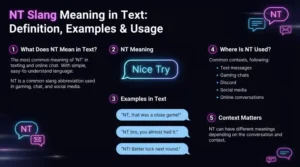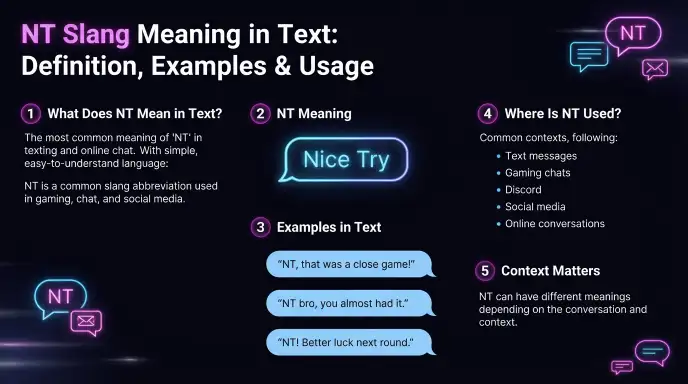
NT slang in text most commonly means “nice try,” a quick reply used to playfully acknowledge someone’s attempt, whether it worked or not.
“NT” became popular in online gaming chats, where players type it after a teammate or opponent makes a good effort.In addition, it is short, fast, and easy to type during a match. Over time, it spread to texts, DMs, and social media comments.
In casual texting, “NT” can be friendly encouragement, like “NT, you almost got it.”However, it can also be light teasing when someone fails at something or tries to trick you. Ultimately, the tone depends on the emoji and the relationship between the people chatting.
Depending on the context, “NT” can have other meanings tooIn some cases, some people use it for “no thanks,” and in online communities it can stand for “neurotypical.”As a result, reading the full conversation is the best way to understand which meaning fits.
In this guide, you will learn the exact NT meaning in text, how to use it in real conversations, and what its common variations are. Besides that, you will find examples, similar slang terms, and answers to frequently asked questions to help you use it with confidence.
Quick Answer:
NT slang usually stands for “Nice Try.” In most cases, it is used to acknowledge someone’s attempt, especially when they almost succeeded but did not quite achieve the desired result.
What Does NT Mean in Text?
The most common meaning of NT in text is “Nice Try.”
It is a shortened expression used to recognize someone’s effort. Instead of typing the full phrase, people simply write “NT,” especially in fast-moving online conversations.
For example:
“NT! That was almost a win.”
“nt bro, you nearly got me.”
“NT, maybe next round.”
“That was a good attempt. NT!”
The expression is especially common in online gaming, where players often need to communicate quickly.
However, NT can have different meanings in other situations. For this reason, context is important. If someone writes “NT” during a gaming match, “Nice Try” is a strong possibility. In another conversation, though, it could have a different meaning.
NT Slang Full Form and Definition
What Does NT Stand For?
In internet slang, NT commonly stands for “Nice Try.”
The phrase can be broken down simply:
| Term | Meaning |
|---|---|
| NT | Nice Try |
| N | Nice |
| T | Try |
| Tone | Usually casual or encouraging |
| Common setting | Gaming, texting, chats, social media |
“Nice Try” does not necessarily mean that the person succeeded. In fact, it is often used precisely because the attempt failed or fell short.
For example, if a player attempts to defeat an opponent but loses at the last moment, another player might say “NT!”
Is NT Rude, Offensive, or Neutral?
Is NT a Positive Expression?
Generally, NT is neutral to positive when it means “Nice Try.”
It can show encouragement, sportsmanship, or simple acknowledgment of someone’s effort.
For example:
“NT! You were one move away from winning.”
This sounds supportive.
However, NT can also become sarcastic depending on the situation.
For example:
“NT 😂 You really thought that would work.”
Here, the speaker may not genuinely be praising the attempt.
In other words, the words themselves are not offensive. The context, punctuation, emojis, and relationship between the people can change the tone.
Where Is NT Commonly Used?
NT in Gaming
Gaming is one of the most common places to see NT.
Players use it after:
- A close match
- A failed attack
- A missed opportunity
- A nearly successful strategy
- A last-second mistake
Example:
“NT, that was a really close round.”
Because gaming conversations move quickly, abbreviations like NT save time.
NT in Texting and Chats
Friends may also use NT in everyday messaging.
For example:
“I tried to fix the computer myself.”
“NT 😂”
Depending on the relationship, this might be friendly encouragement or playful teasing.
NT on Social Media
NT can appear in comments, replies, gaming posts, livestream chats, and community discussions.
Therefore, its meaning should always be interpreted based on the surrounding conversation.
Real-Life Examples of NT Slang
Friendly Example
Person A: “I almost beat your score!”
Person B: “NT! You were really close.”
Here, NT clearly means “Nice Try” and sounds encouraging.
Casual Example
Person A: “I tried making homemade pizza.”
Person B: “NT 😂”
This could mean “Nice Try,” possibly with a little playful teasing.
Argumentative Example
Person A: “You can’t prove that.”
Person B: “NT, but I literally have the screenshot.”
In this context, NT may sound sarcastic rather than genuinely supportive.
Gaming Example
Player A: “I nearly got the final enemy!”
Player B: “NT!”
This is one of the clearest examples of NT meaning “Nice Try.”
Social Media Example
Someone posts a video attempting a difficult trick.
A commenter might write:
“NT! Almost had it.”
As a result, the comment recognizes the effort without saying the person succeeded.
NT Slang in Gaming Culture
Why Gamers Use NT
Gaming requires fast communication. For that reason, players often use short expressions rather than complete sentences.
Common gaming abbreviations can communicate an idea in just a few characters.
NT is useful because it quickly tells another player:
- You made a good attempt.
- You almost succeeded.
- Your effort was noticed.
- The result could have been different.
This makes NT particularly useful after close plays.
In some gaming communities, however, NT can also be used sarcastically. For example, a player may type it after an obviously poor decision to tease another player.
Therefore, the same two letters can be either encouraging or mocking depending on the situation.
NT vs Similar Slang Terms
NT is not the only short expression used to react to someone’s attempt.
| Slang | Meaning | Typical Tone | Common Use |
|---|---|---|---|
| NT | Nice Try | Friendly/casual | Gaming and chats |
| GG | Good Game | Positive | Gaming |
| WP | Well Played | Positive | Gaming |
| GL | Good Luck | Friendly | Gaming and competitions |
| LOL | Laughing Out Loud | Humorous | Texting/social media |
These terms are related to online communication, but they do not mean exactly the same thing. In particular, NT focuses on the attempt, while GG usually refers to the game or match as a whole.
NT vs “Nice Try” vs “Well Played”
NT
“Nt” recognizes an attempt that may not have worked.
Example:
“NT! You almost caught me.”
Nice Try
“Nice Try” is simply the complete version of NT.
Example:
“Nice try! That was close.”
Well Played
“WP” or “Well Played” usually praises how someone performed rather than simply acknowledging an unsuccessful attempt.
| Expression | Main Idea | Example |
|---|---|---|
| NT | Your attempt was good | “NT, almost won.” |
| Nice Try | Same meaning as NT | “Nice try!” |
| WP | Your performance was good | “WP, that was clever.” |
When Should You Avoid Using NT?
Avoid It When the Meaning Could Be Misunderstood
If you are speaking in a professional setting, abbreviations can create confusion.
For example, an email to a client is usually not the right place for:
“NT!”
As a result, the person may not understand what you mean.
Avoid It During Sensitive Conversations
If someone has made a serious mistake or is upset, “NT” might sound dismissive or sarcastic.
Instead of:
“NT.”
You could say:
“I know you tried. Let’s figure out what went wrong.”
Avoid Ambiguous Abbreviations With Strangers
Not everyone knows internet slang. For this reason, when you communicate with someone unfamiliar with online abbreviations, writing “Nice Try” is clearer.
Polite Alternatives to NT
If you want to communicate the same idea more clearly, you can use:
- Nice try!
- Good attempt!
- You almost had it!
- That was close!
- Good effort!
- You were nearly there.
- Great attempt.
- Maybe next time!
- You gave it a good shot.
These alternatives work especially well when you want to make your meaning obvious.
Why Do People Use NT Slang?
It Is Short and Fast
The biggest reason people use NT is convenience.
Typing two letters is much faster than typing “Nice Try,” especially during a fast game.
It Fits Online Communication
Internet conversations frequently use abbreviations because people want to communicate quickly.
NT fits naturally into:
- Gaming chats
- Discord conversations
- Text messages
- Social media comments
- Livestream chats
It Can Show Sportsmanship
Used sincerely, NT can be a simple way of recognizing someone’s effort.
After all, a player does not have to win to receive an encouraging “NT.”
It Can Also Be Playful
Friends may use NT to tease one another without serious hostility.
For example:
“NT 😂 You almost fooled me.”
In this case, the emoji helps make the playful tone clearer.
The Impact of NT on Communication
Positive Impact
When used sincerely, NT can make online communication more friendly.
It can:
- Encourage someone
- Recognize effort
- Reduce tension after a close game
- Show sportsmanship
- Keep conversations short and natural
Negative Impact
The problem occurs when NT is used sarcastically.
A short message such as:
“nt.”
can sometimes sound cold or mocking.
Without facial expressions or voice tone, text messages can easily be misunderstood. This is why context matters so much when interpreting internet slang.
How to Understand the Tone of NT
Look at the Conversation
Read the messages before and after NT.
If the conversation is friendly, NT is probably supportive.
Look at Emojis
An emoji can change the tone.
“NT! 👍” sounds encouraging.
“NT 😂” may sound playful.
“NT 🙄” may suggest sarcasm or criticism.
Consider the Relationship
Friends may use NT differently from strangers.
For instance, a close friend saying “NT” may be joking, while the same message from someone in an argument could sound dismissive.
Is NT Safe for Social Media?
Can You Use NT on Social Platforms?
Generally, NT is a harmless abbreviation when it means “Nice Try.”
It is not inherently offensive or inappropriate.
Still, the way it is used matters. If it is directed at someone in a mocking or insulting manner, the interaction can become negative even though the abbreviation itself is harmless.
For public comments, a clearer version such as “Nice try!” may sometimes be better because everyone can understand it.
Other Possible Meanings of NT
Why Context Matters
Although “Nice Try” is a common internet meaning, NT can represent different phrases in different communities.
For example, abbreviations may have specialized meanings in:
- Workplaces
- Education
- Technology
- Medical contexts
- Gaming communities
- Private online groups
Therefore, you should not automatically assume that every NT means “Nice Try.”
If the surrounding conversation does not involve an attempt, competition, game, or mistake, another interpretation may be intended.
NT Slang:
| Feature | NT | Nice Try | WP |
|---|---|---|---|
| Full form | Nice Try | Nice Try | Well Played |
| Length | 2 letters | 8 letters including space | 2 letters |
| Tone | Casual | Casual/friendly | Positive |
| Common online | Yes | Yes | Yes |
| Gaming use | Very common | Common | Very common |
| Can be sarcastic? | Yes | Yes | Yes |
This comparison shows why context is important. In short, NT and “Nice Try” have the same basic meaning, while WP focuses more on good performance.
Common Mistakes When Using NT
Mistake 1: Assuming Everyone Knows It
Not every reader understands online abbreviations.
Therefore, if clarity matters, write “Nice Try” instead.
Mistake 2: Using It in Formal Communication
NT is informal. For this reason, avoid it in professional emails, academic writing, official documents, and formal business communication.
Mistake 3: Ignoring Tone
A simple “NT” can sometimes sound sarcastic.
Adding a little context can make your intention clearer:
“NT! You almost got the win.”
Mistake 4: Assuming NT Always Means Nice Try
NT has multiple possible meanings outside internet slang. Hence, always consider the context before interpreting it.
FAQs
Q1: What does “NT” mean in texting?
In texting, NT most commonly means “nice try.” People send it to acknowledge someone’s effort, especially when the attempt did not fully work out. It can sound encouraging, like “NT, you almost got it,” or playfully teasing when a friend fails at something. In either case, emojis and the relationship between the two people usually show which tone is meant.
Q2: What is NT chat?
NT chat refers to messages where people type “NT” to show good sportsmanship or light humor. It is very common in gaming lobbies, team chats, and group conversations. Players use it right after a close miss, a failed play, or a clever attempt. Because it is quick to type, it keeps fast-paced chats friendly without breaking the flow of the game.
Q3: What does “NT” stand for?
NT most often stands for “nice try” in online chats and gaming. Depending on the context, it can also mean “no thanks” in quick replies. Moreover, in some communities, it stands for “neurotypical,” and in Australia, it can refer to the Northern Territory. Since the surrounding conversation almost always makes the correct meaning clear, read the full message before replying.
Q4: What does “NT” mean in LOL?
In League of Legends (LoL), NT means “nice try,” and players type it to encourage teammates after a failed fight or missed skill shot. It is a simple way to keep morale high and avoid blame during a tense match. However, if you see it after a clear mistake, it may also be sarcastic. For this reason, judging the tone by the moment and the team’s mood helps you read it correctly.
Conclusion
NT slang most commonly means “Nice Try” in texting, gaming, social media, and online chats. It is a short way to acknowledge someone’s effort, especially when they came close to succeeding.
The expression is generally neutral or positive, but context can change its tone. For example, a message such as “NT! You almost won” is usually encouraging, while a short “nt 😂” might be playful or sarcastic.
If you see NT meaning slang in a gaming conversation, “Nice Try” is usually the first interpretation to consider. However, because abbreviations can have different meanings in different communities, always look at the surrounding conversation.
In short, what does NT stand for? In common internet slang, it stands for “Nice Try.” Use it casually with people who understand online abbreviations, and choose the complete phrase when clarity or formality is important.
In This Guide!

I am Ann Raimes, an applied linguist and English language educator. I am widely recognized for my contributions to writing pedagogy and research in ESL writing. I have authored several well-known books, including Techniques in Teaching Writing, Keys for Writers, and How English Works: A Grammar Handbook with Readings. Throughout my career, I have worked to promote communicative writing and the process-based approach to teaching writing, helping both teachers and learners develop effective writing skills.