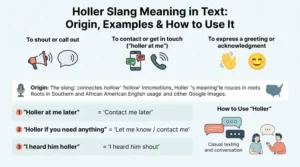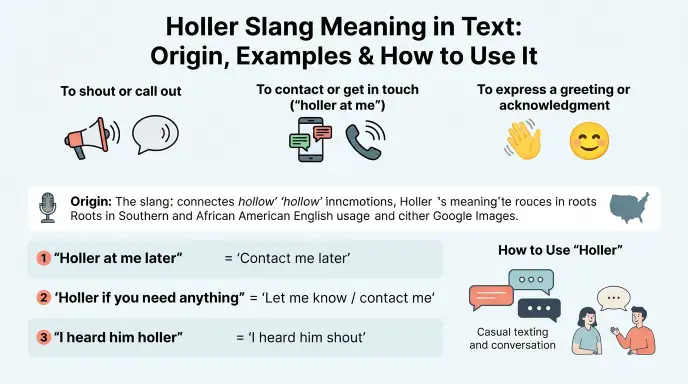
Holler in text means “to call, text, or get in touch with someone,” as in “Holler at me when you’re free.”
Holler started as a word for shouting or calling out loudly. Over time, it became popular slang for reaching out to someone, usually in a casual and friendly way. Today, people use it in texts, DMs, and social media comments.
In text conversations, “holler” most often means “hit me up” or “let me know.” For example, “Holler if you need anything” simply means “message me if you need help.” It can also be used as a casual greeting, like “Holler at your boy.”
The slang has strong roots in African American Vernacular English (AAVE) and Southern US speech. Hip-hop and R&B music helped spread it worldwide, which is why it still feels natural in modern chats. It sounds relaxed and warm, never formal.
In this guide, you will learn the exact holler meaning in text, how to use it in real conversations, and what the common variations are. You will also find examples, similar slang terms, and answers to frequently asked questions to help you use it with confidence.
Quick Answer
Holler slang usually means to call, shout, or contact someone. For example, “holler at me later” can mean “contact me later” or “let me know later.”
What Does Holler Mean in Slang?
Holler Slang Definition
In informal English, “holler” can mean to shout loudly or call out to someone.
However, modern slang often uses it in a less literal way.
For example:
“Holler at me when you get home.”
This usually means:
“Contact me when you get home.”
Another common expression is:
“Give me a holler.”
This means:
“Let me know” or “contact me.”
So, the slang meaning depends heavily on the phrase in which “holler” appears.
What Does “Holler at Me” Mean?
A Common Texting Expression
“Holler at me” is one of the most common informal expressions containing the word.
It can mean:
- Contact me
- Call me
- Message me
- Let me know
- Get in touch with me
For example:
“If you need anything, holler at me.”
The speaker is not necessarily asking the other person to literally shout. They are simply saying “contact me if you need something.”
The exact meaning can vary slightly depending on the situation.
What Does “Give Me a Holler” Mean?
Another Popular Expression
“Give me a holler” is an informal way of asking someone to contact or notify you.
For example:
“Give me a holler when you’re ready.”
This can mean:
“Let me know when you’re ready.”
It can refer to calling, texting, or simply getting someone’s attention.
The expression sounds casual and friendly, although it can have an old-fashioned or regional flavor.
Is Holler Rude or Offensive?
Understanding the Tone
“Holler” is generally not a rude or offensive word.
Its tone is usually:
- Casual
- Friendly
- Informal
- Conversational
- Sometimes playful
- Occasionally regional or old-fashioned
The word itself is harmless in most everyday contexts.
However, “holler” can literally mean shout loudly, so the tone may sound more forceful when it is used in a sentence about yelling.
For example:
“He hollered across the street.”
Here, the meaning is closer to shouted than “contacted.”
Holler Slang vs. Standard English
How the Meaning Changes
| Expression | Meaning | Tone |
| Holler | Shout or call out | Informal |
| Holler at me | Contact me | Casual |
| Give me a holler | Contact or let me know | Friendly |
| Holler across the room | Shout loudly | Literal |
| Holler for help | Call out loudly for assistance | Literal |
This shows why it is important to look at the complete sentence rather than translating “holler” by itself.
Where Is Holler Commonly Used?
American English and Regional Speech
“Holler” has a strong association with American English, particularly Southern and Appalachian speech.
The word can also appear in:
- Casual conversations
- Text messages
- Social media
- Country music
- Hip-hop and popular music
- Movies and television
- Informal American writing
- Friendly conversations
Although the expression has regional roots, many English speakers outside the Southern United States recognize phrases such as “holler at me.”
What Does Holler Mean in Texting?
Holler in Messages and Social Media
When someone writes “holler” in a text, they usually mean one of two things:
- Contact me
- Call or shout to get my attention
For example:
“Holler when you arrive.”
Usually means:
“Let me know when you arrive.”
Another example:
“Just holler if you need help.”
This means:
“Let me know if you need help.”
In texting, the word generally creates a relaxed and approachable tone.
Real-Life Examples of Holler Slang
Friendly Example
“Holler at me if you’re free this weekend.”
Meaning: Contact me if you’re free.
Casual Example
“Give me a holler when you get there.”
Meaning: Let me know when you arrive.
Literal Example
“She hollered for her brother.”
Meaning: She shouted or called loudly for her brother.
Argumentative Example
“Don’t holler at me like that.”
Here, “holler” means shout or yell, rather than contact someone.
Social Media Example
“Holler at me if you want the details.”
Meaning: Message or contact me if you want the details.
Gaming Context
“Holler if you need another player.”
In a gaming conversation, this usually means:
“Let me know or message me if you need another player.”
Origin and Background of Holler
Where Did the Word Come From?
“Holler” has a long history in English and is related to words meaning to shout or call loudly.
The verb has been used in English for centuries, and American English developed several distinctive uses of it.
In regional American speech, especially in Southern and Appalachian communities, “holler” can also refer to a small valley or hollow. This is a completely different meaning from the verb “holler.”
Over time, the verb developed familiar informal expressions such as “holler at someone” and “give me a holler.”
Because of its regional history, the word can sometimes give a sentence a distinctly American or Southern flavor.
Holler vs. Shout vs. Yell
Comparing Similar Words
| Word | Main meaning | Typical tone |
| Holler | Shout, call, or contact | Informal |
| Shout | Speak very loudly | Neutral |
| Yell | Shout loudly, often emotionally | Neutral/informal |
| Call | Speak to or contact someone | Neutral |
| Scream | Make a very loud, intense sound | Strong |
“Holler” is more informal and regional than “shout” or “call.”
For example:
“Holler at me later.”
sounds much more casual than:
“Contact me later.”
Holler vs. “Holler at Me”
Are They the Same?
Not always.
| Phrase | Likely meaning |
| Holler! | Shout/call out |
| Holler at me | Contact me |
| Give me a holler | Let me know/contact me |
| Holler for help | Shout for assistance |
| He hollered | He shouted |
The surrounding words usually make the intended meaning clear.
Holler vs. Modern Texting Expressions
Similar Expressions Today
| Holler expression | Modern equivalent |
| Holler at me | Message me |
| Give me a holler | Let me know |
| Holler when you’re ready | Tell me when you’re ready |
| Holler if you need anything | Reach out if you need anything |
| Holler later | Hit me up later |
“Holler” can therefore function similarly to modern expressions such as “hit me up” or “message me,” although its style is different.
Why Do People Use Holler Slang?
Reasons Behind Its Popularity
People use “holler” because it can make communication sound:
- Relaxed
- Friendly
- Personal
- Informal
- Regional
- Approachable
It is also short and flexible.
Instead of saying:
“Please contact me if you require additional information.”
Someone in a casual conversation might say:
“Holler if you need anything.”
The second version feels much more conversational.
Impact of Holler in Communication
How It Changes Tone
Choosing “holler” instead of “contact” or “call” can make a message feel less formal.
Compare:
Formal:
“Please contact me if you have any questions.”
Casual:
“Holler if you have any questions.”
Both communicate a similar idea, but the second sounds more relaxed.
This makes “holler” useful in friendly conversations, social media captions, informal messages, and conversational writing.
When Should You Avoid Holler?
Formal Communication
Although “holler” is not offensive, it may be too informal for certain situations.
Consider avoiding it in:
- Formal business letters
- Academic writing
- Legal documents
- Professional reports
- Formal applications
- Official notices
- Highly professional emails
In those situations, use words such as:
- Contact
- Call
- Notify
- Inform
- Reach out
For casual communication, however, “holler” can sound perfectly natural.
Is Holler Safe for Social Media?
Using Holler Online
Yes, “holler” is generally harmless for social media.
It is not inherently sexual, hateful, or offensive. It is simply an informal English word.
For example:
“Holler at me if you want to join the game!”
is a casual social-media message.
The main consideration is audience. A professional company account may prefer “contact us” or “message us,” while a personal account can comfortably use informal language.
Common Mistakes About Holler Slang
Mistake 1: Thinking Holler Always Means Shout
In “holler at me,” the word usually means contact me, not literally shout at me.
Mistake 2: Assuming It Is Always Southern
The word has strong Southern and Appalachian associations, but it is understood and used more broadly.
Mistake 3: Thinking Holler Is an Acronym
“Holler” has no standard full form. It is an ordinary word with informal uses, not an abbreviation.
Mistake 4: Assuming It Is Rude
The word itself is generally not offensive. Its tone depends on how it is used.
Mistake 5: Confusing the Noun and Verb
In American English, “a holler” can also refer to a hollow or small valley in certain regional contexts. That is different from the verb meaning “shout.”
FAQs:
Q1: What does holler slang mean?
Holler slang means to contact, call, or message someone, usually in a casual way. People say “holler at me” to mean “hit me up” or “let me know.” The word grew out of its older meaning of shouting, and it became popular through Southern US speech, AAVE, and hip-hop culture. Today it appears in texts, DMs, and social media comments as a friendly way to invite someone to reach out.
Q2: What does “holler girl” mean?
“Holler girl” is a casual phrase used to get a girl’s attention or to say you want to talk to her. In its most common use, “holler at that girl” means to approach her, message her, or show interest in her. The tone depends on the context, so it can sound friendly, flirty, or just playful. It also appears in song titles and lyrics, which is why many people search for it. Among friends it is usually harmless, but in a serious conversation it can come across as too casual.
Q3: Is it okay to say “holler” at me?
Yes, it is perfectly okay to say “holler at me” in casual conversation. It simply means “contact me” or “get in touch,” and it sounds warm and relaxed. It works well with friends, family, and peers in texts or chats. In formal settings, such as work emails or professional messages, it is better to use a more polished phrase like “please reach out” or “feel free to contact me.” Knowing your audience is the key to using this slang naturally.
Q4: What does “lemme holler at you” mean?
“Lemme holler at you” is short for “let me holler at you,” which means “let me talk to you for a moment.” People use it to start a quick private chat, ask for a minute of someone’s time, or share something important. In some situations, it can also signal romantic interest, similar to “let me talk to you.” The meaning becomes clear from the tone and setting, but it is always informal and best suited for casual conversations among friends.
Conclusion:
Holler slang is a useful example of how one English word can have several meanings depending on context. As a verb, “holler” can literally mean shout or call loudly. In informal expressions such as “holler at me” and “give me a holler,” it usually means contact me, call me, or let me know.
The expression has strong roots in American English and is particularly associated with Southern and Appalachian speech. Today, however, many people recognize it through texting, social media, music, movies, and casual conversation.
“Holler” is generally friendly and informal rather than offensive. Just remember that it may sound too casual in professional or academic writing.
When you see “holler” in a text, always look at the surrounding words. Context will usually tell you if the speaker means “shout” or “contact me.”
Find Out More!

I am Ann Raimes, an applied linguist and English language educator. I am widely recognized for my contributions to writing pedagogy and research in ESL writing. I have authored several well-known books, including Techniques in Teaching Writing, Keys for Writers, and How English Works: A Grammar Handbook with Readings. Throughout my career, I have worked to promote communicative writing and the process-based approach to teaching writing, helping both teachers and learners develop effective writing skills.