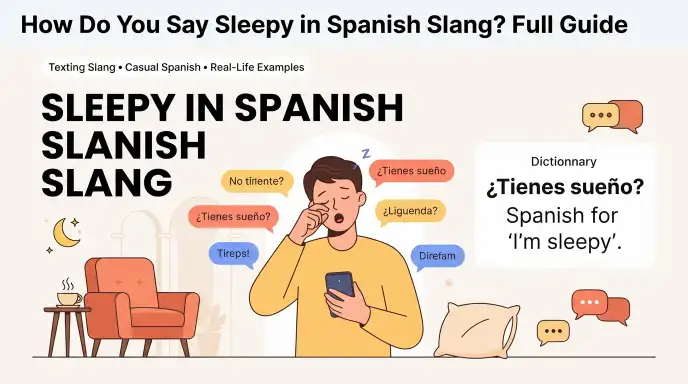
“Tener sueño” is the most common way to say “sleepy” in Spanish, but slang speakers often use more casual expressions instead.
Words like “sueñera” or phrases like “estar muerto de sueño” (literally “dying of sleep”) are widely used in everyday conversations to express extreme tiredness. These expressions add emotion and personality that the standard phrase doesn’t fully capture.
Slang for “sleepy” also varies by region, Mexican, Argentinian, and Spanish speakers may use different casual terms or intensifiers to describe drowsiness. Understanding these variations helps learners sound more natural and fluent in real conversations.
This article explores the most popular slang terms for “sleepy” in Spanish, their meanings, regional differences, and how native speakers actually use them in daily life.
Quick Answer:
The most common casual way to say “I’m sleepy” in Spanish is “tengo sueño” or “estoy con sueño.” In informal speech, people may also use stronger expressions such as “estoy muerto/a de sueño,” meaning “I’m extremely sleepy.”
What Does “Sleepy in Spanish Slang” Mean in Text?
When someone searches for sleepy in Spanish slang, they are usually looking for an informal way to express tiredness or the feeling that they need to sleep.
The standard Spanish phrase is:
“Tengo sueño.”
It literally translates to something like “I have sleep,” but naturally means:
“I’m sleepy.”
This is one of the most common and natural ways to express the feeling.
Another casual expression is:
“Estoy con sueño.”
This also means “I’m sleepy” or “I feel sleepy.”
Spanish speakers may choose different expressions depending on their country or personal speaking style.
Common Spanish Expressions for Sleepy
Here are some useful expressions:
- Tengo sueño : I’m sleepy.
- Estoy con sueño : I’m feeling sleepy.
- Ando con sueño “; I’m feeling sleepy / I’ve been sleepy.
- Me da sueño :It makes me sleepy.
- Estoy muerto de sueño : I’m extremely sleepy. (masculine)
- Estoy muerta de sueño :I’m extremely sleepy. (feminine)
- Me estoy quedando dormido/a : I’m falling asleep.
- Tengo mucho sueño : I’m very sleepy.
The best choice depends on how strong the feeling is and where the conversation takes place.
Sleepy in Spanish Slang: Full Meaning and Definition
Unlike some internet slang terms, “sleepy” does not have one official Spanish slang full form.
Instead, Spanish speakers use several informal expressions to describe being sleepy.
The most useful phrase to remember is:
Tengo sueño = I’m sleepy.
If you want to emphasize how tired you are, you can say:
Tengo muchísimo sueño = I’m extremely sleepy.
Or:
Estoy muerto/a de sueño = I’m dead tired/sleepy.
The second expression is figurative. The person is not literally dead. It simply emphasizes that they are extremely tired.
“Tengo Sueño” vs “Estoy Dormido”
These phrases should not be confused.
Tengo sueño means “I’m sleepy.”
Estoy dormido/a means “I’m asleep.”
For example:
“Tengo sueño, pero todavía quiero ver la película.”
This means:
“I’m sleepy, but I still want to watch the movie.”
The speaker is tired but still awake.
In contrast:
“Estoy dormido.”
means:
“I’m asleep.”
Understanding this difference is important for learners.
Is Sleepy Spanish Slang Rude or Offensive?
The common Spanish expressions for being sleepy are neutral and harmless.
For example:
“Tengo sueño.”
is completely normal.
“Ando con sueño.”
is also casual but not offensive.
More expressive phrases such as:
“Estoy muerto de sueño.”
are informal and dramatic, but they are not normally considered rude.
The only thing to consider is the setting. A very casual phrase may not be the best choice in a formal presentation or professional email.
Formal vs Casual Spanish
| Expression | English Meaning | Tone |
| Tengo sueño | I’m sleepy | Neutral |
| Estoy con sueño | I’m feeling sleepy | Casual/neutral |
| Ando con sueño | I’m feeling sleepy | Informal |
| Tengo mucho sueño | I’m very sleepy | Neutral |
| Estoy muerto/a de sueño | I’m extremely sleepy | Informal/expressive |
| Me estoy quedando dormido/a | I’m falling asleep | Neutral |
Where Is “Sleepy in Spanish Slang” Commonly Used?
Expressions for sleepiness can be used almost anywhere, but informal versions are especially common in everyday conversations.
Text Messages
Friends may write:
“Tengo sueño 😴”
This is a simple way to say “I’m sleepy.”
Social Media
A person might post:
“Tengo demasiado sueño hoy.”
This means:
“I’m way too sleepy today.”
Emojis such as 😴 or 🥱 are often added to make the meaning even clearer.
Gaming Chats
Gamers may say:
“Tengo sueño, pero una partida más.”
Meaning:
“I’m sleepy, but one more game.”
This is a natural casual use among friends.
Everyday Conversation
You can use these expressions with friends, family members, classmates, and coworkers in casual situations.
For example:
“¿Quieres salir?”
“No sé, tengo mucho sueño.”
Meaning:
“Do you want to go out?”
“I don’t know, I’m really sleepy.”
Real-Life Examples of Sleepy in Spanish Slang
Examples make these expressions much easier to understand.
Friendly Example
Friend: “¿Vamos por un café?”
You: “Sí, porque tengo mucho sueño.”
English: “Yeah, because I’m really sleepy.”
This is friendly and natural.
Casual Text Example
“Tengo sueño 😴 hablamos mañana.”
English: “I’m sleepy 😴 we’ll talk tomorrow.”
This is a common type of informal message.
Argumentative Example
Person 1: “¿Por qué no me contestaste?”
Person 2: “Porque tenía sueño y me quedé dormido.”
English: “Because I was sleepy and I fell asleep.”
Here, the expression explains why someone did not respond.
Gaming Example
“Tengo sueño, pero no me voy hasta ganar.”
English: “I’m sleepy, but I’m not leaving until I win.”
This gives the expression a humorous gaming context.
Social Media Example
“Lunes otra vez y tengo muchísimo sueño.”
English: “Monday again and I’m extremely sleepy.”
This would fit naturally as a social media caption.
Origin and Background of Spanish Expressions for Sleepiness
The Spanish expression “tener sueño” comes from a common Spanish construction in which certain physical or emotional states are expressed using tener, meaning “to have.”
For example:
- Tengo hambre : I’m hungry.
- Tengo sed : I’m thirsty.
- Tengo frío : I’m cold.
- Tengo sueño : I’m sleepy.
English speakers sometimes find this structure unusual because English normally uses “I am” for these states.
Spanish developed these expressions naturally as part of its everyday grammar, so “tengo sueño” is not a literal slang invention. It is a standard and highly natural expression.
Informal expressions such as “estoy muerto/a de sueño” developed from figurative speech, where exaggerated language is used to emphasize extreme tiredness.
Sleepy vs Tired vs Falling Asleep in Spanish
These ideas are related but not identical.
| English | Spanish | Meaning |
| I’m sleepy | Tengo sueño | I feel like sleeping |
| I’m tired | Estoy cansado/a | I lack energy |
| I’m very sleepy | Tengo mucho sueño | Strong desire to sleep |
| I’m falling asleep | Me estoy quedando dormido/a | I am beginning to fall asleep |
| I’m asleep | Estoy dormido/a | I am already sleeping |
| I’m exhausted | Estoy agotado/a | Extremely tired |
Knowing these differences can help you choose the right expression instead of translating English word-for-word.
Sleepy in Spanish Slang: Regional Differences
Spanish is spoken across many countries, and everyday expressions can vary.
“Tengo sueño” is widely understood throughout the Spanish-speaking world.
Other expressions may sound more natural in particular regions or communities.
For example, “ando con sueño” is a more conversational construction that you may encounter in informal speech.
Regional slang can also change over time because of social media, music, gaming, and online communities.
Standard vs Informal Expressions
| Spanish Expression | Meaning | Level of Informality |
| Tengo sueño | I’m sleepy | Standard |
| Tengo mucho sueño | I’m very sleepy | Standard |
| Estoy con sueño | I’m feeling sleepy | Casual |
| Ando con sueño | I’m feeling sleepy | Informal |
| Estoy muerto/a de sueño | I’m extremely sleepy | Very expressive |
| Me estoy quedando dormido/a | I’m falling asleep | Standard/casual |
When Should You Avoid Informal Sleepy Expressions?
Most sleepy expressions are harmless, so there are few situations where you truly need to avoid them.
Still, formal situations call for clearer and more standard language.
For example, during a professional presentation, saying:
“Estoy muerto de sueño.”
may sound overly casual.
A more neutral choice would be:
“Estoy muy cansado/a.”
or:
“Tengo mucho sueño.”
You should also avoid assuming that a regional expression will be understood exactly the same way everywhere. If speaking with someone from another Spanish-speaking country, widely understood phrases are usually safest.
Polite Alternatives for Saying You Are Sleepy
If you want to sound polite or professional, use straightforward Spanish.
Some good alternatives include:
- Tengo sueño. : I’m sleepy.
- Tengo mucho sueño. : I’m very sleepy.
- Estoy un poco cansado/a. : I’m a little tired.
- Necesito descansar. : I need to rest.
- Creo que necesito dormir. : I think I need to sleep.
- Me siento cansado/a. : I feel tired.
These expressions work well in many situations.
Why Do People Use Slang for Sleepy?
People often choose informal expressions because they make conversations feel more natural and emotional.
Instead of simply saying:
“Tengo sueño.”
someone might say:
“Estoy muerto de sueño.”
The second phrase communicates stronger emotion.
Informal expressions can also:
- Make conversations more relaxed
- Add humor
- Show personality
- Fit naturally into texting
- Express stronger feelings
- Help friends communicate casually
This is one reason slang and colloquial language are so common online.
Impact of Sleepy Slang on Communication
Using the right expression can make your Spanish sound more natural.
However, literal translation can sometimes produce unnatural sentences.
For example, translating “I have sleep” into English would sound strange. But in Spanish, “Tengo sueño” is completely normal.
This shows why learning expressions as complete phrases is often more useful than translating every word individually.
If you are learning Spanish, try to remember:
Tengo sueño = I’m sleepy
as one complete expression.
Is Sleepy Spanish Slang Safe for Social Media?
Yes. Common expressions for being sleepy are generally safe for social media.
You can comfortably use:
- Tengo sueño 😴
- Tengo muchísimo sueño 🥱
- Estoy muerto/a de sueño
- Me estoy quedando dormido/a
They are not inherently offensive or inappropriate.
Still, remember that some expressions are more dramatic or regional than others. If your audience includes Spanish speakers from different countries, “tengo sueño” is one of the safest and most universally understandable options.
Common Mistakes English Speakers Make
Mistake 1: Saying “Soy sueño”
This is incorrect.
Use:
“Tengo sueño.”
Mistake 2: Confusing Sleepy With Asleep
Tengo sueño = I’m sleepy.
Estoy dormido/a = I’m asleep.
Mistake 3: Translating Every Word Literally
Spanish does not always follow English sentence structure. Learning the phrase as a whole makes communication easier.
Mistake 4: Using Strong Slang Everywhere
Expressions such as “estoy muerto/a de sueño” are casual and expressive. Use them when the situation is relaxed.
FAQs:
Q1: How Do You Say Sleepy in Spanish Slang?
In Spanish slang, “sleepy” is most commonly expressed as “tengo sueño” (I’m sleepy) in standard speech. For a more casual, slang version, people say “estoy grogui” (I’m groggy) or “tengo modorra” (I’ve got the drowsies). In Mexico, you might also hear “ando picudo de sueño” as a fun regional way to express extreme sleepiness.
Q2: How Do Mexicans Say “Tired”?
Mexicans commonly say “estoy cansado” (I’m tired) in everyday conversation. In slang, they often use “ando muerto” (literally “I’m dead,” meaning extremely tired) or “estoy hecho polvo” (I’m turned to dust/exhausted). Another popular casual phrase is “ya no puedo” (I can’t anymore), used when someone is worn out.
Q3: How Do You Say “You Sleepy” in Spanish?
To ask someone if they’re sleepy, you say “¿Tienes sueño?” (Are you sleepy?). In a more casual or slang tone, you can say “¿Andas grogui?” or “¿Traes sueño?”, which are common in everyday spoken Spanish, especially in Latin America.
Q4: How Do You Say Sleepiness in Spanish?
The word for “sleepiness” in Spanish is “sueño” (the same word used for “sleep” and “dream,” with meaning depending on context). A more descriptive or slang term is “modorra”, which refers to a heavy, drowsy feeling of sleepiness.
Conclusion
If you searched “sleepy in Spanish slang,” the most useful phrase to remember is “tengo sueño,” which naturally means “I’m sleepy.” It is widely understood and works in everyday conversations, texts, social media, and casual situations.
Other expressions add different levels of emotion. “Estoy con sueño” and “ando con sueño” sound conversational, while “estoy muerto/a de sueño” emphasizes that someone is extremely sleepy. Meanwhile, “me estoy quedando dormido/a” specifically means that someone is falling asleep.
The key is to pay attention to context. Not every expression that describes sleepiness is technically slang, but informal Spanish often uses colorful and expressive phrases to communicate feelings naturally.
For learners, starting with “tengo sueño” is the safest choice. Once you understand the basics, you can explore regional and informal expressions to make your Spanish conversations sound more natural and authentic.
Find Out More!

I am Ann Raimes, an applied linguist and English language educator. I am widely recognized for my contributions to writing pedagogy and research in ESL writing. I have authored several well-known books, including Techniques in Teaching Writing, Keys for Writers, and How English Works: A Grammar Handbook with Readings. Throughout my career, I have worked to promote communicative writing and the process-based approach to teaching writing, helping both teachers and learners develop effective writing skills.