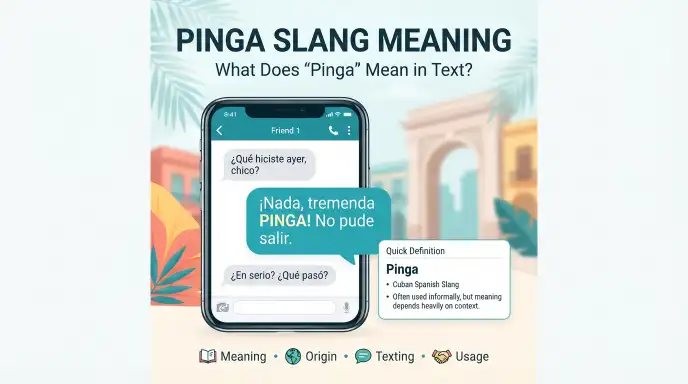
“Pinga” is a vulgar Caribbean Spanish slang term referring to male genitalia, widely used in Cuba, Dominican Republic, and Puerto Rico.
While it may sound unfamiliar to Spanish learners outside the Caribbean, “pinga” is one of the most frequently used slang words in everyday informal speech across these regions. Its meaning and tone shift dramatically depending on context, phrase, and delivery.
Originally a crude term for male anatomy, “pinga” has evolved far beyond its literal meaning. Today, it functions as an all-purpose intensifier, exclamation, and even a term of endearment in certain phrases.
Unlike standard textbook Spanish, this word rarely appears in formal writing or classroom lessons. Yet understanding it is essential for anyone trying to grasp real, spoken Caribbean Spanish.
In this article, we’ll break down its core meaning, common phrases like “pa’ la pinga” and “mi pinga,” and how context changes everything.
Quick Answer:
“Pinga” is a vulgar Spanish slang term commonly used to refer to the penis, especially in Cuban Spanish. In informal expressions, its meaning can change depending on context and tone.
What Does Pinga Mean in Text?
In slang and informal Spanish, “pinga” most commonly refers to the penis. It is considered vulgar or crude, so it is not a word you would normally use in polite or formal conversation.
The term is particularly associated with Cuban Spanish, although people may recognize or use it in other Spanish-speaking communities as well.
Online, “pinga” can appear in:
- Text messages
- Social media comments
- Memes
- Music lyrics and discussions
- Gaming chats
- Arguments
- Informal conversations
However, its meaning is not always strictly anatomical.
For example, a person might use “pinga” as part of an idiomatic phrase to show frustration or strong emotion. This is why simply translating the word without considering the entire sentence can sometimes lead to a misleading interpretation.
Pinga Slang Full Meaning
The most direct pinga slang full meaning is a vulgar reference to the penis.
In English, depending on the situation, it may correspond to words such as:
- Dick
- Cock
- Penis
- A vulgar reference to male genitalia
The first two English equivalents are also vulgar, while “penis” is the standard anatomical term.
The important distinction is that “pinga” is not normally a polite Spanish word for the body part. It belongs to informal and vulgar language.
In some expressions, however, the word functions more like an intensifier or exclamation rather than a literal reference.
Is Pinga Rude, Offensive, or Neutral?
Pinga is generally considered vulgar and potentially offensive.
Its strength can vary depending on the speaker, country, relationship between the people, and surrounding expression.
Among close friends who regularly use strong slang, it may be used jokingly. In other situations, it can sound aggressive or disrespectful.
| Context | Likely Tone | Appropriate? |
| Close friends joking | Vulgar/casual | Depends on the group |
| Online meme | Humorous/vulgar | Depends on audience |
| Argument | Aggressive | Usually not |
| Professional conversation | Inappropriate | No |
| Formal writing | Vulgar | No |
| Medical discussion | Incorrect terminology | Use anatomical terms |
Knowing that a word is common online does not automatically make it appropriate everywhere.
Why Context Matters
The same slang term can carry different emotional meanings.
For example, if someone uses “pinga” while joking with a close friend, the intention may be humorous. During an argument, the same word can contribute to an insulting or hostile tone.
This is common with profanity in many languages.
Where Is Pinga Commonly Used?
Pinga is strongly associated with Cuban Spanish and Cuban informal speech.
It may also be encountered online by Spanish speakers from other regions because social media, music, television, gaming, and internet culture allow slang to spread across borders.
You might encounter it in:
Social Media
People sometimes use “pinga” in memes, comments, captions, and informal discussions.
The meaning may be literal or figurative depending on the post.
Text Messages
Friends may use vulgar slang casually when they know each other well.
However, a learner should be careful about copying slang without understanding its strength.
Gaming Chats
Online gaming conversations often contain profanity and regional slang. “Pinga” may appear in Spanish-language gaming communities, especially when players are joking, frustrated, or reacting emotionally.
Music and Pop Culture
Vulgar slang can also appear in music, entertainment, and internet culture. In these settings, understanding the surrounding phrase is essential because artists may use slang creatively.
Real-Life Examples of Pinga Slang
The following examples demonstrate how context can influence the meaning and tone.
Friendly Example
Friend 1: “¿Qué pasó?”
Friend 2: “Nada, estoy jugando con los muchachos.”
A conversation between close friends may contain “pinga” as part of an informal Cuban expression. The tone may be joking rather than deliberately insulting.
The key point is that friendship and local speech patterns can affect how vulgar slang is received.
Casual Example
Someone might use “pinga” in an informal conversation simply as a vulgar reference to male anatomy.
Because it is explicit slang, it is better understood as comparable to English words such as “dick” rather than the neutral word “penis.”
Argumentative Example
During an argument, a speaker may include “pinga” in an insult or aggressive expression.
In this situation, the word can make the conversation sound significantly harsher.
This is one reason language learners should avoid repeating phrases they hear without first understanding their social meaning.
Gaming or Social Media Example
A frustrated gamer might use Cuban slang containing “pinga” after losing a match.
The word may function as part of an emotional reaction rather than being directed literally at another player.
On social media, memes may use the term for shock value, humor, or cultural references.
Origin and Background of Pinga
The history of pinga is connected to Spanish vocabulary and the development of regional slang.
The term has become especially recognizable as part of Cuban colloquial Spanish, where it can occur in numerous informal expressions.
Cuban Spanish has a rich vocabulary of local expressions influenced by historical Spanish usage, regional culture, African and Caribbean linguistic influences, and changing popular speech.
Like many slang words, “pinga” can develop meanings beyond its original literal reference. Speakers may use a vulgar word metaphorically to communicate emotion, emphasis, frustration, disbelief, or humor.
This process is not unique to Spanish. English has many examples of ordinary words or body-related terms developing additional slang meanings through popular culture.
Why Pinga Can Have Multiple Meanings
Slang is highly dependent on context.
A word may have:
- A literal meaning.
- A figurative meaning.
- An emotional meaning.
- A humorous meaning.
- A regional meaning.
Therefore, when you see “pinga” online, translating the word alone may not be enough. Look at the entire sentence, the speaker’s location, and the tone of the conversation.
Pinga vs Similar Spanish Slang
There are several Spanish words that may refer to male genitalia or be used as vulgar expressions, but they are not identical.
| Spanish Term | General Meaning | Tone |
| Pinga | Vulgar term for penis | Very informal/vulgar |
| Pene | Penis | Anatomical/neutral |
| Verga | Vulgar term for penis | Vulgar |
| Miembro | Male organ/member | Formal/euphemistic |
| Poronga | Vulgar regional term | Informal/vulgar |
Regional usage varies, so a word that is common in one Spanish-speaking country may sound unusual or have a different level of familiarity elsewhere.
Pinga vs Pene
The clearest comparison is pinga vs pene.
Pene is the standard Spanish anatomical word for penis.
Pinga is slang and vulgar.
For example:
- pene → suitable for medical or educational contexts
- pinga → informal, vulgar, and context-dependent
If you are learning Spanish, knowing both terms is useful, but they should not be treated as interchangeable in every situation.
Pinga Compared With English Slang
Understanding an English equivalent can make the tone easier to recognize.
| Pinga | Approximate English Equivalent | Tone |
| Pinga | Dick | Vulgar |
| Pinga | Cock | Very vulgar |
| Pene | Penis | Neutral/anatomical |
| Miembro | Male member | Euphemistic/formal |
| Genitales | Genitals | Neutral/anatomical |
These are approximate comparisons, not perfect translations. Slang strength differs between cultures and situations.
When Should You Avoid Using Pinga?
If you are not a native speaker, it is generally safest to avoid using “pinga” unless you fully understand the local expression and the relationship between the speakers.
You should especially avoid it in:
- Job interviews
- Professional emails
- School assignments
- Academic writing
- Business meetings
- Customer-service conversations
- Formal presentations
- Conversations with strangers
- Official documents
Even when people use the word jokingly online, it can still be interpreted as vulgar or disrespectful by someone unfamiliar with the intended tone.
Polite Alternatives to Pinga
If you are referring to the body part in a neutral or educational situation, use:
- Pene : penis
- Genitales : genitals
- Órgano sexual masculino : male sexual organ
These expressions are much more appropriate for medical, educational, and formal communication.
If “pinga” appears as part of an idiomatic expression, the best alternative depends on the exact sentence. Sometimes a neutral Spanish phrase is more appropriate than trying to replace the slang word directly.
Choosing the Right Word
A useful rule is:
Use standard vocabulary when clarity and politeness matter.
Use regional slang only when you are confident that you understand its meaning, tone, and cultural context.
Why Do People Use Pinga Slang?
People use vulgar slang for many reasons.
To Express Emotion
Profanity can make frustration, excitement, surprise, or anger feel stronger.
To Sound Informal
Close friends may use strong slang because it fits their conversational style.
To Create Humor
Memes and online communities often use vulgar language for comedic effect.
To Show Regional Identity
Some slang terms are strongly associated with particular cultures or regions.
To Add Emphasis
In certain expressions, a vulgar term can make a statement sound more intense.
This does not mean everyone who uses the word intends to offend someone. Intent, relationship, and context all matter.
Impact of Using Pinga in Communication
Using “pinga” can make communication sound more informal, humorous, aggressive, or vulgar.
The impact depends on the situation.
For someone who knows Cuban slang well, the word may be immediately recognizable. For a Spanish learner, however, using it incorrectly could produce an awkward or offensive interaction.
This is why learning slang requires more than memorizing translations.
You should also learn:
- Where the term is common
- How strong it sounds
- Who normally uses it
- Whether it is appropriate for your audience
- Whether it has figurative meanings
Understanding these factors helps you communicate more naturally.
Is Pinga Safe for Social Media?
Pinga is not inherently dangerous, but it is vulgar language.
On social media, its acceptability depends on the platform, audience, community rules, and context.
A meme using the word may be understood as humor by one audience but considered inappropriate by another.
If you are creating public content for a broad audience, using a neutral word is usually safer.
You should also remember that social media posts can be viewed outside their original cultural context. A regional slang term may be interpreted differently by international audiences.
Pinga and Online Communication
When you encounter “pinga” online, don’t immediately assume that the speaker is directly insulting someone.
Check:
- The complete sentence
- The surrounding comments
- The speaker’s likely region
- Whether the conversation is humorous
- Whether the word is being used literally or figuratively
This approach gives you a much more accurate understanding of pinga slang meaning.
Common Mistakes When Understanding Pinga
Mistake 1: Treating Pinga as Formal Spanish
Pinga is slang and vulgar. It should not replace the standard anatomical term in formal communication.
Mistake 2: Assuming It Has One Meaning Everywhere
Spanish varies considerably between countries. Regional context can change how slang is understood.
Mistake 3: Using It Without Knowing the Expression
Some phrases containing “pinga” may have meanings that are not obvious from a word-for-word translation.
Mistake 4: Assuming Every Use Is an Insult
The word can appear in jokes, expressions, or casual regional speech. The surrounding context determines its function.
FAQs
Q1: What Does “Pinga” Mean in Spanish Slang?
“Pinga” is a vulgar slang term used primarily in Caribbean Spanish (Cuba, Dominican Republic, Puerto Rico) that refers to male genitalia : similar to a crude English equivalent. It’s considered offensive/vulgar in formal settings but is used casually among friends in informal, everyday speech in these regions. Note: “Pingo,” a related but different word, can mean “mischievous” or “naughty” (often used for kids) in some Latin American countries : context matters a lot here.
Q2: What Does the Spanish Phrase “Pa’ La Pinga” Mean?
“Pa’ la pinga” is a vulgar Caribbean Spanish expression (short for “para la pinga”) used to express strong frustration, anger, or disbelief : roughly equivalent to saying “damn it” or a much stronger curse in English. It’s commonly heard in Cuban and Dominican slang but is considered crude/offensive and isn’t appropriate for formal or professional contexts.
Q3: What Does “Mi Pinga” Mean?
“Mi pinga” literally translates to a vulgar reference to male anatomy (“my “), but in Caribbean slang it’s often used as an exclamation of shock, annoyance, or emphasis : similar to how some vulgar English phrases are used as filler expressions rather than literally. It’s highly informal and vulgar, so it should only be used casually among close friends, never in formal writing or professional speech.
Conclusion
If you searched for pinga slang, the basic meaning is that “pinga” is a vulgar slang term for the penis, especially associated with Cuban Spanish. However, its use goes beyond a simple dictionary definition because it can appear in regional expressions, jokes, arguments, memes, and informal online conversations.
The most important lesson is context. “Pinga” can sound humorous among people who share the same cultural background, while the same word may sound highly offensive or inappropriate in a formal setting.
If you are learning Spanish, understand the word before attempting to use it. For neutral communication, “pene” is the safer and more standard term. In professional, educational, or formal situations, avoid vulgar slang altogether.
Understanding pinga meaning slang is therefore not only about knowing its translation. It is about recognizing its regional background, vulgar tone, and different uses so you can understand Spanish conversations accurately and communicate respectfully.
Must Read!

I am Ann Raimes, an applied linguist and English language educator. I am widely recognized for my contributions to writing pedagogy and research in ESL writing. I have authored several well-known books, including Techniques in Teaching Writing, Keys for Writers, and How English Works: A Grammar Handbook with Readings. Throughout my career, I have worked to promote communicative writing and the process-based approach to teaching writing, helping both teachers and learners develop effective writing skills.