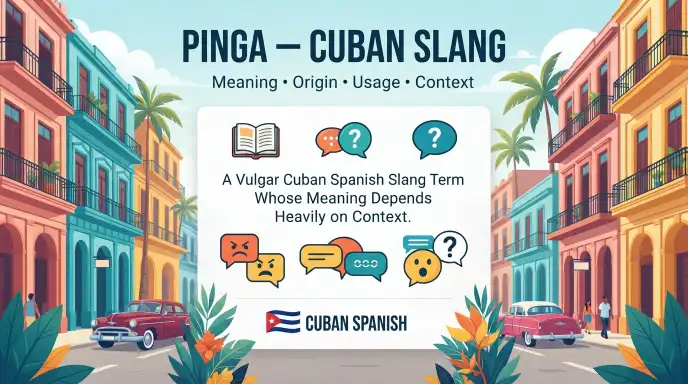
Quic”Pinga” is a versatile Cuban Spanish slang term that literally translates to a vulgar word for male anatomy, but is commonly used as an all-purpose exclamation similar to “damn” or “hell” in English.
Cuban Spanish is known for its expressive, rhythmic slang, and few words capture that spirit better than “pinga.” Despite its crude literal meaning, the term has evolved into one of the island’s most flexible expressions.
Depending on tone and context, “pinga” can convey frustration, admiration, surprise, or emphasis : making it one of the most context-dependent words in Cuban vocabulary. It’s frequently used in phrases like “qué pinga” (what the heck) or “está de pinga” (that’s awesome).
While the word is deeply embedded in everyday Cuban speech, it’s considered informal and can come across as crude in formal settings or with strangers. Understanding its nuances offers insight into Cuban culture’s bold, expressive communication style.
For travelers or language learners, knowing terms like “pinga” helps decode real conversations : but it’s a word best used carefully, and typically only among close friends.
quick Answer:
Pinga cuban slang is a vulgar Cuban Spanish word literally referring to the penis. In everyday Cuban expressions, it can also work as a strong exclamation, insult, or intensifier, depending on the phrase and situation.
What Does Pinga Cuban Slang Mean in Text?
The basic meaning of pinga in Cuban Spanish is a vulgar term for the penis. It is similar to highly informal or profane words for male genitalia in English.
However, Cuban speakers often use pinga in expressions where the literal meaning is not the main point.
For example:
- ¡Pinga! : A strong exclamation showing surprise, frustration, or shock.
- De pinga : Can describe something as excellent, impressive, difficult, terrible, or intense depending on context.
- Vete pa’ la pinga : A very rude way of telling someone to go away or leave you alone.
- Qué pinga… : Can express frustration, disbelief, or emphasis.
Therefore, when someone searches for pinga cuban slang meaning in text, they should not automatically translate every occurrence literally.
The surrounding words, relationship between speakers, tone, and situation all matter.
Pinga Cuban Slang Full Form and Definition
People sometimes search for the pinga cuban slang full form or ask, “What does pinga stand for?”
Unlike acronyms such as “LOL” or “BRB,” pinga is not a shortened phrase or abbreviation. It is a Spanish slang noun.
Its literal definition is a vulgar word for the penis.
In Cuban Spanish, however, it can become part of many idiomatic expressions. These expressions may communicate emotions rather than directly refer to anatomy.
Simple definition
Pinga: A vulgar Spanish slang term for the penis that is also widely used in Cuban informal expressions as an exclamation, insult, or intensifier.
Because it is profanity, learners should be careful about repeating it without understanding the context.
Is Pinga Rude, Offensive, or Neutral?
In most situations, pinga is vulgar.
It is not a neutral word that you would normally use in professional communication, school assignments, formal emails, or polite introductions.
Its offensiveness can vary depending on how it is used.
| Usage | Typical tone |
| Literal reference | Vulgar |
| Strong exclamation | Vulgar but sometimes casual |
| Insult toward someone | Offensive |
| Between close friends | May be playful |
| Formal workplace conversation | Inappropriate |
| Public or professional writing | Usually best avoided |
Cuban speakers may use profanity more casually than learners expect, but that does not make every use appropriate.
A word can be culturally common while still being considered rude.
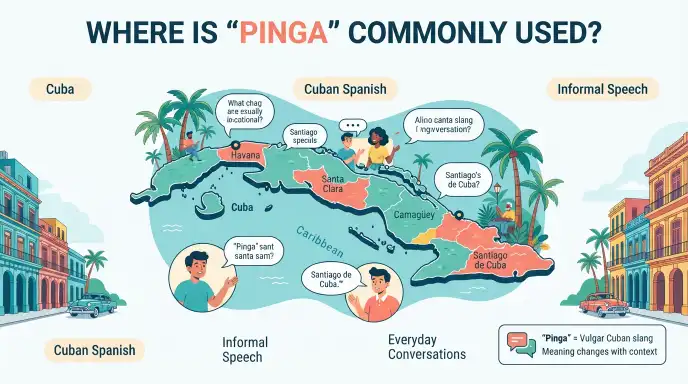
Where Is Pinga Commonly Used?
Pinga cuban slang is especially associated with informal Cuban Spanish.
You may encounter it in:
- Casual conversations
- Text messages
- Social media comments
- Cuban music
- Movies and television
- Online communities
- Jokes and memes
- Arguments
- Conversations between close friends
It is much less suitable for formal communication.
If you hear the word in a Cuban movie or song, do not assume that the speaker is literally talking about anatomy. Cuban slang frequently uses strong words figuratively.
Real-Life Examples of Pinga Cuban Slang
Context is the easiest way to understand this slang.
1. Friendly or playful context
“Ese tipo es de pinga.”
Depending on the situation, this can express strong approval or admiration, roughly similar to saying that someone is impressive, tough, or really good.
The expression is still vulgar, even when the intention is positive.
2. Surprise or frustration
“¡Pinga! Se me olvidaron las llaves.”
Here, the speaker is not literally referring to the penis. The word works as a strong exclamation expressing frustration.
A natural English equivalent might be something like “Damn!” depending on the situation.
3. Argumentative context
“Vete pa’ la pinga.”
This is a strongly offensive expression telling someone to go away or leave.
It should not be used casually with strangers because it can escalate an argument.
4. Social media context
Someone might comment:
“¡Pinga, qué golazo!”
Here, the expression can communicate excitement or amazement about an impressive goal.
5. Gaming context
A Cuban gamer might use “¡Pinga!” after losing an important round.
In this situation, it functions more like an angry or frustrated exclamation than a literal reference.
Common Cuban Expressions With Pinga
Understanding the surrounding expression is often more useful than translating the individual word.
“¡Pinga!”
Used as a strong exclamation.
Depending on tone, it can communicate:
- Surprise
- Anger
- Frustration
- Excitement
- Disbelief
“De pinga”
This is one of the most context-dependent expressions.
Depending on the speaker and situation, it can describe something as:
- Excellent
- Impressive
- Intense
- Difficult
- Awful
For example, “Está de pinga” may be understood positively or negatively depending on what is being discussed and how the speaker says it.
“Vete pa’ la pinga”
This is highly vulgar and confrontational.
It generally means something like:
- Go away.
- Get lost.
- Fuck off.
The final English equivalent is also vulgar, so it is important to recognize the intensity.
Origin and Background of Pinga
The Spanish word pinga has a long history as vulgar slang for the penis. Its use is not exclusive to Cuba, although Cuban Spanish has developed many distinctive expressions around it.
Cuban speech is particularly known for expressive, colorful slang. Historical influences on Cuban Spanish include Spanish varieties brought during colonization as well as linguistic influences from different communities that shaped Cuban culture over time.
As with many slang words, meaning can shift when a word becomes part of an idiom.
That is why pinga cuban slang cannot always be understood through a simple dictionary translation.
For example, a literal translation may tell you the anatomical meaning, but it will not necessarily explain why someone says “¡Pinga!” after receiving surprising news.
Pinga vs. Similar Slang Terms
Several Spanish vulgar expressions can refer to the penis or use sexual language as profanity. However, their regional popularity and meanings differ.
| Slang | General meaning | Common context |
| Pinga | Vulgar term for penis; also an exclamation or intensifier | Especially associated with Cuban informal speech |
| Polla | Vulgar term for penis | Common in Spain |
| Pito | Informal term for penis | Used in several Spanish-speaking regions |
| Verga | Vulgar term for penis; also used as an exclamation | Common in parts of Latin America |
| Coño | Vulgar term with many exclamatory uses | Various Spanish-speaking regions |
| Carajo | Strong exclamation or profanity | Widespread across Latin America |
These words are not perfect equivalents.
Regional Spanish is extremely diverse, so a word that sounds normal or familiar in one country can sound unusual or much stronger somewhere else.
When Should You Avoid Using Pinga?
If you are learning Cuban Spanish, it is usually better to understand this word before trying to use it.
Avoid using it when:
- Speaking to your employer
- Writing a formal email
- Talking to a customer
- Meeting someone for the first time
- Speaking with children
- Giving a formal presentation
- Writing an academic assignment
- Communicating with someone whose preferences you do not know
Even if you hear native speakers using the expression casually, your relationship with the listener matters.
A close friend may understand it as joking or expressive language. A stranger may interpret the same words as disrespectful.
Polite Alternatives to Pinga
If you want to express the same emotion without profanity, there are safer alternatives.
For surprise or frustration, depending on the situation, you can use expressions such as:
- ¡Ay!
- ¡Vaya!
- ¡Qué sorpresa!
- ¡Dios mío!
- ¡No puede ser!
- ¡Qué problema!
In English, alternatives might include:
- “Wow!”
- “Damn!”
- “Oh no!”
- “Seriously?”
- “That’s intense!”
- “I can’t believe it!”
The best replacement depends on if you are trying to sound surprised, annoyed, amused, or impressed.
Why Do People Use Pinga Cuban Slang?
People use strong slang for many of the same reasons English speakers use profanity.
1. Emotional expression
Profanity can make emotions sound stronger.
2. Informal identity
Slang can help speakers sound relaxed and familiar with a particular community.
3. Humor
Among friends, vulgar expressions can become part of jokes and playful conversations.
4. Emphasis
A strong slang word can make an opinion sound more intense.
5. Cultural expression
Cuban slang is an important part of informal speech and popular culture.
However, using slang does not automatically make someone sound more authentic. Using a regional expression incorrectly can sometimes sound unnatural or inappropriate.
Impact of Using Pinga in Communication
The effect of pinga cuban slang depends almost entirely on context.
With close friends, it may create a humorous or informal tone.
During an argument, however, it can make the conversation much more aggressive.
Online, there is another problem: you cannot always hear the speaker’s tone. A phrase intended as a joke may look genuinely offensive in a text message.
This is especially important when communicating with people from different Spanish-speaking countries.
A Cuban speaker may understand a phrase differently from a Spanish learner or someone from another Spanish-speaking region.
Is Pinga Safe for Social Media?
You can encounter pinga on social media, particularly in informal Cuban-language content, memes, comments, music discussions, and jokes.
However, “safe” depends on what you mean.
From a communication perspective, it is not universally safe or polite because it is vulgar language.
From a platform perspective, if a particular post is allowed depends on the platform’s current rules and the surrounding content. A word appearing in a casual conversation is different from targeted harassment, sexual content, or abusive behavior.
If you are creating professional content, educational material, or brand posts, a less offensive alternative is usually the better choice.
How to Understand Pinga in a Text Message
When you see pinga in a message, follow these steps:
Step 1: Look at the entire sentence
Do not translate the word by itself.
Step 2: Check the surrounding expressions
Words such as de, pa’, or other slang can change the meaning.
Step 3: Consider the relationship
Is the speaker talking to a close friend, stranger, or someone they are arguing with?
Step 4: Consider the emotion
Does the message sound excited, angry, joking, surprised, or insulting?
Step 5: Look for regional context
Cuban Spanish has expressions that may not carry exactly the same meaning elsewhere.
This approach will help you understand what does pinga stand for in the practical sense: it is not an acronym, but a vulgar word whose meaning can change considerably when used idiomatically.
Pinga Cuban Slang: Common Meanings at a Glance
| Expression | Possible meaning | Tone |
| Pinga | Vulgar reference to penis | Vulgar |
| ¡Pinga! | Damn!/Wow!/strong reaction | Vulgar |
| De pinga | Very good, intense, difficult, or bad depending on context | Vulgar/informal |
| Vete pa’ la pinga | Go away/get lost | Very offensive |
| Qué pinga… | Strong emphasis, frustration, or disbelief | Vulgar |
Remember that translations are approximate. Tone and context can change the intended meaning.
FAQs
Q1: What does “cara pinga” mean?
“Cara pinga” is a crude Cuban insult that combines “cara” (face) with the vulgar term “pinga,” roughly translating to calling someone a “dickhead” or similar insult in English. It’s used to express strong irritation or disrespect toward someone and is considered highly offensive : best avoided in polite or formal conversation.
Q2: What does “mi pinga” mean?
“Mi pinga” literally translates to a vulgar reference to male anatomy, but as an expression, it’s used similarly to saying “my ass” or “yeah, right” in English : often as a sarcastic way to dismiss or reject something someone just said. It’s an informal, vulgar phrase typically used only among close friends in casual settings
3. What does “de pinga” mean?
De pinga is a highly informal Cuban expression whose meaning depends on context. It can describe something as excellent, impressive, intense, difficult, or negative.
4. What does “vete pa’ la pinga” mean?
It is a strongly vulgar way of telling someone to go away or get lost. It can be highly offensive during an argument.
Conclusion
Pinga cuban slang is a good example of why slang cannot always be translated word for word. Its literal meaning is a vulgar reference to the penis, but in Cuban informal speech, pinga can appear in expressions that communicate surprise, frustration, excitement, admiration, anger, or insult.
The most important thing is context. “¡Pinga!” can function as a strong exclamation, while “de pinga” can have different meanings depending on the situation. Meanwhile, expressions such as “vete pa’ la pinga” are considerably more aggressive and should be treated as offensive language.
If you are learning Cuban Spanish, understanding these differences will help you interpret conversations, text messages, music, memes, and social media more accurately. At the same time, it is wise to avoid using pinga in formal or unfamiliar situations. When in doubt, choose a neutral expression and pay attention to how native speakers use the word.
Ultimately, knowing the pinga cuban slang meaning in text is less about memorizing one translation and more about understanding Cuban language, tone, and cultural context.
Related Articles!

I am Ann Raimes, an applied linguist and English language educator. I am widely recognized for my contributions to writing pedagogy and research in ESL writing. I have authored several well-known books, including Techniques in Teaching Writing, Keys for Writers, and How English Works: A Grammar Handbook with Readings. Throughout my career, I have worked to promote communicative writing and the process-based approach to teaching writing, helping both teachers and learners develop effective writing skills.