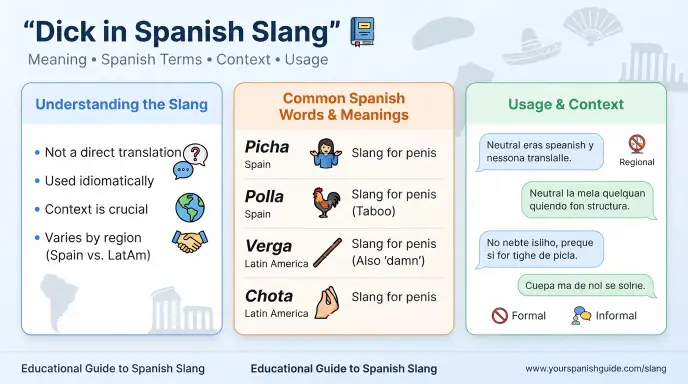
“Dick” in Spanish slang usually translates to informal or vulgar terms like “pito,” “verga,” or “pinga,” depending on the region.
When people search for “dick in Spanish slang,” they’re often trying to understand how the word is casually or crudely translated in everyday conversation. Spanish, like English, has multiple slang terms for male anatomy that vary widely by country and context.
Common informal terms include “pito,” “verga,” “pinga,” and “chile,” each carrying different levels of vulgarity depending on the region. For example, “verga” is widely used in Mexico, while “pinga” is more common in Caribbean Spanish-speaking countries like Cuba and Puerto Rico.
These slang terms are rarely used in formal writing or polite conversation, and are instead found in casual texting, memes, or informal speech among friends. Understanding regional differences is key, since a word considered mild in one country might be highly offensive in another.
This guide breaks down the most common Spanish slang terms for “dick,” their regional usage, and the context in which they typically appear in text messages or online conversations : helping you understand tone, vulgarity level, and appropriate usage.
Quick Answer:
Depending on context, “dick” can refer to the male penis or be used as an insult for an unpleasant person. Common Spanish equivalents include pene for the anatomical meaning and various regional vulgar expressions for the insulting meaning.
What Does Dick in Spanish Slang Mean?
When someone searches for dick in Spanish slang, they may be asking about two different meanings.
The first is the literal anatomical meaning. In standard Spanish, the neutral word is pene, meaning penis.
The second is the insulting meaning. In English, calling someone a “dick” can mean that the person is being rude, selfish, irritating, or unpleasant.
Spanish does not translate this insulting sense with one universal word. Instead, different countries and communities use different expressions.
Literal Meaning
When “dick” refers to male anatomy, the neutral Spanish translation is:
pene = penis
Other informal or vulgar terms may exist, but they are not interchangeable in every situation.
Insulting Meaning
When “dick” means an unpleasant person, the appropriate Spanish word depends on the intended tone.
Possible equivalents may communicate ideas such as:
- jerk
- idiot
- asshole
- rude person
- unpleasant person
Some Spanish expressions are considerably more vulgar than others, so using a direct slang equivalent without knowing the regional context can cause offense.
Dick in Spanish Slang: Full Meaning and Definition
Unlike an abbreviation, “dick” does not have a full form. It is an English word with both literal and figurative uses.
Its two major meanings are:
| English Use | General Meaning | Spanish Equivalent |
| Anatomical | Male penis | Pene |
| Insult | An unpleasant or rude person | Depends on regional slang |
| Casual/vulgar | Informal reference to anatomy | Depends on expression |
| Figurative | Someone behaving badly | Regional equivalent |
This distinction is important for anyone searching dick meaning slang or asking what does dick stand for.
The answer is not simply one Spanish word because the English word itself has multiple meanings.
Is Dick Rude, Offensive, or Neutral?
The word dick is generally considered vulgar or informal when referring to male anatomy.
As an insult, it is also rude.
However, the strength of the word depends on the situation.
In a Medical Context
A neutral Spanish term such as pene is appropriate when discussing anatomy, medicine, education, or health.
In Casual Conversation
English speakers may use “dick” informally among friends, but it remains vulgar.
As an Insult
Calling someone “a dick” usually expresses strong annoyance or disapproval.
Spanish equivalents can range from mildly insulting to highly vulgar.
| Situation | Tone | Recommended Approach |
| Medical discussion | Neutral | Use anatomical terminology |
| Educational content | Neutral | Use formal terminology |
| Friends joking | Informal | Depends on relationship |
| Argument | Offensive | Avoid vulgar expressions |
| Professional setting | Inappropriate | Use polite language |
Where Is Dick in Spanish Slang Commonly Discussed?
The phrase dick in Spanish slang is most often encountered in online searches rather than as a fixed Spanish expression.
People may search for it because they:
- are learning Spanish
- saw a Spanish insult online
- want to translate an English phrase
- encountered Spanish slang in a movie or song
- saw a comment on social media
- are communicating with Spanish-speaking friends
- want to understand regional differences
Spanish is spoken across many countries, and slang differs significantly between regions.
For this reason, there is no single “Spanish slang dictionary answer” that works perfectly everywhere.
Real-Life Examples of Usage
Understanding the difference between literal and figurative meanings makes translation much easier.
Friendly or Educational Context
“The article uses the word ‘dick’ to discuss informal English vocabulary.”
Here, the word is being discussed rather than directed at someone.
A neutral Spanish translation would normally use pene when the anatomical meaning is intended.
Casual Context
“He was acting like a dick.”
This does not necessarily mean anything anatomical. It means the person was behaving badly.
A natural Spanish translation would depend on the country and could use a regional equivalent for “jerk” or “idiot.”
Argumentative Context
“Don’t be a dick.”
Here, the speaker is criticizing someone’s behavior.
The best Spanish equivalent should communicate the insulting tone, rather than translating the anatomical meaning.
Social Media Context
“Why is everyone calling him a dick?”
The word here is being used as an insult.
A translator should look at the sentence before choosing a Spanish equivalent.
Gaming Context
“That player was being a dick.”
This usually means the player was behaving badly, being disrespectful, or deliberately annoying others.
Again, the intended meaning is figurative, not anatomical.
Origin and Background of the Word Dick
The English word dick has a long linguistic history and has not always had its modern vulgar meanings.
“Dick” became widely used historically as a nickname for Richard. English also developed the word as informal slang for a man or person.
Over time, “dick” developed additional meanings, including the vulgar anatomical sense and its use as an insult.
This is an example of how slang develops gradually. Words can acquire new meanings through:
- everyday speech
- nicknames
- humor
- insults
- popular culture
- regional language
- social groups
The modern insulting use of “dick” is therefore part of a much longer history of English informal vocabulary.
Spanish Equivalents Depend on the Meaning
One of the biggest translation mistakes is assuming that every English slang word has one exact Spanish equivalent.
For “dick,” the correct choice depends on what the speaker means.
If It Means the Anatomy
Use the neutral Spanish word:
pene
If It Means an Insult
Choose a Spanish expression that matches the intended idea, such as:
- jerk
- idiot
- rude person
- unpleasant person
A more vulgar regional equivalent may exist, but it should only be used when the context and audience are understood.
Comparison With Similar English Slang
Several English words are related to “dick,” but they do not always have identical meanings.
| English Term | General Meaning | Tone |
| Dick | Penis or unpleasant person | Vulgar |
| Jerk | Rude or unpleasant person | Mild to moderate |
| Idiot | Foolish person | Insulting |
| Asshole | Very unpleasant person | Strong/vulgar |
| Dude | Man/person | Casual, usually neutral |
This table demonstrates why translating “dick” as one fixed Spanish word can produce an unnatural result.
Dick vs. Penis vs. Jerk
These words may overlap in some contexts, but they are not interchangeable.
| Word | Meaning | Typical Use |
| Penis | Male anatomical organ | Medical/neutral |
| Dick | Vulgar anatomical slang or insult | Informal |
| Jerk | Unpleasant person | Informal insult |
| Rude | Poor behavior or manners | Neutral/formal |
| Idiot | Someone behaving foolishly | Insult |
For a medical or educational article, penis is the appropriate neutral term. For an informal insult, the translation should focus on the person’s behavior.
Spanish Slang Varies by Country
A major issue with translating dick in Spanish slang is regional variation.
Spanish-speaking countries have their own vocabulary, expressions, and levels of vulgarity.
For example, an expression that is common in one country may be:
- unfamiliar somewhere else
- stronger than expected
- humorous in another region
- offensive in a different context
This is why professional translation focuses on meaning and audience, not just individual words.
Important Factors
Before using a Spanish slang equivalent, consider:
- Country
- Region
- Age group
- Relationship between speakers
- Formality
- Conversation topic
- Intended tone
When Should You Avoid Using Dick in Spanish Slang?
If you are not familiar with regional Spanish slang, avoid directly copying a vulgar expression from a translation website or social media post.
Be especially careful in:
- workplaces
- schools
- professional emails
- public announcements
- customer service
- formal conversations
- conversations with strangers
Even if an expression is technically understandable, it may sound much stronger than you intended.
Polite Alternatives
If your goal is to describe someone’s behavior without using vulgar language, there are many better options.
Instead of an insulting slang expression, you can say:
- rude
- unpleasant
- disrespectful
- inconsiderate
- unkind
- difficult
- selfish
- annoying
For the anatomical meaning, use the neutral term pene when Spanish is appropriate.
Choosing a neutral term is especially useful in educational, medical, and professional writing.
Why Do People Use This Slang?
People use vulgar slang for several reasons.
To Express Anger
An insulting slang term can communicate strong frustration.
To Sound Casual
Friends sometimes use vulgar vocabulary because it feels less formal.
For Humor
Slang can be used jokingly between people who know each other well.
To Show Emotion
Strong informal words can communicate annoyance, surprise, or disbelief.
Because of Online Culture
Social media, gaming, movies, music, and memes spread slang quickly across languages and cultures.
However, popularity online does not mean a word is appropriate everywhere.
Impact of Slang on Communication
Slang can make communication more expressive, but it can also create misunderstandings.
This is particularly true when translating between English and Spanish.
A literal translation may preserve the dictionary meaning while completely losing the intended tone.
For example, an English speaker using “dick” as an insult is not necessarily talking about anatomy. Translating it literally could make the Spanish sentence sound strange.
Good translation considers:
- Meaning
- Tone
- Context
- Audience
- Regional language
This approach produces much more natural communication.
Is Dick in Spanish Slang Safe for Social Media?
The phrase dick in Spanish slang is not itself a harmful expression, but the word “dick” is vulgar and can be inappropriate depending on the platform and audience.
When creating social media content, consider whether the audience includes:
- children
- students
- professional readers
- international audiences
- people unfamiliar with slang
For educational content, it is often better to explain the term rather than use vulgar expressions unnecessarily.
Social Media Tips
- Explain slang in context.
- Avoid directing insults at individuals.
- Use neutral language when possible.
- Consider your audience.
- Be aware of regional Spanish differences.
- Do not assume a slang term has the same strength everywhere.
Common Mistakes When Translating Dick Into Spanish
Mistake 1: Using One Translation for Every Situation
The anatomical meaning and insulting meaning are different.
Mistake 2: Ignoring Regional Slang
Spanish vocabulary varies across countries.
Mistake 3: Using Vulgar Language in Formal Situations
A slang expression may sound disrespectful in professional communication.
Mistake 4: Translating Word-for-Word
Literal translation does not always preserve tone.
Mistake 5: Assuming Online Slang Is Universal
A term popular on one platform may not be familiar to everyone.
How to Choose the Right Spanish Translation
When you encounter “dick” in English, ask yourself what the speaker actually means.
Step 1: Identify the Meaning
Is it referring to anatomy or someone’s behavior?
Step 2: Identify the Tone
Is the speaker being serious, humorous, angry, or insulting?
Step 3: Consider the Audience
Are they friends, strangers, coworkers, or students?
Step 4: Consider Regional Spanish
A natural expression in Mexico may not be the most natural expression in Spain, Argentina, Colombia, or another Spanish-speaking region.
Step 5: Choose Neutral Language When Unsure
If there is any doubt, a polite description such as “rude” or “unpleasant” is safer than guessing a vulgar regional expression.
FAQs:
What is “dick” in Spanish slang?
There is no single Spanish slang equivalent for every use of “dick.” Pene is the standard neutral term for the anatomical meaning, while the insulting meaning requires a context-appropriate Spanish expression.
What does dick mean as an insult?
As an insult, “dick” generally describes someone who is being rude, selfish, unpleasant, or disrespectful. The appropriate Spanish translation depends on the desired tone and region.
What does dick stand for?
“Dick” is not an abbreviation, so it does not have a standard full form. It is an English word with both literal and figurative meanings.
Is dick a bad word?
“Dick” is generally considered vulgar or offensive when used as slang, particularly when used to insult someone. Its acceptability depends on the context.
What is the polite Spanish word for dick?
For the anatomical meaning, pene is the standard neutral Spanish word. It is appropriate in medical, educational, and formal contexts.
Does Spanish have different slang words for dick?
Yes. Spanish-speaking regions have various informal and vulgar expressions. Their meanings and levels of offensiveness can differ considerably, so regional context matters.
Conclusion:
Dick in Spanish slang can refer to two very different ideas: a vulgar English term for the male anatomy or an insult describing someone who is rude, selfish, or unpleasant.
For the neutral anatomical meaning, pene is the standard Spanish term. When “dick” is being used as an insult, there is no single universal Spanish replacement. The best translation depends on the speaker’s intention, the country or region, and the level of formality.
If you are researching dick meaning slang, dick in Spanish, or what does dick stand for, always examine the complete sentence instead of translating the word in isolation.
The key lesson is simple: context matters more than a direct word-for-word translation. Understanding tone, regional usage, and audience will help you choose language that is accurate, natural, and appropriate.
Further Reading!

I am Ann Raimes, an applied linguist and English language educator. I am widely recognized for my contributions to writing pedagogy and research in ESL writing. I have authored several well-known books, including Techniques in Teaching Writing, Keys for Writers, and How English Works: A Grammar Handbook with Readings. Throughout my career, I have worked to promote communicative writing and the process-based approach to teaching writing, helping both teachers and learners develop effective writing skills.