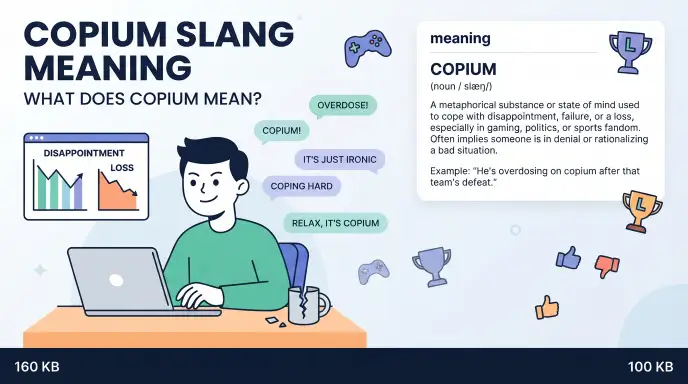
Copium is internet slang that combines “cope” and “opium,” used to mock someone who is in denial or making excuses to feel better about a disappointing situation.
If you’ve seen the word “copium” trending on Reddit, Twitter, or gaming forums and wondered what it means, you’re in the right place. This witty internet slang term has taken online culture by storm.
Copium is often used humorously or sarcastically to call out someone who’s clearly in denial. It blends real emotion with internet humor, making it a favorite among meme creators.
Understanding copium slang meaning helps you make sense of online debates, sports discussions, and meme culture where the term is used frequently. It’s especially popular in gaming and political discourse.
In this article, we’ll explain exactly what copium means, where it came from, and how people use it in everyday online conversations : so you’re never confused when you see it again
Quick Answer:
Copium is internet slang for a humorous form of coping with disappointment by making excuses, staying unrealistically hopeful, or convincing yourself that a bad situation is not as bad as it seems.
What Does Copium Mean in Text?
Simple Definition of Copium Slang
The copium slang meaning is closely connected to the idea of “coping.” It describes the mental or emotional process of trying to deal with an unpleasant reality, especially by convincing yourself that things will somehow turn out better.
The word is commonly used as a joke.
For example:
“Our team lost 5–0, but he’ll probably say they were just saving energy. That’s pure copium.”
In this example, “copium” suggests that the person is creating an excuse to feel better about the loss.
Another example is:
“The game is definitely getting a huge update next week. Trust me.”
If there is no evidence for the claim, someone might respond:
“Pass the copium.”
The phrase jokingly suggests that the person is using unrealistic hope to handle disappointment.
Copium Full Form and Meaning
What Does Copium Stand For?
Unlike abbreviations such as “LOL” or “BRB,” copium is not really a traditional acronym.
The word is a playful combination of:
COPE + OPIUM = COPIUM
“Cope” refers to dealing with a difficult situation, while “opium” is used metaphorically to create the image of something that provides temporary relief.
Therefore, the copium full form is best understood as a wordplay rather than an official expanded abbreviation.
In internet culture, copium usually means false comfort, denial, excuses, or unrealistic optimism used to deal with an unwanted outcome.
| Term | Meaning | Typical Situation |
| Copium | Unrealistic or exaggerated coping | Someone refuses to accept a bad result |
| Cope | Deal with a difficult situation | Someone tries to handle disappointment |
| Hopium | Unrealistic or excessive hope | Someone expects an unlikely positive outcome |
The exact tone depends on how the word is used.
Is Copium Rude, Offensive, or Neutral?
Understanding the Tone of Copium
Copium is generally informal and humorous, but it can sometimes be insulting.
When friends use it with each other, it is often harmless teasing.
For example:
“You still think we’re making the playoffs? That’s some serious copium 😂.”
The speaker is probably joking.
However, saying:
“You’re just coping. Stop using copium.”
during a serious argument can sound dismissive.
Copium is therefore best described as mildly mocking internet slang rather than an offensive swear word.
| Tone | Example | Likely Effect |
| Friendly | “That’s some copium, bro 😂” | Playful teasing |
| Casual | “I’m on copium right now.” | Self-deprecating humor |
| Sarcastic | “Sure, keep drinking the copium.” | Mocking |
| Argumentative | “Your whole argument is copium.” | Dismissive |
| Serious/Formal | “The customer is displaying copium.” | Unnatural/inappropriate |
Context is extremely important.
Where Is Copium Commonly Used?
Popular Online Places for Copium
Copium is mainly found in internet communities where people discuss outcomes, predictions, competition, entertainment, or controversial opinions.
Common places include:
- Gaming communities
- YouTube comments
- Reddit discussions
- Discord servers
- TikTok comments
- X or other social-media discussions
- Sports communities
- Esports communities
- Meme pages
- Fan communities
Gaming is one of the environments where copium is especially easy to understand.
Imagine a player loses a match and says:
“The other player only won because of luck. I would win every other time.”
A friend might respond:
“Maximum copium.”
The expression does not necessarily mean the person is actually lying. It often means they are making excuses because they do not want to accept the result.
Real-Life Examples of Copium Slang
Friendly Example
“You really think she’ll text you back after three months? 😂”
“Let me have my copium.”
Here, the person jokingly admits that they are holding onto unrealistic hope.
Casual Example
“The update isn’t coming this year.”
“Nah, the developers are probably waiting for the perfect moment.”
“Bro is running on copium.”
This is casual teasing between people discussing a game.
Argumentative Example
“Your favorite team only lost because the referee was biased.”
“That’s pure copium.”
Here, the speaker is suggesting that the other person’s explanation is an excuse rather than a reasonable argument.
Gaming Example
“We lost the first two rounds, but we’re still winning this match.”
“That’s some serious copium.”
The phrase is used humorously to describe confidence that may not be supported by the current situation.
Sports Example
“Our team lost three games in a row, but we’re definitely winning the championship.”
“The copium is strong today.”
This usage is common among sports fans who joke about their team’s chances.
Social Media Example
“They haven’t announced the sequel yet, but I know it’s coming tomorrow.”
Someone may reply:
“Pass the copium.”
This means, humorously, “Give me some of that unrealistic optimism too.”
Origin and Background of Copium
Where Did the Word Copium Come From?
Copium is an internet-created word that combines “cope” with “opium.” The construction is designed as a joke: coping with an unpleasant reality is compared metaphorically to consuming something that provides relief.
The expression became associated with online meme culture and communities where people frequently argued about disappointing outcomes, especially gaming, sports, politics, and entertainment.
A widely recognized visual representation of copium is the “COPIUM” gas mask meme, which became popular online as a humorous symbol of people trying to survive disappointment through excuses or unrealistic hope.
The term became increasingly common during the late 2010s and early 2020s as internet communities spread slang rapidly across platforms.
Because internet slang evolves quickly, there is no single universally agreed moment when everyone began using copium. Its popularity grew organically through memes, livestream chats, gaming communities, and social media.
Copium vs. Similar Internet Slang
How Copium Differs From Cope and Hopium
Copium is closely related to several other internet expressions.
| Slang | Meaning | Example |
| Copium | Humorous or unrealistic coping | “He’s on copium after that loss.” |
| Cope | Attempting to deal with a bad reality | “Just cope with the result.” |
| Hopium | Excessive or unrealistic hope | “There’s still a 1% chance:we’re on hopium.” |
| Denial | Refusing to accept reality | “He’s in denial about the result.” |
| Excuse | Reason given to explain a failure | “That’s just an excuse.” |
Although these terms overlap, they are not exactly the same.
Cope is the broadest word.
Copium usually adds a humorous or mocking internet tone.
Hopium focuses more specifically on unrealistic hope.
Copium vs. Hopium
Understanding the Difference
Copium and hopium are often used together, but there is an important distinction.
Copium is usually connected to dealing with a bad result.
Hopium is more focused on believing that a positive outcome will happen despite weak evidence.
For example:
“We lost the match, but I’ll keep saying the next one will be different.”
This could be called copium because the person is coping with the loss.
Meanwhile:
“We’re going to win the championship even though we’re currently last.”
could be described as hopium because the focus is unrealistic hope.
| Feature | Copium | Hopium |
| Main idea | Coping with disappointment | Holding onto hope |
| Common emotion | Disappointment | Hope |
| Typical use | After something goes wrong | Before an expected outcome |
| Tone | Often mocking | Often humorous |
| Example | “He’s using copium after losing.” | “We’re surviving on hopium.” |
Both words are informal internet slang.
When Should You Avoid Using Copium?
Situations Where It May Not Work
Copium is best suited to informal conversations.
You should generally avoid using it in:
- Formal emails
- Academic writing
- Business reports
- Job applications
- Professional presentations
- Official documents
- Serious personal discussions
For example, writing:
“The customer is using copium about the failed project.”
would sound strange in a professional report.
A clearer alternative would be:
“The customer appears to be struggling to accept the outcome.”
Similarly, if someone is genuinely upset about a serious problem, calling their feelings “copium” may come across as insensitive.
The slang works best when everyone understands that the conversation is humorous.
Polite Alternatives to Copium
Better Words for Formal or Sensitive Situations
If you want to communicate the same general idea without internet slang, you can use:
- Unrealistic optimism
- Denial
- Wishful thinking
- Excuse-making
- Rationalization
- Self-comfort
- Refusing to accept reality
- Trying to stay hopeful
For example:
Slang:
“You’re on copium.”
Neutral:
“You might be trying to find reasons to feel better about the situation.”
Polite:
“I think you’re being a little too optimistic about the outcome.”
The polite version is especially useful when discussing something serious.
Why Do People Use Copium?
Reasons Behind the Slang
People use copium because it expresses a complicated idea in one short, memorable word.
Instead of saying:
“You are trying to make yourself feel better by creating explanations that may not be realistic.”
someone can simply say:
“That’s copium.”
The word is also funny because of its unusual construction.
People use it to:
- Joke about disappointment
- Tease friends
- Mock unrealistic predictions
- Describe their own denial
- Make memes
- Express exaggerated optimism
- React to losses
- Keep online conversations entertaining
One of the most interesting aspects of copium is that people often use it about themselves.
For example:
“I know there’s almost no chance, but let me have my copium.”
This makes the word less aggressive because the speaker is openly admitting that their optimism may not be realistic.
The Impact of Copium in Communication
How Context Changes the Meaning
Internet slang can make communication faster and more entertaining, but it can also create misunderstandings.
Calling someone “copium” may be funny in a gaming chat but offensive in a serious conversation.
For example:
“I’m sure everything will work out.”
A friend might jokingly respond:
“Copium 😂.”
The comment may simply mean, “You’re being overly optimistic.”
But if someone is discussing a serious personal problem, the same response could seem insensitive.
| Situation | Use of Copium | Recommended? |
| Gaming with friends | Humorous | Yes |
| Sports debate | Playful | Usually |
| Meme discussion | Common | Yes |
| Casual group chat | Informal | Usually |
| Serious emotional conversation | May seem dismissive | Avoid |
| Professional setting | Too informal | Avoid |
This is why understanding the audience matters as much as understanding the word itself.
Is Copium Safe for Social Media?
Using Copium Online
Yes, copium is generally safe for casual social media use.
It is not normally a profanity or a harmful expression. It is primarily internet slang used for humor, teasing, and commentary.
You may encounter it in memes, gaming videos, livestream chats, sports discussions, and comment sections.
However, safe does not always mean appropriate.
Avoid using copium to mock someone who is dealing with grief, serious failure, mental-health struggles, or another sensitive situation.
A useful rule is:
If the conversation is playful, copium is usually fine. If the conversation is serious, choose clearer and more respectful language.
Common Mistakes About Copium:
Mistake 1: Thinking Copium Is a Medical Term
Copium is not a standard medical treatment or official medical substance. It is internet slang created as wordplay.
Mistake 2: Thinking It Always Means Lying
Someone described as being on copium may not intentionally be lying. They may simply be overly optimistic or looking for a comforting explanation.
Mistake 3: Using It in Formal Writing
Copium is informal internet language and usually does not belong in professional or academic writing.
Mistake 4: Confusing Copium With Hopium
The two terms are related, but copium generally emphasizes coping with disappointment, while hopium emphasizes unrealistic hope.
FAQs:
What does copium mean in slang?
Copium is internet slang for unrealistic or exaggerated coping with a disappointing situation. It often describes excuses, denial, or optimism used to feel better about an unwanted outcome.
What is the copium full form?
Copium is not a traditional acronym. It is a wordplay combination of “cope” and “opium.” The word humorously describes something that provides emotional comfort when someone is dealing with disappointment.
Is copium a bad word?
No. Copium is generally not considered a swear word or offensive term. However, it can sound mocking or dismissive when directed at someone during a serious conversation.
What does “I’m on copium” mean?
“I’m on copium” usually means “I know I may be coping or being unrealistic, but I am still holding onto this belief because it makes me feel better.”
What is the difference between copium and hopium?
Copium focuses on coping with an unpleasant reality, while hopium focuses on holding onto unrealistic or excessive hope.
Is copium safe to use on social media?
Yes. Copium is generally safe for casual social-media conversations. However, it should be avoided when discussing serious or sensitive situations where joking about someone’s coping could be hurtful.
Final Thoughts:
The copium slang meaning is simple once you understand the context. It describes a humorous way of coping with disappointment, often by making excuses, refusing to accept an unfavorable result, or holding onto unrealistic optimism.
The term is formed from “cope” and “opium” and became popular through internet meme culture, gaming communities, sports discussions, and social media.
For example, if a person insists their team will win the championship immediately after a terrible loss, someone might jokingly say:
“That’s some serious copium.”
Copium can be playful, sarcastic, or mildly insulting depending on the situation. It is usually safe for casual online conversations, but it is not suitable for formal writing or sensitive discussions.
The easiest way to remember the copium meaning slang is:
Copium = using excuses, denial, or unrealistic optimism to cope with disappointment.
Understanding the audience and tone is the key to using it correctly. When chatting with friends or participating in online communities, copium can be a funny and expressive piece of internet slang. In professional or serious conversations, however, clearer words such as denial, wishful thinking, rationalization, or unrealistic optimism are usually better choices.
Knowledge Hub!

I am Ann Raimes, an applied linguist and English language educator. I am widely recognized for my contributions to writing pedagogy and research in ESL writing. I have authored several well-known books, including Techniques in Teaching Writing, Keys for Writers, and How English Works: A Grammar Handbook with Readings. Throughout my career, I have worked to promote communicative writing and the process-based approach to teaching writing, helping both teachers and learners develop effective writing skills.