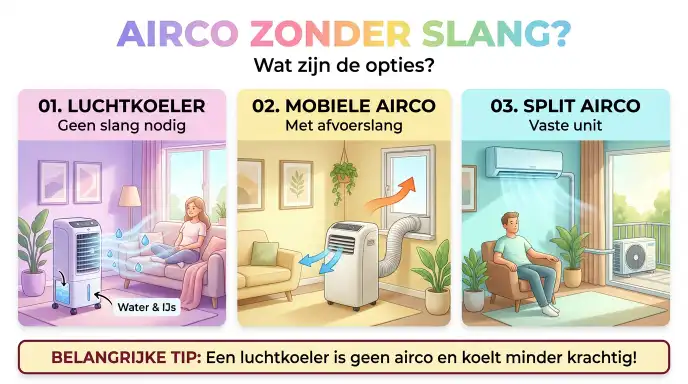
“Airco zonder slang” is Dutch for an air conditioner without a hose, and it usually means a cooling device that does not need a pipe to push hot air out of the window.
The word “slang” in Dutch means hose, not slang as in informal language. So an airco zonder slang is simply a cooler or air conditioner that skips the exhaust hose used by standard portable units.
Most hose-free options are evaporative air coolers, which cool the air with water instead of a full refrigeration system. They work best in dry climates, use less power, and are easy to move, but they cool less strongly than a real airco.
If you need strong cooling, a real air conditioner still needs a way to release heat. That is why split units, window units, and hose models are better for hot, humid rooms, while hose-free coolers suit small spaces and light use.
This guide explains what airco zonder slang means, how hose-free cooling works, and who should buy it. You will also find simple comparisons and tips so you can choose the right option and avoid common mistakes.
Quick Answer:
An airco zonder slang is a cooling device that operates without a traditional exhaust hose. Most hose-free models are evaporative air coolers or fans, while true air conditioners generally need a way to release heat outside.
What Does Airco Zonder Slang Mean?
The phrase airco zonder slang comes from Dutch:
- Airco: Air conditioner or air conditioning.
- Zonder: Without.
- Slang: Hose or flexible tube.
Together, the phrase means an air conditioner without a hose.
Traditional portable air conditioners usually have an exhaust hose connected to a window. This hose carries hot air from the room to the outside. A hose-free cooling device does not require this type of connection.
However, the term can describe different products. Some are designed to cool people by moving air, while others use water evaporation to create a cooling effect.
The most important thing to understand is that a fan, an evaporative cooler, and a real air conditioner do not provide the same results.
How Does an Air Conditioner Without a Hose Work?
A hose-free cooling device can work in several ways. The exact method depends on the type of product.
1. Evaporative Cooling
Many products advertised as air conditioners without hoses are evaporative coolers.
These devices draw warm air through a water-soaked filter or cooling pad. As water evaporates, it absorbs some heat from the air. The device then blows the cooled air into the room.
Some models include a water tank or ice compartment.
Advantages:
- No traditional exhaust hose.
- Usually simple to operate.
- Often uses less electricity than a compressor-based air conditioner.
- Can be moved between rooms.
Limitations:
- Adds moisture to the air.
- Works best in dry conditions.
- Does not provide the same cooling power as a traditional air conditioner.
2. Fan-Based Cooling
Some hose-free devices are simply advanced fans. They circulate air around a room and create a cooling sensation on your skin.
They do not actually remove heat from the room. Instead, moving air helps sweat evaporate from your skin, making you feel cooler.
These products are generally affordable and easy to maintain.
3. Fixed Air Conditioning Without a Portable Hose
A fixed split air conditioner does not need a flexible exhaust hose running through a window. Instead, it has an indoor unit and an outdoor unit connected through refrigerant pipes and other installation connections.
The outdoor unit releases heat outside the building.
This is a genuine air-conditioning system, but it still requires an outdoor installation and a connection between the units.
Types of Airco Zonder Slang:
Before choosing a hose-free cooling device, it helps to understand the main options.
Portable Air Cooler
A portable air cooler uses water evaporation to cool the air passing through it. It usually has a water tank and can be moved around easily.
It is suitable for people who want a simple cooling solution without permanent installation.
Tower Fan
A tower fan has a slim design and circulates air vertically through a room. Some models include additional features such as remote controls, timers, and different speed settings.
A tower fan does not lower the actual room temperature, but it can improve comfort.
Air Cooler With Ice Compartment
Some evaporative coolers allow users to add ice packs or cold water to the tank. This may provide a temporary cooling boost, although it does not turn the device into a traditional air conditioner.
Split Air Conditioner
A split air conditioner uses an indoor and outdoor unit to transfer heat outside. It offers genuine room cooling without a portable exhaust hose.
However, professional installation is normally required.
Airco Zonder Slang vs. Traditional Air Conditioner:
Both options can improve comfort, but they work differently.
| Feature | Airco zonder slang (air cooler) | Traditional portable air conditioner |
| Exhaust hose | Usually not required | Usually required |
| Cooling method | Water evaporation | Refrigeration cycle |
| Room temperature | Limited reduction | Can lower room temperature |
| Humidity | Usually increases | Usually removes moisture |
| Installation | Generally simple | Window exhaust setup needed |
| Best environment | Dry conditions | Different climates and humidity levels |
A traditional portable air conditioner is generally the better choice when your main goal is to reduce the actual temperature of an entire room.
An evaporative cooler may be more suitable when you want direct, gentle cooling in a dry environment.
Benefits of an Airco Zonder Slang:
A hose-free cooling device offers several practical benefits.
No Exhaust Hose Needed
One of its biggest advantages is that you do not need to connect a large flexible tube to a window. This makes the device easier to position in different areas.
Easy to Move
Many air coolers and fans have wheels or lightweight designs. You can move them between a bedroom, living room, or home office.
Simple Installation
Most portable air coolers only need a power connection and, depending on the model, water in the tank.
There is no need to arrange a window exhaust connection.
Lower Energy Consumption in Many Cases
Fans and evaporative coolers often consume less electricity than compressor-based portable air conditioners. Actual consumption depends on the model and operating settings.
Convenient for Small Spaces
A compact cooling device can be useful in a small bedroom, personal workspace, or area where installing a traditional air conditioner is difficult.
Disadvantages of an Airco Zonder Slang:
Although hose-free cooling devices are convenient, they also have limitations.
They May Not Cool an Entire Room
A fan only moves air, while an evaporative cooler provides limited cooling through water evaporation. Neither should be expected to perform like a powerful compressor-based air conditioner.
Higher Indoor Humidity
Evaporative coolers release moisture into the air. This can make a room feel uncomfortable when humidity is already high.
Regular Water Tank Maintenance
Models that use water require regular refilling and cleaning. Filters and cooling pads may also need maintenance.
Performance Depends on the Environment
Evaporative cooling works best in dry conditions. In humid weather, water evaporates more slowly, reducing the cooling effect.
Which Is Better: Air Cooler, Tower Fan, or Portable Air Conditioner?
The best option depends on your room, climate, budget, and cooling expectations.
| Device | Best for | Main limitation |
| Air cooler | Dry environments and personal cooling | Adds humidity |
| Tower fan | Air circulation and everyday comfort | Does not lower room temperature |
| Portable air conditioner | Cooling an enclosed room | Requires hot-air exhaust |
| Split air conditioner | Regular and stronger room cooling | Requires installation |
If you want a device without a hose and do not need a major temperature reduction, an air cooler or fan may be enough.
If your room becomes extremely hot, a real air conditioner is usually a more effective solution.
How to Choose the Best Airco Zonder Slang:
Not every hose-free cooling product offers the same features. Check these points before buying.
1. Room Size
Consider where you plan to use the device.
A small fan may be enough for a desk or personal space, while a larger room may require a more powerful cooling solution.
2. Water Tank Capacity
If you are buying an evaporative cooler, check its water tank capacity. A larger tank may reduce how frequently you need to refill it.
3. Energy Consumption
Look at the product’s power rating in watts. Compare electricity consumption rather than assuming that every hose-free model is energy-efficient.
4. Noise Level
Noise matters if you plan to use the device in a bedroom or office. Check the manufacturer’s noise rating before purchasing.
5. Cleaning and Maintenance
Choose a model with an accessible water tank and removable filters or cooling pads. Easy cleaning helps prevent unpleasant smells and buildup.
6. Extra Features
Useful features may include:
- Remote control.
- Timer settings.
- Adjustable fan speeds.
- Oscillation.
- Water-level indicators.
- Easy-to-move wheels.
These features can make daily use more convenient, but they do not necessarily improve the device’s cooling capacity.
Is an Airco Zonder Slang Suitable for Bedrooms?
Yes, a hose-free cooling device can be useful in a bedroom, depending on the type.
A quiet tower fan can improve air circulation while you sleep. An evaporative cooler may also help in a dry bedroom, provided you are comfortable with the additional moisture.
However, in a humid room, an evaporative cooler may make the environment feel warmer or stuffier.
If you need strong temperature control during hot nights, consider a properly sized air conditioner instead.
Always check the noise level, cleaning requirements, and safety instructions before using a cooling device overnight.
Common Mistakes When Buying a Hose-Free Air Conditioner:
People sometimes buy these products expecting them to work exactly like traditional air conditioners. This can lead to disappointment.
Avoid these common mistakes:
- Assuming every air cooler is an air conditioner: Check if the product uses a compressor or evaporative cooling.
- Ignoring humidity: Evaporative coolers are less effective in humid environments.
- Choosing only by appearance: A stylish design does not guarantee good performance.
- Ignoring room size: A small device may not provide enough cooling for a large space.
- Forgetting maintenance: Water tanks and filters need regular cleaning.
- Expecting ice to replace refrigeration: Ice may provide a temporary effect but does not create the cooling performance of a real AC.
FAQs:
Q1: Which is better, an air conditioner with a hose or without?
For real cooling power, a hose model is better. A portable air conditioner with an exhaust hose sends hot air outside, so it can lower the room temperature even in hot, humid weather. A unit without a hose, usually an evaporative air cooler, uses less electricity and is easy to move, but it cools much less and adds moisture to the room. Choose a hose unit for strong cooling and a hose-free cooler for dry climates and small spaces.
Q2: Can a portable air conditioner work without a hose?
A true air conditioner needs a way to release heat, so it cannot work properly without a hose or an outside unit. What people call a “hose-free airco” is normally an evaporative cooler, which cools the air with water. Some portable units use a single-hose setup, and split systems have no hose at all because the heat leaves through a separate outdoor unit.
Q3: What are the disadvantages of a portable air conditioner without a hose?
The main downside is weaker cooling, since evaporative coolers lower the temperature only a few degrees. They also work poorly in humid rooms, raise indoor humidity, and need regular water refills and cleaning to avoid odors and bacteria. In very hot or closed rooms they may feel more like a fan than an air conditioner.
Q4: How much does 1 hour of air conditioning cost?
The cost depends on the unit’s power and your electricity rate. Use this formula: kilowatts x price per kWh x hours. For example, a 1 kW portable airco at about 0.30 euros per kWh costs roughly 0.30 euros per hour, and a stronger 1.2 kW unit costs around 0.35 to 0.40 euros. Check the wattage label and your own tariff for an exact figure.
Q5: Is a portable air conditioner worth it?
It can be, depending on your needs. A portable airco is useful for renters, small bedrooms, and homes where you can’t install a split unit. However, it is noisier and less efficient than a split system, and cooling large or very hot rooms is difficult. If you need occasional cooling in one room, it is a practical choice, but for daily heavy use a split unit is usually the better long-term investment.
Q6: How much does 1 night of air conditioning cost?
Multiply the hourly cost by the number of hours it runs. If a 1 kW unit costs about 0.30 euros per hour, running it for 8 hours costs roughly 2.40 euros. Using sleep or eco mode, a timer, or a thermostat can lower this, since the compressor does not run non-stop. Real cost varies with your electricity price, room size, and outside temperature.
Conclusion:
An airco zonder slang can be a convenient cooling option for people who want to avoid installing a traditional portable air conditioner’s exhaust hose. However, it is important to understand what you are buying.
Most hose-free portable devices are fans or evaporative air coolers. They can improve comfort, but they do not provide the same performance as a traditional air conditioner. Evaporative models are especially useful in dry conditions and may be less effective when humidity is high.
Before choosing a device, consider your room size, climate, electricity use, noise level, and maintenance needs. If you simply want better airflow, a fan may be enough. If you want stronger cooling, a real air-conditioning system is usually the more reliable option.
Publishing tip: Because the keyword is Dutch, consider adding a Dutch-language version or Dutch translations of the main headings if your target readers are in the Netherlands or Belgium. This can make the page more useful to the audience searching for this exact phrase.
Kye insights!
Explore more!

Hi, I’m Jack Anderson, a writer at Slang Prime. I love exploring slang words, their meanings, and origins. My goal is to explain modern slang in simple language and help readers understand everyday expressions.