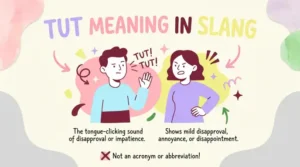
Tut is a slang word with a few meanings: in text it is short for “tutorial,” in British English “tut” is the clicking sound of disapproval, and in Gen Z slang it can be a playful nickname for a friend.
The tut meaning in slang depends on where you see it. Online, “tut” is most often short for “tutorial,” as in “drawing tut” or “makeup tut,” a quick guide that shows someone how to do something step by step.
In British English, “tut” or “tut-tut” describes the clicking sound people make with their tongue to show disapproval or mild annoyance. In texts you may see “tut” or “tut tut” written to show a disapproving, teasing tone.
Tut can also mean other things depending on the group. In Egyptian history it refers to King Tut, and in some Gen Z circles it is used as a cute or joking nickname, though that use is less common and varies by community.
If you are unsure what tut means in a message, check the platform, the tone, and the words around it. This guide explains what tut means in text, how to use it in a sentence, and which meaning fits each situation. You will also find simple chat examples to help you avoid mixing it up.
Quick Answer:
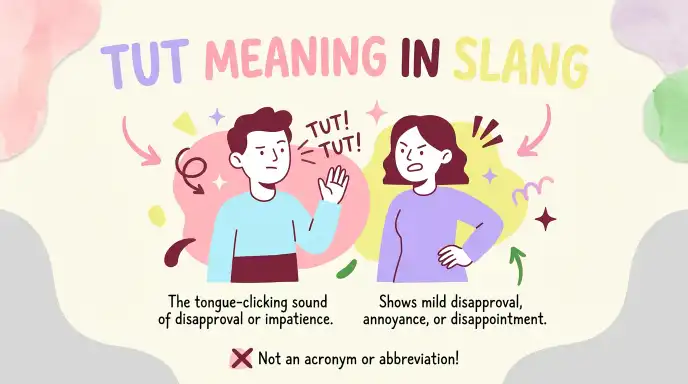
“Tut” is an informal expression used to show mild disapproval, annoyance, disappointment, or frustration. It often represents the clicking sound someone makes with their tongue when they disapprove of something.
What Does Tut Mean in Text?
In text messages, tut usually expresses disappointment, irritation, or disapproval. It is similar to saying “that’s not good,” “oh, come on,” or “shame on you,” depending on the conversation.
People may send it when someone makes a silly mistake, behaves irresponsibly, or does something they do not approve of.
For example:
- “Tut, you forgot your keys again!”
- “Tut tut, that’s not very nice.”
- “Tut, I thought you knew better.”
The expression can sound playful between friends or slightly critical in a serious conversation. It is not usually a strong insult or swear word.
What Is the Full Form of Tut?
Unlike abbreviations such as LOL (laughing out loud) or BRB (be right back), tut does not have a standard full form.
It is an actual expression rather than an acronym. It represents a sound people make by clicking their tongue to communicate disappointment or disapproval.
Some people write it as:
- Tut
- Tut-tut
- Tsk
- Tsk-tsk
These forms are closely related, although their exact use can vary.
Is Tut Rude, Offensive, or Neutral?
Tut is generally considered mild and non-offensive. However, its tone can change depending on how someone uses it.
It may sound friendly when used jokingly with someone you know well. On the other hand, it can sound judgmental when directed at someone who has made a serious mistake.
| Tone | Meaning | Example |
| Friendly | Playful disappointment | “Tut, you ate the last cookie!” |
| Casual | Mild annoyance | “Tut, the bus is late again.” |
| Critical | Disapproval | “Tut, you should have told me earlier.” |
| Sarcastic | Mocking disappointment | “Tut, what a brilliant idea!” |
Is it offensive? Usually not. It is much softer than insulting or abusive language. Still, using it repeatedly may make someone feel criticized.
Where Is Tut Commonly Used?
The expression is particularly associated with British English, where people commonly use it in everyday speech to show disapproval.
You may encounter it in several situations:
- Text messages: Friends use it to react to silly mistakes.
- Everyday conversations: Someone may say “tut” after hearing disappointing news.
- Social media: People sometimes use it in comments or replies.
- Books and television: It appears in British dialogue to show a character’s reaction.
- Informal discussions: It can express mild frustration without sounding aggressive.
Although people outside the United Kingdom may understand the expression, it is more strongly associated with British English than with American internet slang.
Real-Life Examples of Tut in Text Messages:
Understanding examples makes it easier to recognize the expression in everyday conversations.
1. Friendly Conversation
Person A: I forgot to bring your notebook.
Person B: Tut! I reminded you twice.
Here, tut shows playful disappointment rather than serious anger.
2. Casual Conversation
Person A: The shop is closed today.
Person B: Tut, I was planning to buy something there.
The sender uses tut to express mild frustration about an inconvenient situation.
3. Argumentative Conversation
Person A: You told everyone my secret.
Person B: Tut, I didn’t think it was that serious.
In this example, tut sounds dismissive because the conversation involves disagreement.
4. Social Media Comment
User A: I missed the final episode because I fell asleep.
User B: Tut tut! You missed the best part.
Here, the expression is playful and shows disappointment.
5. Gaming Conversation
Player A: I accidentally deleted my saved game.
Player B: Tut! That’s painful.
The word communicates sympathy mixed with mild disapproval or disappointment.
What Is the Origin of Tut?
Tut comes from the sound people make by clicking their tongue against the roof of their mouth or teeth. This sound can communicate disappointment, impatience, annoyance, or disapproval without using words.
The written form “tut” developed as a way to represent that sound in language.
The expression has a long history in English, especially in British speech and writing. The repeated form “tut-tut” is also common and can make the disapproval sound more noticeable.
Today, people still use it in spoken conversations, messages, books, and informal online communication.
Tut vs. Similar Expressions:
Tut is often confused with expressions such as “tsk,” “oops,” and “ugh.” However, these words communicate slightly different feelings.
| Expression | Meaning | Common Use |
| Tut | Mild disapproval | Reacting to someone’s mistake |
| Tsk | Disappointment or annoyance | Expressing disapproval |
| Oops | A small mistake | Admitting an accident |
| Ugh | Frustration or disgust | Reacting to something unpleasant |
| Oh dear | Concern or disappointment | Responding to bad news |
Tut vs. Tsk
Both tut and tsk can express disapproval. However, they are often different written representations of a similar tongue-clicking sound.
“Tut” is particularly familiar in British English, while “tsk” is also widely recognized in written English.
Tut vs. Oops
Oops is usually used when someone makes a mistake, especially an accidental one.
Tut, however, is more likely to show that someone is disappointed or disapproves of what happened.
Tut vs. Ugh
Ugh expresses frustration, disgust, or irritation. Tut is usually softer and more controlled.
| Situation | Better Expression | Example |
| Someone forgets something | Tut | “Tut, you forgot again!” |
| You make an accidental mistake | Oops | “Oops, wrong message!” |
| Something annoys you | Ugh | “Ugh, this traffic!” |
| You disapprove of behavior | Tsk | “Tsk, that wasn’t fair.” |
When Should You Avoid Using Tut?
Although tut is not generally offensive, it may not be suitable for every conversation.
Avoid using it in these situations:
- Professional emails: It may sound judgmental or unprofessional.
- Serious arguments: The expression can make another person feel dismissed.
- Sensitive situations: Someone dealing with a difficult problem may not appreciate a disapproving reaction.
- Formal communication: Clear sentences are usually better than informal expressions.
- Conversations with strangers: They may misunderstand your intended tone.
For example, instead of writing “Tut, you made another mistake” to a coworker, you could say, “I noticed a mistake. Could we review it together?”
Polite Alternatives to Tut:
If you want to express disappointment without sounding critical, several alternatives can work better.
| Alternative | Meaning | Example |
| Oh dear | Mild concern | “Oh dear, you missed the train.” |
| That’s unfortunate | Polite disappointment | “That’s unfortunate. Maybe next time.” |
| Never mind | Letting something go | “Never mind, it happens.” |
| What a shame | Expressing disappointment | “What a shame you couldn’t come.” |
| Oh well | Accepting a situation | “Oh well, we can try again.” |
Choose an alternative based on your relationship with the other person and the seriousness of the situation.
Why Do People Use Tut?
People use tut because it communicates a reaction quickly and naturally. Instead of writing a long sentence, they can use one short expression to show how they feel.
Common reasons include:
- Saving time: It is short and easy to type.
- Showing disappointment: It communicates disapproval without a long explanation.
- Keeping conversations playful: Friends may use it to tease each other.
- Expressing emotion: It adds personality to ordinary messages.
- Avoiding harsh language: It can express mild criticism without using an insult.
Its meaning is usually clear when readers understand the surrounding conversation.
Is Tut Safe to Use on Social Media?
Yes. Tut is generally safe to use on platforms such as Instagram, TikTok, Facebook, and WhatsApp because it is not normally considered offensive language.
However, context still matters. A playful comment between friends may be harmless, while the same expression directed at someone during a serious disagreement could sound rude.
If you are unsure how another person will interpret it, use a clearer phrase such as “Oh no!” or “That’s disappointing.”
FAQs:
Q1: What does it mean to tut at someone?
To tut at someone means to make a short clicking sound with your tongue against the roof of your mouth to show disapproval, annoyance, or mild criticism. It is very common in British English, where people tut at queue jumpers, rude behavior, or small mistakes. The tone is usually passive-aggressive rather than angry, though it can still feel dismissive to the person on the receiving end.
Q2: What does tut mean in texting?
In texting, “tut” most often appears as “tut” or “tut tut” to show a disapproving or teasing tone, as if the sender is clicking their tongue at you. It can also be short for “tutorial,” as in “got a good tut for this?” Check the sentence around it to see which meaning the sender intends.
Q3: What does tut stand for?
“Tut” is not a true acronym in most cases. As a shortened word, it stands for “tutorial” in online and creative communities. It is also the short name of the Egyptian pharaoh Tutankhamun, known as King Tut, and it imitates the sound of a tongue click in English speech.
Q4: What is a tut on TikTok?
On TikTok, a “tut” usually means a tutorial, such as a makeup, hair, nail, or editing guide, and creators often tag these videos with “tut” or “tutorial.” Some users also type “tut tut” in comments as a playful way to scold or tease someone. The platform meaning is mostly the quick how-to video.
Q5: What does tut-tut mean in British slang?
“Tut-tut” is a British expression of mild disapproval, written to copy the clicking sound. People also use it as a verb, as in “She tut-tutted at the mess,” and as an interjection to gently scold someone. It can sound old-fashioned or humorous, and it is often used with a raised eyebrow for effect.
Q6: What does “tut” mean in slang?
As slang, “tut” has two main uses: a short form of “tutorial” in online spaces, and a written sound that signals disapproval or playful scolding. Some small communities may use it as a friendly nickname, but that is informal and not standardized, so confirm the context before assuming it.
Q7: What is another word for “tut”?
For the disapproval sound, similar words are “tsk,” “tsk-tsk,” “tut-tut,” and “pshaw.” For the verb, you can say “disapprove,” “scold,” or “chide.” When “tut” means tutorial, alternatives are “guide,” “how-to,” “walkthrough,” and “lesson.”
Conclusion:
The expression tut is a simple way to communicate mild disappointment, annoyance, or disapproval in everyday conversations. It is especially familiar in British English and often represents the sound someone makes when they disapprove of something.
In text messages, tut can sound playful, casual, or slightly critical depending on the context. It is not an acronym, does not have a standard full form, and is generally not considered offensive.
The most important thing is to understand the situation before using it. When used naturally, tut can make informal conversations more expressive without requiring a long explanation.
Publishing tip: Because “tut” is strongly associated with British English, examples and wording that reflect British usage can make the article more useful to readers searching for this expression. No article can guarantee a top Google position, but clear definitions, accurate examples, and useful comparisons help build a stronger page.
Continue reading!
Explore more!

Hi, I’m Jack Anderson, a writer at Slang Prime. I love exploring slang words, their meanings, and origins. My goal is to explain modern slang in simple language and help readers understand everyday expressions.