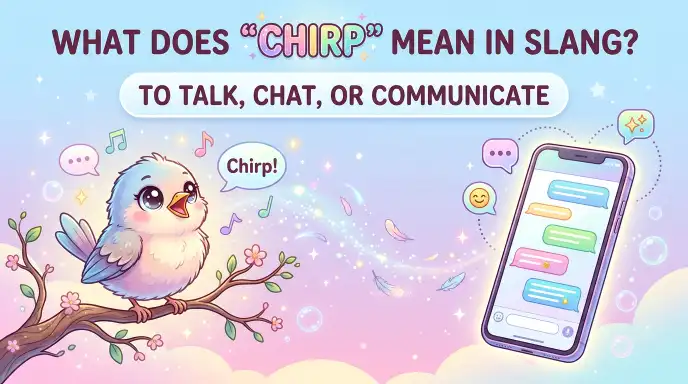
Chirp is a slang word that means to tease, mock, or playfully rip on someone, and it is especially common in Canadian English, where friends “chirp” each other all the time.
The chirp meaning in slang comes from the sound birds make, a quick, repeated noise. In the same way, chirping someone means giving them light, repeated jabs or jokes, often about something small like their team, outfit, or a mistake.
The word is most popular in Canada, especially in hockey culture, where players chirp opponents during games. In texts and on social media, you will see it in lines like “stop chirping me” or “he got chirped in the comments.”
Tone decides whether chirping is friendly or hurtful. Between close friends it is usually playful banter, but if the jokes get personal or do not stop, it can feel like bullying.
Chirp has other uses too, such as the sound of a bird, a cricket, or a phone alert, and in some places “chirp” can mean to talk back or give lip. This guide explains what chirp means in text, how to use it in a sentence, and how it differs from words like roast and troll. You will also find simple chat examples to avoid misusing it.
Quick Answer:
In slang, chirp often means to tease, mock, or make playful or insulting remarks toward someone. Its meaning depends on the conversation, tone, and situation.
What Does Chirp Mean in Slang?
The slang word chirp usually means making teasing, mocking, or sarcastic comments toward another person. It can describe friendly jokes between friends or sharper remarks meant to annoy an opponent.
For example, if someone makes fun of your football team’s performance, you might say:
- “Stop chirping me about my team.”
- “He kept chirping during the whole game.”
- “My friends always chirp me when I make mistakes.”
In these examples, chirp describes verbal teasing rather than the sound of a bird.
The expression is particularly familiar in Canadian English and sports culture, where players sometimes use verbal comments to distract or challenge their opponents.
What Does Chirp Stand For? Is It an Abbreviation?
Chirp is not an abbreviation or acronym. It does not have a standard full form like LOL or BRB.
It is an ordinary English word that has developed additional informal meanings.
The word can be used in several ways:
| Meaning | Explanation | Example |
| Bird sound | A short, high-pitched sound | “I heard a bird chirp.” |
| Friendly teasing | Playfully making fun of someone | “My brother keeps chirping me.” |
| Mocking remarks | Making comments to annoy someone | “The opposing player was chirping.” |
| Talking back | Responding with cheeky or challenging comments | “Don’t chirp at the referee.” |
When people search for “chirp meaning slang,” they are often looking for the teasing or mocking meaning rather than the traditional bird-related definition.
Is Chirp Rude, Offensive, or Friendly?
Chirp is not automatically rude. Its tone depends on the words used, the relationship between the people, and the situation.
When Chirp Is Friendly
Friends may chirp each other as a form of harmless teasing. It can make conversations funny and entertaining.
Example: “You missed an easy goal! I’m going to chirp you about that all week.”
Here, the comment is probably playful if both friends enjoy joking with each other.
When Chirp Is Insulting
Chirping can become rude when someone uses personal insults or tries to embarrass another person.
Example: “He kept chirping me about my appearance.”
In this situation, the comments may be hurtful rather than funny.
When Chirp Is Competitive
In sports, chirping often means making comments to distract or provoke an opponent.
Example: “The players were chirping each other before the match.”
This can be part of competitive banter, although it may cross the line if the comments become abusive.
| Situation | Tone | Meaning |
| Friends joking | Friendly | Playful teasing |
| Sports competition | Competitive | Provoking an opponent |
| Personal argument | Negative | Mocking or insulting |
| Online comments | Depends on context | Teasing or criticism |
Where Is Chirp Commonly Used?
Chirp appears in different types of conversations, but it is especially common in informal English and sports-related discussions.
Here are some places where you may encounter it:
- Sports: Players and fans use chirp to describe teasing or mocking opponents.
- Text messages: Friends use it when joking about each other’s mistakes.
- Social media: People may use it in comments, replies, and sports discussions.
- Gaming chats: Players sometimes chirp opponents after winning or losing.
- Everyday conversations: Someone might use it to describe a person who keeps making sarcastic remarks.
The word is strongly associated with Canadian sports slang, particularly hockey. However, people can understand and use it in other English-speaking communities too.
Real-Life Examples of Chirp in Text Messages:
The following examples show how chirp can work in different situations.
1. Friendly Conversation
Person A: I forgot my lunch at home again.
Person B: Haha, your memory is terrible. I’m going to chirp you forever!
Here, chirp means teasing a friend about a small mistake.
2. Casual Conversation
Person A: Why is everyone laughing at me?
Person B: They’re just chirping you because you arrived late.
The word describes casual teasing among people who know each other.
3. Argumentative Conversation
Person A: Stop making comments about me.
Person B: I’m not trying to start anything. I was just chirping.
Here, chirp refers to comments that may be irritating or unwelcome.
4. Gaming Conversation
Player A: You lost the match again!
Player B: Stop chirping me. Let’s play another round.
In gaming, chirp can mean teasing someone about their performance.
5. Sports Conversation
Player A: The other team’s players wouldn’t stop talking.
Player B: They were chirping us throughout the game.
Here, chirp describes competitive remarks made to distract or provoke opponents.
6. Social Media Comment
User A: My team lost three matches in a row.
User B: The rival fans are going to chirp you all week!
This example shows how the word is used in online sports discussions.
What Is the Origin of Chirp?
The traditional word “chirp” imitates the short, high-pitched sounds made by birds and some small animals.
Over time, the word also developed figurative meanings connected to making short, sharp sounds or comments. Its informal meaning of teasing or mocking someone became particularly familiar in Canadian English.
Sports culture helped popularize this use. In hockey, players may make sarcastic or challenging remarks toward opponents during a match. These comments are commonly called chirping.
Today, the word can describe teasing in sports, gaming, friendships, and online conversations. Its meaning is not limited to hockey, although that is one of its best-known slang contexts.
Chirp vs. Similar Slang Words:
Chirp is often confused with words such as roast, tease, trash-talk, and banter. These expressions are related, but they have slightly different meanings.
| Slang Word | Meaning | Example |
| Chirp | Teasing or mocking comments | “Stop chirping me.” |
| Roast | Making fun of someone, often humorously | “They roasted his outfit.” |
| Tease | Making playful jokes about someone | “She likes to tease her brother.” |
| Trash-talk | Insulting an opponent to provoke them | “The players were trash-talking.” |
| Banter | Friendly and playful conversation | “We had some funny banter.” |
Chirp vs. Roast
Chirp usually describes teasing or mocking remarks, often during sports or competitive situations. Roast generally means making jokes about someone, sometimes in a more direct or exaggerated way.
For example:
- “He chirped me about my missed goal.”
- “My friends roasted me for my haircut.”
Both involve making fun of someone, but roasting is often more focused on humorous criticism.
Chirp vs. Trash-Talk
Trash-talk is usually more aggressive than friendly teasing. It involves comments intended to challenge, distract, or upset another person.
Chirping can be playful, but in sports it may also become a form of trash-talk.
Chirp vs. Banter
Banter usually refers to a friendly exchange of jokes between people. Chirping can be part of banter, but it can also involve more competitive or insulting remarks.
| Expression | Main Purpose | Typical Feeling |
| Chirp | Tease or provoke | Playful or competitive |
| Roast | Make someone the target of jokes | Humorous or harsh |
| Trash-talk | Distract or intimidate | Competitive |
| Banter | Exchange friendly jokes | Lighthearted |
When Should You Avoid Using Chirp?
Although chirp can be harmless, it is not appropriate in every situation.
You should avoid using it when:
- Someone is upset: Teasing may make the situation worse.
- The conversation is serious: Jokes can seem disrespectful.
- You are speaking professionally: The word may sound too informal.
- Someone dislikes being teased: Respect their boundaries.
- Comments become personal: Avoid making jokes about someone’s appearance, family, or sensitive experiences.
For example, if a friend is genuinely upset about losing a game, repeatedly chirping them may hurt their feelings.
The best approach is to understand if the other person is comfortable with playful teasing.
Polite Alternatives to Chirp:
If you want to describe teasing without sounding too negative, you can use other expressions.
| Alternative | Meaning | Example |
| Tease | Make playful jokes | “He likes to tease his friends.” |
| Joke around | Have fun with someone | “We were just joking around.” |
| Banter | Exchange friendly jokes | “They enjoy friendly banter.” |
| Make a comment | Say something about a situation | “She made a funny comment.” |
| Playfully criticize | Point out something jokingly | “He playfully criticized my performance.” |
Choose the expression that best matches the situation. “Banter” is a good choice when the teasing is friendly, while “mock” or “insult” may be more accurate when the comments are hurtful.
Why Do People Use Chirp?
People use chirp because it describes a particular kind of teasing in a short and familiar way.
Some common reasons include:
- Entertainment: Friends use it to make conversations more amusing.
- Competition: Sports players may use it to challenge opponents.
- Humor: It helps describe playful jokes and sarcastic comments.
- Confidence: Some people use chirping to show confidence during a competition.
- Social connection: Friendly teasing can become part of how close friends communicate.
However, the intention matters. A joke that one person finds funny may feel insulting to someone else.
Is Chirp Safe to Use on Social Media?
Yes. Chirp is generally safe to use on platforms such as Instagram, TikTok, Facebook, Snapchat, and X.
It is not normally considered a swear word or an offensive abbreviation. People use it in sports discussions, funny comments, and casual conversations.
For example:
- “The fans are chirping after that win.”
- “My friends never stop chirping me.”
- “Just a little friendly chirping!”
However, avoid using the word to excuse bullying or personal attacks. Friendly teasing should remain respectful, if it happens online or face to face.
FAQs:
1. What does chirp mean in slang?
Chirp means to tease, mock, or make playful or insulting remarks toward someone. It is especially familiar in sports and Canadian English.
2. Is chirp a bad word?
No. Chirp is not generally considered a swear word. However, the comments described as chirping can be rude or hurtful depending on their content.
3. What does chirping mean in hockey?
In hockey, chirping means making teasing, sarcastic, or provocative comments toward opponents. Players may use it to distract or challenge each other.
4. Does chirp mean flirting?
Not usually. Chirp generally means teasing or making mocking comments. It can sometimes be playful between people who flirt, but flirting is not its main meaning.
5. Is chirp the same as roast?
They are similar but not identical. Chirp often refers to teasing or competitive remarks, while roast usually means making jokes at someone’s expense.
6. Does chirp have a full form?
No. Chirp is a regular English word, not an abbreviation. It does not have a standard slang full form.
Conclusion:
The slang word chirp usually means teasing, mocking, or making playful remarks toward someone. It is especially familiar in Canadian English and sports culture, where players may chirp opponents during a competition.
In everyday texting, friends may use it to describe harmless jokes or sarcastic comments. However, chirping can become rude when someone uses it to embarrass or hurt another person.
Remember that context and tone determine its meaning. If the conversation is friendly, chirp may simply describe playful teasing. If the comments are aggressive or personal, it may refer to mocking or verbal provocation.
Publishing tip: Keep the hockey and Canadian English context in the article because it gives readers a more specific explanation than simply defining chirp as “teasing.” No article can guarantee a top Google ranking, but accurate context, natural examples, and clear comparisons make it more useful.
Explore more!

I am Ann Raimes, an applied linguist and English language educator. I am widely recognized for my contributions to writing pedagogy and research in ESL writing. I have authored several well-known books, including Techniques in Teaching Writing, Keys for Writers, and How English Works: A Grammar Handbook with Readings. Throughout my career, I have worked to promote communicative writing and the process-based approach to teaching writing, helping both teachers and learners develop effective writing skills.