1940 slang is the set of informal words and phrases people used in the 1940s, shaped by jazz, swing dancing, and World War II, with terms like “hep,” “jive,” “swell,” and “snafu.”
The 1940 slang meaning covers the everyday language of that decade, from street talk to military jargon. Many of these words started in Black jazz communities and spread through radio, movies, and music.
Some of the most popular 1940s slang terms include “hep cat” (a cool person), “dig it” (understand or enjoy), and “killer-diller” (something excellent). Teens also said “swell” for great and “square” for someone old-fashioned.
World War II added its own words to the mix. Soldiers used “snafu” for a chaotic mess and “G.I.” for an American soldier, and “hubba hubba” became a cheerful phrase of approval.
Many of these words still show up in movies, vintage fashion, and retro social media posts. This guide explains the meaning of 1940 slang, how people used each word in a sentence, and which terms are still alive today. You will also find simple examples so you can use them correctly.
Quick Answer:
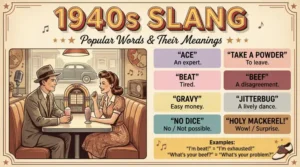
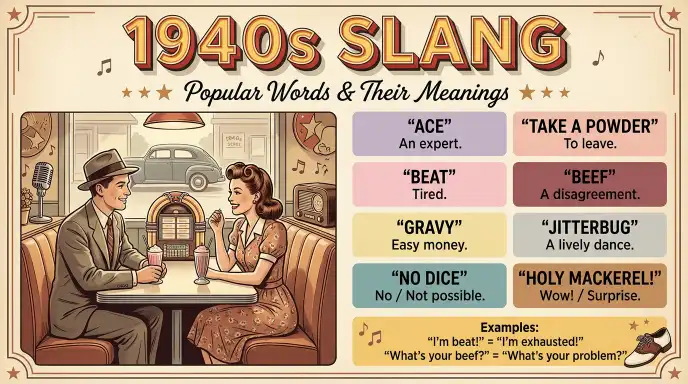
1940s slang means the informal words and expressions popular during the 1940s, especially in American everyday life and military culture. Examples include “ace” for an expert, “beat” for tired, and “take a powder” for leaving.
What Does 1940 Slang Mean?
1940 slang describes the casual language people commonly used during the 1940s. Although the decade includes different countries and communities, many surviving slang lists focus on American English.
These expressions helped people speak in a relaxed, humorous, or memorable way. Some came from military life, while others grew through jazz clubs, films, radio, sports, and neighborhood conversations.
For example:
- Ace: Someone who is highly skilled at something.
- Beat: Tired or exhausted.
- Gravy: Easy money or an easy benefit.
- Beef: A disagreement or complaint.
- Take a powder: Leave or go away.
- No dice: No, or a refusal.
- Holy mackerel!: An expression of surprise.
Historical slang dictionaries record many of these expressions as part of 1940s usage. However, not every word was exclusive to that decade, and popularity varied by region and social group.
Popular 1940s Slang Words and Their Meanings
The following expressions offer a useful introduction to the language of the decade.
1. Ace
Meaning: An expert or highly skilled person.
People used “ace” to praise someone who was especially good at a task. The word could describe a talented worker, performer, or professional.
Example: “Frank is an ace mechanic. He can fix almost any engine.”
2. Beat
Meaning: Tired or exhausted.
This expression described the feeling of having little energy after a long day.
Example: “I worked a double shift today, and now I’m beat.”
3. Gravy
Meaning: Easy money or an easy advantage.
When something was described as “gravy,” it meant the situation offered a comfortable benefit without much extra effort.
Example: “The job pays well, and the hours are short. That’s gravy!”
4. Beef
Meaning: A disagreement, complaint, or argument.
This use of “beef” referred to a problem between people rather than food.
Example: “What’s your beef with Jack? He hasn’t done anything to you.”
5. Take a Powder
Meaning: To leave or go away.
This informal phrase could be used when someone wanted to leave a place quickly or end a conversation.
Example: “It’s getting late. Let’s take a powder before the rain starts.”
6. No Dice
Meaning: No, that will not work, or an offer has been rejected.
People used this phrase to turn down a suggestion or explain that something was unsuccessful.
Example: “I asked Dad for the car keys, but he said, ‘No dice!’”
7. Flip Your Wig
Meaning: To become extremely surprised, excited, or upset.
The expression described a strong emotional reaction.
Example: “She’ll flip her wig when she sees the birthday present.”
8. Holy Mackerel!
Meaning: An exclamation of surprise.
This playful phrase expressed amazement without using a strong swear word.
Example: “Holy mackerel! You finished that entire project in one day?”
9. Bupkis
Meaning: Nothing or practically nothing.
This term is associated with Yiddish-influenced American slang and was used to describe getting nothing in return.
Example: “I worked all afternoon and earned bupkis.”
10. Honcho
Meaning: The person in charge or the boss.
“Head honcho” became a familiar expression for the main leader of a group or organization.
Example: “Ask the head honcho before changing the schedule.”
11. Greenback
Meaning: A dollar or paper money.
The word referred to American paper currency because of its traditional green coloring.
Example: “He offered me a few greenbacks to help move the furniture.”
12. Jitterbug
Meaning: A lively dance associated with swing music.
The jitterbug was strongly connected with the energetic dance culture of the swing era.
Example: “The band played a fast tune, and everyone started jitterbugging.”
13. Take a Pass or Make a Pass
Meaning: In period usage, “make a pass” could mean trying to flirt with someone. “Take a pass” is a different expression meaning to decline an offer.
Example: “He tried to make a pass at her, but she wasn’t interested.”
14. Nuts
Meaning: wild, foolish, or unreasonable.
The word could describe a person, idea, or situation that seemed ridiculous.
Example: “You’re nuts if you think we’ll finish this job in five minutes.”
15. Nice Going!
Meaning: Well done, or congratulations.
Depending on tone, it could also be sarcastic after a mistake.
Example: “Nice going! You solved the puzzle before everyone else.”
1940s Slang Comparison Table:
These words often appeared in casual conversation, but each one served a different purpose.
| Slang word or phrase | Meaning | Example |
| Ace | Expert or skilled person | “She’s an ace cook.” |
| Beat | Exhausted | “I’m beat after work.” |
| Gravy | Easy money or benefit | “This contract is gravy.” |
| Beef | Disagreement | “What’s your beef?” |
| Bupkis | Nothing | “I got bupkis.” |
| Honcho | Boss or leader | “Talk to the head honcho.” |
| No dice | Refusal or failure | “Sorry, no dice.” |
| Take a powder | Leave | “Let’s take a powder.” |
Military Slang From the 1940s:
World War II influenced many expressions used by military personnel and civilians. Soldiers developed shorthand for equipment, ranks, duties, and experiences. Some military terms later entered ordinary conversation.
Here are several expressions associated with the period:
GI
Meaning: Government issue; also widely associated with American enlisted service members.
The initials appeared in military language and became strongly linked with American soldiers.
Example: “The old movie follows a GI serving overseas.”
Dogface
Meaning: An infantry soldier, particularly in American military slang.
The expression became associated with the everyday experiences of ordinary infantrymen.
Example: “The story follows a dogface during wartime.”
Ack-Ack
Meaning: Anti-aircraft fire or anti-aircraft guns.
This was a military expression connected with defenses against enemy aircraft.
Example: “The crew heard ack-ack fire during the air raid.”
Butter Bar
Meaning: A second lieutenant.
The nickname referred to the gold bar insignia worn by a second lieutenant in the United States military.
Example: “The new butter bar reported to the unit.”
Dear John Letter
Meaning: A letter ending a romantic relationship, traditionally sent to a service member by a partner.
The expression is closely associated with wartime separations and the emotional difficulties of relationships during military service.
Example: “He received a Dear John letter while stationed overseas.”
Military and wartime slang reflects the historical setting of the 1940s, but individual expressions were not necessarily used by every service member or in every country.
1940s Slang Used for Money, People, and Everyday Life:
Everyday expressions make it easier to understand how people spoke during the decade.
| Expression | Meaning in the 1940s | Example sentence |
| Greenback | A dollar or paper money | “He saved his greenbacks.” |
| Wad | A bundle of money | “He carried a wad in his pocket.” |
| Peanuts | A small amount of money | “They paid peanuts for the work.” |
| Mug | A person’s face | “Get that grin off your mug.” |
| Dish | An attractive woman; now dated and potentially objectifying | “The old film calls her a dish.” |
| Old lady | Could mean one’s mother in period usage | “His old lady made dinner.” |
| Knucklehead | A foolish person | “Don’t be a knucklehead.” |
| Gumshoe | A private detective | “The gumshoe followed the suspect.” |
Some terms, especially those used to describe women, can sound disrespectful today. Their historical use does not mean they are appropriate in modern conversation.
1940s Slang vs. Modern Slang:
Language changes as technology, entertainment, and social habits change. Many expressions from the 1940s remain understandable, while modern slang often develops through online communities, texting, and social media.
| 1940s expression | Meaning | A modern equivalent |
| Beat | Very tired | Exhausted or worn out |
| Ace | Highly skilled | Pro or expert |
| No dice | No or not happening | “Nope” or “not a chance” |
| Take a powder | Leave | “I’m heading out” |
| Beef | Complaint or disagreement | Issue or drama |
| Flip your wig | React with great surprise | Freak out |
| Nice going! | Praise or sarcasm | “Well done!” or “Nice one!” |
These are approximate comparisons, not exact replacements. The best modern equivalent depends on the situation, speaker, and tone.
How Was 1940s Slang Commonly Used?
People used slang in ordinary conversation, entertainment, work, and military settings. The same expression could sound friendly in one situation and sarcastic in another.
Friendly conversations
Friends might use playful language to joke with each other or describe a fun evening.
Example: “That dance was a gas! We should go again next Saturday.”
Here, “a gas” meant a very enjoyable or amusing experience.
Casual conversations
People used short expressions to discuss work, money, or plans.
Example: “I’m beat, so I’m going home to get some shut-eye.”
“Shut-eye” means sleep.
Arguments and disagreements
Expressions such as “beef” could describe a dispute. Other phrases were sharper and could sound insulting.
Example: “If you’ve got a beef with me, just tell me what it is.”
Music and dancing
Swing music and jazz helped popularize expressions connected with dancing and nightlife.
Example: “The band is playing tonight. Let’s go jitterbugging!”
Movies, radio, and popular entertainment
Films and radio programs helped spread memorable phrases. Modern viewers may still encounter these expressions in old Hollywood movies, period dramas, and recordings.
However, a phrase appearing in a film does not prove that everyone used it in everyday life. Scripts sometimes exaggerated slang to create a particular character or atmosphere.
Where Did 1940s Slang Come From?
There was no single source for all 1940s slang. Expressions developed across different communities and became popular through repeated use.
World War II and military life
Wartime created new terms for equipment, ranks, duties, and experiences. Some expressions remained within the military, while others spread to civilian life.
Jazz and swing culture
Dance halls, jazz musicians, and swing fans contributed expressions linked to music and nightlife. Words such as “jitterbug” reflected the popularity of energetic dancing.
Hollywood and radio
Actors, comedians, radio hosts, and fictional characters brought distinctive phrases to large audiences. Popular entertainment helped some expressions travel beyond their original communities.
Cultural and regional influences
American English included words and expressions influenced by many languages and communities. Yiddish-influenced terms such as “bupkis,” for example, became part of broader American informal speech.
Not every expression originated in the 1940s. Some were older phrases that remained popular, while others became more widely recognized during the decade.
Is 1940s Slang Rude or Offensive?
Most 1940s slang was informal rather than inherently offensive. Words such as “ace,” “beat,” and “greenback” can usually be discussed without causing offense.
However, some expressions reflected attitudes that are considered outdated today.
For example:
- “Broad” was used to refer to a woman and could sound disrespectful.
- “Dame” could be used informally for a woman, but it may sound old-fashioned or dismissive today.
- “Dish” described an attractive woman and could reduce her to her appearance.
- “Knucklehead” is a mild insult for someone acting foolishly.
If you’re writing historical dialogue, these words may help create a period-appropriate voice. In everyday communication, neutral terms such as “woman,” “person,” “friend,” or “foolish idea” may be more suitable.
When Should You Avoid Using 1940s Slang?
You can use historical slang for fun, but consider your audience and setting.
Avoid relying heavily on old expressions when:
- Writing formal business emails or professional documents.
- Communicating with someone who may not understand the phrase.
- Discussing sensitive subjects where outdated wording could sound disrespectful.
- Trying to sound natural in modern conversation.
- Using a term whose meaning you have not checked.
If you are writing a story set in the 1940s, research the character’s location, age, background, and circumstances. A soldier, jazz musician, office worker, and teenager might not use exactly the same expressions.
Why Do People Still Search for 1940s Slang?
People explore 1940s slang for several reasons:
- Understanding classic films: Old dialogue often includes expressions that are unfamiliar today.
- Historical research: Students and history enthusiasts use slang to understand everyday life in the past.
- Creative writing: Writers use period expressions to make dialogue sound more authentic.
- Vintage fashion and culture: Fans of swing music and retro styles enjoy learning the language of the era.
- Family history: Old letters, diaries, and photographs may contain slang that younger relatives do not recognize.
These expressions also show how informal language connects people to a particular time and culture.
FAQs:
1. What was the most popular slang in the 1940s?
There was no single slang term used by everyone. Expressions such as “ace,” “beat,” “no dice,” “gravy,” and “take a powder” are documented examples of 1940s American slang.
2. What did “ace” mean in the 1940s?
“Ace” meant an expert or someone who was very good at a particular activity. It could describe a skilled worker, performer, or professional.
3. What did “beat” mean in 1940s slang?
“Beat” meant tired or exhausted. Someone who had worked all day might say, “I’m beat,” to explain that they needed rest.
4. What did “take a powder” mean?
“Take a powder” meant to leave or go away. It was an informal expression rather than a literal reference to powder.
5. Did World War II influence 1940s slang?
Yes. Military life and wartime experiences contributed many expressions related to soldiers, equipment, ranks, and daily duties. Some terms later became familiar outside the military.
6. Is 1940s slang still used today?
Some expressions remain in modern English, including “ace,” “beef,” “nuts,” and “greenback.” Others sound old-fashioned or are mainly recognized through historical entertainment.
Conclusion:
1940s slang offers a fascinating look at the way people communicated during a decade shaped by World War II, swing music, Hollywood, and changing everyday life. Expressions such as “ace,” “beat,” “gravy,” “no dice,” and “take a powder” carried meanings that helped people describe their feelings, plans, relationships, and experiences.
Some of these phrases remain familiar today, while others are best understood in their historical context. Their meanings can also vary depending on the situation and the speaker.
if you’re studying history, watching classic movies, or writing a story set in the 1940s, learning these expressions can make the decade feel more vivid. The key is to understand not only what each phrase meant, but also how and where people used it.
Related topics!

I am Ann Raimes, an applied linguist and English language educator. I am widely recognized for my contributions to writing pedagogy and research in ESL writing. I have authored several well-known books, including Techniques in Teaching Writing, Keys for Writers, and How English Works: A Grammar Handbook with Readings. Throughout my career, I have worked to promote communicative writing and the process-based approach to teaching writing, helping both teachers and learners develop effective writing skills.