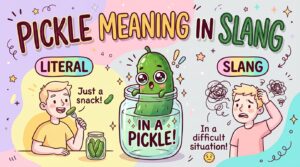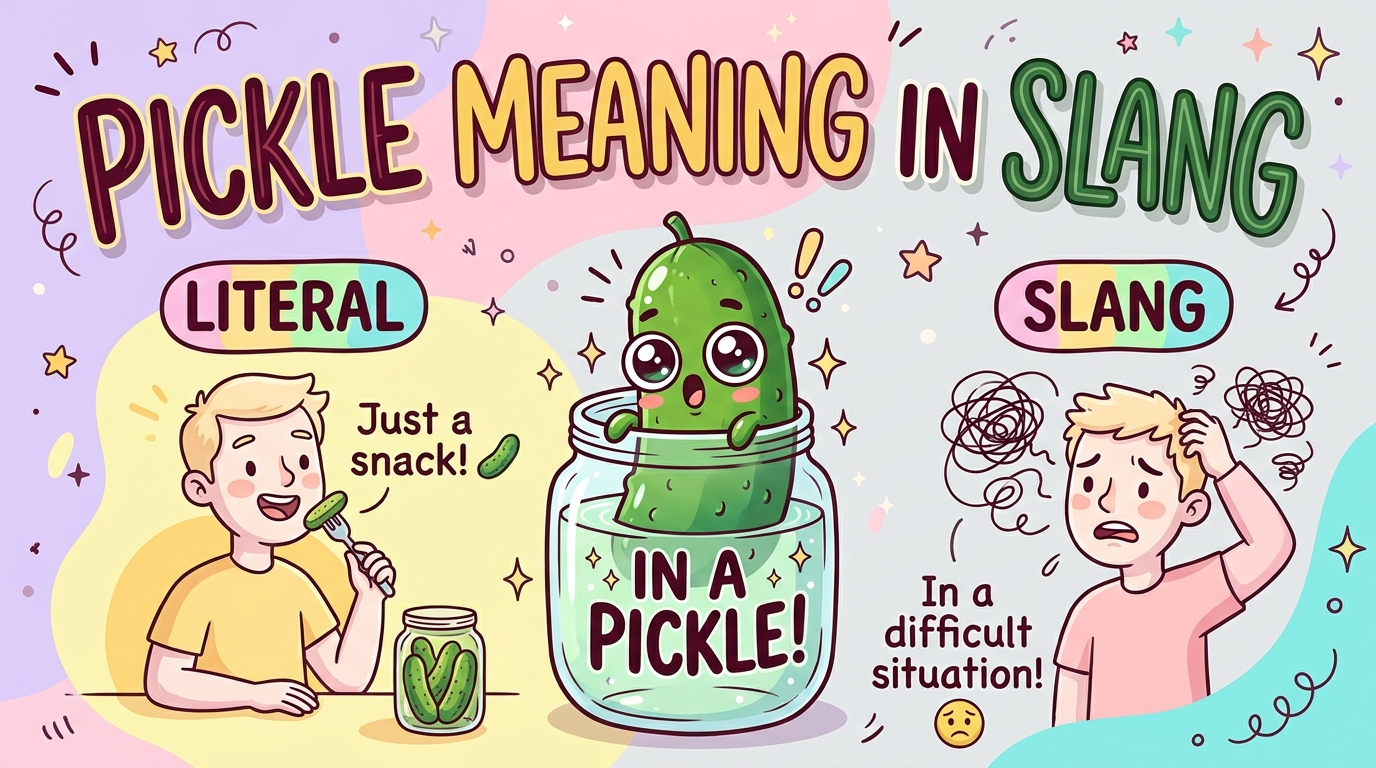
Pickle is a slang word that most often means a tricky or awkward situation, as in “I’m in a pickle,” but online it can also be a playful nickname or a slang term for a male body part.
The pickle meaning in slang comes from an old English idiom. Being “in a pickle” means being stuck in a difficult spot, much like a vegetable stuck in a jar of brine, and people still use it today for small, everyday problems.
In texting and on social media, pickle has a few extra meanings. People use it as a cute nickname for a funny or quirky friend, and on TikTok and Instagram you will also see it used as a joke or innuendo, so context matters.
Pickle also shows up in other slang uses. Pickleball fans shorten the sport’s name to “pickle,” and “pickle juice” or “pickled” can be used for being drunk or for something strongly preserved or stuck in time.
This guide explains what pickle means in text, how to use it in a sentence, and how the meaning changes by tone and platform. You will also find real chat examples and tips to avoid using it the wrong way.
Quick Answer
In slang, “pickle” usually means a difficult, awkward, or troublesome situation. When someone says, “I’m in a pickle,” they mean they have a problem or are in a tricky position. The word can also have other meanings in sports, jokes, and informal conversations, so context matters.
What Does Pickle Mean in Slang?
The slang expression “in a pickle” means being in trouble, facing a problem, or dealing with a situation that is hard to resolve. It is an informal English expression that people use in everyday conversations.
For example:
- “I forgot my homework at home. I’m in a pickle.”
- “We missed the last bus, so now we’re in a pickle.”
- “She got caught between two friends arguing and ended up in a pickle.”
In each example, the speaker is describing a difficult situation. The phrase often sounds lighthearted, so people may use it for minor problems rather than serious emergencies.
The word “pickle” can also appear in playful expressions or have specific meanings in certain activities. That is why it is important to read the full sentence instead of assuming that every use has the same meaning.
What Does “In a Pickle” Mean in Text Messages?
In texting, “in a pickle” usually means someone has gotten into trouble or needs help with a difficult situation.
For example:
Friend 1: “Did you finish the assignment?”
Friend 2: “No, and it’s due in an hour. I’m in a pickle!”
The second person is saying they have a problem because they have very little time to finish the work.
People may use the phrase in messages because it communicates a problem in a casual, sometimes humorous way. It can make a stressful situation sound less serious.
Pickle Slang Full Form: What Does Pickle Stand For?
The word pickle does not have a standard full form in everyday slang. It is a regular English word that is also used in the expression “in a pickle.”
Sometimes, people search for “pickle full form” or “what does pickle stand for” because they think it might be an abbreviation used online. However, in its common slang use, it is not an acronym.
| Term | Meaning |
| Pickle | A cucumber preserved in vinegar or brine |
| In a pickle | In a difficult or troublesome situation |
| Pickle full form | No standard full form in everyday slang |
| Pickle someone | In certain contexts, to put someone in a difficult position |
The exact meaning depends on how the word appears in a sentence. If someone writes “I love pickles,” they are probably talking about food. If they write “I’m in a pickle,” they are describing a problem.
Is Pickle Slang Rude, Offensive, or Neutral?
The expression “in a pickle” is generally neutral, friendly, and non-offensive. People of different ages can use it in casual conversations without sounding rude.
It is often a softer or more humorous way to describe being in trouble. For example, saying “I’m in a pickle” may sound less serious than saying “I’m in big trouble.”
However, tone and context still matter. Someone could use the phrase sarcastically to make fun of another person’s mistake, but the word itself is not usually an insult.
When Does Pickle Sound Funny?
People often use “in a pickle” when describing small mistakes or unexpected problems.
Examples include:
- Forgetting your wallet when you arrive at a restaurant.
- Missing a deadline because you started too late.
- Getting lost while following directions.
- Having two plans scheduled for the same time.
In these situations, the expression adds a playful tone to an inconvenient experience.
Can Pickle Be Used as an Insult?
Not usually. The phrase is not a common offensive insult by itself. However, a person could use it mockingly when talking about someone else’s problem.
For example:
“You got yourself into quite a pickle this time!”
Depending on the speaker’s tone, this might sound friendly or teasing. It is not necessarily aggressive.
Where Is Pickle Slang Commonly Used?
The expression “in a pickle” is used in everyday English, particularly in casual conversation. It is familiar to many English speakers and can appear in both spoken and written communication.
1. Text Messages and Online Chats
Friends may use the phrase to describe problems with schoolwork, plans, money, or everyday responsibilities.
Example: “I’m in a pickle because I promised to attend both parties.”
2. Social Media
People may use “pickle” in captions, comments, and funny posts about awkward situations.
Example: “When you spend your entire paycheck in two days and still have bills to pay. Now you’re in a pickle.”
3. Everyday Conversations
The phrase works well when talking to friends, family members, or coworkers in an informal setting.
Example: “We’re in a pickle because the car won’t start.”
4. Movies, Books, and Comedy
Writers may use the expression to make a character’s problem sound amusing or to create a lighthearted moment. It can help communicate trouble without making the situation seem too dramatic.
5. Sports and Games
The word “pickle” has additional meanings in certain sports. In baseball, a pickle can refer to a rundown, when a runner is caught between bases by fielders trying to tag them out. In pickleball, “pickle” may appear in informal jokes or game-related expressions.
These meanings differ from the everyday expression “in a pickle,” so the surrounding context is important.
Real-Life Examples of Pickle Slang:
The following examples show how people can use “pickle” in different situations and tones.
Friendly Examples
These examples describe minor problems in a relaxed way.
- “I’m in a pickle. Can you lend me a pen?”
- “We are in a pickle because nobody remembered to book a table.”
- “You got yourself into a pickle, but we’ll figure it out.”
- “I’m in a bit of a pickle trying to choose a birthday gift.”
Casual Texting Examples
People often use the expression naturally in messages to friends.
- “Bro, I’m in a pickle. My phone is at 2% and I forgot my charger.”
- “I’m in a pickle because I have three assignments due tomorrow.”
- “Help! I’m in a pickle and don’t know what to wear.”
- “We missed our train. Looks like we’re in a pickle now.”
Argumentative or Frustrated Examples
The expression can also appear when someone is annoyed about a problem or another person’s decision.
- “You said you would handle the booking, and now we’re in a pickle.”
- “Your last-minute change has put us all in a pickle.”
- “I’m in a pickle because you didn’t tell me about the meeting.”
- “We wouldn’t be in this pickle if everyone had followed the plan.”
In these examples, the phrase describes a problem, but the surrounding words make the speaker sound frustrated.
Gaming and Social Media Examples
- “I ran out of health points and got surrounded. I’m in a pickle!”
- “Our team forgot the objective, and now we’re in a pickle.”
- “When your internet stops working during the final round, you’re in a pickle.”
- “I accidentally posted the wrong picture. Definitely in a pickle.”
These are illustrative examples of how the expression might be used online, not fixed gaming terms.
Pickle vs. Similar Slang Expressions:
Several English expressions describe being in trouble or facing a difficult situation. They have similar meanings, but their tone and usage can differ.
| Expression | Meaning | Tone |
| In a pickle | In a difficult situation | Casual, often humorous |
| In hot water | In trouble, often because of something you did | Casual, sometimes serious |
| In a jam | Stuck in a difficult situation | Informal |
| In a bind | Facing a problem with limited options | Neutral |
| In deep trouble | Facing a serious problem | More direct and serious |
Pickle vs. In Hot Water
“In a pickle” often describes a tricky situation, even if nobody has done anything wrong. “In hot water” more commonly suggests that someone may face consequences for their actions.
Example: “I’m in a pickle because both buses are delayed.”
Example: “He’s in hot water because he broke the office rules.”
Pickle vs. In a Jam
Both expressions describe difficult situations and can often be used interchangeably.
Example: “I’m in a pickle because I lost my keys.”
Example: “I’m in a jam because I lost my keys.”
Both sentences communicate the same basic problem.
Pickle vs. In a Bind
“In a bind” often suggests that someone has limited choices or feels caught between competing responsibilities.
Example: “I’m in a bind because I need to work and attend a family event at the same time.”
“In a pickle” sounds a little more playful, while “in a bind” may sound more practical or serious.
Other Meanings of the Word Pickle:
Although “in a pickle” commonly means being in trouble, the word can have different meanings depending on the setting.
Pickle as Food
The most familiar meaning is a cucumber preserved in vinegar or salty brine. In some English-speaking regions, the word “pickle” can also refer to other vegetables preserved in a similar way.
Example: “Can you add a pickle to my sandwich?”
Here, the word refers to food, not slang.
Pickle in Baseball
In baseball, a pickle is a situation in which a runner is caught between two bases while fielders attempt to tag them out. It is also called a rundown.
Example: “The runner got caught in a pickle between second and third base.”
This is a sports term rather than the everyday slang expression.
Pickle in Pickleball
Pickleball is a paddle sport that combines elements of tennis, badminton, and table tennis. In conversations about the game, the word may refer to the sport itself or appear in game-related jokes.
Do not assume that every use of “pickle” in a sports conversation means someone is in trouble. Look at the full sentence to understand the intended meaning.
Origin and Background of “In a Pickle”:
The expression “in a pickle” has been used in English for centuries. It became a familiar way to describe a difficult or confusing situation.
The exact origin of the expression is not completely certain. One explanation connects the phrase to the idea of being mixed up or caught in an unpleasant condition, much like ingredients in a pickle mixture. However, this is not a proven explanation of the phrase’s origin.
The expression is also known from historical literature, including William Shakespeare’s play The Tempest, in which a character asks if he is “in a pickle.” This historical use helped make the phrase recognizable in English.
Today, “in a pickle” remains a common idiom. It can be used in everyday speech, books, jokes, text messages, and online conversations.
When Should You Avoid Using Pickle Slang?
Although “in a pickle” is not offensive, it may not suit every situation.
1. Formal Reports
In a formal report or professional document, direct wording may be clearer.
Instead of: “Our department is in a pickle.”
Write: “Our department is facing a significant problem.”
2. Serious Emergencies
The phrase can sound too lighthearted when someone is facing a serious emergency.
Instead of saying, “I’m in a pickle,” you may need to explain the problem clearly and ask for specific help.
3. When the Meaning Is Unclear
Someone unfamiliar with the expression may interpret “pickle” literally as food. If clarity is important, explain the situation directly.
4. Sensitive Conversations
If a person is upset or dealing with a serious personal issue, a humorous expression may sound dismissive. Choose words that match the person’s feelings and the seriousness of the situation.
Polite Alternatives to “In a Pickle”:
If you want to describe a difficult situation without using an idiom, these alternatives can help.
| Alternative | Example |
| In a difficult situation | “I’m in a difficult situation and need advice.” |
| Facing a problem | “We’re facing a problem with the schedule.” |
| In a tough spot | “I’m in a tough spot because I have two deadlines.” |
| Having trouble | “I’m having trouble finishing the assignment.” |
| Need some help | “I need some help figuring this out.” |
These alternatives are useful in professional emails, school assignments, workplace discussions, and serious conversations.
Why Do People Use Pickle Slang?
People use “in a pickle” because it makes a problem sound conversational and easy to understand. Rather than describing every detail immediately, a speaker can use the expression to signal that something has gone wrong.
Common reasons include:
- Keeping things light: The phrase can make a small problem sound less stressful.
- Sounding natural: It is a familiar expression in everyday English.
- Adding humor: It can make an awkward situation sound funny.
- Saving time: It communicates the general idea of being in trouble without a long explanation.
- Building connection: Friends may use familiar expressions to make conversations feel relaxed.
The phrase is especially useful when a person wants to explain a problem without sounding overly dramatic.
Does Pickle Slang Affect Communication?
Like other idioms, “in a pickle” can make communication more expressive. It conveys the idea of difficulty while adding a casual or humorous tone.
However, idioms depend on shared language knowledge. Someone learning English may not immediately understand what the phrase means.
For clear communication, consider your audience. Use the expression with people who are likely to recognize it, and choose a direct explanation when precision matters.
Is Pickle Slang Safe to Use on Social Media?
Yes. The expression “in a pickle” is generally safe for social media because it is not inherently vulgar, hateful, or sexually explicit.
You can use it in:
- Instagram captions about everyday mishaps.
- TikTok videos about funny problems.
- Group chats with friends.
- Gaming conversations.
- Casual posts about school, work, or travel.
For example: “Forgot my charger before a long trip. I’m officially in a pickle.”
The main thing to remember is that the phrase should fit the situation. In a serious post about a crisis, a clearer and more sensitive explanation may be better.
FAQs:
Q1: What is a pickle in British slang?
In British English, a pickle is a tricky or awkward situation, as in “I’m in a right pickle.” The phrase is old-fashioned but still widely understood. Britons also use “pickle” for a mischievous child, and “Branston pickle” is a well-known sweet chutney eaten with cheese, so the word can also be purely about food.
Q2: What does it mean when you call someone a pickle?
Calling someone a pickle is usually a playful nickname for a funny, cheeky, or slightly naughty person. Parents often use it for kids who get into mischief, and friends use it affectionately for a quirky buddy. The tone is almost always light and friendly, but it can carry innuendo in some online jokes, so context matters.
Q3: Why does Gen Z love pickles?
Pickles became a popular online trend through TikTok food videos, “pickle girl” memes, and the general love for sour and salty snacks. Pickle-flavored chips, candy, and drinks also pushed the trend. For many Gen Z users, the pickle is a funny, quirky symbol that works well in memes, jokes, and self-descriptions.
Q4: What does it mean to be a pickle girl?
“Pickle girl” is not an official slang term. Online, it usually describes a girl who loves pickles and often jokes about it, and it became a meme and aesthetic on social media. Some creators use it as a playful identity label, but it has no fixed meaning, so it depends on the video or comment section.
Q5: What is pickle lady?
“Pickle lady” has no single slang definition. It can simply mean a woman who sells or makes pickles, or a woman who is known for loving them. In some online jokes it is used as a quirky nickname, so check the context before assuming a deeper meaning.
Q6: What is a pickle relationship?
“Pickle relationship” is not a widely recognized slang phrase. People may use it informally for a complicated or awkward relationship, based on the idiom “in a pickle.” Because there is no standard definition, the meaning depends entirely on the speaker.
Q7: What does “pickled” mean in LGBT slang?
There is no well-established LGBT slang meaning for “pickled.” In general English slang, “pickled” means drunk. Some online communities may use pickle-related words as in-jokes or coded humor, but those uses are small, vary by group, and are not standardized. If you cover this in your article, say that clearly rather than claiming a fixed meaning.
Q8: What does pickle princess mean?
“Pickle princess” is an informal, playful label for someone who adores pickles, often used in memes and captions in a cute or humorous way. It is not a recognized slang term with a set definition, and its meaning depends on the person using it.
Conclusion
“Pickle meaning slang” usually refers to being in a difficult, awkward, or troublesome situation, especially in the expression “in a pickle.” People use it in texts, everyday conversations, jokes, and social media posts to describe problems in a casual and sometimes humorous way.
The word does not have a standard slang full form, and it is generally not rude or offensive. It can also refer to food or have specific meanings in sports, so the context is important.
If someone texts, “I’m in a pickle,” they probably mean they have a problem and may need help. Understanding the situation and tone will help you interpret the expression correctly and use it naturally in your own conversations.
Read more about!
Deep dive!

I am Ann Raimes, an applied linguist and English language educator. I am widely recognized for my contributions to writing pedagogy and research in ESL writing. I have authored several well-known books, including Techniques in Teaching Writing, Keys for Writers, and How English Works: A Grammar Handbook with Readings. Throughout my career, I have worked to promote communicative writing and the process-based approach to teaching writing, helping both teachers and learners develop effective writing skills.