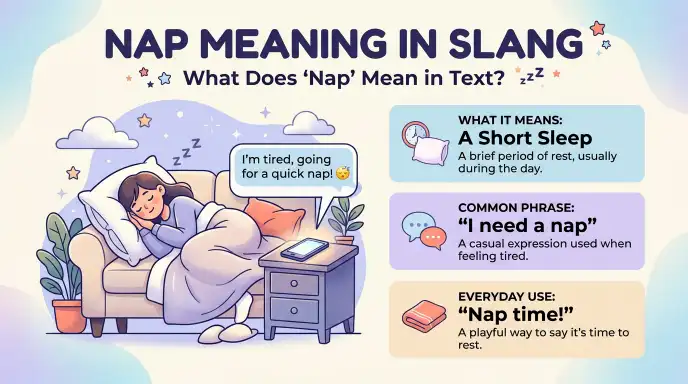
Nap in slang most commonly means a short sleep, but it also has older and niche slang uses, such as to catch or seize someone, to cheat, or to pick a “best bet” in horse racing.
The everyday meaning is simple: a short rest, usually during the day. In text, people use it casually, as in “I need a nap” or “Nap time, talk later.” That plain meaning is by far the most common one.
Slang dictionaries also record older British uses of the word. For example, to “nap” someone once meant to seize or arrest them, and “you’ll nap it” meant “you’ll get a beating.” In horse racing, a “nap” is a tipster’s top pick of the day.
Because these meanings are rare or old-fashioned, the setting decides which one is meant. In a chat, a text, or a caption, “nap” almost always means sleep. If you see it near words about racing, crime, or old British speech, one of the other meanings may fit better.
In this guide, you will learn the exact nap meaning in slang, how people use it in real conversations, and which older meanings still exist. You will also find examples, similar slang terms, and answers to frequently asked questions to help you use it with confidence.
Quick Answer:
In slang and text messages, “nap” means a short sleep or quick rest. It is generally a neutral, friendly word used to express tiredness or the need to recharge.
What Does Nap Mean in Text?
When someone sends you the word “nap,” they are usually talking about sleeping for a short time. It is a common word in everyday conversations, especially when people feel exhausted or need a break.
For example:
- “I’m going to take a nap.” :The person wants to sleep briefly.
- “Nap time!” :The person is ready to rest.
- “I need a nap so bad.” :The person feels very tired.
- “Wake me up after my nap.” : The person wants someone to wake them after a short sleep.
In online conversations, “nap” can also be used humorously. Someone who has stayed awake late watching videos might write, “I deserve a three-hour nap.”
The word itself is not usually internet slang with a hidden meaning. Its meaning comes mainly from the situation and the tone of the message.
What Does Nap Stand For?
“Nap” is not normally an abbreviation, so it does not have an official full form in texting.
People sometimes invent funny meanings for ordinary words online, but these should not be confused with the standard definition.
The word simply refers to a short period of sleep, often taken during the day.
Is Nap Different From Sleep?
Yes, there is a small difference in everyday usage.
| Word | Meaning | Example |
| Nap | A short period of sleep | “I’m taking a nap.” |
| Sleep | Resting in a sleeping state, often overnight | “I need eight hours of sleep.” |
| Doze | To sleep lightly for a short time | “I dozed off on the sofa.” |
| Snooze | To sleep briefly or delay an alarm | “I’ll snooze for ten more minutes.” |
People sometimes use these words interchangeably in casual conversations, but “nap” usually suggests a shorter rest than a full night’s sleep.
Is Nap Rude, Offensive, or Neutral?
The word “nap” is generally neutral and harmless. It is not a swear word, insult, or offensive expression.
People use it with friends, family members, coworkers, and online communities without causing offense.
However, the tone can affect how a message sounds.
- Friendly: “You look tired. Go take a nap!”
- Playful: “Bro, you need a nap after that gaming session.”
- Sarcastic: “Maybe take a nap before arguing with everyone.”
- Dismissive: “Go take a nap and stop bothering me.”
In the last two examples, the word itself is not offensive, but the surrounding message could sound rude or disrespectful.
If you are unsure how someone intends it, consider the full conversation rather than judging the word alone.
Where Is Nap Commonly Used?
People use “nap” in everyday speech, private messages, and online discussions. It is a familiar word across many English-speaking communities.
1. Text Messages
Friends and family members often mention naps when discussing their plans or energy levels.
Examples:
- “I’ll text you after my nap.”
- “Just woke up from a nap.”
- “I’m too tired to go out. Nap first!”
2. Social Media
On platforms such as TikTok, Instagram, Snapchat, and Facebook, people may use “nap” in captions, comments, and posts about their daily routines.
Examples:
- “My weekend plans: eat, nap, repeat.”
- “A nap fixes almost everything.”
- “POV: You planned a five-minute nap and woke up three hours later.”
These examples are casual and humorous rather than expressions with a special hidden meaning.
3. Gaming Communities
Gamers sometimes mention naps after long gaming sessions, late-night matches, or extended streams.
Examples:
- “One more match, then I’m taking a nap.”
- “I stayed up gaming all night. I need sleep.”
- “BRB, nap break.”
Here, “nap” simply describes a short rest.
4. Work and School Conversations
Students and employees may use the word when discussing busy schedules, long study sessions, or tiring workdays.
Examples:
- “I need a nap after studying for five hours.”
- “Lunch break nap sounds perfect.”
- “I’ll finish my assignment after a quick nap.”
The word is informal enough for everyday conversation, although you may prefer “short rest” or “break” in formal workplace writing.
Real-Life Examples of Nap in Text Messages:
The easiest way to understand the nap meaning slang is to see how people use it in different situations.
Friendly Examples
Friend 1: “Are you coming over later?”
Friend 2: “Yeah, just need a quick nap first.”
Meaning: The person wants to rest before visiting.
Friend 1: “You sound exhausted.”
Friend 2: “I barely slept last night. Nap time!”
Meaning: The person needs some sleep because they did not rest enough.
Casual Examples
- “Taking a nap before dinner.”
- “I accidentally slept through my afternoon nap alarm.”
- “Give me 20 minutes. I need a nap.”
- “Today is officially a stay-home-and-nap day.”
These messages use “nap” in its ordinary meaning.
Argumentative or Sarcastic Examples
- “Go take a nap before you start another argument.”
- “Someone clearly needs a nap today.”
- “Maybe you should rest before replying like that.”
Meaning: The speaker suggests that another person is tired or behaving irritably. Depending on the relationship, these messages may sound playful or insulting.
Gaming and Social Media Examples
- “GG, everyone. I’m logging off for a nap.”
- “That stream was so long. Time for a nap.”
- “My gaming schedule is sleep, play, nap, repeat.”
- “I said I’d close my eyes for ten minutes. Three hours later…”
These examples show how the word fits naturally into internet conversations without needing an additional slang definition.
Comparison Table: Nap vs. Similar Internet Expressions
Although “nap” is straightforward, other words and phrases can express similar ideas.
| Term | Meaning | When to use it |
| Nap | A short sleep | When you want a brief rest |
| Power nap | A short nap intended to help you feel refreshed | When you want a quick recharge |
| Crash | To sleep because you are extremely tired | After a tiring day or late night |
| Doze off | To fall asleep unintentionally or lightly | When you fall asleep while sitting or watching something |
| Knock out | To fall asleep quickly or sleep deeply in casual speech | When you are completely exhausted |
| Snooze | To sleep briefly or delay an alarm | When you want a little extra rest |
For example, “I’m going to crash” often suggests stronger tiredness than “I’m going to take a nap.”
These phrases are related, but they are not always interchangeable.
What Is the Origin of the Word Nap?
The word “nap” is not a newly invented internet expression. It has been used in English for centuries.
Its historical development is generally traced to older English and related European forms associated with dozing or sleeping lightly. Over time, it became a common term for a short period of sleep, particularly during the day.
Modern texting and social media have not fundamentally changed its meaning. Instead, digital communication has made the word easier to use in short, casual messages.
Expressions such as “nap time,” “power nap,” and “nap break” are now common in everyday conversations.
It is important to distinguish this established word from internet abbreviations that have specific expanded forms. “Nap” does not need a special decoding process in most text conversations.
Why Do People Use Nap in Text Messages?
People use “nap” because it is short, familiar, and easy to understand. It communicates a simple idea without requiring a long explanation.
1. To Explain Why They Are Unavailable
Someone might say, “I’ll reply after my nap,” to explain why they will not respond for a little while.
2. To Express Tiredness
A message like “I need a nap” quickly communicates exhaustion.
3. To Make Jokes
People often exaggerate their need for sleep for humorous effect.
Example: “My workout today was walking to the fridge. Now I need a nap.”
4. To Share Daily Routines
People may mention naps when discussing studying, working, parenting, relaxing, or spending a lazy afternoon at home.
5. To Connect With Others
When someone says they are tired, another person may respond with a relatable comment about needing rest too.
Because the word is familiar, it works well in both personal conversations and public posts.
When Should You Avoid Using Nap?
There is usually no reason to avoid the word itself. However, certain situations call for more thoughtful wording.
- Professional emails: Use “short break” or “rest period” when appropriate for the workplace.
- Serious conversations: Avoid telling someone to “take a nap” if it could sound dismissive.
- Arguments: Saying “go take a nap” may make the other person feel mocked rather than understood.
- Urgent situations: Do not use a casual joke about napping when someone needs immediate help or attention.
For example, instead of texting, “Go take a nap and stop complaining,” you could say, “You seem exhausted. Maybe take a break if you can.”
The second message communicates concern without sounding insulting.
Polite Alternatives to Nap:
If you want to express tiredness or suggest that someone rest, several alternatives may fit your situation.
| Expression | Meaning | Example |
| Take a short rest | Relax for a little while | “I’ll take a short rest before dinner.” |
| Get some rest | Sleep or relax to recover energy | “You should get some rest tonight.” |
| Take a break | Stop an activity temporarily | “Let’s take a break from studying.” |
| Recharge | Recover energy | “I need some time to recharge.” |
| Power nap | Take a brief nap | “I’ll have a power nap before the meeting.” |
| Catch up on sleep | Get sleep you missed earlier | “I need to catch up on sleep this weekend.” |
Choose the expression that best matches the situation. “Recharge” can sound more general, while “power nap” specifically refers to a short sleep.
Is Nap Safe to Use on Social Media?
Yes. The word “nap” is generally safe for ordinary social media posts, captions, comments, and messages.
It is not inherently vulgar, threatening, or offensive. You can use it in humorous posts, lifestyle content, conversations about sleep, and everyday updates.
For example:
- “Weekend mood: nap and relax.”
- “A quick nap before the evening plans.”
- “Who else loves an afternoon nap?”
- “Sleepy all day, energetic at midnight.”
However, platform rules can still apply to the overall content of a post. A harmless word does not automatically make every surrounding message appropriate.
If you use “nap” sarcastically toward another person, consider if your message might be interpreted as bullying or an insult.
FAQs:
Q1: What does nap stand for in texting?
In texting, “NAP” is sometimes used as an abbreviation for “not a problem,” as in “NAP, I can help.” It can also appear in writing as the simple word for a short sleep, as in “Taking a nap, talk later.” Because both uses exist, the context shows which one is meant. The abbreviation is less common than “NP” for “no problem,” so many readers may not know it.
Q2: What is the other meaning of nap?
Besides a short sleep, “nap” also means the soft, raised surface of a fabric, such as velvet or a carpet. It is also a horse-racing term for a tipster’s top pick of the day. In older British slang, the verb “nap” could mean to catch, seize, or cheat someone. These uses are rare today, so the sleep meaning is the one most people expect.
Q3: What does nap mean for adults?
For adults, a nap is usually a short daytime sleep that helps restore energy, often called a “power nap.” Many people use it to feel more alert after lunch or a long morning. It can also be a casual way to say you need a break, as in “I need a nap.” Short naps of about 20 to 30 minutes are generally recommended, and anyone with ongoing sleep problems should speak with a doctor.
Q4: What does “take a nap” mean in slang?
In everyday slang, “take a nap” simply means to sleep for a short time. People also say “catch some Zs,” “crash,” or “power down” for the same idea. In jokes, “go take a nap” can be a playful or sarcastic way to tell someone to calm down or stop being grumpy. The tone depends on the speaker and the relationship.
Q5: What does “nap” mean in slang?
In slang, “nap” most commonly means a short sleep. Some older slang dictionaries also list meanings such as to cheat, to seize someone, or a racing tip. I could not confirm a widely accepted modern Gen Z meaning beyond sleep, so it is safest to read the sentence around the word. Always check the conversation before assuming a hidden meaning.
Q6: What does “nap” mean in British slang?
In British slang, “nap” is best known as a racing term for a tipster’s best bet of the day, as in “tonight’s nap.” Older British slang also used “nap” to mean seizing or cheating someone. In everyday UK speech, though, “have a nap” still means to sleep for a short time. The meaning depends on whether you are reading about horse racing, old slang, or daily life.
Q7: How do you say nap in slang?
Common slang words for a nap include “catnap,” “forty winks,” “shut-eye,” “snooze,” and “power nap.” “Siesta” is used for an afternoon nap, especially in Spanish-speaking countries. These words are casual, friendly, and fit most chats and posts. Pick one that matches your tone, such as “forty winks” for a British feel.
Q8: What is nap in gaming terms?
In some online games, “NAP” stands for “non-aggression pact,” an agreement between players or groups not to attack each other. It is especially known in space and strategy games with large player alliances. In other settings, “nap” can also mean taking a short break from the game. Check the game and the community, because the term is not used the same way everywhere.
Conclusion:
The nap meaning slang is simple: it usually refers to a short sleep or brief rest. People use the word in text messages, social media captions, gaming chats, and everyday conversations to express tiredness, explain their plans, or make jokes about sleeping.
Unlike many internet slang terms, “nap” is not an abbreviation with a special full form. Its meaning generally stays the same across different platforms, although the tone can change depending on the conversation.
Use “nap” freely in casual messages, but pay attention to context when speaking to someone who may interpret a sarcastic comment as rude. Understanding the tone behind the word helps you communicate clearly and naturally.
Discover More!

Hi, I’m Jack Anderson, a writer at Slang Prime. I love exploring slang words, their meanings, and origins. My goal is to explain modern slang in simple language and help readers understand everyday expressions.