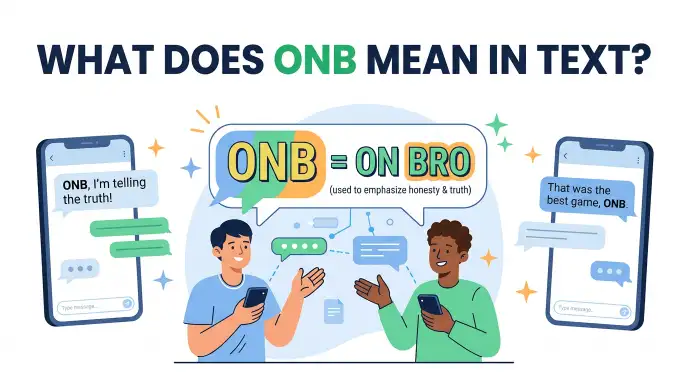
ONB in text most commonly stands for “on bro,” a slang phrase people use to say they are being honest or serious about what they just said.
The phrase comes from the idea of swearing on your brother to prove that you are telling the truth. It grew out of street slang and spread through TikTok, Snapchat, Instagram, and group chats. Because it is short and punchy, it fits fast, casual texting.
In a message, ONB usually backs up a claim or a promise. For example, “I didn’t do it, ONB” means “I swear I didn’t,” and “I got you next time, ONB” shows a sincere promise. As a result, it adds weight to a sentence without a long explanation.
The tone is casual, so it suits friends and young audiences more than work or school messages. Older readers may not know it, and some forms, such as “on blood,” sound more intense. In technical or business settings, ONB can also mean something completely different, so context always matters.
In this guide, you will learn the exact ONB meaning in text, how to use it in real conversations, and what its common variations are. You will also find examples, similar slang terms, and answers to frequently asked questions to help you use it with confidence.
Quick Answer:
ONB in text stands for “on bro.” People use it to show they are telling the truth or being serious, like “I didn’t do it, ONB.”
What Does ONB Mean in Texting?
ONB Means “On Bro”
In many informal text conversations, ONB stands for “On Bro.” The phrase works as a way to emphasize honesty, seriousness, or confidence in what someone says.
For example, someone might write:
- “ONB, that movie was amazing.”
- “I’m not lying, ONB.”
- “ONB, I didn’t tell anyone.”
- “That was the funniest thing ever, ONB.”
In these examples, the sender uses ONB to make their statement sound more sincere or emphatic. It is similar to saying “I swear” or “I’m telling the truth.”
The word “bro” does not always refer to a person’s actual brother. In slang, people often use it for friends, acquaintances, or simply as part of an expression.
What Does “On Bro” Actually Express?
The phrase usually adds emphasis to a statement. It can communicate honesty, surprise, excitement, frustration, or agreement.
For example, if your friend says, “That test was impossible,” you might reply, “ONB, I couldn’t answer half the questions.”
Here, ONB reinforces your agreement and shows that you genuinely feel the same way.
The phrase is informal, so it fits naturally into conversations with friends rather than formal emails, school assignments, or professional messages.
Other Possible Meanings of ONB:
ONB as “Outward Nose Breath”
Another interpretation of ONB is “Outward Nose Breath.” This expression describes a small breath through the nose that happens when something is mildly funny or amusing.
It is similar to the reaction people sometimes call a nose exhale. Instead of laughing loudly, someone briefly breathes out through their nose.
For example:
- “That comment gave me an ONB.”
- “I didn’t laugh out loud, but it was definitely an ONB.”
- “His reply was so unexpected that I let out an ONB.”
This meaning is less universal than “On Bro,” and people may not recognize it without context.
ONB in Specific Communities
ONB can also appear as an abbreviation in organizations, workplaces, technical discussions, or other specialized settings. In those situations, it may have nothing to do with texting slang.
For instance, an abbreviation used in a workplace message could refer to an internal process or a named organization. You should not automatically assume it means “On Bro” when the conversation is about a completely different subject.
The most reliable approach is to read the entire sentence and consider the topic of the conversation.
ONB Meaning at a Glance:
The table below compares the main interpretations and the situations in which they may appear.
| ONB meaning | How it is used | Example |
| On Bro | Emphasizing honesty or seriousness | “ONB, I’m telling the truth.” |
| Outward Nose Breath | Describing a small amused exhale | “That joke gave me an ONB.” |
| Context-specific abbreviation | Referring to a term in a particular group or field | A workplace or organization-specific message |
Quick tip: If ONB appears in a casual conversation about friends, feelings, or an everyday experience, “On Bro” may be the intended meaning. If the message describes a reaction to a joke, the nose-breath interpretation may fit better.
How Is ONB Used in Text Messages?
1. To Show Honesty
People often use ONB to make it clear that they mean what they say.
Example:
Friend 1: “Did you really see him at the mall?”
Friend 2: “ONB, I saw him near the entrance.”
In this conversation, the sender uses ONB to emphasize that the statement is true.
2. To Show Strong Agreement
ONB can also strengthen agreement with another person’s opinion.
Example:
Friend 1: “That new song is the best one this year.”
Friend 2: “ONB, I’ve had it on repeat all week.”
The reply shows that the second person agrees enthusiastically.
3. To Express Surprise or Excitement
People sometimes add ONB to messages about something unexpected or exciting.
Example:
“ONB, I never expected her to win!”
The abbreviation adds emphasis and makes the reaction sound more personal.
4. To Emphasize Frustration
ONB can appear in complaints or frustrated reactions, too.
Example:
“ONB, my internet stopped working right before the meeting.”
Here, the sender uses the phrase to stress how frustrating the situation feels.
5. To Make a Casual Message More Emphatic
Sometimes, ONB simply adds extra force to a statement between friends.
Example:
“ONB, we need to try that restaurant next weekend.”
The phrase makes the suggestion sound more enthusiastic, although the exact tone depends on the relationship and conversation.
ONB Examples in Realistic Conversations:
Here are more examples showing how people might use ONB in everyday digital communication.
Example 1: Talking About School
Alex: “The homework took me three hours.”
Sam: “ONB, that assignment was way too long.”
Meaning: Sam strongly agrees and emphasizes the point.
Example 2: Talking About a Friend
Mia: “I think Jordan forgot about the plan.”
Lena: “ONB, they haven’t replied all day.”
Meaning: Lena reinforces her observation.
Example 3: Sharing Good News
Noah: “I finally passed my driving test!”
Chris: “ONB, that’s amazing!”
Meaning: Chris expresses excitement and enthusiasm.
Example 4: Responding to a Funny Video
Taylor: “Did you see that video?”
Jamie: “I didn’t laugh out loud, but it gave me an ONB.”
Meaning: Jamie describes a small amused exhale, using the alternative interpretation of ONB.
Example 5: Clearing Up a Rumor
Riley: “People are saying you told everyone.”
Morgan: “ONB, I never said anything about it.”
Meaning: Morgan uses ONB to emphasize that the denial is sincere.
These examples illustrate why context matters. The abbreviation may reinforce honesty or agreement in one conversation and describe a reaction to humor in another.
ONB vs. Similar Texting Slang:
How ONB Compares With Other Abbreviations
ONB is not the only abbreviation people use to express honesty, agreement, or emphasis. The following terms can communicate similar ideas, but they are not exact substitutes in every situation.
| Slang | Common meaning | Typical use |
| ONB | On Bro | Emphasizing sincerity or a statement |
| ONG | On God | Strong emphasis, sincerity, or agreement |
| NGL | Not Gonna Lie | Introducing an honest opinion |
| FR | For Real | Showing agreement or seriousness |
| ISTG | I Swear to God | Expressing strong emphasis, frustration, or sincerity |
ONB vs. ONG
ONB commonly expands to “On Bro,” while ONG commonly stands for “On God.” Both can emphasize a statement, but the wording differs.
Example:
- “ONB, that was a great game.”
- “ONG, that was a great game.”
Both messages express enthusiasm, although the sender may prefer one abbreviation over the other.
ONB vs. NGL
NGL means “Not Gonna Lie.” People often use it before sharing a personal opinion or admitting something.
Example:
- “NGL, that movie was boring.”
- “ONB, that movie was boring.”
The first version introduces an honest opinion. The second places emphasis on the statement. They may sound similar in some contexts, but they have different common uses.
ONB vs. FR
FR means “For Real.” People use it to show that something is true or to agree with another person.
Example:
- “FR, that exam was difficult.”
- “ONB, that exam was difficult.”
Both can express agreement or emphasis. The best choice depends on the sender’s usual texting style.
Where Is ONB Commonly Used?
ONB on Snapchat
Snapchat conversations often involve quick messages, reactions, and abbreviations. ONB may appear when friends emphasize a story, agree with an opinion, or respond to something surprising.
For example:
“ONB, I thought you were joking!”
This use is casual and relies on the shared understanding between the people chatting.
ONB on TikTok
On TikTok, users may include slang in comments, captions, or replies. ONB can help emphasize a reaction to a video or support someone’s opinion.
For example:
“ONB, this is the funniest clip I’ve seen today.”
However, not every viewer will interpret the abbreviation the same way. Some people may be unfamiliar with it, especially if they use different slang communities.
ONB on Instagram
Instagram users may use ONB in direct messages, story replies, or comments. It can make a message feel more conversational.
Example:
“ONB, your pictures from the trip look amazing.”
The phrase adds emphasis, but it is not necessary for the message to make sense.
ONB in Gaming Chats
In casual gaming conversations, players often use short expressions to react quickly. ONB may appear when someone emphasizes a claim about a match, a teammate, or an unexpected result.
Example:
“ONB, that was the closest match we’ve played.”
The abbreviation is most suitable for informal conversations with people who understand the expression.
Is ONB Positive, Negative, or Neutral?
ONB does not have one fixed emotional tone. Its meaning depends on what the person says and how they use it.
| Context | Possible tone | Example |
| Agreeing with a friend | Positive or supportive | “ONB, that idea is great.” |
| Denying a rumor | Serious or defensive | “ONB, I didn’t do it.” |
| Complaining about a problem | Frustrated | “ONB, this app keeps crashing.” |
| Reacting to something funny | Amused, if using the nose-breath meaning | “That gave me an ONB.” |
The abbreviation itself does not automatically indicate anger, excitement, or dishonesty. Look at the complete message, the conversation history, and your relationship with the sender before deciding how it sounds.
How to Reply When Someone Says ONB:
If someone sends you ONB, you usually do not need to ask for an explanation if the meaning is clear from context. You can reply naturally to the message itself.
If They Are Agreeing With You
Them: “ONB, that was the best episode.”
Possible replies:
- “FR, I loved it.”
- “Exactly!”
- “Glad you agree.”
If They Are Emphasizing Honesty
Them: “ONB, I didn’t know about the surprise.”
Possible replies:
- “Okay, I understand.”
- “No worries.”
- “Got it, thanks for explaining.”
If They Use ONB in a Way You Do Not Understand
You can simply ask:
- “What do you mean by ONB?”
- “Does ONB mean ‘On Bro’ here?”
- “I’m not familiar with that abbreviation. What does it stand for?”
Asking for clarification is perfectly normal. Slang changes between communities, and even frequent social media users may encounter expressions they have never seen before.
Should You Use ONB in Your Messages?
When ONB Fits Naturally
ONB can work well in casual conversations with friends who understand the expression. It may fit when you want to emphasize a statement, show agreement, or sound more expressive.
For example:
“ONB, we should plan another trip soon.”
The phrase gives the message an informal, enthusiastic tone.
When You Should Avoid It
Avoid ONB in formal communication, such as job applications, professional emails, academic writing, or messages to someone who may not understand internet slang.
Instead of writing:
“ONB, I finished the report.”
You could write:
“I can confirm that I finished the report.”
The second version is clearer and more appropriate in a professional setting.
You should also avoid assuming that everyone uses the same slang. If clarity matters, writing out your meaning is usually the safest choice.
Common Mistakes People Make About ONB:
Assuming It Always Means “On Bro”
Although “On Bro” is a common slang interpretation, ONB can have other meanings. The topic and sentence structure help determine which one makes sense.
Confusing ONB With ONG
The two abbreviations look similar, but they stand for different phrases. ONB commonly means “On Bro,” while ONG commonly means “On God.”
Thinking ONB Is Always Serious
ONB can emphasize an honest statement, but the message may also be playful, excited, or frustrated. Tone depends on the words surrounding it.
Using It in Every Conversation
Not everyone understands current slang. Repeating ONB in situations where the other person does not recognize it can create confusion. Use it when it feels natural and appropriate for the conversation.
FAQs:
What does ONB mean in text messages?
ONB commonly means “On Bro” in casual texting. People use it to emphasize honesty, seriousness, or agreement. In other contexts, it may have a different meaning.
What does ONB mean on Snapchat?
On Snapchat, ONB may mean “On Bro” when someone wants to emphasize a statement or show that they are serious. The intended meaning depends on the conversation.
What does ONB mean on TikTok?
On TikTok, ONB can appear in comments and replies as a casual slang abbreviation. It may emphasize a reaction or agreement, although meanings can vary across communities.
Is ONB the same as ONG?
No. ONB commonly stands for “On Bro,” while ONG stands for “On God.” Both can add emphasis to a message, but they are different abbreviations.
Does ONB mean “Outward Nose Breath”?
It can. Some people use ONB to describe a small breath through the nose in response to something amusing. This interpretation is context-dependent and may be less familiar to some readers.
Is ONB rude?
ONB is not inherently rude. It can emphasize a statement, show agreement, or express a reaction. The surrounding words and the situation determine if the message sounds friendly, serious, or frustrated.
Can I use ONB with friends?
Yes, you can use it in informal conversations if your friends understand the abbreviation. For clearer communication with unfamiliar people, spelling out your meaning may be better.
What should I say if I do not understand ONB?
Ask the sender what they mean. A simple question such as “What does ONB mean here?” can clear up confusion without making the conversation awkward.
Final Thoughts:
ONB is a short abbreviation that can carry different meanings depending on how someone uses it. In casual texting, “On Bro” is a common interpretation that adds emphasis to a statement, shows sincerity, or expresses strong agreement. In other settings, ONB may refer to “Outward Nose Breath” or a specialized term.
The easiest way to understand ONB is to read the whole message rather than focus on the abbreviation alone. Pay attention to the topic, the sender’s tone, and the other words they use.
Once you understand the context, it becomes much easier to interpret ONB and decide how to respond naturally. Like many internet slang terms, its meaning can shift between communities, so a quick question is always helpful when the intended meaning is unclear.
Related Articles!

I am Ann Raimes, an applied linguist and English language educator. I am widely recognized for my contributions to writing pedagogy and research in ESL writing. I have authored several well-known books, including Techniques in Teaching Writing, Keys for Writers, and How English Works: A Grammar Handbook with Readings. Throughout my career, I have worked to promote communicative writing and the process-based approach to teaching writing, helping both teachers and learners develop effective writing skills.