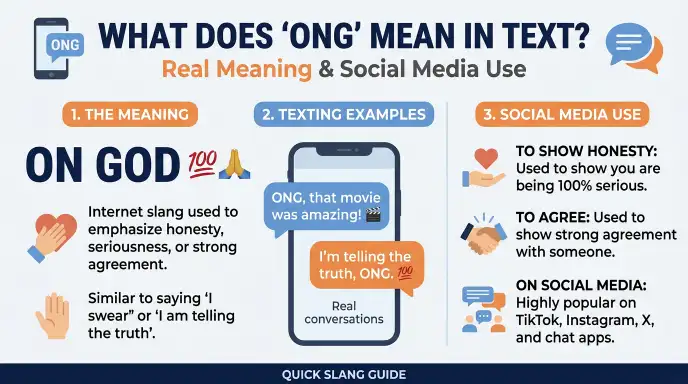
ONG in text most commonly stands for “on God,” a slang phrase people use to say they are telling the truth or being completely serious.
The phrase works like a promise, as if the writer is swearing on God that the statement is real. It grew out of African American Vernacular English (AAVE) and spread widely through hip-hop, TikTok, Snapchat, and Instagram. Because it is short and strong, it fits fast, casual chats.
In a message, ONG usually backs up a claim, a feeling, or a plan. For example, “I’m not lying, ONG” means “I swear I’m telling the truth,” and “That was the best meal ever, ONG” adds extra excitement. As a result, it gives a sentence more weight without a long explanation.
The tone is informal, so it suits friends and young audiences better than work or school messages. Some people may find the religious reference too strong, so it is wise to think about your audience before using it. In a different setting, ONG can also stand for other things, such as the abbreviation for “oil and natural gas,” so context always matters.
In this guide, you will learn the exact ONG meaning in text, how to use it in real conversations, and what its common variations are. You will also find examples, similar slang terms such as “ONB” and “FR,” and answers to frequently asked questions to help you use it with confidence.
Quick Answer:
ONG in text stands for “on God.” People use it to show they are telling the truth or being serious, like “I’m not lying, ONG.”
What Does ONG Stand for in Text?
ONG stands for “On God.” It is an informal expression that people use to emphasize honesty, sincerity, or strong feelings about something.
The phrase comes from the idea of calling on God to show that a statement is truthful or serious. In modern online communication, people often use the shortened form ONG because it is quick to type and easy to recognize.
For example:
- “ONG, I forgot about the homework.” :The person emphasizes that they genuinely forgot.
- “This song is perfect, ONG.” : The person strongly believes the song is excellent.
- “ONG, you made my day.”: The person expresses sincere appreciation.
ONG does not always mean that someone is making a religious statement. Many people use it casually as part of everyday internet language.
However, its original wording has a religious connection, so its meaning can carry more weight for some people than others.
Why Do People Use ONG?
People use ONG because it adds emphasis without requiring a long explanation. A short message can sound more convincing, emotional, or enthusiastic when someone includes it.
Common reasons include:
- Showing honesty: Emphasizing that something is true.
- Expressing agreement: Showing strong support for another person’s opinion.
- Adding excitement: Highlighting how impressive or surprising something feels.
- Showing frustration: Emphasizing annoyance or disbelief.
- Making conversations casual: Using familiar internet language with friends.
The surrounding words usually reveal which meaning fits best.
How Is ONG Used in Text Messages?
ONG can appear at the beginning, middle, or end of a message. Its placement depends on the speaker’s writing style and the emotion they want to express.
Here are common examples of how people use it in everyday conversations.
1. ONG to Show Honesty
Someone may use ONG when they want another person to believe what they are saying.
Example conversation:
Friend A: Did you really see him at the mall?
Friend B: ONG, I saw him near the food court.
In this example, the speaker emphasizes that the statement is true.
Another example:
“ONG, I didn’t tell anyone your secret.”
This message communicates that the person wants to be believed. Still, using ONG does not automatically prove that someone is telling the truth.
2. ONG to Express Agreement
People also use ONG when they strongly agree with something another person says.
Example conversation:
Alex: That exam was harder than I expected.
Sam: ONG, the last question was impossible.
Here, Sam uses ONG to show strong agreement with Alex’s opinion.
Other examples include:
- “ONG, that restaurant is so good.”
- “You’re right, ONG.”
- “ONG, we need another vacation.”
In these messages, the expression adds emphasis rather than introducing a new meaning.
3. ONG to Show Excitement
When something makes a person happy or excited, ONG can make the reaction feel more energetic.
Example conversation:
Friend A: Your favorite artist just announced a new album!
Friend B: ONG, finally!
The reply communicates excitement and anticipation.
People might also write:
- “ONG, this outfit looks amazing.”
- “ONG, I got the job!”
- “That concert was incredible, ONG.”
This usage is common in informal conversations where people want their messages to sound lively and expressive.
4. ONG to Express Frustration or Disbelief
ONG can also appear when someone feels annoyed, shocked, or overwhelmed.
For example:
Friend A: My phone battery died right before the call.
Friend B: ONG, that’s the worst timing.
Here, ONG adds frustration and emphasizes the situation.
Another example is “ONG, not this again.” Depending on the conversation, this could express annoyance, disbelief, or playful disappointment.
The expression does not always communicate happiness or agreement. Its emotional meaning comes from the words around it.
ONG Meaning on Social Media:
ONG appears across different social platforms, but people may use it in slightly different ways depending on the content and audience.
ONG on TikTok
On TikTok, users may include ONG in video captions, comments, and replies. It often emphasizes a strong reaction to a funny clip, relatable situation, opinion, or surprising moment.
Examples:
- “ONG, this is literally me.”
- “ONG, the ending shocked me.”
- “This trend is everywhere, ONG.”
TikTok comments often rely on short expressions to communicate emotions quickly. ONG fits naturally into this style of conversation.
ONG on Snapchat
On Snapchat, ONG commonly appears in direct messages and casual conversations between friends.
For example:
“ONG, send me the pictures from yesterday.”
Or:
“ONG, I thought you were coming!”
In these cases, the expression adds emphasis to an ordinary request or reaction.
ONG on Instagram
Instagram users may use ONG in comments, captions, and direct messages. It can communicate agreement, excitement, or admiration.
For example:
- “ONG, you look amazing!”
- “ONG, this is the best edit.”
- “That outfit is everything, ONG.”
Its meaning remains the same across these platforms, although the tone changes with the situation.
ONG on Discord and in Gaming Chats
In gaming communities and Discord servers, ONG may appear during live discussions, matches, or conversations about games.
For example:
“ONG, that was the luckiest win ever.”
Or:
“ONG, we almost lost that round.”
Players use the expression to react quickly to surprising events or emphasize their opinions. Like other internet abbreviations, its use depends on the community and the people participating in the conversation.
ONG Examples in Real Conversations:
The following examples show how ONG can fit into different everyday situations.
| Situation | Example message | Meaning |
| Honesty | “ONG, I didn’t touch it.” | I am emphasizing that I am telling the truth. |
| Agreement | “ONG, you’re absolutely right.” | I strongly agree with you. |
| Excitement | “ONG, we’re going to the concert!” | I am really excited. |
| Surprise | “ONG, that actually happened?” | I am shocked or surprised. |
| Frustration | “ONG, my internet stopped again.” | I am annoyed by the situation. |
| Compliment | “ONG, your hair looks great.” | I genuinely think your hair looks great. |
| Humor | “ONG, why am I like this?” | I am reacting humorously to my own behavior. |
These examples demonstrate why context matters. The same abbreviation can communicate different emotions without changing its basic meaning.
A Short Conversation Using ONG
Mia: Did you finish the assignment?
Noah: ONG, I finished it last night.
Mia: Seriously? I still have two pages left.
Noah: ONG, start now. You’ll get it done.
In this conversation, Noah first emphasizes that he completed the assignment. He then uses ONG again to stress his advice.
The expression makes the conversation sound casual and familiar, especially between friends.
ONG vs. ON GOD vs. FR:
ONG, ON GOD, and FR are related expressions, but they are not exactly the same in every situation.
ONG is the abbreviation of “On God,” while FR stands for “For Real.” Both can emphasize sincerity, agreement, or seriousness, but people may choose one over the other depending on their usual texting style.
| Slang | Full form | Common meaning | Example |
| ONG | On God | Emphasizing honesty or a strong feeling | “ONG, I’m telling the truth.” |
| ON GOD | On God | The complete phrase, often used for emphasis | “On God, that was amazing.” |
| FR | For Real | Expressing sincerity or agreement | “FR, that movie was great.” |
| FRFR | For real, for real | Adding extra emphasis | “FRFR, I mean it.” |
| ISTG | I Swear to God | Strongly emphasizing a statement or emotion | “ISTG, I didn’t know.” |
These expressions overlap, but they are not always interchangeable. For example, “FR, that’s true” sounds like agreement, while “ONG, I didn’t do it” more directly emphasizes the speaker’s claim of honesty.
ONG vs. OMG: What’s the Difference?
ONG and OMG look similar, but they have different meanings.
ONG means “On God,” while OMG means “Oh My God.”
People use ONG to emphasize sincerity, agreement, or a strong opinion. They commonly use OMG to express surprise, excitement, shock, or disbelief.
| Feature | ONG | OMG |
| Full form | On God | Oh My God |
| Main purpose | Emphasize sincerity or a strong opinion | Express surprise or excitement |
| Common tone | Serious, emphatic, or enthusiastic | Surprised, excited, or shocked |
| Example | “ONG, I told you already.” | “OMG, I forgot my keys!” |
| Typical use | Emphasizing a claim or reaction | Reacting to unexpected news |
For example, if your friend says, “ONG, I really saw that celebrity,” they are emphasizing their claim.
If they say, “OMG, I just saw that celebrity,” they are expressing surprise or excitement.
The expressions can sometimes communicate similar emotions, but their central meanings differ.
How Do You Reply to ONG in a Text?
Your response to ONG depends on what the other person is trying to communicate. You do not need to use slang in every reply. A simple, natural response is usually enough.
When Someone Uses ONG to Agree
If someone says, “ONG, that was the best movie,” you can respond with:
- “Right? I loved it.”
- “Exactly!”
- “I knew you’d agree.”
- “For real!”
These replies keep the conversation friendly and natural.
When Someone Uses ONG to Emphasize Honesty
If a friend says, “ONG, I’m telling the truth,” you could reply:
- “Okay, I believe you.”
- “Really? Tell me what happened.”
- “Got it, thanks for explaining.”
- “I hear you.”
Choose your response based on how well you know the person and what the conversation is about.
When Someone Uses ONG to Express Excitement
If someone texts, “ONG, I got the tickets!” you might say:
- “No way! That’s amazing!”
- “Let’s go!”
- “I’m so excited!”
- “That’s awesome!”
Matching the other person’s excitement can make the conversation feel more engaging.
When Someone Uses ONG to Complain
If someone says, “ONG, my laptop crashed again,” you can respond with:
- “Oh no, that sounds frustrating.”
- “Again? That’s so annoying.”
- “I hope you can fix it.”
- “Did you save your work?”
The best reply acknowledges the person’s feelings rather than focusing only on the abbreviation.
Is ONG Rude or Offensive?
ONG is generally informal rather than rude. Friends and people who regularly use internet slang often understand it as a normal part of online communication.
However, its suitability depends on the audience and setting.
In a casual group chat, writing “ONG, that was hilarious” is unlikely to seem unusual. In a formal email to a teacher, employer, or customer, the same expression may look too casual.
There is also a religious consideration. Because ONG stands for “On God,” some people may prefer not to use it casually. Others may use it frequently without intending a religious meaning.
Consider these points before using it:
- With friends: It usually fits naturally into casual conversation.
- On social media: It is common in informal comments and captions.
- At school or work: Use more formal language when appropriate.
- In religious or sensitive conversations: Consider your audience’s preferences.
ONG is not automatically offensive, but being aware of its original wording helps you use it respectfully.
Is ONG the Same as Swearing?
ONG can function like an oath or an emphatic promise, but it is not necessarily a swear word in the usual sense of profanity.
When someone says “ONG, I’m serious,” they are emphasizing the truth or importance of their statement. Some people may view the religious wording as inappropriate when used casually, while others consider it ordinary slang.
The key distinction is that ONG expresses emphasis through the phrase “On God.” It does not automatically contain profanity or an insult.
If you want to avoid religious wording, you can use alternatives such as “I swear,” “I’m serious,” “honestly,” or “for real,” depending on the situation.
Common Mistakes People Make With ONG:
Although ONG is easy to understand, a few mistakes can lead to confusion.
1. Thinking ONG Always Means Surprise
ONG can express surprise, but that is not its only meaning. It can also emphasize honesty, agreement, excitement, or frustration.
2. Assuming ONG Proves Someone Is Telling the Truth
A person may use ONG to sound convincing, but the abbreviation does not verify their claim. Consider the context and the available facts.
3. Confusing ONG With OMG
ONG means “On God,” while OMG means “Oh My God.” Their meanings overlap in some emotional situations, but they serve different purposes.
4. Using ONG in Every Message
Like any slang expression, ONG becomes repetitive if you use it too often. Use it when you want to add emphasis, not as a replacement for every other word.
5. Using It in the Wrong Setting
ONG usually fits casual conversations. For professional communication, clear and direct language is often more appropriate.
Understanding these differences makes it easier to recognize the expression and use it naturally.
FAQs:
What does ONG mean in texting?
ONG means “On God.” People use it to emphasize that they are being honest, strongly agree with something, or feel intensely about a situation.
What does ONG mean on TikTok?
On TikTok, ONG usually means “On God.” Users include it in comments, captions, and replies to emphasize opinions, express excitement, or react to relatable content.
Does ONG mean I swear?
ONG can communicate a meaning similar to “I swear” when someone wants to emphasize honesty. However, the exact tone depends on the conversation.
What does ONG mean from a girl or a boy?
The abbreviation has the same general meaning regardless of who uses it. A girl or boy might use ONG to show honesty, excitement, agreement, or frustration. The surrounding message matters more than the sender’s gender.
Can ONG mean something other than On God?
In common texting and social media slang, ONG usually stands for “On God.” Other interpretations may exist in specific groups or technical contexts, so the surrounding conversation can help clarify the intended meaning.
Is ONG a positive or negative expression?
ONG can be either positive or negative. Someone might use it to praise a song, agree with a friend, complain about a problem, or emphasize a serious statement.
What is the difference between ONG and FR?
ONG means “On God,” while FR means “For Real.” Both can emphasize sincerity or agreement, but ONG often has a stronger oath-like tone, while FR commonly signals agreement or confirms that something is genuine.
How should I respond when someone texts ONG?
Respond according to the message. You can say “For real?”, “I believe you,” “Exactly,” or “That’s amazing,” depending on if the person is emphasizing honesty, agreeing with you, or expressing excitement.
Final Thoughts:
ONG means “On God” in most texting and social media conversations. People use it to emphasize honesty, agreement, excitement, frustration, or a strong opinion. You may encounter it in messages on Snapchat, TikTok, Instagram, Discord, and other online platforms.
The easiest way to understand ONG is to read the complete message instead of focusing on the abbreviation alone. “ONG, I’m telling the truth” emphasizes sincerity, while “ONG, this song is amazing” expresses a strong positive opinion.
Now that you understand its meaning, examples, and differences from expressions such as OMG and FR, you can recognize ONG more confidently in everyday online conversations.
Related Topics!

Hi, I’m Jack Anderson, a writer at Slang Prime. I love exploring slang words, their meanings, and origins. My goal is to explain modern slang in simple language and help readers understand everyday expressions.