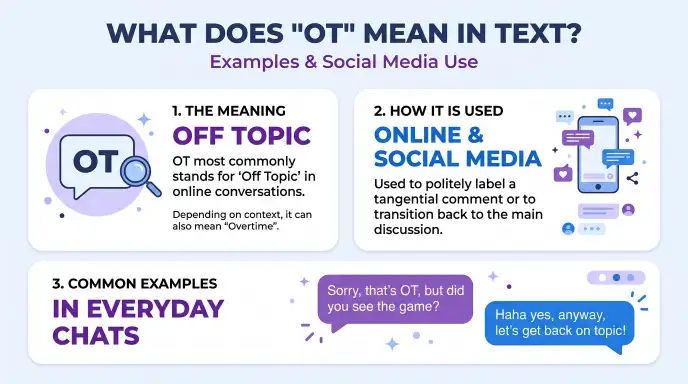
OT in text most commonly stands for “off topic,” a quick label people add when they are about to say something that does not fit the current conversation.
People use OT to avoid confusing a group chat or a forum thread. For example, “OT, did anyone see the game last night?” tells everyone the message has nothing to do with the earlier topic. It started in online forums and message boards, then spread to texting, Discord, and social media.
In casual chats, OT keeps conversations tidy and polite. It also works at the end of a message, such as “Sorry, OT but I need a charger.” As a result, readers know they can skip the message if it is not useful to them.
OT has other common meanings, so the setting matters a lot. At work, it usually means “overtime,” and in health, it can mean “occupational therapy.” Some people also use it for “over the top” when something feels too dramatic or extreme.
In this guide, you will learn the exact OT meaning in text, how to use it in real conversations, and what its other meanings are. You will also find examples, similar abbreviations such as “BTW” and “IIRC,” and answers to frequently asked questions to help you use it with confidence.
Quick Answer:
OT in text stands for “off topic.” People use it to show that their message does not fit the current conversation, like “OT, did anyone see the game?”
What Does OT Mean in Text Messages?
In text messages, OT can mean “off-topic” or “overtime.” These are two common interpretations, and the correct one usually becomes clear from the conversation.
People often use OT because it saves time when typing. Instead of writing a complete phrase, they use two letters that the other person can understand from context.
Here are two simple examples:
- Off-topic: “Sorry, this is a little OT, but did you watch the new movie?”
- Overtime: “I have to work OT tonight, so I might reply late.”
The first message changes the subject, while the second describes working extra hours.
OT can also have other meanings in specific communities. For example, it may refer to occupational therapy in healthcare or overtime in sports. That is why you should consider the topic before deciding what someone means.
Why Do People Use OT in Texting?
People use abbreviations to make conversations quicker and more casual. OT is especially useful when the meaning is already clear to the people involved.
For instance, friends discussing a movie might use OT to introduce an unrelated topic. In a work conversation, the same abbreviation might refer to extra hours on the job.
The main point is simple: OT does not have one universal meaning. Read the full message to understand which definition fits best.
The Most Common Meanings of OT:
OT can stand for different expressions depending on where you encounter it. The following table summarizes several common meanings and the situations in which they appear.
| Meaning of OT | Common situation | Example |
| Off-topic | Group chats and online discussions | “That comment is OT.” |
| Overtime | Work and sports | “I’m doing OT today.” |
| On time | Scheduling conversations, when context supports it | “The delivery was OT.” |
| Occupational therapy | Healthcare and rehabilitation | “She works in OT.” |
| Original trilogy | Movie and entertainment discussions | “I prefer the OT films.” |
These meanings are not equally common in every setting. Off-topic and overtime are particularly useful meanings to recognize, while the others depend more heavily on the subject being discussed.
1. OT Meaning Off-Topic
When someone uses OT to mean “off-topic,” they are talking about something that does not directly relate to the current discussion.
This meaning often appears in online forums, group chats, comment sections, and conversations where people are discussing a particular subject.
Examples include:
- “Sorry for going OT, but I have a question.”
- “Let’s not get OT during the meeting.”
- “That joke is funny, but it’s completely OT.”
- “Can we keep the discussion on topic instead of going OT?”
In these examples, OT signals that a message has moved away from the main subject.
For example, imagine your friends are discussing a football match. One person suddenly starts talking about a new phone. Another friend might reply, “That’s OT 😂.” They mean the conversation has moved away from football.
2. OT Meaning Overtime
OT also commonly means “overtime,” especially in workplace conversations and sports.
At work, overtime refers to working beyond regular hours. In sports, overtime is an additional period played when a game requires extra time to determine the result.
Examples include:
- “I have OT at work today.”
- “My manager asked me to stay for OT.”
- “The match went into OT.”
- “I earned extra money from working OT.”
Imagine your friend says, “Can’t hang out tonight. I’m doing OT.” They probably mean they need to work extra hours and cannot meet up.
In a sports conversation, someone might write, “What a game! It went to OT.” This means the match continued into an overtime period.
3. OT Meaning On Time
Some people may use OT to mean “on time,” particularly in personal shorthand or a conversation where they have already established the abbreviation.
However, this is less standardized than meanings such as off-topic and overtime. Many readers may not immediately understand it without additional context.
For example:
- “The train arrived OT.”
- “Try to be OT for the meeting.”
These messages may be intended to mean that something arrived or happened on time, but the abbreviation can cause confusion. For clear communication, writing “on time” is usually better.
4. OT Meaning Occupational Therapy
In healthcare and rehabilitation, OT commonly stands for “occupational therapy.”
Occupational therapy helps people develop, recover, or maintain skills needed for everyday activities. These may include dressing, eating, writing, working, or completing other daily tasks.
Examples include:
- “My sister studies OT.”
- “The patient has an OT appointment.”
- “He works as an OT professional.”
This meaning is more likely in a medical, educational, or professional discussion than in a casual conversation between friends.
How Is OT Used in Texting and Online Chats?
OT can make online conversations shorter, but its meaning changes depending on the setting. Recognizing the situation is often the easiest way to understand it.
OT in Conversations With Friends
Friends may use OT when they change subjects or discuss something unrelated to the original conversation.
Examples:
- “OT, but have you seen my keys?”
- “This is OT, but I need your advice.”
- “Sorry for the OT question 😂.”
- “We’re getting OT again. Let’s get back to the plan.”
The abbreviation helps the sender acknowledge that they are moving away from the main subject.
It does not automatically mean the new topic is unimportant. Someone may use OT simply because they want to ask a quick question before returning to the original conversation.
OT in Workplace Messages
In professional conversations, OT often refers to overtime. Employees may use it to discuss schedules, additional hours, workload, or pay.
Examples:
- “I’ll be doing OT until 7 PM.”
- “Can you confirm the OT schedule?”
- “I worked two hours of OT yesterday.”
- “I’m unavailable because of OT.”
In an office discussion about a report or meeting, OT might instead mean off-topic. Context determines which interpretation makes sense.
OT in Gaming and Sports
Sports conversations frequently use OT to refer to overtime. Fans may discuss an extra period in a match, while players may use the term when talking about game results.
Examples:
- “They scored the winning goal in OT.”
- “This match is going to OT.”
- “We lost in OT last night.”
In gaming communities, the meaning depends on the game and the conversation. OT may refer to overtime in a competitive match, but it can also be used to describe an unrelated discussion.
OT Texting Examples With Real-Life Situations:
Seeing OT in complete sentences makes it easier to understand how people use it naturally.
| Text message | Likely meaning | Explanation |
| “Sorry, going OT for a second.” | Off-topic | The sender is changing the subject. |
| “I’m stuck doing OT tonight.” | Overtime | The sender must work extra hours. |
| “The game ended in OT.” | Overtime | The match required additional playing time. |
| “That’s OT for this discussion.” | Off-topic | The message does not fit the main subject. |
| “She has an OT appointment tomorrow.” | Occupational therapy | The context suggests a healthcare appointment. |
| “Please arrive on time.” | No abbreviation needed | Writing the full phrase avoids confusion. |
Example 1: A Casual Conversation
Alex: “Did you finish the assignment?”
Sam: “Almost. OT, but did the teacher change the deadline?”
Alex: “Yeah, it’s due Friday now.”
Here, Sam uses OT to introduce a question that moves away from the original discussion.
Example 2: A Work Conversation
Mia: “Are you coming to dinner tonight?”
Jordan: “I don’t think so. I have OT until 8.”
Mia: “No problem. We can meet tomorrow.”
In this conversation, OT means overtime because Jordan is talking about work hours.
Example 3: A Sports Conversation
Chris: “Did your team win?”
Taylor: “Yes! They scored in OT.”
Here, OT refers to overtime in a sporting event.
Example 4: An Online Group Discussion
Member 1: “Let’s focus on the travel plans.”
Member 2: “Sorry, that was OT. Back to the hotel options.”
The second member acknowledges that their earlier message was unrelated to the group’s main discussion.
These examples show why you should avoid assuming that every use of OT has the same meaning.
OT vs. Other Common Text Abbreviations:
OT can sometimes be confused with other short forms used in messages. Learning the differences can help you interpret online conversations more accurately.
| Abbreviation | Meaning | Example |
| OT | Off-topic or overtime | “Sorry, that’s OT.” |
| BTW | By the way | “BTW, are you coming?” |
| OOO | Out of office | “I’m OOO tomorrow.” |
| BRB | Be right back | “BRB, answering the door.” |
| IMO | In my opinion | “IMO, this movie is great.” |
| ETA | Estimated time of arrival | “What’s your ETA?” |
OT vs. BTW
OT and BTW can both appear when someone introduces a new subject, but they serve different purposes.
BTW means “by the way.” People use it to add information or introduce another thought.
OT, when it means “off-topic,” highlights that the conversation is moving away from its original subject.
For example:
- BTW: “BTW, I bought tickets for Saturday.”
- OT: “OT, but can you help me with my homework?”
The two abbreviations can overlap in some conversations, but they are not interchangeable in every situation.
OT vs. OOO
OOO usually means “out of office,” especially in workplace emails, calendars, and messaging apps.
For example, “I’m OOO tomorrow” means the person will be away from work or unavailable in their usual work capacity.
OT, by comparison, may refer to overtime or an off-topic message.
The context makes the difference clear.
OT vs. IMO
IMO means “in my opinion.” People use it to share a personal view rather than state something as an unquestionable fact.
For example, “IMO, this is the best restaurant in town.”
OT does not express an opinion by itself. It usually describes a topic shift or overtime, depending on the conversation.
Does OT Have a Different Meaning on Social Media?
OT can appear on platforms such as TikTok, Instagram, Facebook, Reddit, Discord, and other messaging services. However, it does not have one special meaning that applies to every platform.
OT on TikTok and Instagram
On TikTok and Instagram, users may encounter OT in comments, captions, direct messages, or discussions about work and sports.
Examples include:
- “OT, but your outfit looks amazing.”
- “I have OT tomorrow, so I can’t go.”
- “That comment is OT for this post.”
The first example introduces an unrelated thought, the second refers to overtime, and the third points out that a comment does not fit the topic.
Always consider the surrounding content rather than assuming the platform determines the meaning.
OT on Reddit and Discord
On discussion-based platforms, OT can be particularly useful for identifying off-topic comments.
For example, a group might be discussing computer hardware when someone asks about a vacation. Another member could respond, “That’s a little OT for this thread.”
Some online communities have specific rules about staying on topic. In those settings, OT helps members describe posts or comments that move away from the discussion.
On Discord, however, OT may also refer to overtime in gaming chats or workplace communities.
OT in Text Messages
In ordinary SMS messages and private chats, OT usually depends on the sender’s habits and the conversation.
If a friend texts, “I’m working OT,” overtime is the natural interpretation. If they write, “OT, but I wanted to ask you something,” off-topic is more likely.
If neither interpretation seems to fit, asking a quick follow-up is perfectly reasonable.
How to Understand OT From Context:
You do not need to memorize every possible definition of OT. A few simple clues can help you identify the intended meaning.
1. Look at the Subject
First, consider what the conversation is about.
If people are discussing work schedules, overtime is a likely meaning. If they are discussing a specific topic in a group chat, off-topic may make more sense.
For example, “I have OT on Friday” in a work conversation probably refers to extra hours.
2. Read the Entire Sentence
The words around OT often provide the clearest clue.
Compare these messages:
- “Sorry, this is OT.” This probably means off-topic.
- “I’m getting paid for OT.” This means overtime.
- “My OT session is tomorrow.” In a healthcare context, this may mean occupational therapy.
The surrounding words help you distinguish between otherwise confusing interpretations.
3. Consider Who Sent the Message
A coworker, sports fan, friend, or healthcare professional may use the same abbreviation differently.
Someone discussing a shift schedule is more likely to mean overtime. A member of an online forum may use OT to point out an unrelated comment.
The sender’s usual communication style can also provide useful clues.
4. Ask for Clarification if Necessary
If you still cannot understand the message, ask politely.
You could say:
- “Do you mean overtime?”
- “Are you saying the message is off-topic?”
- “What does OT mean in this conversation?”
Abbreviations are meant to make communication easier. They should not leave you guessing when the meaning matters.
Is OT Formal or Informal?
OT can be appropriate in both casual and professional settings, but its suitability depends on the audience and purpose.
In casual chats, people often use OT without explaining it because they expect others to understand.
In professional communication, OT is commonly used for overtime when the workplace already recognizes the abbreviation. However, a formal email to someone unfamiliar with the term should spell it out the first time.
For example:
Casual message: “I’m doing OT tonight.”
More formal message: “I will be working overtime tonight and may respond later than usual.”
Similarly, when OT means off-topic, writing the full phrase may be clearer in a formal report or meeting summary.
The goal is not to avoid abbreviations completely. It is to choose language that your reader can easily understand.
Common Mistakes People Make With OT:
Even though OT is short, it can cause misunderstandings when people assume everyone uses it in the same way.
Assuming OT Always Means Overtime
Overtime is a common interpretation, but it is not the only one. In online discussions, OT frequently refers to off-topic content.
Always consider the conversation before deciding.
Confusing OT With a Universal Internet Slang Term
Unlike some internet expressions that have a fairly stable meaning, OT can refer to several different things.
It is an abbreviation rather than a slang word with one fixed definition. Its meaning often changes with the setting.
Using OT Without Enough Context
A message such as “OT tomorrow” may confuse the reader. Does it mean overtime tomorrow, an occupational therapy appointment, or something else?
A clearer message would be “I’m working overtime tomorrow.”
Using Too Many Abbreviations in Professional Messages
Short forms can save time, but using too many of them can make workplace communication difficult to follow.
When writing to clients, supervisors, or people outside your team, prefer clear wording whenever an abbreviation might be unfamiliar.
FAQs:
What does OT mean in texting?
OT commonly means “off-topic” or “overtime.” In a group discussion, it may indicate an unrelated subject. In a work message, it often refers to extra working hours.
What does OT mean from a girl or a guy?
OT does not have a different standard meaning based on the sender’s gender. Its interpretation depends on the message and the situation, not if a girl or guy sends it.
What does OT mean on Instagram?
On Instagram, OT can mean off-topic in comments or messages. It can also mean overtime when users discuss work or sports. The surrounding conversation helps determine the intended meaning.
What does OT mean at work?
At work, OT usually means overtime, which refers to working additional hours beyond a regular schedule. In some professional discussions, it can also mean off-topic.
What does OT mean in sports?
In sports, OT generally means overtime. It refers to an additional period of play used in competitions that require extra time to determine the outcome.
Does OT mean on time?
Some people may use OT informally to mean “on time,” but this interpretation is less standardized. Writing the full phrase is clearer when you want to avoid confusion.
Is OT slang?
OT is best described as an abbreviation that people use in texting and online communication. It can function like internet shorthand, but it also has established meanings in workplaces, sports, and healthcare.
How should I reply when someone says OT?
Your response depends on the meaning. If the person says they are working overtime, you could reply, “Hope your shift goes smoothly.” If they say something is off-topic, you could respond, “No worries, go ahead,” or return to the original subject.
Final Thoughts:
OT is a useful abbreviation, but its meaning depends on the conversation. The two interpretations worth recognizing first are “off-topic” and “overtime.” The first is common in online discussions and group chats, while the second often appears in workplace and sports conversations.
You may also encounter OT in healthcare, where it can stand for occupational therapy, or in less common informal uses.
When you see OT in a message, read the full sentence and consider the subject being discussed. If the meaning remains unclear, asking the sender is the easiest way to avoid a misunderstanding.
Once you understand these common uses, you can recognize OT more confidently in texts, social media comments, workplace messages, and online conversations.
Explore More!

I am Ann Raimes, an applied linguist and English language educator. I am widely recognized for my contributions to writing pedagogy and research in ESL writing. I have authored several well-known books, including Techniques in Teaching Writing, Keys for Writers, and How English Works: A Grammar Handbook with Readings. Throughout my career, I have worked to promote communicative writing and the process-based approach to teaching writing, helping both teachers and learners develop effective writing skills.