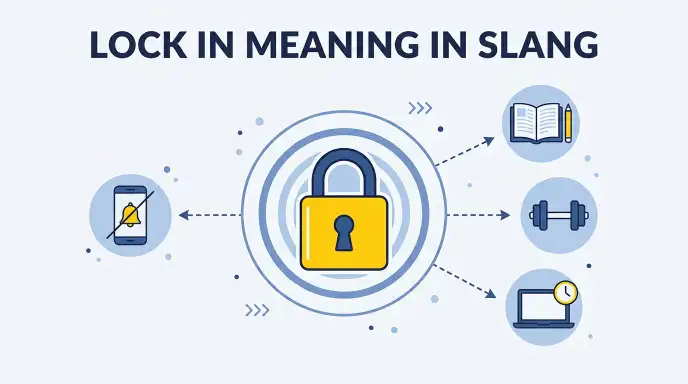
Lock in is slang for focusing completely on a task or goal, giving it your full attention and cutting out distractions.
People say “lock in” when they want to work hard. It means you stop playing around and give your best effort. The phrase is popular on TikTok, YouTube, and in gaming chats.
You can use it for studying, working out, or playing a game. For example, “I have an exam tomorrow, time to lock in.” It is a short way to tell yourself or a friend to get serious.
The word is friendly and not rude. Sometimes people use it as a joke, even for small things like cleaning a room. The emojis and the mood of the chat show if it is serious or funny.
In this guide, you will learn what lock in means and how to use it in a chat. You will also find simple examples, similar slang words, and answers to common questions.
Quick Answer:
“Lock in” means to focus fully, commit to a goal, or get serious about what you are doing. In slang, people often use it as encouragement to stop getting distracted and give their best effort.
What Does Lock In Mean in Text?
In text messages, lock in means to concentrate, become serious, and give your full attention to something important. It can also mean committing to a decision, plan, or person, depending on the context.
Friends often use this phrase to motivate each other. If someone keeps putting off their homework, a friend might say, “It’s time to lock in.” This means they should stop procrastinating and start working.
The expression is popular among students, gamers, athletes, and people who talk about self-improvement on social media.
Here are the main meanings of lock in:
- Focus: Give your full attention to a task.
- Commit: Decide to follow through with a plan.
- Get serious: Stop playing around and take responsibility.
- Perform well: Prepare mentally to do your best.
- Stay consistent: Keep working toward a goal without unnecessary distractions.
The phrase can also have other meanings in specific situations. For example, a person might say they have locked in a reservation, meaning they have confirmed it. Context helps you understand the intended meaning.
What Is the Definition of Lock In Slang?
Lock in is an informal expression that people use to describe focusing, committing, or becoming mentally prepared for a task.
The phrase comes from the everyday meaning of locking something securely in place. In slang, it suggests keeping your attention or commitment firmly on a particular goal.
Unlike an acronym, lock in does not stand for a longer phrase. It is a regular English expression that has become especially common in online conversations and motivational content.
For example:
- “I need to lock in for finals.” : I need to focus on my exams.
- “Lock in, bro!” : Get serious and concentrate.
- “I’m locked in today.” : I’m focused and ready to work.
- “We need to lock in our plans.” : We need to confirm our plans.
Lock In Meaning in Simple English
In simple English, lock in means to focus on what matters and stop wasting time on distractions.
Imagine you have an important exam tomorrow. Instead of scrolling through social media, you put your phone away and study. Your friend might say you are finally locking in.
The phrase can apply to almost any goal, including fitness, work, school, gaming, and personal development.
Where Did Lock In Slang Come From?
The phrase “lock in” did not begin as internet slang. English speakers have long used it to describe securing something, confirming a decision, or fixing something in place.
Over time, people also began using the phrase figuratively to describe concentration and commitment. The modern slang use builds on this familiar meaning: once you lock in mentally, your attention stays firmly on the task.
Social media, gaming communities, sports conversations, and motivational videos have helped make the expression more visible. On platforms such as TikTok, creators often use it in videos about studying, gym routines, productivity, and personal goals.
The phrase also works well as a short command. Saying “lock in” is a quick way to tell someone to stop getting distracted and focus on what they need to accomplish.
There is no single confirmed origin for its modern slang use. Rather, it developed from ordinary English and became popular through repeated use in different communities.
Today, you may hear it from a student preparing for an exam, a player getting ready for a competitive match, or a friend encouraging someone to take a goal seriously.
How to Use Lock In in Text Messages:
You can use lock in when you want to encourage someone, describe your own focus, or confirm a plan. Here are some common examples.
1. When Studying for Exams
Text: “Finals are coming. Time to lock in!”
Meaning: It’s time to focus on studying and prepare seriously for exams.
Students often use this phrase when deadlines or important tests are approaching.
2. When Working Toward a Goal
Text: “I’m locking in this month and hitting the gym every day.”
Meaning: The person is committing to a fitness routine and intends to stay focused.
In this example, lock in suggests discipline and consistency.
3. When Someone Is Distracted
Text: “Bro, lock in! We’ve got five minutes left.”
Meaning: The speaker wants the other person to pay attention and work faster.
This use may sound encouraging, urgent, or slightly impatient.
4. When Playing Video Games
Text: “One round left. Everyone lock in!”
Meaning: The team should concentrate and play seriously to improve its chances of winning.
Gaming communities often use the phrase before an important match or during a difficult round.
5. When Making a Commitment
Text: “I’ve locked in my plans for Saturday.”
Meaning: The plans are confirmed.
Here, the phrase uses the broader meaning of securing or finalizing something rather than focusing mentally.
These examples show that the phrase can express motivation, concentration, or a confirmed decision.
Lock In vs. Locked In vs. Lock It In:
These expressions look similar, but their grammatical forms and meanings can differ slightly.
| Phrase | Meaning | Example |
| Lock in | Focus or commit to something | “I need to lock in.” |
| Locked in | Already focused, committed, or confirmed | “I’m locked in for the exam.” |
| Lock it in | Confirm a decision or encourage someone to commit | “That date works. Let’s lock it in.” |
| Locking in | The ongoing action of focusing or committing | “I’m locking in for the next two weeks.” |
The main difference is how each phrase fits into the sentence. Lock in often describes an action or gives a command, while locked in describes a state that has already begun or a decision that is settled.
For example, “Lock in!” is a direct instruction. “I’m locked in” tells someone that you are already focused.
What Does “Lock In” Mean on TikTok and Social Media?
On TikTok and other social platforms, lock in often appears in motivational videos, study routines, fitness challenges, and self-improvement posts.
Creators use the phrase to encourage viewers to stop procrastinating, develop discipline, and work toward their goals.
For example, a student might post a video of a clean desk, open textbooks, and a study timer with the caption “Lock in season.” The caption means that the student is taking studying seriously.
Someone who wants to improve their fitness might write, “No more excuses. Time to lock in.” This suggests a renewed commitment to exercise and healthy habits.
Common social media expressions include:
- Lock in season: A period when someone plans to focus on their goals.
- Time to lock in: A reminder to start taking a task seriously.
- Locked in mode: A state of strong concentration and commitment.
- Stay locked in: Keep your attention on the goal.
- Lock in and level up: Focus on self-improvement.
People sometimes use the phrase humorously, too. Someone might post “I’m locked in” while doing something unimportant, making the phrase an exaggerated joke about concentration.
Is Lock In a Compliment, Command, or Motivational Phrase?
Lock in can serve several purposes, depending on who says it and why.
As a Motivational Phrase
Someone might say, “You’ve got this. Just lock in.”
They are encouraging you to concentrate and give your best effort.
As a Command
A coach, teammate, or friend might say, “Lock in now!”
They want you to pay attention and take the situation seriously. Depending on the tone, it can sound firm or impatient.
As a Personal Statement
You might text, “I’m locked in for the next three months.”
This means you have committed to working toward a goal during that period.
As a Playful Expression
Friends might joke, “Bro locked in just to win a mobile game.”
The speaker exaggerates the person’s focus for humor.
| Context | Example | Intended meaning |
| Studying | “Lock in for finals.” | Concentrate on studying |
| Fitness | “I’m locked in at the gym.” | Commit to training |
| Gaming | “Team, lock in!” | Focus and play seriously |
| Planning | “Let’s lock in Friday.” | Confirm the date |
| Humor | “He locked in to choose a pizza.” | Exaggerate someone’s focus |
The phrase is usually positive or neutral, but the tone can make it sound demanding.
Why Do People Say Lock In?
People use lock in because it expresses a simple idea in just two words: focus on what matters.
It can be useful when someone needs a quick reminder to stop procrastinating or prepare for an important task.
For students, it may mean putting away their phones and studying. Among athletes, it can mean mentally preparing before a game. In the workplace, it may mean concentrating on a deadline.
The phrase also fits modern online communication because it is short, direct, and easy to include in captions or messages.
However, locking in does not mean you must work constantly without taking breaks. Healthy concentration includes rest, planning, and realistic goals. A person can stay committed while still making time for sleep and relaxation.
The most useful interpretation is simple: give the task your attention, follow through on your commitment, and avoid distractions that prevent you from making progress.
Common Mistakes to Avoid When Using Lock In:
Although lock in is easy to understand, a few mistakes can cause confusion.
Mistake 1: Thinking lock in always means studying.
The phrase applies to many activities, including sports, work, fitness, gaming, and personal goals.
Mistake 2: Confusing focus with confirmation.
“Lock in for the exam” usually means concentrate, while “lock in the appointment” means confirm the appointment.
Mistake 3: Assuming it is always friendly.
“Lock in, bro!” may sound encouraging among friends, but it can sound impatient if someone says it sharply.
Mistake 4: Treating it as an acronym.
Lock in is a regular English expression, not an abbreviation with a full form.
Mistake 5: Using it in every formal message.
The phrase is common in casual speech. In formal writing, words such as concentrate, commit, finalize, or confirm may be clearer.
Mistake 6: Thinking being locked in means never resting.
The phrase suggests focus and commitment, not endless work. Breaks can help you maintain attention and perform better.
FAQs:
Q1: What is lock-in in Gen Z slang?
In Gen Z slang, “lock in” means to focus fully on a task, goal, or challenge and block out distractions. People say it before studying, working out, gaming, or finishing a deadline. It spread through TikTok, YouTube, and sports and gaming communities. The tone is positive and motivating, and it is not considered rude.
Q2: What does “lock in” mean in a relationship?
In a relationship, “lock in” or “lock it in” usually means to commit to someone or make things official. For example, “He finally locked it in” means a couple decided to be exclusive. It can also describe giving a relationship your full focus and effort. Because the phrase has two meanings, the conversation shows whether it is about commitment or about concentration.
Q3: What does it mean if someone tells me to lock in?
If someone tells you to lock in, they want you to focus, work harder, or take the moment seriously. Friends often say it before an exam, a game, or an important task, as encouragement. It can also be a light joke when the task is small. Check the tone and the situation, and you will know whether it is serious support or friendly teasing.
Q4: What does “lock in chat” mean in slang?
“Lock in, chat” is a phrase from livestreaming and gaming, where “chat” means the viewers watching and typing along. A streamer or a viewer may say it to tell the audience to focus on a tense moment, such as a hard boss fight or a close match. It can also be a hype message before something important. The phrase carries the same focus meaning as regular “lock in.”
Q5: What does “lock in” in slang mean?
In slang, “lock in” means to concentrate completely on what you are doing and give it your best effort. It works as a command (“lock in”) or as a statement (“I’m locked in”). People use it in captions, group chats, and motivation videos. The phrase is friendly, short, and easy to use in almost any casual conversation.
Q6: What is the locked in meme?
The “locked in” meme usually shows a character or a person suddenly becoming extremely serious and focused, often with dramatic music or an intense stare. The joke is that someone goes from relaxed to fully determined in a moment. It spread widely on TikTok and Instagram Reels, and people add the caption “locked in” to clips from games, movies, sports, and daily life. Memes change quickly, so exact versions may vary.
Q7: What does “18” mean in slang?
“18” has more than one meaning, so context matters. Most often it refers to the age of adulthood, as in “18+” for adult content or age limits. In Jewish culture, 18 is a meaningful number that stands for “chai,” the Hebrew word for life. Some hate groups also use “18” as a coded reference, so if you see it in an extreme or hateful setting, treat it with caution. In “lock in” conversations, it is most likely a simple number or age.
Q8: Is “lock” in modern slang?
Yes, “lock” is used in modern slang, although it has a few meanings. “Lock in” means to focus, and “lock it in” can mean to confirm a plan or commit. As a noun, “a lock” means something that is certain to happen, as in “that win is a lock” in sports and betting talk. The word also appears in phrases like “lock down” and “locked out,” so the full sentence tells you which meaning is used.
Final Thoughts:
Lock in is a useful slang expression that means to focus, get serious, and commit to a goal. People commonly use it in text messages, gaming chats, motivational videos, and social media captions.
Its meaning can change with the situation. “Lock in for finals” means concentrate on studying, while “lock in our plans” means confirm an arrangement. Understanding the context helps you recognize which meaning the speaker intends.
if you’re preparing for an exam, training at the gym, playing a game, or working toward a personal goal, the phrase offers a simple reminder: focus on what matters and follow through.
In this guide!

Hi, I’m Jack Anderson, a writer at Slang Prime. I love exploring slang words, their meanings, and origins. My goal is to explain modern slang in simple language and help readers understand everyday expressions.