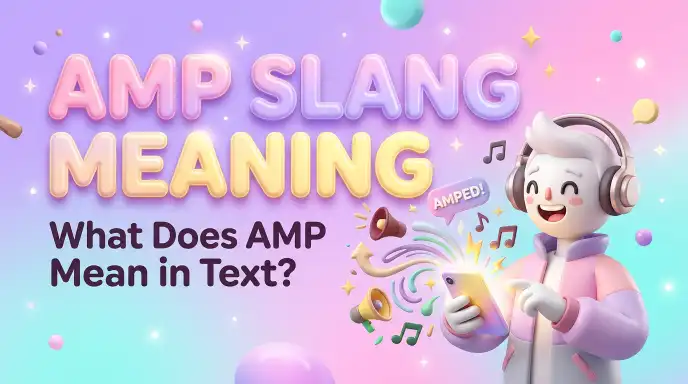
Amp is a slang word that means to get hyped, energized, or excited, and it is most often used in the forms “amped” and “amp up.”
The amp meaning in slang comes from the amplifier, a device that makes sound louder and stronger. In the same way, to “amp” something means to turn up the energy, excitement, or intensity.
On social media, “so amped” means super excited, as in “so amped for the trip.” People also say “amp it up” or “amp me up” to ask for more hype. Phrases like “amp it up” and “amp me up” also ask someone to bring more energy or hype.
The tone is almost always positive, but it can also mean nervous energy before a big event.The amp slang meaning is popular in gaming, sports, and fitness circles, where players say “I’m amped for the match” to show they are fired up and ready to go.
Amp also has other uses, such as a short form of amplifier, ampere, or “amphetamine” in some drug slang, so context matters. This guide explains what amp means in text, how to use it in a sentence, and which meaning fits each situation, with real chat examples.
Quick Answer:
AMP can mean “amplifier” or relate to being energized or hyped in informal contexts. Its exact meaning depends on the sentence, platform, and conversation.
What Does AMP Mean in Text?
AMP can have several meanings in digital communication, but the intended definition depends on how someone uses it.
The amped meaning in casual conversation is simple: it describes someone who is thrilled, fired up, and full of energy. Saying “I’m amped for the concert!” tells people you can’t wait for it to start.
AMP itself is also a common abbreviation for “amplifier,” a device that increases the strength of an electrical signal or sound. In other contexts, AMP stands for “Accelerated Mobile Pages,” a web technology associated with mobile page performance.
Here are the main meanings to recognize:
- Excitement or energy: Usually expressed through the word “amped.”
- Amplifier: A device used to increase sound or signal strength.
- Accelerated Mobile Pages: A web-related term.
- Other context-specific abbreviations: AMP can have specialized meanings in technology, business, music, and other fields.
It is important not to assume that AMP always means someone is excited. Look at the words around it to understand what the person means.
What Does “Amped” Mean in Slang?
“Amped” is an informal expression meaning excited, enthusiastic, energized, or ready for something.
Examples:
- “I’m so amped for the weekend!”
- “Fans were so amped before kickoff that the whole stadium was buzzing.”
- “Everyone is amped about the new update.”
In these sentences, the word describes a high level of excitement or energy.
People sometimes connect “AMP” with this slang meaning, especially in online conversations. The amp slang meaning mostly lives inside the word “amped.” That is the form people actually use to say they are excited, and “amp” by itself is rarely treated as a standalone slang abbreviation.
AMP Full Form: What Does AMP Stand For?
AMP has several full forms, and there is no single expansion that applies to every situation.
| AMP meaning | Full form or definition | Common context |
| Amp | Amplifier | Music and audio equipment |
| Amp | Ampere | Electricity and electrical measurements |
| AMP | Accelerated Mobile Pages | Web development and publishing |
| Amped | Excited or energized | Casual conversation |
| AMP | Context-specific abbreviation | Specialized communities and industries |
An ampere, often shortened to “amp,” is a unit used to measure electric current. In music, an amp is commonly short for an amplifier that makes an audio signal stronger.
In online communication, someone may use AMP in a way that relates to excitement, but this is not a universal texting definition.
What Does AMP Stand for on Social Media?
On social media, AMP can have different meanings depending on the account, topic, and conversation.
For example:
- In a music discussion, “amp” may refer to audio equipment.
- In a technology post, AMP may refer to Accelerated Mobile Pages.
- In a casual conversation about excitement, the related word “amped” may describe someone’s mood.
If you see AMP in a short message without additional context, you may need to ask the sender what they mean.
Is AMP Slang Rude, Offensive, or Neutral?
AMP is generally neutral. It is not inherently rude, insulting, or offensive.
When someone uses “amped” to describe excitement, the expression is usually positive and informal. For example, “I’m amped for the match” simply means the person is looking forward to it.
The abbreviation AMP is also neutral when used in technical discussions.
However, tone matters. Someone can use almost any word sarcastically or aggressively, depending on the situation. The abbreviation itself does not normally carry an offensive meaning.
Is AMP Appropriate for Professional Conversations?
It depends on what you are discussing.
- Casual messages: “I’m amped for the trip!” sounds natural in an informal conversation.
- Workplace messages: “I’m excited about the upcoming project” is clearer and more professional.
- Technical discussions: AMP is appropriate when the abbreviation is relevant to the subject.
- Formal reports: Spell out the intended term the first time if your audience may not recognize it.
The best choice is to use language that your audience can understand easily.
Where Is AMP Commonly Used?
AMP appears in different settings because it is an abbreviation with several meanings.
1. Text Messages and Group Chats
Friends may use “amped” to express excitement about an event, trip, game, or celebration.
Example: “I’m amped for Saturday!”
In this case, the word communicates enthusiasm.
2. Social Media Posts
People may write “amped” in captions or comments when discussing something they are excited about.
Example: “So amped to see my favorite band tonight!”
The word is casual and expressive, making it suitable for informal posts.
3. Gaming Communities
Gamers may use “amped” to describe excitement before a match or enthusiasm after a win.
Example: “Our squad is amped for the tournament.”
This is an illustrative use of the word “amped,” not proof that AMP itself has one fixed gaming definition.
4. Music and Audio Discussions
In music conversations, an amp usually means an amplifier.
Example: “I need a new amp for my guitar.”
Here, the word refers to equipment, not excitement.
5. Technology and Websites
In web development, AMP can refer to Accelerated Mobile Pages, a technology designed around mobile web page performance.
Example: “The developer is reviewing the site’s AMP implementation.”
This is a technical use rather than slang.
Real-Life Examples of AMP and Amped:
The following examples show how the abbreviation and related expression may appear in different situations.
Friendly Examples
These examples express excitement in a positive way.
- “I’m amped for your birthday party!”
- “We’re all amped about the vacation.”
- “You should be amped. Your team made the finals!”
- “I’m so excited for you!”
The first three examples use “amped” to express enthusiasm. The fourth uses a more standard alternative.
Casual Texting Examples
- “Bro, I’m amped for tonight!”
- “Just got the tickets. I’m so amped!”
- “Are you amped for the concert?”
- “I’m amped to try the new game.”
These messages are informal and work well between friends.
Argumentative or Frustrated Examples
“Amped” generally describes excitement or energy, but it can also describe someone who is highly worked up. In some contexts, it may suggest that a person is becoming emotionally intense.
- “You’re getting too amped over a small mistake.”
- “Everyone was so amped that nobody listened.”
- “Don’t get yourself amped up before the meeting.”
- “He was too worked up to have a calm conversation.”
In these examples, “amped up” can refer to heightened emotion rather than positive excitement.
Gaming and Social Media Examples
- “I’m amped for the final round!”
- “Our team is amped after that win.”
- “This update has me amped to play again.”
- “The crowd was amped during the livestream.”
These are examples of how people might use “amped” naturally in online settings.
Technical Examples
- “Turn down the amp before you connect the guitar.”
- “The technician checked the current in amps.”
- “The developer discussed AMP in the website project.”
These examples show why the surrounding topic matters when interpreting AMP.
AMP vs. Similar Slang and Abbreviations:
AMP can be confused with other expressions related to excitement, energy, or intensity. The following comparisons help clarify the differences.
| Term | Meaning | Example |
| Amped | Excited or energized | “I’m amped for the show.” |
| Hype | Excitement or anticipation | “There’s so much hype about the game.” |
| Pumped | Very excited or enthusiastic | “I’m pumped for the trip.” |
| Lit | Exciting, fun, or impressive in some contexts | “The party was lit.” |
| Fired up | Highly enthusiastic or emotionally energized | “The team is fired up.” |
AMP vs. Hype
“Hype” describes excitement, anticipation, or publicity surrounding something. “Amped” usually describes how a person feels.
For example:
- “There’s a lot of hype about the new movie.”
- “I’m amped to watch the new movie.”
The first sentence focuses on the excitement surrounding the movie. The second focuses on the speaker’s feelings.
Amped vs. Pumped
“Amped” and “pumped” are often interchangeable when describing enthusiasm.
- “I’m amped for the match.”
- “I’m pumped for the match.”
Both sentences express excitement. The choice often comes down to personal preference and conversational style.
AMP vs. Ampere
These terms are related in spelling but differ in meaning.
| Term | Meaning | Where it appears |
| AMP | An abbreviation with several possible meanings | Technology, audio, and other contexts |
| Amp | A shortened form of ampere or amplifier | Electricity and music |
| Amped | Excited or energized | Informal conversation |
The key difference is that “amped” is an informal descriptive word, while “amp” often refers to a technical unit or device.
Origin and Background of AMP and Amped:
The word “amp” is commonly used as a shortened form of “amplifier” or “ampere.” Both terms are connected to increasing or measuring electrical signals and current.
The informal expression “amped” developed from the idea of increasing energy or intensity. It is now commonly used to describe someone who feels excited, energized, or highly enthusiastic.
For example, a person might say, “I’m amped for the competition,” to show that they feel ready and excited.
Although the expression is established in informal English, AMP does not have one universal slang origin or a single accepted expansion for texting. Claims that it always stands for a particular phrase should be treated cautiously unless the specific community clearly defines it.
When Should You Avoid Using AMP Slang?
Although “amped” is generally harmless, informal language may not fit every situation.
1. Formal Emails and Reports
Use clear professional language when writing to clients, managers, or people who may not understand the expression.
Instead of “I’m amped about the proposal,” write “I’m excited about the proposal.”
2. Technical Conversations Without Context
If you use AMP in a technical discussion, explain which meaning you intend when there is a chance of confusion.
For example, specify “audio amplifier” or “Accelerated Mobile Pages” rather than assuming everyone understands the abbreviation.
3. Serious or Sensitive Situations
“Amped up” can suggest heightened emotions. If someone is upset, describing them as “amped” might sound dismissive or judgmental.
A more considerate expression could be “You seem stressed” or “Let’s take a moment to talk calmly.”
4. Messages to People Who May Not Know the Slang
Not everyone uses the same informal expressions. If clarity matters, choose a straightforward alternative such as “excited” or “enthusiastic.”
Polite Alternatives to AMP and Amped:
If you want to express excitement in a clear or professional way, consider these alternatives.
| Alternative | Best use | Example |
| Excited | General conversation | “I’m excited about the trip.” |
| Enthusiastic | Professional or formal settings | “The team is enthusiastic about the project.” |
| Looking forward to it | Polite everyday communication | “I’m looking forward to the event.” |
| Eager | Work, school, or personal plans | “I’m eager to get started.” |
| Energized | Describing motivation or energy | “I feel energized after the workout.” |
These alternatives communicate a similar idea without relying on slang.
Why Do People Use AMP or Amped?
People use informal expressions like “amped” because they communicate emotion quickly and naturally.
Common reasons include:
- Expressing excitement: The word shows enthusiasm about an event or activity.
- Sounding conversational: It fits naturally into messages between friends.
- Adding energy: It makes a sentence sound more expressive than simply saying “I’m ready.”
- Connecting with a group: Shared slang can help people feel part of a social or online community.
- Keeping messages short: Informal expressions can communicate a feeling without a lengthy explanation.
However, using AMP without context may create confusion because it has several meanings. When writing online, it is best to make the intended meaning clear.
Is AMP Safe to Use on Social Media?
Yes, AMP and “amped” are generally safe to use on social media. The word is not inherently offensive or inappropriate.
You can use “amped” in:
- Instagram captions about events and trips.
- TikTok comments expressing excitement.
- Group chats about games or concerts.
- Gaming conversations about upcoming matches.
- Posts celebrating achievements.
For example: “I’m amped for the weekend!”
This is a normal, positive use of the expression. Just remember that AMP may have a different meaning in a technical post or a specialized community.
FAQs:
Q1: What does “amp” mean in slang?
In slang, “amp” means to get hyped, energized, or pumped up. It is most often used as “amped” or “amp up,” as in “I’m so amped for the concert.” The word comes from the amplifier, which turns the volume up, so to amp something is to turn up its energy or intensity.
Q2: What does amp stand for on social media?
On social media, amp is usually not an abbreviation but a short form of “amped,” meaning excited or hyped. You will see it in captions and comments like “amped for the weekend.” In a technical context, AMP can also stand for Accelerated Mobile Pages, a Google format for fast-loading mobile web pages, so check the context.
Q3: What does amp mean?
Amp has a few meanings depending on the setting. In everyday speech it is short for amplifier, the device that boosts sound, and in science it is short for ampere, the unit of electric current. As a verb in slang, it means to increase energy, excitement, or intensity.
Q4: What does & mean in texting?
“&” is not slang. It is an HTML code that stands for the ampersand symbol (&). It shows up in messages and posts when a website or app fails to display the “&” sign correctly, so “Tom & Jerry” really means “Tom & Jerry.” If you see it in a text, the sender simply meant “and.”
Q5: What is AMP in social media?
In social media and digital marketing, AMP means Accelerated Mobile Pages, an open-source format that helps web pages load faster on phones. Publishers and creators used it so shared links would open quickly. It is a technical term and has nothing to do with the slang meaning of being hyped.
Q6: What does “amp” mean in chat?
In chat, “amp” or “amped” means someone is excited, energized, or ready for something, as in “I’m amped for the game tonight.” Friends also say “amp me up” to ask for hype or motivation. The tone is almost always positive, though it can sometimes describe nervous energy before a big event.
Conclusion:
AMP slang meaning depends on where and how the abbreviation appears. In casual conversations about excitement, the related expression “amped” means excited, energized, or enthusiastic. However, AMP can also refer to an amplifier, an ampere, Accelerated Mobile Pages, or another specialized term.
The abbreviation does not have one universal texting full form, so avoid assuming that every person uses it in the same way. Check the surrounding words and the topic of the conversation before deciding what it means.
If you want to express excitement clearly, “I’m amped” is a natural informal choice. In professional or unfamiliar settings, words such as “excited,” “eager,” and “enthusiastic” may be easier for everyone to understand.
Kye insights!

Hi, I’m Jack Anderson, a writer at Slang Prime. I love exploring slang words, their meanings, and origins. My goal is to explain modern slang in simple language and help readers understand everyday expressions.