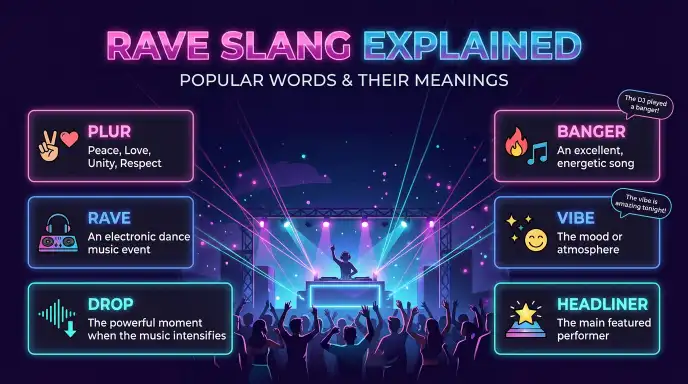
Rave slang is the set of casual words and phrases used by electronic music fans and party-goers, such as “PLUR,” “kandi,” “the drop,” and “raver.”
Rave culture grew out of underground dance parties in the late 1980s and early 1990s, and it brought its own language with it. Fans use these words to talk about the music, the fashion, and the community. Today, festivals and social media have made the slang popular well beyond the dance floor.
Many terms describe the sound and the stage. For example, “the drop” is the moment a track hits its biggest beat, and “a set” is the performance a DJ plays. “PLUR” stands for peace, love, unity, and respect, and “kandi” refers to colorful beaded bracelets that ravers trade as a friendly gesture. As a result, a simple phrase like “trading kandi at the main stage” says a lot about the culture.
The slang also changes by scene, country, and generation, so a word used at one festival may sound strange at another. Some terms are cheerful and welcoming, while others are inside jokes shared by small groups. Listening first and following the crowd is the best way to use these words naturally.
In this guide, you will learn the most popular rave slang words, what each one means, and how people use them in real conversations. You will also find examples, related festival terms, and answers to frequently asked questions to help you understand the culture with confidence.
Quick Answer:
Rave slang refers to the informal words and expressions used in rave and electronic music communities. Popular terms include PLUR (Peace, Love, Unity, Respect), kandi (colorful handmade bead bracelets), and headliner (a featured performer).
What Does Rave Slang Mean?
Rave slang is informal language associated with rave parties, electronic music festivals, DJs, and dance music communities. People use it to communicate quickly, describe experiences, and express their connection to the scene.
For example, someone might post, “The vibes were amazing, and the headliner absolutely crushed it!” This means the atmosphere was great and the main performer delivered an excellent performance.
Unlike ordinary texting abbreviations, rave slang often reflects a shared culture. Some terms describe music and performances, while others represent friendship, creativity, and respect among attendees.
What Does Rave Mean?
A rave is a dance event centered on electronic music, often featuring DJs, elaborate lighting, and energetic crowds. Raves may take place in clubs, warehouses, outdoor spaces, or large festival venues.
Rave culture includes more than music. It can involve distinctive clothing, visual art, handmade accessories, dancing, and community traditions.
Popular Rave Slang Words and Their Meanings:
Several expressions appear frequently in conversations about electronic music events. Understanding them can help you follow festival discussions and communicate with other fans.
| Rave slang | Meaning | Example |
| PLUR | Peace, Love, Unity, Respect | “Keep the PLUR spirit alive.” |
| Kandi | Handmade bead bracelets exchanged at events | “I made kandi for my friends.” |
| Headliner | A major featured performer | “The headliner starts at midnight.” |
| Drop | The moment a track builds into a powerful musical section | “That drop was incredible!” |
| Set | A DJ’s or performer’s scheduled performance | “Her set was my favorite.” |
| Vibes | The atmosphere or overall feeling | “The vibes were perfect.” |
| EDM | Electronic dance music | “I listen to EDM every weekend.” |
| Raver | Someone who attends or enjoys rave events | “He’s been a raver for years.” |
| Afterparty | A gathering or party following the main event | “Are you going to the afterparty?” |
| B2B | Back-to-back performance by two DJs | “Those DJs are playing B2B.” |
Not every term is exclusive to raves. Words such as “vibes,” “drop,” and “set” also appear in wider music culture.
What Does PLUR Mean in Rave Culture?
PLUR stands for Peace, Love, Unity, and Respect. It is a well-known expression of the community values associated with rave culture.
People use PLUR to encourage kindness, inclusion, and consideration for others. You might see it on clothing, bracelets, social media captions, or festival signs.
For example: “Look out for your friends and treat everyone with respect. That’s PLUR.”
What Does Kandi Mean?
Kandi refers to colorful, handmade bead bracelets and other accessories popular in parts of rave culture. People often create them with words, symbols, or playful designs and exchange them with other attendees.
Kandi can serve as a way to express creativity and make connections with people who share similar interests.
What Does a Drop Mean?
A drop is a musical moment when a buildup transitions into a strong beat or more intense section of a track. It is often a highlight of electronic dance music.
For example: “The crowd went wild when the beat dropped.”
Where Is Rave Slang Commonly Used?
Rave slang appears in several settings, from live music events to online communities. The meaning usually becomes clear when you understand the conversation.
1. Music Festivals and Rave Events
At festivals, people use rave vocabulary to discuss performers, schedules, music, clothing, and experiences.
Examples include:
- “Which stage has the best set tonight?”
- “The headliner was amazing.”
- “Let’s meet near the main stage.”
- “I love the energy at this festival.”
These expressions help attendees coordinate plans and share their excitement.
2. TikTok and Instagram
Social media users often include rave slang in captions, videos, comments, and festival recaps.
For example:
- “PLUR all weekend.”
- “Still thinking about that drop.”
- “Festival vibes were unmatched.”
- “My favorite set of the year.”
Hashtags and community expressions help people find videos related to DJs, festivals, outfits, and electronic music.
3. Group Chats and Text Messages
Friends use rave slang to organize meetups, discuss tickets, and share memories.
For example:
Friend A: “Who’s going to the rave on Saturday?”
Friend B: “I’m going! I can’t wait for the headliner.”
Friend A: “Same. Let’s meet before the first set.”
In this conversation, the slang is casual and practical rather than formal.
4. Online Gaming and Music Communities
Some rave terms also appear in gaming streams, music forums, Discord servers, and communities focused on electronic music production.
People may discuss a song’s drop, recommend a DJ set, or describe a high-energy atmosphere using words such as “fire,” “vibes,” and “banger.”
Real-Life Examples of Rave Slang:
The following examples show how people may use rave-related language in everyday conversations.
Friendly Examples
- “I made you a kandi bracelet for the festival.”
- “Let’s stay together and look out for each other.”
- “The PLUR energy was amazing last night.”
These expressions emphasize friendship and community.
Casual Examples
- “That DJ’s set was unreal.”
- “The drop in that song is so good.”
- “The vibes at the festival were incredible.”
These messages communicate excitement about music and events.
Argumentative Examples
Rave slang can also appear when people disagree about music or event experiences.
- “That set wasn’t my vibe, but the next DJ was great.”
- “The headliner was good, but the sound quality was disappointing.”
- “You can’t call it the best drop ever just because it’s your favorite song.”
These examples show that slang does not always express positivity. Tone and wording determine if a message sounds respectful or confrontational.
Social Media Examples
- “POV: Your favorite DJ plays your favorite track.”
- “Still recovering from those festival vibes.”
- “That B2B set deserves another listen.”
- “The crowd went to get confused when the drop hit.”
These are natural examples of how music fans describe memorable moments online.
Rave Slang vs. General Internet Slang:
Although rave slang and internet slang sometimes share similar expressions, they are used in different contexts. Rave slang is rooted in electronic dance music, music festivals, colorful outfits, and the culture surrounding rave events. Internet slang, on the other hand, covers a much broader range of expressions used in text messages, online gaming, social media, and digital conversations. Knowing the difference makes it easier to understand how people communicate both at music events and online.
| Rave-related term | General internet slang | Difference |
| PLUR | IMO | PLUR expresses community values; IMO means “in my opinion.” |
| Kandi | Drip | Kandi refers to handmade accessories; drip describes stylish clothing or appearance. |
| Headliner | GOAT | A headliner is a featured performer; GOAT means “greatest of all time.” |
| Drop | Fire | A drop is a musical moment; fire means something is excellent or impressive. |
| B2B | IRL | B2B describes a back-to-back DJ performance; IRL means “in real life.” |
Knowing the difference helps you choose words that fit the conversation.
Rave Slang vs. Music Industry Terms:
Some expressions belong mainly to rave communities, while others are standard music industry vocabulary.
| Term | Main meaning | Typical context |
| Raver | A person who attends or enjoys rave events | Community and lifestyle |
| Kandi | Handmade bead accessories | Rave fashion and friendship |
| DJ set | A scheduled music performance | Clubs, festivals, and events |
| Headliner | A featured or major performer | Event schedules and promotions |
| B2B | Two DJs performing back-to-back | DJ lineups and collaborations |
These distinctions are useful for beginners who are learning how rave events work.
Where Did Rave Slang Originate?
Modern rave slang developed alongside rave culture and electronic dance music communities. Rave scenes grew in different forms during the 1980s and 1990s, particularly in the United Kingdom and other parts of Europe and North America.
As these communities expanded, attendees developed shared expressions for music, dancing, events, fashion, and social connections.
PLUR became particularly associated with rave culture through the broader electronic music scene. Kandi traditions also became recognizable in parts of the North American rave community.
Social media has helped spread these terms to people who may never have attended a rave. Today, someone can encounter rave vocabulary through a TikTok video, a DJ livestream, a music playlist, or a festival announcement.
However, rave culture is not identical everywhere. Terminology and traditions can vary by country, generation, music genre, and local community.
Is Rave Slang Rude or Offensive?
Most common rave terms are neutral, positive, or descriptive. Words such as “headliner,” “set,” “kandi,” and “drop” are generally not offensive.
PLUR is also associated with positive community values.
However, not every term used at a rave is appropriate in every situation. Some expressions may refer to intoxication, sexual behavior, or other adult topics. Their appropriateness depends on the specific word, audience, and context.
A good rule is to consider who will read your message. Informal expressions may work well among friends but may be confusing in professional conversations or family-friendly posts.
When Should You Avoid Rave Slang?
Avoid unfamiliar slang when:
- Writing a formal email or business message.
- Communicating with someone who may not understand the terminology.
- Publishing content for a broad audience without explaining specialized terms.
- Discussing sensitive subjects where clarity matters.
- Using language that could make another person feel uncomfortable or excluded.
When in doubt, use plain English and explain specialized vocabulary.
Why Do People Use Rave Slang?
People use rave slang for several practical and social reasons.
It creates a sense of community. Shared expressions help attendees feel connected to a music scene.
It makes communication quicker. Terms such as “B2B,” “set,” and “headliner” can communicate specific information without lengthy explanations.
It expresses excitement. Words such as “fire,” “banger,” and “vibes” help people describe music they enjoy.
It reflects personal identity. Some fans use rave vocabulary in their clothing, social media profiles, and conversations to express their interests.
It helps people share experiences. Familiar terms make it easier to describe performances, festival memories, and connections with other music fans.
Rave slang is not simply a collection of unusual words. It is also part of how communities share interests and communicate their experiences.
FAQs:
Q1. What does “rave girl” mean?
A “rave girl” is a woman or girl who regularly attends raves, electronic dance music (EDM) festivals, or club nights. The term is often linked to a colorful, expressive style: neon outfits, glitter, bodysuits, fishnets, platform boots, and handmade kandi bracelets. It describes a lifestyle and fashion scene, not a personality type.
Q2. What do they call rave girls?
Rave girls are commonly called ravers, rave babes, festival girls, or festies. Within the community, people also use terms like PLUR girls or rave fam members. “Raver” is the most widely used and neutral term.
Q3. What do rave people say?
Ravers use a shared slang built around music and community. Common phrases include:
- PLUR: Peace, Love, Unity, Respect, the unofficial motto of rave culture
- Rave fam: friends or fellow ravers
- Drop: the high-energy moment in a song when the beat or bass kicks in
- Set: a DJ’s live performance
- Kandi: colorful beaded bracelets traded between ravers
- Vibes: the overall mood or energy of an event
- Stay hydrated: a popular safety reminder in the community
Q4. What does “rave” mean?
“Rave” has two main meanings. As a noun, a rave is a large dance party, often held at night in a club, warehouse, or outdoor venue, with electronic music, DJs, and light shows. As a verb, to rave means to speak or write about something with great enthusiasm, as in “a rave review.”
Q5. What is “rave” slang for?
In slang, “rave” refers to an electronic dance music party or event. It can also mean praising something excitedly, such as “she raved about the concert.” The word first became popular in the UK in the 1980s and 1990s with the growth of acid house and dance music culture.
Q6. Is a rave girl a red flag?
No. Being a rave girl is not a red flag. Enjoying raves and festival fashion says nothing about someone’s character, loyalty, or values. A person’s honesty, respect, and behavior matter far more than their hobbies or style. As with anyone, judge by actions and communication, not by the scene they enjoy.
Conclusion:
Rave slang is an important part of the language surrounding electronic dance music, festivals, and rave communities. Terms such as PLUR, kandi, headliner, drop, and B2B help people describe music, events, friendships, and community traditions.
Understanding these expressions can make festival conversations, social media posts, and music discussions easier to follow. Although some terms are widely recognized, others vary between communities, so context is always important.
if you’re new to electronic music or simply curious about the vocabulary, learning a few common rave expressions can help you understand the culture and communicate more confidently.
Learn More!

Hi, I’m Jack Anderson, a writer at Slang Prime. I love exploring slang words, their meanings, and origins. My goal is to explain modern slang in simple language and help readers understand everyday expressions.