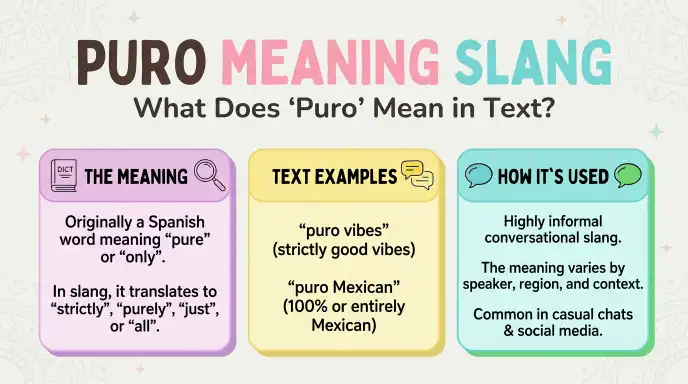
Puro is a Spanish-origin slang word that means “pure,” “only,” or “nothing but,” and in texting it is used to stress that something is all one thing.
The puro meaning in slang comes from the Spanish word for “pure,” but online it works as an emphasis word. People use it to say a situation, place, or person is full of just one thing, like “puro drama” or “puro party.”
You will mostly see this slang in Spanglish chats, TikTok captions, and Instagram comments. Chicano and Mexican-American communities in the US helped spread it, and now many Gen Z users use it too.
In text, puro usually sits before a noun to show “all of this and nothing else.” Saying “puro love” means only love, while “puro chisme” means nothing but gossip.
If you are asking what puro means in text, think of it as a casual way to say “straight up” or “all of it.” Tone and context matter, because it can sound fun, proud, or sarcastic.
This guide explains the meaning of puro, how to use it in a sentence, and where it came from. You will also find real chat examples and common mistakes to avoid.
Puro Meaning Slang: Quick Answer
Puro is a Spanish word that means “pure” or “only,” but its slang meaning depends on context. People may use it to show pride in their culture, hometown, community, or way of life. In phrases like “puro 956,” it can express a strong connection to a place or community.
Examples:
- “Puro Mexican!” can express Mexican pride or identity.
- “Puro 956!” can show pride in the 956 area code in South Texas.
- “Puro love!” can mean nothing but love or lots of love, depending on the speaker.
The key is to read the whole phrase. Puro may be a simple Spanish word, a cultural expression, or part of a local slang phrase.
What Does Puro Mean?
The Basic Meaning of Puro
In Spanish, puro is an adjective that often means “pure,” “clean,” or “free from other things.” It can also mean “only,” “nothing but,” or “just,” depending on how it is used.
For example, “agua pura” means “pure water.” In a phrase like “puro trabajo,” the meaning may be “nothing but work” or “just work.”
The word can also appear in everyday expressions. Its exact meaning changes with the sentence, the region, and the speaker’s intention.
What Does Puro Mean in Slang?
In slang, puro often adds emphasis. It can suggest that something is real, genuine, strongly connected to a group, or full of a particular quality.
For example, a person who writes “puro orgullo” may be expressing strong pride. Someone who says “puro Texas” may be showing love for Texas or identifying with its culture.
In some Mexican and Mexican American communities, puro is used in phrases that celebrate a hometown, regional identity, music, or cultural background. The word can sound warm, proud, playful, or enthusiastic.
However, puro does not always mean “pride.” In other sentences, it may simply mean “only” or “nothing but.” Context matters.
What Does Puro Mean in Text Messages?
When someone sends puro in a text, look at the words around it.
| Text phrase | Possible meaning |
| “Puro love” | Nothing but love or lots of love |
| “Puro Mexican” | Mexican pride or a strong Mexican identity |
| “Puro 956” | Pride in the 956 area code or its community |
| “Puro party” | Only partying or a party-focused mood |
| “Puro facts” | Nothing but facts, or strong agreement with what was said |
These are examples of possible meanings, not fixed definitions. A phrase may have a special meaning among friends or within a local community.
The Origin of Puro:
Where Does the Word Puro Come From?
Puro comes from Spanish. It is related to the idea of purity and can describe something that is pure, unmixed, or free from unwanted additions.
Spanish speakers have used the word in everyday language for a long time. It appears in ordinary descriptions, expressions, and phrases. Its use in slang grew from the flexibility of the word and the way people use it to emphasize a quality or identity.
Because Spanish is spoken across many countries and communities, the word can take on different shades of meaning in different places.
Why Is Puro Used in Mexican and Mexican American Slang?
Puro is especially recognizable in some Mexican and Mexican American expressions. Speakers may use it to celebrate their roots, hometown, neighborhood, music, or community.
For example, a person might write “puro San Antonio” to show love for San Antonio. Another person might use “puro rancho” to express a connection to rural life or their hometown roots.
In these settings, puro can communicate more than its literal dictionary meaning. It may signal belonging, shared experience, or pride in where someone comes from.
Still, not every Spanish speaker uses the word in the same way. Its slang meaning depends on regional speech, personal style, and the situation.
British English vs American English:
Is Puro Different in British and American English?
Puro is a Spanish word, so it does not have a standard British English spelling and an American English spelling. The spelling remains puro in both contexts.
The main difference is where people are likely to encounter its slang use. In the United States, puro may appear in Mexican American communities, especially in areas with strong Mexican cultural ties. In the United Kingdom, someone may encounter it through Spanish-language conversations, music, online content, or contact with Spanish-speaking communities.
The meaning still depends on context rather than English spelling rules.
| Feature | British English context | American English context |
| Spelling | Puro | Puro |
| Word origin | Spanish | Spanish |
| Literal meaning | Pure or only, depending on context | Pure or only, depending on context |
| Slang use | Depends on the speaker and community | Common in some Mexican American expressions |
| Best way to understand it | Read the full phrase | Read the full phrase |
Does Puro Have One Meaning Around the World?
No. Spanish is spoken in many countries, and local expressions vary. A phrase that sounds natural in one community may be uncommon or unfamiliar in another.
For this reason, do not assume that every use of puro refers to Mexican identity. It may express pride, emphasis, exclusivity, or a literal sense of purity.
Which Meaning of Puro Should You Use?
The right interpretation depends on the audience and situation.
- In the United States: Consider whether the phrase refers to a Mexican American community, a hometown, a regional identity, or something else.
- In the United Kingdom: Use the surrounding words to understand whether puro is being used literally or as slang.
- In Mexico: Pay attention to regional expressions and the speaker’s tone. Local meanings may differ.
- In international conversations: Explain the phrase if your audience may not know Spanish slang.
- In academic writing: Use the literal translation or explain the slang meaning rather than assuming all readers know it.
- In business writing: Avoid casual slang unless it fits the audience and purpose.
- On social media: Puro may work as an expression of pride, excitement, or community belonging when the context is clear.
If you are unsure, do not guess from the word alone. Ask the speaker what they mean or look at the entire message.
Common Mistakes About Puro:
Mistake 1: Thinking Puro Always Means Pure
Incorrect assumption: Puro always means pure in every sentence.
Better understanding: The literal meaning is often “pure,” but in common Spanish usage it can also mean “only,” “just,” or “nothing but.”
Memory tip: Translate the whole phrase, not just one word.
Mistake 2: Assuming Puro Is Always Mexican Slang
Incorrect assumption: Only Mexican people use puro.
Better understanding: Puro is a Spanish word used in many Spanish-speaking communities. Some slang expressions are especially associated with Mexican or Mexican American culture, but the word itself is not limited to those groups.
Memory tip: Separate the Spanish word from its regional slang uses.
Mistake 3: Treating Every Phrase as a Fixed Expression
Incorrect assumption: “Puro love” and “puro 956” mean the same thing.
Better understanding: The words that follow puro change its meaning. One phrase may express affection, while another may express local pride.
Memory tip: Read the entire phrase before interpreting it.
Mistake 4: Assuming It Is Offensive
Incorrect assumption: Puro is a rude or insulting word.
Better understanding: Puro is not inherently offensive. It is an ordinary Spanish word that can be used in casual, positive, or neutral ways. Its tone depends on the phrase and the situation.
Memory tip: Look at the speaker’s intent and the surrounding conversation.
Mistake 5: Using It Without Understanding the Context
Incorrect example: Adding “puro” to a phrase just because it sounds trendy.
Better approach: Learn what the full expression means and how people in that community use it before repeating it.
Memory tip: Understand the expression before using it.
Puro in Everyday Examples:
Puro can appear in conversations, social media captions, music, and casual messages. These examples show how its meaning can change with the context.
1. Puro in Text Messages
Example:
“Tonight is puro fun!”
Meaning: The speaker means that the night is all about having fun.
This is an informal, illustrative example. A speaker’s natural wording may vary by region.
2. Puro in Social Media Captions
Example:
“Puro orgullo de mi gente!”
Meaning: “Nothing but pride in my people!” The caption expresses a strong sense of pride and belonging.
Someone might use a phrase like this to celebrate family, friends, or their community.
3. Puro in Music and Entertainment
Puro may appear in song lyrics, artist names, music captions, and entertainment discussions. In some contexts, it can emphasize authenticity, cultural roots, or a particular style.
Example:
“Puro sabor!”
Meaning: Literally, this can mean “pure flavor.” Depending on the context, it may suggest strong flavor, style, energy, or a distinctive cultural feel.
The phrase should be interpreted based on how it is used in the song or conversation.
4. Puro in Daily Conversation
Example:
“Es puro café.”
Meaning: “It is pure coffee” or “It is nothing but coffee,” depending on the intended meaning.
This example shows that puro is not always slang. It can be part of ordinary Spanish speech.
5. Puro in a Friendly Conversation
Example:
“Puro apoyo para ti!”
Meaning: The speaker is expressing strong support for someone.
The wording may be informal or regional, so it should not be treated as a universal expression used by all Spanish speakers.
6. Puro in a Business or Formal Setting
In formal writing, it is usually better to choose a clear translation rather than use slang without explanation.
For example, instead of writing “puro support,” write “strong support” or “full support,” depending on what you mean.
This makes your message easier for readers who do not know Spanish.
Puro Meaning in Modern Usage and Online Culture:
Why Do People Search for Puro?
People often search for puro after seeing it in a social media caption, a song, a video, or a message from a friend. They may know that it is Spanish but not understand why it appears in a particular phrase.
The word is interesting because it can be literal or expressive. In one sentence, it may describe something pure. In another, it may emphasize pride, identity, or a strong feeling.
Is Puro Popular on TikTok and Instagram?
Puro may appear in captions, hashtags, comments, and short videos, especially when content relates to Spanish-speaking communities or Mexican American culture. However, its visibility varies by audience, location, and trend.
Without verified search data, it would not be accurate to claim that puro is trending in a specific country or that its popularity has increased by a certain percentage.
The most useful way to understand a post containing puro is to read the full caption, consider the creator’s background when relevant, and look at the subject of the video.
Does Puro Have a Hidden Meaning?
Not usually. Puro is a real Spanish word with established meanings. Some expressions that include it may have local, cultural, or slang meanings that are not obvious to outsiders.
For example, a phrase that includes a city name or an area code may refer to local pride. A phrase about love or support may simply emphasize the feeling.
Do not assume a secret or inappropriate meaning without evidence from the conversation.
Quick Comparison Table: Different Uses of Puro
| Expression | Meaning | Usage | Tone |
| Puro | Pure, only, or nothing but | Everyday Spanish | Neutral |
| Puro Mexican | Mexican identity or pride | Cultural or casual context | Often proud |
| Puro 956 | Pride in a community linked to area code 956 | Regional expression | Often enthusiastic |
| Puro love | Nothing but love or strong affection | Informal messages | Warm |
| Puro orgullo | Nothing but pride | Captions and conversation | Positive |
| Puro sabor | Pure flavor or strong style, depending on context | Food, music, or cultural expression | Expressive |
These translations are context-sensitive. They describe common possible interpretations rather than fixed meanings for every speaker.
Key Takeaways:
- Puro is a Spanish word that often means “pure.”
- Depending on the sentence, it can also mean “only,” “just,” or “nothing but.”
- In slang, it may express pride, identity, authenticity, or strong feelings.
- Some uses are associated with Mexican and Mexican American culture.
- The word is not inherently offensive.
- Its meaning depends on the phrase, speaker, and situation.
- Puro is spelled the same in British and American English contexts.
- Read the entire message before deciding what the word means.
FAQs:
Q1: What does “pure” mean in slang?
In slang, “pure” is mostly an intensifier that means “very,” “really,” or “totally.” It is especially common in Scottish, Irish, and northern English speech, as in “that’s pure brilliant” or “she was pure raging.” Don’t mix it up with “puro,” a Spanish word that looks similar and has a different meaning.
Q2: What is the meaning of puro?
Puro is a Spanish adjective that literally means “pure,” “clean,” or “unmixed.” It can also mean “only” or “nothing but,” and as a noun (un puro) it means a cigar. In English-language chats, people usually borrow it for the “nothing but” sense, like “puro drama.”
Q3: What does “purr” mean in Gen Z slang?
“Purr” is a Gen Z exclamation of approval, excitement, or confidence, similar to “slay” or “yes, queen.” People use it to react to a great outfit, a smart move, or good news. It grew out of Black and LGBTQ+ ballroom culture before spreading through TikTok. It is unrelated to “puro” apart from the similar sound.
Q4: What is the difference between “puro” and “pura”?
The difference is grammatical gender. Puro goes with masculine nouns, as in “puro oro” (pure gold), and pura goes with feminine nouns, as in “pura mentira” (pure lie). The meaning is the same in both. The plural forms are “puros” and “puras.”
Q5: What does “puro” mean in slang?
As slang, puro signals that something is completely one thing. It usually comes before a noun to say “all of this, nothing else,” for example “puro love,” “puro chisme” (nothing but gossip), or “puro Texas” (all Texas pride). It is popular in Spanglish captions and comments, and the tone can be proud, playful, or sarcastic depending on context.
Q6: What does pura mean?
Pura is the feminine form of “pure” in Spanish, used with words like “agua” (water) or “verdad” (truth). Its best-known use is the phrase “pura vida” (“pure life”), a Costa Rican expression that works as hello, goodbye, or “all is good.” In slang it carries the same “nothing but” feeling as puro, as in “pura diversión” (pure fun).
Conclusion:
The meaning of puro slang depends on how the word is used. In Spanish, puro often means “pure,” “only,” or “nothing but.” In casual conversations and cultural expressions, it can also communicate pride, authenticity, affection, or a strong connection to a place or community.
You may see phrases such as “puro Mexican,” “puro 956,” and “puro love” in messages, captions, and online videos. Each phrase can have a different meaning, so it is important to read the surrounding words rather than assume that puro always means the same thing.
The word itself is not offensive. It is a normal Spanish word that has different uses in everyday speech and slang. Its tone depends on the speaker, the audience, and the situation.
If you are trying to understand a message with puro in it, begin with the basic meaning of “pure” or “only,” then look at the context around it. When it appears with a hometown, culture, or community, as in “puro Texas,” it often shows pride and belonging. When it sits next to an object or a substance, such as “puro oro,” it usually keeps its plain, literal meaning.
Kye insights!
- Italian Slang for Friend: Common Words & How Italians Use Them:
- Mainey Slang Meaning in Text: What Does Mainey Mean?
- Nap Meaning Slang: What Does “Nap” Mean in Text?

Hi, I’m Jack Anderson, a writer at Slang Prime. I love exploring slang words, their meanings, and origins. My goal is to explain modern slang in simple language and help readers understand everyday expressions.