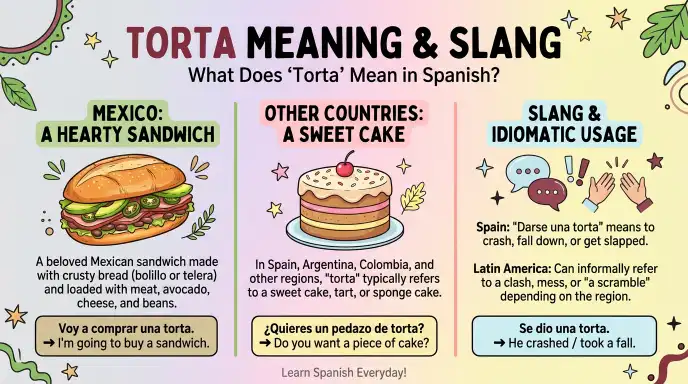
Torta is a Spanish word that means “cake” or “sandwich,” and in slang it can also mean a slap or, in some regions, an offensive term for a lesbian.
The torta meaning in Spanish slang changes from country to country. In Mexico it is a popular sandwich served on a soft roll, while in Spain and much of Latin America it often means cake or a flat pie.
In everyday slang, “dar una torta” means to slap or hit someone, and a big hit is called a “tortazo.” You will hear this in casual chats, jokes, and street talk, so tone and context matter.
In some places, such as Argentina and parts of Latin America, torta is also used as a slur for a lesbian. It can sound rude or hurtful, so it is best to avoid using it unless you know the culture well.
This guide explains what torta means in Spanish slang, how people use it in real sentences, and which meaning fits each region. You will also find simple examples so you do not use it the wrong way.
Quick Answer:
Torta is a Spanish word that often means a sandwich in Mexico or a cake in several other Spanish-speaking regions. Depending on the context, it can also be slang for a slap or hit.
What Does Torta Mean in Spanish Slang?
The meaning of torta depends mainly on the country and the surrounding conversation. Although it is a common Spanish word for food, some speakers also use it informally to describe physical actions or other local expressions.
For example, in Mexico, someone might say “Me comí una torta”, meaning “I ate a sandwich.” In an informal expression such as “Te voy a dar una torta,” the speaker may mean “I’m going to give you a slap,” depending on the region and context.
Here are the main meanings to know:
- Sandwich: A common meaning in Mexican Spanish, especially for a bread roll filled with meat, cheese, vegetables, or sauces.
- Cake: In some countries and regions, torta refers to a cake or baked dessert.
- Slap or hit: In certain informal expressions, the word can refer to a slap or physical blow.
- Regional slang: Its meaning may vary depending on local speech, humor, and the relationship between speakers.
The key is not to assume that every use of torta has a slang meaning. It is often simply an ordinary food word.
Torta Meaning in Different Situations
| Situation | Possible meaning | Example |
| Ordering food in Mexico | Sandwich | Quiero una torta. |
| Talking about dessert | Cake | La torta está deliciosa. |
| Informal warning in some regions | Slap or hit | Te voy a dar una torta. |
| Casual conversation | A regional expression | Meaning depends on the full sentence |
If you encounter the word online, read the surrounding message before deciding what the speaker means.
What Is the Full Form of Torta?
Unlike internet abbreviations such as LOL or BRB, torta does not have a standard full form. It is a regular Spanish word rather than an acronym.
Its meaning comes from Spanish vocabulary and regional usage, not from a set of initials.
People sometimes search for “torta full form” or “what does torta stand for” because they encounter unfamiliar words in chats and social media posts. However, there is no widely recognized slang expansion in which each letter of TORTA represents a separate word.
The correct interpretation comes from the language, region, and context in which someone uses it.
Is Torta Rude, Offensive, or Neutral?
In most everyday situations, torta is a neutral word. If someone uses it to talk about a sandwich or cake, there is generally nothing rude about it.
However, its tone can change when someone uses it to describe a slap or hit. In that situation, the phrase may sound threatening, playful, or aggressive, depending on the conversation.
When Torta Is Neutral
The word is usually neutral when people discuss food, restaurants, recipes, or meals.
Examples:
- “Let’s get tortas for lunch.”
- “My grandmother makes a delicious torta.”
- “Which torta do you want to order?”
These examples involve food and do not carry an insulting meaning.
When Torta Can Sound Aggressive
A phrase such as “Te voy a dar una torta” may be understood as a threat to slap someone in certain Spanish-speaking contexts.
Friends might use similar expressions jokingly, but the same words could sound hostile during an argument. Your relationship with the speaker and their tone of voice matter.
It is best not to interpret every use as an insult. Equally, do not assume a potentially threatening expression is harmless simply because the speaker uses casual language.
Where Is Torta Commonly Used?
Torta is used across many Spanish-speaking communities, but its everyday meaning differs by region.
Mexico
In Mexico, torta commonly means a sandwich made with a bread roll, often filled with ingredients such as meat, cheese, beans, avocado, tomato, or chili.
For example:
- “Vamos por unas tortas.” : “Let’s go get some sandwiches.”
- “Me gusta la torta de milanesa.” :“I like the breaded-meat sandwich.”
The word can also appear in informal expressions with meanings beyond food. Local context determines the intended meaning.
Spain
In Spain, torta can refer to different types of flatbreads, cakes, or baked goods, depending on the region. Some informal expressions also use the word to refer to a slap.
For instance, “Le dio una torta” may mean “they slapped him or her” in a context where that usage is familiar.
Other Spanish-Speaking Countries
In several Latin American countries, torta can mean cake, although other words may be more common in particular places.
For example, pastel is widely used for cake in some regions, while torta is preferred in others. Local culinary traditions influence these differences.
This regional variation explains why two Spanish speakers may understand the same word differently.
Real-Life Examples of Torta in Spanish Slang:
The easiest way to understand torta is to see how the word works in different conversations. These examples illustrate common food meanings and possible informal uses.
Friendly Conversations
Example 1
Person A: “¿Qué quieres comer?”
Person B: “Una torta de pollo.”
English meaning:
Person A: “What do you want to eat?”
Person B: “A chicken sandwich.”
Example 2
Person A: “Tu torta se ve deliciosa.”
Person B: “Gracias, la compré cerca de la escuela.”
English meaning:
Person A: “Your sandwich looks delicious.”
Person B: “Thanks, I bought it near the school.”
Casual Conversations
Example 3
Friend A: “¿Vamos por tortas después del trabajo?”
Friend B: “¡Claro! Tengo hambre.”
English meaning:
Friend A: “Shall we get sandwiches after work?”
Friend B: “Sure! I’m hungry.”
Example 4
Person A: “Mi mamá hizo una torta para el cumpleaños.”
Person B: “¡Qué bien! ¿De qué sabor es?”
English meaning:
Person A: “My mom made a cake for the birthday.”
Person B: “That’s great! What flavor is it?”
Here, the intended meaning depends on the speaker’s regional variety of Spanish.
Argumentative or Threatening Contexts
Example 5
Person A: “¡Ya basta! Te voy a dar una torta.”
Possible English meaning:
“That’s enough! I’m going to slap you.”
This is an illustrative example of an informal regional expression. It may sound threatening rather than friendly.
Example 6
Person A: “No quiero pelear contigo.”
Person B: “Entonces, cálmate y hablemos.”
English meaning:
Person A: “I don’t want to fight with you.”
Person B: “Then calm down and let’s talk.”
This example shows a more constructive way to handle a tense exchange without using threatening language.
Gaming and Social Media Contexts
Example 7
Comment: “Esa torta se ve increíble.”
Meaning: “That sandwich or cake looks amazing.”
The precise food meaning depends on the image and the speaker’s region.
Example 8
Chat message: “¿Quién trae las tortas para la reunión?”
Meaning: “Who’s bringing the sandwiches for the gathering?”
Although torta may appear in gaming chats or social media posts, it is not a universal gaming abbreviation. Its meaning still depends on the conversation.
Torta vs. Similar Spanish Words:
Spanish has several words that may seem interchangeable with torta, but their meanings vary by region. Understanding the differences can help you avoid confusion when reading messages or speaking with native speakers.
Comparison Table: Torta vs. Other Food Words
| Spanish word | Common English meaning | Important detail |
| Torta | Sandwich or cake | Meaning varies by country |
| Pastel | Cake | Common in many Latin American regions |
| Sándwich | Sandwich | Widely understood across Spanish-speaking regions |
| Bocadillo | Sandwich or filled roll | Common in Spain; usage varies elsewhere |
| Tarta | Tart or cake | Often used for desserts in Spain |
These words are not always direct substitutes. For example, ordering a torta in Mexico may get you a filled bread roll, while using the same word elsewhere could suggest a baked dessert.
Comparison Table: Torta vs. Informal Expressions
| Expression | General meaning | Typical tone |
| Dar una torta | To give someone a slap in some regional usage | Potentially aggressive |
| Dar una bofetada | To slap someone | Direct and relatively standard |
| Dar una cachetada | To slap someone | Common in many Latin American varieties |
| Dar un golpe | To hit or strike someone | General and direct |
| Dar un abrazo | To give someone a hug | Friendly and affectionate |
The first three expressions can overlap, but regional preferences differ. The important distinction is that torta may refer to food or a physical action, while the other expressions make their intended meaning clearer in most contexts.
Origin and Background of the Word Torta:
The word torta has a long history in Spanish and is not a newly invented internet slang term.
It is related to the Latin word torta, associated with something twisted or rounded, and historically developed in connection with bread and baked foods. Over time, the word became established in different Spanish-speaking regions, where local cooking traditions shaped its meaning.
How Its Meanings Developed
Food terms often change as they move between countries and communities. In Mexico, torta became strongly associated with filled bread rolls. In other places, the word remained associated with cakes, flatbreads, or other baked foods.
Informal expressions developed alongside these everyday meanings. In some varieties of Spanish, torta is used for a slap or blow. This regional use does not mean that the word always carries an aggressive meaning.
There is no single modern social media trend responsible for all the meanings of torta. Its different uses reflect the wider history and regional diversity of Spanish.
Why Do People Use Torta in Conversation?
People use torta because it is familiar, convenient, and meaningful within their local Spanish-speaking community. Most of the time, they are talking about food rather than using a special slang expression.
Common Reasons People Use the Word
- Everyday communication: People use it to order food, discuss recipes, or talk about meals.
- Regional identity: Local vocabulary can reflect where someone grew up or which Spanish variety they speak.
- Informal expressions: In some regions, people use torta in familiar expressions that refer to a slap or hit.
- Humor and casual speech: Friends may use regional expressions playfully, depending on their relationship and tone.
- Online communication: People naturally bring the vocabulary they use offline into messages, comments, and social media posts.
Understanding these reasons helps you interpret the word without assuming it is automatically slang or offensive.
When Should You Avoid Using Torta as Slang?
You can generally use torta when discussing food, but you should be more careful with expressions that suggest hitting or threatening another person.
Situations That Require Caution
Avoid using a potentially aggressive expression when:
- You are speaking to someone you do not know well.
- You are in a professional or formal setting.
- You are unsure if the other person understands your regional slang.
- The conversation is already tense or argumentative.
- Your words could be interpreted as a threat rather than a joke.
If you are learning Spanish, it is better to understand an expression before using it. A phrase that sounds playful among close friends may sound rude or intimidating to someone unfamiliar with the local usage.
Polite Alternatives to Torta-Related Expressions:
If you want to communicate clearly without sounding aggressive, choose words that describe what you mean directly.
Better Ways to Express Yourself
| Instead of saying | You could say | English meaning |
| Te voy a dar una torta | Cálmate, por favor | Please calm down |
| Quiero una torta | Quiero un sándwich | I want a sandwich |
| No me des una torta | No me pegues | Don’t hit me |
| Dame una torta | Dame un sándwich | Give me a sandwich |
The food-related alternatives may not always describe exactly the same dish. In Mexico, for example, sándwich and torta can refer to different types of sandwiches.
The best choice depends on if you are talking about food, setting a boundary, or trying to calm a difficult conversation.
How Torta Affects Communication:
Regional slang can make conversations feel more natural and help speakers connect with people who share their vocabulary. However, it can also create confusion when people come from different linguistic backgrounds.
Benefits and Possible Problems
Benefits
- Helps learners understand everyday Spanish.
- Makes regional conversations easier to follow.
- Reveals cultural differences in vocabulary.
- Helps people interpret comments, jokes, and informal messages.
Possible problems
- Different countries may use the word differently.
- A food-related meaning may be confused with an informal expression.
- A joke about hitting someone may be taken as a real threat.
- Literal translations may miss the speaker’s intended meaning.
The simplest solution is to pay attention to the complete sentence, the conversation topic, and the speaker’s tone. When necessary, ask what the person means instead of guessing.
Is Torta Safe to Use on Social Media?
Yes, torta is generally fine to use on social media when you are talking about food. For example, posting a picture with the caption “Mi torta favorita” is an ordinary way to discuss a favorite sandwich or cake.
The word itself is not inherently inappropriate or unsafe for social platforms.
However, an expression that threatens violence can be interpreted differently from a harmless food reference. If your comment could sound aggressive, choose clearer and more respectful wording.
Remember that online readers cannot always hear your tone of voice. A phrase intended as a joke between friends may seem hostile when strangers read it without context.
FAQs:
Q1: What does it mean if a guy calls a girl a torta?
It depends on the region, the tone, and how well they know each other. In Mexican and Chicano slang, it can be a casual way to call a girl curvy or soft-bodied. Some people mean it as a compliment, while others find it rude or body-shaming. If the speaker is a stranger or sounds mocking, it is better to treat it as disrespectful.
Q2: What is a Spanish torta girl?
A “torta girl” is not an official Spanish term. It is informal slang, mostly from Mexican and Mexican-American speech, that borrows the word torta (a sandwich on a soft roll) to describe a girl with a full, rounded figure. In some Latin American countries, torta can also be an offensive word for a lesbian, so the meaning changes with the place.
Q3: What is a torta girl’s body type?
Torta girl slang usually points to a curvy, soft, or fuller body type. Because it is a nickname and not a measurement, there is no fixed definition, and different people use it differently. The word is subjective, so it is best not to label anyone with it unless they are comfortable with it.
Q4: What is a torta girl on TikTok?
On TikTok, “torta girl” appears in captions, jokes, and trend videos, where creators use it to describe themselves or others as curvy, often in a playful or confident way. Many creators use it as a self-description and as a body-positive label. The meaning can still shift from one video or comment section to another, so check the context.
Q5: Why do guys like torta girls?
There is no single reason, since attraction is personal. In online posts, people who use the term often say they like it because it stands for a natural, curvy, and confident look rather than a single “ideal” body. Beauty standards differ across cultures and people, so this is a matter of taste and not a rule.
Q6: What does a torta girl look like?
There is no set look. The slang is tied to a fuller, curvier figure, but it says nothing about height, face, or style. Because it is an informal label, two people using the word may picture different things.
Q7: Why is torta slang for fat girl?
The idea comes from the food. A torta is a thick, soft, filled sandwich, so the word became a comparison for a soft or full figure. That is why it can feel like a joke, a compliment, or an insult depending on who says it and how. Since it can be used to mock body size, many people see it as a negative label.
Q8: How big is a torta woman?
There is no official size. Torta is a slang nickname and not a body measurement, so it does not refer to a specific weight, height, or clothing size. Its meaning depends entirely on the speaker and the situation.
Q9: What is a torta lover?
Literally, a torta lover is someone who loves eating tortas, the popular Mexican sandwich. Online, the phrase is sometimes used jokingly for a person who likes curvy women, but that use is informal and not widely standardized. In most conversations, it simply means a fan of the sandwich.
Conclusion:
The meaning of torta in Spanish slang depends on where the word is used and what the speaker is talking about. In Mexico, it most commonly refers to a sandwich, while in other Spanish-speaking regions it can mean a cake or another baked food. In certain informal expressions, it can also refer to a slap or hit.
If you encounter torta in a message or social media comment, look at the surrounding words before deciding what it means. The food-related meaning is usually neutral, but expressions involving physical aggression require more care.
Understanding these regional differences will help you interpret Spanish conversations more accurately and use the word appropriately in everyday communication.
Deep dive!

I am Ann Raimes, an applied linguist and English language educator. I am widely recognized for my contributions to writing pedagogy and research in ESL writing. I have authored several well-known books, including Techniques in Teaching Writing, Keys for Writers, and How English Works: A Grammar Handbook with Readings. Throughout my career, I have worked to promote communicative writing and the process-based approach to teaching writing, helping both teachers and learners develop effective writing skills.