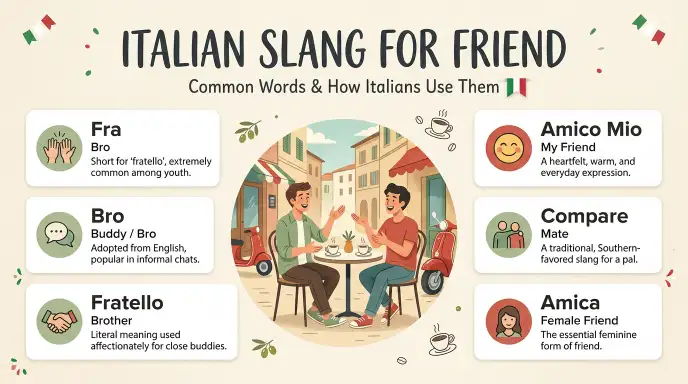
Italian slang for friend includes popular words like “fra,” “zio,” “bro,” and “socio,” which Italians use in casual talk instead of the standard word “amico.”
The standard word for a friend is “amico” for a man and “amica” for a woman, and people use it in every situation. Slang words add a more relaxed and playful tone, especially among teens and young adults. Many of them borrow family terms, such as “fra” (short for “fratello,” meaning brother) and “zio” (uncle).
For example, a friend might say “Ciao fra, come stai?” to greet a close buddy in a friendly way. In some places, “bella” works as a warm greeting for both individuals, and “socio” is a casual word for a partner or pal. As a result, the right word often depends on who you are talking to and where you are in Italy.
Slang changes by region and by age, so a term popular in Milan may sound odd in Naples or Rome. Some words are also trendy for a short time, and older speakers may not use them at all. For this reason, it is wise to listen first and copy how locals speak.
In this guide, you will learn the most common Italian slang words for friend, what each one means, and how to use them in real conversations. You will also find examples, regional differences, and answers to frequently asked questions to help you sound natural with confidence.
Quick Answer:
Common Italian slang for friend includes bro, fra, compare, and amico mio. The best choice depends on the region, the speaker’s age, and how close the people are.
What Does Italian Slang for Friend Mean?
Italian slang for friend refers to informal words and expressions that people use when talking to friends, buddies, or close companions. These terms make conversations sound more relaxed and personal.
The standard Italian word for a male friend is amico, while amica refers to a female friend. However, everyday conversations often include shorter or more expressive alternatives.
For example, younger Italians may use fra when addressing a close friend, much like saying “bro” in English. Others might say compare or use affectionate expressions such as fratello, which literally means “brother.”
The important thing to remember is that not every informal word works in every situation. Some terms are common among young people, while others have regional or cultural associations.
Common Italian Slang Words for Friends
Here are some useful expressions to learn first.
| Italian expression | English meaning | Typical tone |
| Fra | Bro, mate | Casual |
| Bro | Bro, buddy | Very informal |
| Amico mio | My friend | Friendly |
| Fratello | Brother, bro | Affectionate |
| Compare | Buddy, mate | Informal or regional |
| Socio | Partner, buddy | Casual |
| Amicone | Great buddy | Warm and friendly |
| Compagno | Companion, friend | Neutral to informal |
These expressions are not perfect substitutes for one another. The relationship between the speakers and the context determine which one sounds most natural.
15+ Italian Slang Words for Friend and Their Meanings:
Learning a variety of expressions helps you understand how Italians communicate in real situations. Here are some popular words, along with explanations and examples.
1. Fra : Bro or Mate
Fra is a popular informal expression used by many younger Italians. It is commonly understood as a shortened form associated with fratello, meaning “brother.”
People use it when greeting friends, asking questions, or reacting to something surprising.
Examples:
- “Ehi, fra, come va?” : Hey, bro, how’s it going?
- “Grazie, fra!” : Thanks, mate!
- “Fra, hai visto la partita?” : Bro, did you watch the game?
It is especially suitable for relaxed conversations with people you know. Avoid using it in formal business situations.
2. Bro : Brother or Buddy
Italian speakers also use the English-derived word bro, particularly in informal conversations and online communication.
Its meaning is similar to the English expression. It can show familiarity, friendship, or playful excitement.
Examples:
- “Grande, bro!” : Awesome, bro!
- “Ci vediamo dopo, bro.” : See you later, bro.
- “Bro, non ci credo!” : Bro, I can’t believe it!
Although many young people recognize this expression, its popularity varies by social group.
3. Amico Mio : My Friend
Amico mio literally means “my friend.” It is not necessarily slang, but it is a useful informal and affectionate expression.
You can use it with friends to sound warm and personal.
Examples:
- “Come stai, amico mio?” : How are you, my friend?
- “Sei un vero amico mio.” : You’re a real friend of mine.
For a female friend, you can say amica mia.
4. Fratello : Brother or Bro
Fratello literally means “brother,” but people may use it to address a close friend, much like “bro” in English.
It can express trust, loyalty, and closeness.
Examples:
- “Tranquillo, fratello.” : Relax, bro.
- “Ti aiuto io, fratello.” : I’ll help you, brother.
The word can be sincere or playful, depending on the speakers.
5. Compare : Buddy or Mate
Compare is a traditional Italian word used in certain regions and social settings to address a companion or acquaintance. Its use and pronunciation can vary by region.
In some contexts, it can suggest familiarity similar to “mate” or “buddy.”
Example:
– “Come va, compare?” : How’s it going, mate?
This expression has cultural and regional associations, so it may sound more natural in some communities than others.
6. Socio : Partner or Buddy
Socio literally means a partner or member of a group, such as a business partner or club member. Informally, it can also refer to a friend or buddy.
Examples:
- “Che fai, socio?” : What are you doing, buddy?
- “Andiamo, socio!” : Let’s go, mate!
The meaning depends on the situation. It can sound playful among friends, but it may also have a more literal meaning in business or organizational contexts.
7. Amicone : Great Friend
Amicone is an affectionate form of amico. It can describe a close friend or someone who is particularly friendly.
Examples:
- “Luca è un amicone.” : Luca is a great buddy.
- “Ciao, amicone!” : Hey, buddy!
This word sounds warm and friendly rather than like modern youth slang.
8. Compagno : Companion or Friend
Compagno can mean companion, partner, or fellow member of a group. Its exact meaning depends on context.
Examples:
- “È un mio compagno di viaggio.” : He’s my travel companion.
- “Siamo vecchi compagni.” : We’re old companions.
It is less like “bro” and more useful when describing a shared activity, experience, or relationship.
9. Amica : Female Friend
Amica is the standard Italian word for a female friend. It is not slang, but it is essential for speaking naturally.
Examples:
- “Lei è la mia amica.” : She is my friend.
- “Ciao, amica!” : Hey, friend!
Use amica mia when you want to say “my friend” in a warmer or more personal way.
10. Amico : Male Friend
Amico is the standard word for a male friend. It can also be used informally to address someone.
Examples:
- “Lui è un mio amico.” : He is a friend of mine.
- “Ehi, amico!” : Hey, buddy!
Although it is not technically slang, it remains one of the most useful words in everyday Italian.
11. Vecchio Mio : Old Friend or Old Pal
Vecchio mio literally means “my old one,” but it can be used affectionately to address an old friend or familiar companion.
Example:
– “Come stai, vecchio mio?” : How are you, old pal?
The expression can sound old-fashioned, playful, or affectionate. It is not necessarily a reference to someone’s actual age.
12. Caro : Dear or Dear Friend
Caro means “dear” and can express warmth or affection. It is not specifically slang for friend, but it is useful when addressing someone you know.
Examples:
- “Ciao, caro!” : Hello, dear!
- “Grazie, caro amico.” : Thank you, dear friend.
For a female person, use cara.
13. Bestie : Best Friend
Some Italian speakers, particularly younger people familiar with English-language internet culture, use bestie to refer to a best friend.
Examples:
- “Ciao, bestie!” : Hey, bestie!
- “Sei la mia bestie.” : You’re my bestie.
This is an English borrowing rather than a traditional Italian expression. It is most suitable for informal conversations and social media.
14. Ragazzo / Ragazza : Guy or Girl
Ragazzo means “boy” or “young man,” while ragazza means “girl” or “young woman.” These words do not directly mean “friend,” but people use them when referring casually to someone.
Examples:
- “È un mio amico, un bravo ragazzo.” : He’s my friend, a good guy.
- “La mia ragazza è simpatica.” : My girlfriend is nice.
Be careful: la mia ragazza often means “my girlfriend,” not simply “my female friend.”
15. Amico del Cuore : Best Friend
Amico del cuore means a very close friend or best friend. The feminine equivalent is amica del cuore.
Examples:
- “Marco è il mio amico del cuore.” : Marco is my best friend.
- “Lei è la mia amica del cuore.” : She is my best friend.
This is an affectionate expression rather than slang, but it is useful for describing a special friendship.
16. Gemello / Gemella : Twin
Literally meaning “twin,” gemello or gemella can sometimes be used playfully for a friend who feels very similar to you or shares your interests.
Example:
– “Sei il mio gemello!” : You’re my twin!
This is a figurative use, not a universal Italian slang term for friend.
Comparison Table: Italian Slang for Friend
Different expressions fit different friendships. This table helps you choose the right word.
| Term | Closest English equivalent | Best situation |
| Fra | Bro | Casual conversations |
| Bro | Bro | Chats and social media |
| Fratello | Brother, bro | Close friendships |
| Compare | Mate, buddy | Familiar or regional settings |
| Socio | Buddy, partner | Friendly, playful conversations |
| Amicone | Great buddy | Warm, affectionate tone |
| Amico mio | My friend | Friendly and personal |
| Bestie | Bestie | Informal online chats |
Tip: If you are learning Italian for the first time, start with amico, amica, and fra. They give you a useful mix of standard Italian and casual speech.
Italian Slang for Friend vs. Standard Italian:
Not every friendly expression is slang. Understanding the difference helps you avoid awkward phrasing.
| Standard Italian | Informal alternative | Main difference |
| Amico | Fra | Standard word versus casual address |
| Fratello | Bro | Italian word versus English borrowing |
| Amica | Bestie | Standard word versus internet-inspired term |
| Compagno | Socio | Companion versus informal buddy |
| Amico del cuore | Amicone | Best friend versus affectionate friend |
Standard Italian works in almost every setting. Slang is more dependent on age, familiarity, region, and tone.
Real-Life Examples of Italian Slang for Friend:
The easiest way to learn these expressions is to see how people might use them in everyday conversations.
Friendly Conversations
Example 1
Person A: “Ciao, fra! Come stai?”
Person B: “Bene, grazie! E tu?”
Translation:
Person A: “Hey, bro! How are you?”
Person B: “Good, thanks! And you?”
Example 2
Person A: “Grazie, amico mio.”
Person B: “Di niente!”
Translation:
Person A: “Thanks, my friend.”
Person B: “You’re welcome!”
Casual Conversations
Example 3
Person A: “Che fai stasera, bro?”
Person B: “Usciamo con gli amici.”
Translation:
Person A: “What are you doing tonight, bro?”
Person B: “We’re going out with friends.”
Example 4
Person A: “Come va, socio?”
Person B: “Tutto bene!”
Translation:
Person A: “How’s it going, buddy?”
Person B: “Everything’s good!”
Argumentative or Frustrated Conversations
Example 5
Person A: “Fra, ascoltami un secondo!”
Person B: “Va bene, dimmi.”
Translation:
Person A: “Bro, listen to me for a second!”
Person B: “Okay, tell me.”
Example 6
Person A: “Fratello, non è stata colpa mia.”
Person B: “Va bene, ti credo.”
Translation:
Person A: “Bro, it wasn’t my fault.”
Person B: “Okay, I believe you.”
These words are not inherently aggressive. The speaker’s voice and the surrounding words determine if the conversation sounds friendly or confrontational.
Gaming and Social Media
Example 7
“Fra, bella partita!”
Translation: “Bro, great game!”
Example 8
“GG, bro! Ci vediamo domani.”
Translation: “Good game, bro! See you tomorrow.”
Example 9
“Buon compleanno, bestie!”
Translation: “Happy birthday, bestie!”
These expressions work well in gaming chats, private messages, and informal social media posts.
Where Is Italian Slang for Friend Commonly Used?
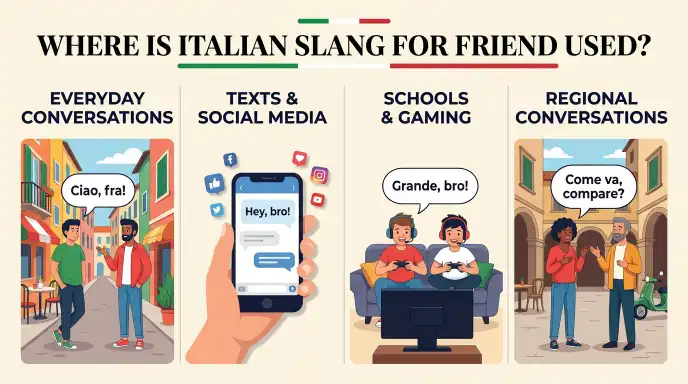
Italian slang varies across regions and communities. Some words are widely understood, while others have a stronger local identity.
Everyday Conversations
Friends often use short, informal expressions when greeting one another, making plans, or joking around. Fra and bro are examples of casual forms of address.
Text Messages and Social Media
People may use bro, bestie, and fra in WhatsApp messages, Instagram comments, TikTok captions, and other online conversations.
These words are convenient because they quickly communicate familiarity.
Schools, Universities, and Gaming Communities
Younger speakers may use English-derived expressions and shortened words among friends. Gaming communities also mix Italian with English terms such as GG, bro, and bestie.
Regional Conversations
Expressions such as compare can carry regional or cultural associations. Their meaning and naturalness may vary, so listening to local speakers is a good way to learn when to use them.
Origin and Background of Italian Friendship Slang:
Italian friendship vocabulary comes from several sources, including traditional Italian words, regional speech, and modern English influence.
Words such as amico and amica have long been part of everyday Italian. Fratello comes from the Italian word for brother and can express closeness when used figuratively.
Shortened forms such as fra reflect informal speech, where people often shorten familiar words. Meanwhile, bro and bestie reflect the influence of English-language entertainment, music, and social media.
Regional expressions such as compare have their own histories and local patterns of use. Their meaning may depend on family traditions, community identity, and the relationship between speakers.
Slang also changes over time. A word popular among teenagers today may sound dated or unfamiliar to another generation. For that reason, it is better to learn expressions in context than to assume every Italian speaker uses the same vocabulary.
Is Italian Slang for Friend Rude or Offensive?
Most of the expressions in this guide are friendly or neutral when used appropriately. However, familiarity matters.
- Usually friendly: amico mio, amica mia, fratello.
- Very informal: fra, bro, bestie.
- Context-dependent: compare, socio, vecchio mio.
A word can sound warm between close friends but strange when used with a stranger. Similarly, joking language can sound disrespectful if the other person does not share your sense of humor.
When speaking with a teacher, employer, customer, or someone you have just met, standard Italian is usually the safer choice.
Polite Alternatives to Italian Slang for Friend:
If you want to sound friendly without being overly casual, use these alternatives.
| Expression | English meaning | Formality |
| Buongiorno | Good morning / good day | Polite |
| Ciao | Hi / bye | Casual and widely used |
| Piacere | Nice to meet you | Polite |
| Amico / Amica | Friend | Neutral |
| Amico mio / Amica mia | My friend | Warm and personal |
| Signore / Signora | Sir / Madam | Respectful |
You do not need to use slang to sound natural. A simple ciao or come stai? can make a conversation friendly without sounding forced.
Why Do People Use Italian Slang for Friend?
People use informal expressions because they make communication feel more relaxed and personal.
Common reasons include:
- Showing closeness: Calling someone fra or fratello can express familiarity.
- Saving time: Short words are convenient in quick conversations and text messages.
- Expressing personality: Some expressions sound playful, affectionate, or humorous.
- Building social connections: Shared language can help people feel included in a group.
- Following online trends: English-derived terms such as bro and bestie spread through digital culture.
However, slang is not a requirement for speaking good Italian. Clear communication and appropriate word choice matter much more than using trendy expressions.
Is Italian Slang Safe for Social Media?
Yes. Most common friendship expressions are generally safe for ordinary social media use.
Words such as fra, bro, amico mio, and bestie are not inherently offensive. You can usually use them in captions, comments, private messages, and gaming chats.
Still, remember three things:
- Avoid slang in professional messages unless the other person welcomes an informal tone.
- Check regional meanings before using an unfamiliar expression.
- Do not assume that a casual word automatically makes a message friendly; the full sentence matters.
For example, “Grande, fra!” is generally a positive expression meaning something like “Awesome, bro!” But an angry message can sound hostile even when it includes a friendly form of address.
FAQs:
Q1: What is a paisano in Italian slang?
“Paisano” comes from the Italian word “paesano,” which means a fellow villager or countryman. In Italian-American slang, people shorten it to “paisan” and use it as a friendly word for a friend, a pal, or someone of the same Italian background. In modern Italy, “paesano” still means someone from your own town or village. The tone is warm and informal, so it fits casual talk better than formal writing.
Q2: What do Italians call their buddies?
Italians use the standard word “amico” for a male friend and “amica” for a female friend. In casual talk, young people also say “fra” (short for “fratello,” meaning brother), “socio,” and “zio,” depending on the region. Phrases like “amico mio” (my friend) are friendly in any setting. Slang changes by city and age, so listening to local speakers is the best guide.
Q3: What do Italians call their best friend?
The most common phrases are “migliore amico” for a male best friend and “migliore amica” for a female best friend. Italians also say “amico del cuore” (friend of the heart) for a very close friend, and “amico fraterno” for a friend who feels like a brother. Many younger speakers use the English term “best friend” or “BFF” in texts and social media. Pick the phrase that fits the tone of your conversation.
Q4: What is homie in Italian?
Italian has no exact word for “homie,” because the term comes from American street culture. The closest casual options are “fra,” “socio,” or “amico del quartiere” (friend from the neighborhood), and their meaning depends on the region. Italian rap and youth slang often borrow English words, so “homie” itself may appear in songs and chats. For everyday speech, “amico” is always safe and clear.
Q5: What does “tutto pepe” mean?
“Tutto pepe” is an Italian expression that describes someone full of energy, lively, and spirited. The word “pepe” means pepper, and the idea is that the person is spicy and full of life. For example, a child who never sits still can be called “tutto pepe.” The phrase is friendly and informal, and it works as a compliment for lively people.
Q6: How do you say “buddy” in Italian?
The simplest translation of “buddy” is “amico,” and it works in any situation. In a casual chat, Italians may also say “socio,” “fra,” or “compare,” depending on the region and the speaker’s age. “Compagno” can mean a pal or a partner, so it depends on the context. If you are learning Italian, start with “amico” and add slang words only when you hear locals use them.
Conclusion:
Learning Italian slang for friend can make your conversations more natural and help you understand Italian culture. Expressions such as fra, bro, fratello, compare, and amico mio all communicate friendship, but they differ in tone, familiarity, and regional use.
If you are a beginner, start with amico and amica for everyday situations, then learn fra and bro for casual conversations with friends. Use amico del cuore when describing a close friendship, and remember that compare may sound more natural in some regions than others.
The most important rule is to match your words to the person and situation. When you understand the relationship behind an expression, you can use Italian friendship slang with greater confidence and avoid sounding too formal or too familiar.
Further Reading!

I am Ann Raimes, an applied linguist and English language educator. I am widely recognized for my contributions to writing pedagogy and research in ESL writing. I have authored several well-known books, including Techniques in Teaching Writing, Keys for Writers, and How English Works: A Grammar Handbook with Readings. Throughout my career, I have worked to promote communicative writing and the process-based approach to teaching writing, helping both teachers and learners develop effective writing skills.