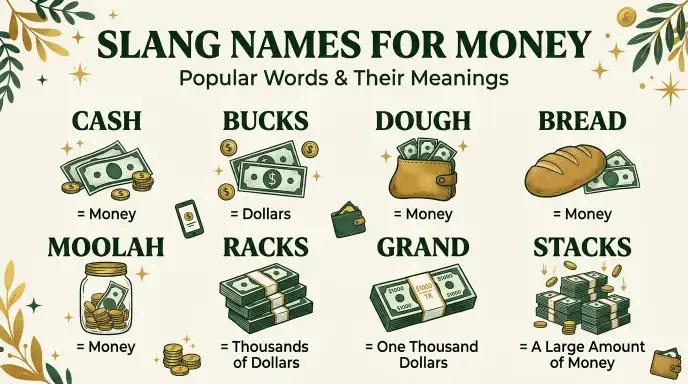
Slang names for money include popular words like “bucks,” “cash,” “bread,” “dough,” and “cheddar,” which people use in everyday talk instead of the plain word “money.”
English has hundreds of nicknames for money, and many of them have been around for decades. Some, like “bucks” and “dough,” are common in daily speech across the United States. Others, such as “quid” in the UK, are tied to a specific country and currency.
Many of these words come from food, history, or street culture. For example, “bread” and “dough” compare money to something you need to live, while “cheddar” and “cheese” are playful food-based terms. As a result, a single phrase like “I need some bread” can mean a sandwich or a bit of cash, depending on the context.
The tone changes from word to word, so the setting matters. Friends may use “stacks,” “paper,” or “racks” in a casual chat, while “funds” and “capital” suit a formal conversation. Choosing the right word helps you sound natural without confusing your listener.
In this guide, you will learn 50+ popular slang names for money, what each one means, and how people use them in real conversations. You will also find examples, regional differences, and answers to frequently asked questions to help you understand the language with confidence.
Quick Answer:
Slang names for money are informal words people use to describe cash, currency, earnings, or wealth. Popular examples include bucks, cash, bread, dough, cheddar, moolah, and bands.
What Are Slang Names for Money?
Slang names for money are informal expressions that people use in place of words such as money, cash, or currency. These terms often come from popular culture, regional speech, music, and everyday conversations.
For example, someone might say, “I need to make some bread,” instead of “I need to earn some money.”
The meaning usually stays the same, but the tone becomes more relaxed.
People use money slang when talking with friends, discussing their salaries, shopping, playing games, or sharing financial goals online. Some expressions are common across the United States, while others have stronger connections to particular communities or cultural backgrounds.
The important thing to remember is that slang depends on context. A word that sounds natural between friends may seem unprofessional in a business meeting.
50+ Popular Slang Names for Money and Their Meanings:
Here are some widely recognized expressions for money, along with simple definitions and examples.
1. Common Slang Words for Money
These expressions are easy to recognize and appear frequently in everyday English.
| Slang term | Meaning | Example |
| Bucks | Dollars | “That jacket costs 50 bucks.” |
| Cash | Physical money or immediately available funds | “I need some cash.” |
| Dough | Money | “She saved enough dough for a trip.” |
| Bread | Money or earnings | “I’m working to make bread.” |
| Moolah | Money, often used playfully | “How much moolah do you have?” |
| Clams | Dollars or money | “The watch cost 100 clams.” |
| Green | Money, referring to the color of US currency | “He’s chasing the green.” |
| Cabbage | Money | “That job pays good cabbage.” |
| Cheddar | Money, often associated with earning or wealth | “She’s making cheddar online.” |
| Scratch | Money | “I need some scratch for rent.” |
| Simoleons | Dollars or money | “That computer costs 500 simoleons.” |
| Coin | Money, sometimes earnings or financial success | “She’s making serious coin.” |
| Loot | Money or valuable possessions | “He earned some extra loot.” |
| Funds | Available money | “We need more funds for the project.” |
| Bank | A large amount of money or wealth | “He’s making bank at his new job.” |
These words do not all have the same tone. Bucks and cash are common and neutral, while moolah, simoleons, and cabbage can sound humorous or old-fashioned.
2. Slang for a Large Amount of Money
When someone earns a lot, buys something expensive, or talks about financial success, they may use more expressive terms.
| Slang term | Meaning | Example |
| Bands | Bundles of money, especially banknotes | “He showed off bands in the video.” |
| Stacks | Large amounts or bundles of cash | “She’s saving stacks for a house.” |
| Racks | Thousands of dollars in some US slang contexts | “That project made him a few racks.” |
| Grand | One thousand dollars in US and other English-speaking contexts | “The laptop costs two grand.” |
| Gs | Thousands of dollars, depending on context | “He paid five Gs for the car.” |
| Bills | Paper money or banknotes | “Keep a few bills in your wallet.” |
| Paper | Money, especially cash or earnings | “He’s focused on making paper.” |
| Big bucks | A large amount of money | “That company pays big bucks.” |
| Heavy money | A substantial amount of money | “They invested heavy money in the business.” |
| Fat stacks | A large amount of cash | “The character carried fat stacks.” |
Important: Terms such as rack, band, and G can vary by community and situation. Their exact value may depend on the country, currency, and context.
3. Modern and Internet Slang for Money
Online conversations have helped popularize several short, expressive ways to talk about money and financial success.
| Slang term | Meaning | Example |
| Bag | Money, earnings, or a financial opportunity | “I’m trying to secure the bag.” |
| Get the bag | Earn money or achieve financial success | “She started a business to get the bag.” |
| Paper chase | The pursuit of money | “He’s on a paper chase.” |
| Breadwinner | Someone who earns the main income for a household | “She’s the breadwinner in her family.” |
| Stacking | Saving or accumulating money | “I’m stacking money for college.” |
| Coins | Money or earnings | “That side hustle brings in coins.” |
| Cash out | Convert something into money or take earnings | “He decided to cash out his investment.” |
| Payday | The day someone receives their pay | “It’s payday, so I’m paying my bills.” |
| Bag secured | Money or an opportunity successfully obtained | “The contract is signed. Bag secured!” |
| Hustle money | Money earned through work or a side business | “I’m putting my hustle money into savings.” |
Some expressions, such as get the bag and secure the bag, also appear in music and motivational social media posts. They can refer to earning money, getting a job, winning a deal, or reaching a financial goal.
What Do Money Slang Words Mean in Different Contexts?
The same expression can have slightly different meanings depending on how someone uses it.
Money Slang in Everyday Conversations
In casual conversations, people often choose simple terms that everyone understands.
Examples:
- “Can you lend me ten bucks?”
- “I spent too much dough this weekend.”
- “Let’s save some cash for the holidays.”
- “That job pays decent money.”
These expressions sound natural when speaking with friends or family. Bucks is especially common in American English when referring to dollars.
Money Slang in Music and Pop Culture
Music, particularly hip-hop, has helped popularize expressions such as bands, racks, paper, and get the bag.
For example:
- “He’s chasing the bag.”
- “They made racks from the business.”
- “She’s stacking paper for her future.”
These phrases often communicate ambition, financial independence, success, or wealth. However, their meaning depends on the lyrics or conversation in which they appear.
Money Slang on Social Media
On platforms such as TikTok, Instagram, YouTube, and X, people frequently use short expressions to describe earnings, spending, and financial goals.
Examples include:
- “Bag secured.”
- “Time to get this bread.”
- “Saving up my coins.”
- “That side hustle is making bank.”
Online, these phrases may be serious, playful, or sarcastic. Someone might write “making bank” about a successful business, but another person might use it jokingly after earning a small amount.
Real-Life Examples of Slang Names for Money:
The following examples show how people use money slang in different situations.
Friendly Examples
Friend1: “Do you have five bucks?”
Friend 2: “Absolutely, I’ll forward it to you.”
- “I made some extra bread this week.”
- “That restaurant charges big bucks.”
- “How much cash do you need?”
- “I’m stacking money for my vacation.”
- “She makes bank working as a designer.”
Argumentative Examples
- “You said you would pay me back. Where’s my money?”
- “Stop acting like money grows on trees.”
- “You spent all the cash without asking me.”
- “I’m not giving you another dime until you repay me.”
These examples also demonstrate that people do not always need slang to express frustration. Direct, clear language often works better when a conversation becomes serious.
Gaming and Social Media Examples
- “I finally got enough coins to unlock the new character.”
- “That player collected all the loot.”
- “One more freelance project and I’ll secure the bag.”
- “Bro made bank selling those virtual items.”
- “Saving my stacks for the next game update.”
In gaming, coins and loot may refer to virtual currency or valuable in-game items rather than real-world money. Always check the context before interpreting the expression.
Comparison Table: Money Slang vs. Standard English:
Money slang can make conversations more expressive, but standard English may be clearer in formal situations.
| Slang expression | Standard English meaning | Best use |
| Bucks | Dollars | Casual conversations |
| Bread | Money or earnings | Informal speech |
| Dough | Money | Friendly conversations |
| Bands | Bundles of cash | Informal discussions |
| Get the bag | Earn money or achieve success | Casual and online speech |
| Make bank | Earn a lot of money | Informal conversations |
| Grand | One thousand dollars | Casual financial discussions |
| Cash out | Withdraw or convert funds into money | Financial or casual contexts |
Notice that some terms have more precise meanings than others. For instance, grand commonly refers to one thousand units of a currency, while bread simply refers to money in general.
Where Did Money Slang Come From?
Money slang developed over many years through everyday speech, regional expressions, trade, popular entertainment, and cultural influences. There is no single origin for all money-related slang.
Historical Expressions
Words such as bucks and dough have long histories in English. People have used informal terms for money for generations, often choosing words that make conversations easier or more colorful.
Bucks became widely associated with dollars in American English. Dough and bread developed as informal ways of referring to money, although their histories and usage patterns differ.
Music and Popular Culture
Music, movies, television, and celebrity culture have helped spread terms such as bands, racks, and paper.
Hip-hop has played a notable role in bringing some money-related expressions into mainstream conversations. However, these expressions may have deeper roots in particular communities, so it is inaccurate to attribute every term to a single artist or song.
Internet Culture
Social media allows slang to travel quickly between countries and age groups. A phrase that starts in one community can become familiar to millions of people through videos, memes, and online conversations.
Even so, not every expression is universal. A term that sounds natural to an American speaker may be unfamiliar to someone in Britain, Australia, or another English-speaking region.
Is Money Slang Rude or Offensive?
Most common money slang is neutral or informal rather than offensive. Words such as bucks, cash, dough, and bread are generally acceptable in friendly conversations.
However, the situation matters.
- Generally neutral: Cash, bucks, funds, grand.
- Casual or playful: Moolah, dough, clams, simoleons.
- Informal and culturally specific: Bands, racks, paper, cheddar.
- Potentially boastful or insensitive: Expressions about being rich or showing off large amounts of money.
Even a harmless word can sound disrespectful if you use it to mock someone who has financial difficulties.
In a professional email, job interview, bank discussion, or financial report, choose clear terms such as income, salary, earnings, budget, or funds.
Why Do People Use Slang for Money?
People use slang for several reasons.
1. It Makes Conversations Casual
Saying “I need a few bucks” can sound more relaxed than saying “I need a small amount of money.”
2. It Expresses Personality
Words such as moolah and simoleons add humor, while bands and racks may sound more connected to particular music or internet communities.
3. It Creates a Sense of Belonging
Shared expressions can help people feel connected to friends, online groups, or cultural communities.
4. It Saves Time
Short expressions such as cash and Gs can communicate ideas quickly when the audience understands them.
5. It Reflects Popular Culture
Movies, songs, memes, and social media trends introduce expressions to new audiences and keep informal language evolving.
When Should You Avoid Money Slang?
Although slang is useful, it is not suitable for every situation.
Avoid informal money expressions when:
- Writing a formal business proposal.
- Discussing a loan, mortgage, or financial agreement.
- Preparing a professional report.
- Communicating with someone who may not understand the expression.
- Explaining financial information where precision matters.
For example, instead of writing “We need more bread for this project,” write “We need additional funding for this project.”
The second sentence communicates the message clearly and professionally.
FAQs:
Q1: What is Gen Z slang for money?
Gen Z often says “bands,” “racks,” “guap,” “bag,” “cheddar,” and “bread” for money. People use “securing the bag” to mean earning money or landing a good deal, and “no cap” and “W” show up in money-related posts too. These words spread through hip-hop, TikTok, and social media, so they change quickly. Most are casual, so they fit chats with friends better than formal writing.
Q2: What are some slang terms for money?
Popular slang terms include “bucks,” “cash,” “dough,” “bread,” “cheddar,” “greens,” “stacks,” “paper,” and “moolah.” In the UK, people also say “quid” for pounds and “wonga” for money in general. Many of these words compare money to food or to its green color. The best choice depends on your audience and region, because some terms sound dated in one place and fresh in another.
Q3: What are some cool names for money?
Cool-sounding names include “guap,” “racks,” “bands,” “cheddar,” “benjamins,” and “bread.” “Benjamins” refers to the $100 bill, which carries Benjamin Franklin’s portrait. These words are common in music, movies, and social media. A cool name is a matter of taste and setting, so test it with the people you are talking to.
Q4: What is the slang term for $1,000,000?
The most common slang for $1,000,000 is “a mil” (also written “a mill” or “1M”). People also say “a million bucks” in casual speech. In British slang, “a bar” is sometimes used for £1 million, although this is less widely known. Because slang changes by region, “a mil” is the safest option in most conversations.
Q5: Why is 500 called a monkey?
In British slang, “a monkey” means £500, and the exact origin is uncertain. One popular explanation says that British soldiers in colonial India used the word because the 500-rupee note carried a picture of a monkey. Another idea links it to old money terms, and no single story is confirmed. Treat any origin as a popular theory rather than a proven fact.
Q6: What is 10,000 called in slang?
The most common slang for 10,000 is “ten grand,” since “grand” means 1,000. People also say “10K,” “ten racks,” or “ten stacks,” and “ten bands” is popular among younger speakers. In the UK, “ten grand” is used in the same way. These terms work for dollars, pounds, and other currencies, so the context usually tells you which one is meant.
Conclusion:
Slang names for money add variety and personality to everyday English. Expressions such as bucks, bread, dough, moolah, cheddar, bands, and racks can describe money, earnings, or wealth in different ways.
Some terms are widely understood, while others depend on cultural background, location, or online communities. The best expression depends on your audience and the situation.
Use casual money slang when chatting with friends or discussing everyday experiences. For professional or financial communication, stick to clear terms such as cash, income, earnings, and funds. Understanding these differences will help you recognize money slang and use it naturally without confusing your audience.
In This Guide!

Hi, I’m Jack Anderson, a writer at Slang Prime. I love exploring slang words, their meanings, and origins. My goal is to explain modern slang in simple language and help readers understand everyday expressions.