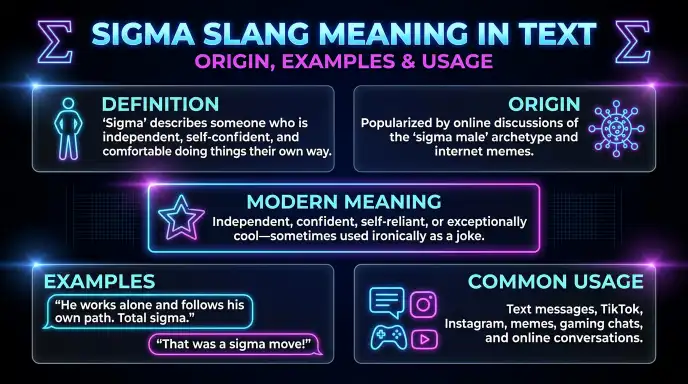
Sigma slang describes a confident, independent person who succeeds on their own terms, without needing a group’s approval or a leadership role.
The word comes from the “sigma male” idea, which describes a lone-wolf type who stays outside the usual social ranking. It started in online discussions about personality types and later spread through TikTok, YouTube Shorts, and memes. Today, it is one of the most recognized Gen Z slang words.
In text, people use “sigma” both seriously and as a joke. For example, “That move was so sigma” praises someone’s calm confidence, while a sarcastic “sigma grindset” can tease someone who tries too hard to look tough. As a result, the same word can sound like a compliment or a playful roast.
The tone depends on the speaker, the situation, and the relationship between the people chatting. Among friends, it is usually lighthearted, and it is not considered vulgar or offensive. Emojis and context often show whether the message is sincere or sarcastic.
In this guide, you will learn the exact sigma slang meaning, where the term came from, and how to use it in real conversations. You will also find examples, similar slang terms, and answers to frequently asked questions to help you use it with confidence.
Quick Answer:
Sigma slang describes someone who appears independent, self-confident, and self-reliant. Online, people also use it humorously in phrases such as “sigma male” and “what the sigma?”
What Does Sigma Mean in Text?
In text messages and online conversations, sigma usually describes someone who acts independently, stays confident, and does not depend on social approval.
The term became popular through the phrase “sigma male,” which describes a person who supposedly follows their own path instead of trying to become a leader or fit into a social hierarchy.
For example, if your friend ignores peer pressure and focuses on personal goals, someone might call them a sigma. The word can express admiration, but it can also be sarcastic.
Today, sigma has a much broader meaning in internet culture. People often use it in memes, gaming chats, short videos, and jokes. Sometimes, the word has little to do with real independence and simply makes a situation sound funny or impressive.
Here are the most common ways people use sigma:
- Independent: Someone who prefers to make their own decisions.
- Confident: Someone who seems comfortable with themselves.
- Self-reliant: Someone who does not always need help or approval.
- Cool or mysterious: Someone who appears calm and unaffected.
- Funny or ironic: A playful label for someone doing something unusual or exaggerated.
The context matters because sigma can be a genuine compliment or a humorous internet expression.
What Is the Full Meaning of Sigma Slang?
Sigma does not have a single official full form in internet slang. It is a Greek letter, and online slang uses the word as a label for a particular personality or attitude.
The phrase “sigma male” became associated with the idea of a man who operates outside traditional social rankings. Rather than trying to dominate a group or gain status, this person supposedly values independence and personal freedom.
Over time, people began using sigma more broadly, including for women, fictional characters, friends, and even everyday actions.
For example:
- “He is a sigma.” : He seems independent and confident.
- “That was a sigma move.” : That action seemed bold, clever, or impressively self-directed.
- “Sigma mindset.” : An attitude focused on independence and personal goals.
- “What the sigma?” : A humorous expression of surprise or confusion.
Sigma is not an acronym, so you should not treat each letter as standing for a separate word.
Sigma Meaning in Simple English
In simple English, sigma means someone who does their own thing, trusts their decisions, and does not constantly seek approval from others.
Imagine a student who works hard, avoids unnecessary drama, and chooses friends based on shared interests rather than popularity. People might describe that student as sigma in an online conversation.
However, real people have many different personality traits. Calling someone sigma is an informal label, not a scientific personality assessment.
Where Did Sigma Slang Come From?
The word sigma originally comes from the Greek alphabet, where it represents the letter sigma. Its modern internet meaning developed from online discussions about social status, masculinity, and personality.
The expression “sigma male” gained attention in online communities during the late 2010s. It described an imagined type of man who supposedly sits outside the traditional alpha-and-beta hierarchy.
The idea often presents a sigma as independent, private, ambitious, and uninterested in competing for social dominance. Online discussions and memes helped spread the label across social media platforms.
Later, the word moved beyond its original associations. People began applying it to fictional characters, gaming moments, funny behaviors, and ordinary situations.
For example, a video might show someone making an unexpected decision, followed by a caption such as “Sigma behavior.” The joke may suggest that the person acted confidently or refused to follow the crowd.
As the term spread, younger internet users also began using “what the sigma?” as a playful expression of surprise. In some cases, sigma became a deliberately silly word rather than a serious description of personality.
This change shows how internet slang often develops: a term begins in one community, spreads through memes, and eventually takes on several meanings.
How to Use Sigma in Text Messages:
You can use sigma in casual conversations when you want to describe independence, confidence, or a funny action. The word works best with friends who understand internet slang.
1. To Describe Independence
Text: “He does not follow trends just to fit in. Total sigma.”
Meaning: He makes his own choices instead of copying others.
This use presents sigma as a compliment.
2. To Praise a Confident Decision
Text: “You finished your project instead of wasting time arguing. Sigma move!”
Meaning: The speaker thinks the decision was smart, confident, or focused.
3. To Make a Joke
Text: “I woke up early on Sunday to study. Sigma mode activated.”
Meaning: The speaker jokingly presents a normal productive habit as an impressive achievement.
4. To React to Something Strange
Text: “What the sigma is going on here?”
Meaning: The speaker expresses surprise or confusion in a playful, meme-inspired way.
5. To Talk About a Fictional Character
Text: “That character stays calm under pressure. He has sigma energy.”
Meaning: The character seems independent, confident, and unaffected by other people’s opinions.
These examples show why the same word can sound serious in one conversation and completely humorous in another.
Popular Sigma Slang Phrases and Their Meanings:
Sigma often appears with other words that help explain the intended message. Learning these expressions can make online conversations easier to understand.
| Sigma phrase | Meaning | Example |
| Sigma male | A man described as independent and self-reliant | “He likes working alone, so they call him a sigma male.” |
| Sigma mindset | An attitude focused on personal goals and independence | “She has a sigma mindset about studying.” |
| Sigma move | An action viewed as confident, clever, or independent | “Turning off notifications was a sigma move.” |
| Sigma energy | A vibe that seems calm, confident, or self-sufficient | “He has sigma energy.” |
| What the sigma? | A humorous reaction to surprise or confusion | “What the sigma just happened?” |
| Sigma grindset | A meme-inspired attitude about working hard toward goals | “He is on his sigma grindset.” |
These phrases are informal. Their meanings may change between online communities, and people often use them for entertainment rather than serious personality descriptions.
Sigma vs. Alpha vs. Beta: What Is the Difference?
Sigma, alpha, and beta appear in online discussions about social behavior and personality. These labels come from informal social hierarchies, not a reliable system for classifying every person’s character.
The terms usually suggest different attitudes toward social status.
| Term | Common online meaning | Typical description |
| Sigma | Independent and self-reliant | Prefers to follow their own path |
| Alpha | Dominant, assertive, or socially influential | Tries to lead or take charge |
| Beta | Less dominant or more accommodating | Often portrayed as following others |
These definitions reflect internet stereotypes. They do not accurately describe the full range of human personalities.
For example, a person can lead a team confidently while also valuing independence. Someone else may enjoy working alone but still care deeply about friendship and cooperation.
You should therefore treat these terms as informal slang rather than fixed personality categories.
Is Sigma a Compliment or an Insult?
Sigma can be a compliment, a joke, or a sarcastic comment. The speaker’s intention and the surrounding conversation determine its meaning.
When Sigma Is a Compliment
Someone might call you sigma if they admire your independence, discipline, or confidence.
Examples:
- “You stayed focused despite all the distractions. Sigma behavior.”
- “She makes her own choices and stands by them. Total sigma.”
- “That was a sigma move. You handled the problem yourself.”
In these cases, the word expresses approval.
When Sigma Is Used as a Joke
On social media, people sometimes use sigma to exaggerate an ordinary action.
For example, someone might post, “I drank water today. Sigma mindset.”
The humor comes from describing a simple, healthy action as if it proves extraordinary independence.
When Sigma Sounds Sarcastic
Someone may call another person sigma to mock behavior that seems unnecessarily dramatic, antisocial, or self-important.
For example, if a friend ignores everyone just to appear mysterious, another person might jokingly call them a sigma.
If you are unsure about the tone, look at the surrounding words, emojis, and relationship between the people chatting.
Where Is Sigma Slang Commonly Used?
Sigma appears in several online spaces, especially communities where memes, short videos, gaming, and youth slang spread quickly.
TikTok and Instagram
Creators use sigma in short videos, captions, edits, and jokes about confidence or independence. Some videos present the term seriously, while others use it for comedy.
Gaming Chats
Players may call a clever move or an independent strategy a sigma move. The word can also appear in humorous reactions during multiplayer games.
Text Messages
Friends may use sigma to tease each other, praise a decision, or react to something unexpected.
YouTube and Memes
Sigma edits often show fictional characters or public figures acting calm, powerful, or mysterious. Meme creators may exaggerate these traits for entertainment.
School and Everyday Conversations
Some people use sigma as a playful label for a friend who works independently or refuses to follow a trend. Others use it simply because they recognize the meme.
Although the term is widespread online, not everyone uses it or interprets it the same way.
Common Mistakes to Avoid When Using Sigma:
Understanding sigma is easier when you know what the word does not mean.
Mistake 1: Assuming sigma has an official full form.
Sigma is not an acronym in this slang usage. It is a word borrowed from the Greek letter’s name.
Mistake 2: Thinking every sigma reference is serious.
Many online uses are jokes, memes, or exaggerated reactions. The word does not always describe someone’s real personality.
Mistake 3: Treating sigma as a scientific personality type.
The sigma label belongs to internet culture. It is not a validated psychological category.
Mistake 4: Assuming sigma means being antisocial.
Independence does not require avoiding people. Someone can enjoy friendships and teamwork while still making independent decisions.
Mistake 5: Using sigma in every conversation.
The word is informal and may sound confusing in professional messages or formal writing. Use it when the audience understands the slang.
Mistake 6: Confusing sigma with alpha.
Sigma commonly suggests independence outside a hierarchy, while alpha usually suggests dominance or leadership within one. These are informal distinctions, not strict rules.
FAQs:
Q1: What is sigma in Gen Z slang?
In Gen Z slang, “sigma” describes a confident, independent person who succeeds on his or her own terms and does not need approval from the crowd. The word comes from the “sigma male” idea, a lone-wolf type who stays outside the usual social ranking. Online, people use it seriously in self-improvement content and jokingly in memes. Because of this double use, the tone depends on the speaker and the setting.
Q2: Why are all the kids saying sigma?
Sigma took off through TikTok, YouTube Shorts, and meme culture, where edits and jokes spread quickly among teens. The word is short, easy to use in any sentence, and works as both a compliment and a joke, such as “that move was so sigma.” Many kids also use it to tease friends or to make fun of internet “alpha” culture. Like most viral slang, it spreads because everyone sees and repeats it.
Q3: Is sigma bad in slang?
No, sigma is not a bad word, and it is not considered vulgar. It is usually used as a mild compliment or a playful joke about someone who acts cool and independent. The tone can turn sarcastic, though, when people use it to mock someone who tries too hard to look tough. Context and the relationship between the speakers decide whether it is positive or teasing.
Q4: Is sigma good or bad?
Sigma is neither fully good nor bad, because its meaning depends on how people use it. As a compliment, it praises confidence, independence, and self-control. As a joke or criticism, it can poke fun at the “sigma male” online trend, which many people see as exaggerated. Most Gen Z speakers use it lightly, so it rarely carries a serious negative meaning.
Q5: Do girls like sigma guys?
There is no single answer, because people have different tastes. Many people admire confidence, calm behavior, and independence, which are traits linked to the sigma image. On the other hand, qualities such as coldness, arrogance, or ignoring others are not attractive to most people, and “sigma” is not a personality type that guarantees attraction. Honesty, respect, and kindness matter more in real relationships than any internet label.
Q6: Is sigma boy a bad thing?
Being called a “sigma boy” is usually not a bad thing, and it is often meant as a playful compliment for someone who is confident and does things his own way. Some people use it sarcastically for someone who acts overly serious or tries to look mysterious. Among friends, it is mostly a joke, and the tone, emojis, and situation show the intended meaning. If you are unsure, ask the person what they meant.
Final Thoughts:
Sigma slang describes independence, self-confidence, and the idea of following your own path. It became popular through the phrase “sigma male” and later spread into memes, gaming chats, TikTok videos, and everyday text messages.
The word can be a compliment when someone admires your confidence or a joke when a situation seems funny or exaggerated. Expressions such as “sigma move,” “sigma mindset,” and “what the sigma?” add different shades of meaning.
The easiest way to understand sigma is to consider the context. When you know if someone is praising an action, making a meme, or teasing a friend, you can understand the intended meaning and use the slang naturally.
Explore more about!

Hi, I’m Jack Anderson, a writer at Slang Prime. I love exploring slang words, their meanings, and origins. My goal is to explain modern slang in simple language and help readers understand everyday expressions.