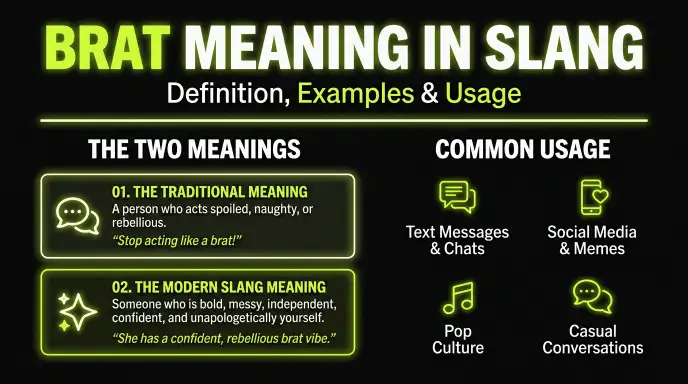
Brat in slang means a confident, carefree, and unapologetic person, although the traditional meaning still describes a spoiled or badly behaved child.
For a long time, “brat” was mostly a mild insult for someone who acted entitled or misbehaved. That changed in 2024, when Charli XCX released her album Brat and the “brat summer” trend took over social media. The word suddenly became a playful badge of honor for Gen Z.
In the modern sense, a brat is someone who is bold, honest, and happy to be a little messy. For example, a friend might say “I’m in my brat era” to joke about enjoying life without trying to be perfect. As a result, the word now appears in captions, memes, and group chats.
The tone still depends on the speaker and the situation. Among friends, it is often a compliment, while in an argument it can sound rude or dismissive. Emojis, context, and the relationship between the people usually show which meaning is intended.
In this guide, you will learn the exact brat meaning in slang, how the trend started, and how people use the word in real conversations. You will also find examples, related slang terms, and answers to frequently asked questions to help you use it with confidence.
Understanding the context helps you know if someone is teasing you, criticizing your behavior, or giving you a playful compliment.
Quick Answer:
Brat slang means a spoiled, demanding, or badly behaved person. In modern internet culture, it can also describe someone who is bold, confident, rebellious, and unapologetically themselves.
What Does Brat Mean in Text?
The word brat usually describes someone who acts spoiled, selfish, demanding, or immature. In text messages, friends may use it to tease someone who wants their own way or refuses to behave sensibly.
For example, if someone texts, “Stop being such a brat,” they may mean that the person is acting demanding or childish.
However, the meaning can change with the situation. Close friends sometimes use brat playfully, without intending to insult each other. On social media, the term can also express confidence, rebelliousness, and a bold attitude.
Here are the most common meanings of brat:
- Spoiled person: Someone who expects special treatment.
- Bad behavior: Someone who acts selfishly or refuses to cooperate.
- Playful teasing: A friendly label for someone being stubborn or mischievous.
- Confident attitude: Someone who expresses themselves boldly and does not worry too much about others’ opinions.
- Brat aesthetic: A bold, messy, rebellious style associated with the 2024 Brat trend.
The tone of the message matters. A friend calling you a brat with a laughing emoji may be joking, while the same word during an argument may be an insult.
What Is the Definition of Brat Slang?
Brat is an informal English noun. Its traditional definition refers to a child who behaves badly, acts spoiled, or demands too much attention.
People also use the word for adults who show similar behavior. For example, someone who constantly complains when they do not get their way might be described as a brat.
Modern internet culture has added a different shade of meaning. In some online spaces, brat suggests a person who is confident, rebellious, playful, and comfortable expressing their personality.
Unlike an acronym, brat does not stand for a longer phrase. It is an established English word that people now use in several cultural and social contexts.
Brat Meaning in Simple English
In simple English, a brat is someone who acts spoiled, demanding, or naughty.
In modern slang, it can also describe a bold person who embraces an imperfect, rebellious, or confident attitude.
For example:
- “You’re acting like a brat.” : You’re behaving selfishly or childishly.
- “She’s such a brat, but she’s funny.” : The speaker is teasing someone about their playful or difficult behavior.
- “I’m having a brat summer.” : The speaker may mean they are embracing confidence, freedom, fun, and a rebellious attitude.
These examples show why you should consider the context before deciding what someone means.
Where Did Brat Slang Come From?
The word brat has existed in English for a long time. Traditionally, it has described a badly behaved or spoiled child. People have used it in everyday speech for generations.
Its modern cultural popularity grew significantly in 2024, when British singer Charli XCX released her album Brat. The album helped turn the word into a recognizable symbol of a particular attitude, aesthetic, and lifestyle.
The Brat era became associated with a bright lime-green color, bold typography, playful messiness, confidence, partying, and rejecting the pressure to appear perfect.
The phrase “brat summer” spread across social media as people embraced a more carefree and unapologetic approach to life. Users created memes, edited photos, shared outfits, and posted captions inspired by the album’s visual style and attitude.
In this cultural context, being a brat did not necessarily mean behaving like a spoiled child. Instead, it could mean being confident, imperfect, rebellious, and comfortable with yourself.
The trend did not erase the traditional meaning. Today, brat can still be an insult, a playful nickname, or a positive cultural reference, depending on how someone uses it.
How to Use Brat in Text Messages:
You can use brat in casual conversations when you want to describe spoiled behavior, tease a friend, or express a bold attitude. The following examples show how the meaning changes.
1. When Someone Acts Spoiled
Text: “You didn’t get your favorite food, and now you’re upset? Don’t be a brat!”
Meaning: The speaker thinks the person is acting demanding or immature.
This use follows the traditional definition.
2. When Teasing a Friend
Text: “You’re such a brat 😂”
Meaning: The speaker is playfully teasing a friend who is being stubborn, cheeky, or mischievous.
The laughing emoji suggests a lighter tone, although the relationship and situation still matter.
3. When Describing Confidence
Text: “I’m in my brat era. I’m doing what makes me happy.”
Meaning: The speaker is embracing independence, confidence, and a less restrictive attitude.
This use connects with modern social media culture.
4. When Talking About Fashion
Text: “That outfit gives total brat energy.”
Meaning: The outfit looks bold, edgy, rebellious, or inspired by the brat aesthetic.
5. When Making a Joke
Text: “I refused to share my fries. Brat behavior!”
Meaning: The speaker is joking about a selfish or stubborn action.
These examples show that brat can sound negative, affectionate, or empowering depending on the context.
Brat vs. Bratty vs. Spoiled vs. Rebellious:
These words share some similarities, but they do not have exactly the same meaning.
| Word | Meaning | Example |
| Brat | A person who behaves in a spoiled or demanding way | “He’s acting like a brat.” |
| Bratty | Behaving in a cheeky, spoiled, or deliberately difficult way | “That was a bratty response.” |
| Spoiled | Accustomed to getting what you want, often without accepting limits | “The spoiled child demanded another toy.” |
| Rebellious | Resisting rules, expectations, or authority | “She has a rebellious attitude.” |
| Bold | Confident and willing to express yourself | “She made a bold fashion choice.” |
The main difference: Brat often suggests difficult or spoiled behavior, while rebellious describes resistance to rules. Bold usually carries a more positive meaning.
In the modern brat trend, people sometimes combine these ideas to express confidence and rebellion without necessarily suggesting selfishness.
What Does “Brat Summer” Mean?
“Brat summer” became a widely recognized cultural phrase in 2024, following the release of Charli XCX’s album Brat.
The phrase refers to an attitude associated with confidence, freedom, partying, self-expression, and embracing imperfections. It often rejects the idea that people must always appear polished, organized, or perfect.
For example, someone might post:
“Messy hair, loud music, and no plans. Brat summer!”
The caption suggests a carefree mood rather than literal spoiled behavior.
The trend also became associated with a distinctive visual style, particularly lime green, simple lettering, and deliberately unpolished images.
However, not everyone uses the phrase in exactly the same way. Some people use it to celebrate independence, while others use it for fashion, humor, music references, or social commentary.
The key idea is that brat summer gives the traditional word a more playful and culturally specific meaning.
Is Brat a Compliment or an Insult?
Brat can be either positive or negative. You need to consider the speaker’s tone, the relationship between the people involved, and the surrounding conversation.
When Brat Is an Insult
Someone may call another person a brat when they think that person is selfish, demanding, immature, or disrespectful.
Examples:
- “Stop acting like a brat and listen.”
- “He threw a tantrum because he didn’t get his way.”
- “She’s being a brat about the smallest things.”
In these situations, brat expresses criticism.
When Brat Is a Playful Nickname
Friends or partners may use brat to tease someone who is stubborn, cheeky, or mischievous.
For example, “You’re a little brat, aren’t you? 😂” might sound affectionate in a friendly conversation.
Still, not everyone likes this label, so the relationship and personal boundaries matter.
When Brat Is a Positive Expression
In the context of brat culture, someone may use the term to celebrate being bold, independent, rebellious, or unapologetically themselves.
For example, “I’m embracing my brat era” may mean that the speaker wants to enjoy life without worrying constantly about other people’s expectations.
| Context | Likely meaning | Tone |
| An argument | Spoiled or badly behaved | Negative |
| A friendly chat | Cheeky or mischievous | Playful |
| A fashion caption | Bold and rebellious style | Positive or expressive |
| A brat summer post | Carefree confidence and self-expression | Playful or empowering |
If you’re unsure what someone means, look at the complete message rather than judging the word alone.
Where Is Brat Slang Commonly Used?
Brat appears in everyday conversations and across several online communities. Its meaning can shift depending on the platform and topic.
TikTok and Instagram
Users may describe outfits, makeup, music, or personal attitudes as brat-inspired. The word also appears in captions and memes connected to the brat summer trend.
Text Messages
Friends may call each other brats when someone acts stubborn, playful, or demanding. The word can be affectionate or critical.
Fashion and Beauty
Brat can describe a bold, edgy, or deliberately messy aesthetic. In this context, it often refers to personal style rather than bad behavior.
Music and Pop Culture
The word is strongly associated with Charli XCX’s Brat album and the cultural trend that followed its release.
Everyday Conversation
People still use brat in its traditional sense to describe someone who behaves selfishly or expects special treatment.
Because these uses overlap, context is the best guide to understanding the intended meaning.
Common Mistakes to Avoid When Using Brat:
Understanding brat is easier when you know which meanings are appropriate for different situations.
Mistake 1: Assuming brat always means spoiled.
That is the traditional meaning, but modern internet culture also uses the word to express confidence, rebellion, and self-expression.
Mistake 2: Assuming brat is always a compliment.
Calling someone a brat can hurt their feelings if they interpret it as criticism. The word is not automatically affectionate.
Mistake 3: Confusing brat with bratty.
Brat usually refers to a person, while bratty describes behavior or characteristics.
Mistake 4: Thinking brat summer means acting selfishly all the time.
The cultural phrase often represents confidence, freedom, and embracing imperfections rather than literal bad behavior.
Mistake 5: Using brat in formal situations.
Brat is informal and can sound insulting. In professional writing, choose more precise words such as demanding, immature, rebellious, or confident.
Mistake 6: Assuming everyone follows the same trend.
Some people know the Charli XCX reference, while others understand only the traditional meaning. Do not assume every use refers to brat summer.
FAQs:
Q1: What does Gen Z brat mean?
In Gen Z slang, “brat” describes a confident, carefree, and unapologetic person who enjoys being a little messy and chaotic. The meaning took off in 2024 with Charli XCX’s album Brat and the “brat summer” trend, which celebrated imperfect, party-loving, honest behavior. The acid-green color became its signature look. Unlike the old meaning, the Gen Z version is mostly positive and playful.
Q2: What does it mean if a girl calls herself a brat?
When a girl calls herself a brat, she is usually being playful, confident, and a bit rebellious. She may mean she is strong-willed, speaks her mind, or likes to have fun without worrying about being perfect. Among friends, it is often a joke or a badge of honor, especially after the brat summer trend. In some adult dating circles, the word can also carry a flirty or role-play meaning, so tone and context matter.
Q3: What does it mean if someone calls me a brat?
It depends on the speaker and the tone. Traditionally, “brat” means a spoiled or badly behaved person, so it can be a mild insult, especially from someone older or in an argument. Among friends or online, however, it may be a playful or even complimentary nickname for someone bold and fun. Check the situation, the relationship, and any emojis to see which meaning the person intended.
Q4: Is brat a vulgar word?
No, “brat” is not a vulgar word. It is a mild, informal term that is fine in everyday conversation and appears in books, music, and media. It can still sound rude when it is used to describe a child or a person in a harsh way. In professional or formal settings, it is better to choose more neutral words such as “difficult” or “demanding.
Final Thoughts:
Brat slang has two main meanings. Traditionally, it describes someone who behaves in a spoiled, demanding, or immature way. In modern internet culture, it can also represent confidence, rebellion, self-expression, and the carefree attitude associated with brat summer.
The best way to understand the word is to look at the context. A message such as “Stop being a brat” usually expresses criticism, while “I’m in my brat era” may celebrate independence and confidence.
Once you understand these differences, you can recognize brat in text messages, social media captions, memes, and everyday conversations without confusing its traditional meaning with its modern cultural use.
Deep dive!

Hi, I’m Jack Anderson, a writer at Slang Prime. I love exploring slang words, their meanings, and origins. My goal is to explain modern slang in simple language and help readers understand everyday expressions.