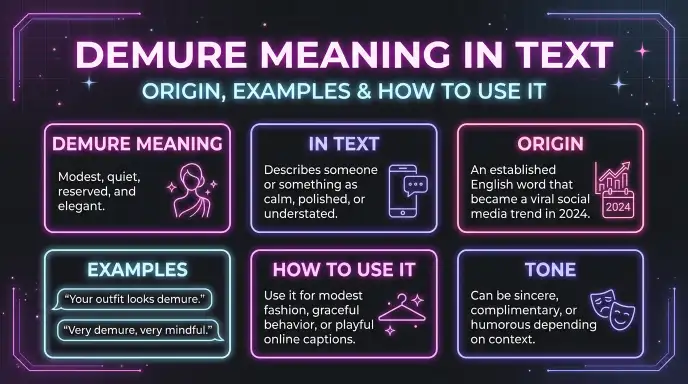
Demure in text means modest, calm, and reserved, and online it has become a playful slang word for classy, thoughtful behavior.
Traditionally, “demure” describes someone who is quiet, polite, and not attention-seeking. It was a formal word that most people rarely used in everyday chats. That changed when social media gave it a fresh, fun meaning.
In 2024, a TikTok trend with the phrase “very demure, very mindful” made the word go viral. People used it to joke about acting graceful, professional, and low-key in daily life. As a result, “demure” now appears in captions, comments, and group chats.
The tone depends on the speaker, because it can be sincere, playful, or sarcastic. For example, “She showed up to work so demure” praises calm and polished behavior, while a joking “very demure” can poke fun at the trend. Context and emojis usually show which one is meant.
In this guide, you will learn the exact demure meaning in text, how the trend started, and how to use the word in real conversations. You will also find examples, similar slang terms, and answers to frequently asked questions to help you use it with confidence.
Quick Answer:
Demure means modest, quiet, reserved, or shy in appearance or behavior. In modern internet slang, people also use it humorously to describe someone who acts polished, mindful, classy, or appropriately reserved.
What Does Demure Mean in Text?
When someone uses demure in a text message, they usually describe a person or action that appears modest, calm, elegant, or reserved. The exact meaning depends on the conversation and the speaker’s tone.
For example, a friend might text, “Your outfit looks so demure today!” This means the outfit looks modest, understated, or elegant.
On social media, however, people may use the word in an exaggerated or funny way. Someone might say, “Very demure, very mindful,” after doing something ordinary or slightly dramatic. The humor comes from describing everyday behavior as if it were especially refined and proper.
Here are three common meanings:
- Traditional meaning: Modest, reserved, or shy.
- Compliment: Elegant, polished, understated, or graceful.
- Internet slang: A playful way to describe behavior as mindful, classy, or appropriately restrained, sometimes ironically.
The word does not automatically mean that someone lacks confidence. A person can be confident and demure at the same time.
What Is the Definition of Demure?
Demure is an adjective in standard English. It describes a person, expression, manner, or style that appears reserved, modest, or quiet.
The word often suggests that someone avoids drawing too much attention to themselves. Depending on the context, it can also suggest grace, politeness, or a carefully understated appearance.
For example:
- “She wore a demure dress to the formal event.”
- “He gave a demure smile when everyone praised him.”
- “Her demure personality makes her seem calm and thoughtful.”
- “The room had a demure color scheme with soft, neutral shades.”
In each sentence, the word suggests restraint rather than loudness or showiness.
However, demure does not always mean shy. Someone may deliberately choose a modest style or a quiet manner without feeling nervous around other people.
Demure Meaning in Simple English
In simple English, demure means quiet, modest, and not trying to attract too much attention.
Imagine someone who wears a simple outfit, speaks politely, and behaves calmly at a formal event. You might describe that person as demure.
The word can describe a person’s behavior, facial expression, clothing, or overall style.
Demure Meaning in Modern Slang:
The traditional meaning of demure has not disappeared, but social media has made the word more playful.
In modern internet slang, people often use demure to describe an action that looks careful, polished, considerate, or appropriately restrained. They may use it seriously, but they can also use it sarcastically or humorously.
For example, someone might post a video of themselves arriving at work with a coffee and write, “Very demure, very mindful.” The caption humorously presents an ordinary morning routine as an example of perfect manners and self-awareness.
People may also use the word to describe fashion, makeup, workplace behavior, social situations, and everyday decisions.
Here is how the traditional and modern meanings compare.
| Feature | Traditional meaning | Modern internet usage |
| Main idea | Modest and reserved | Mindful, polished, or intentionally proper |
| Tone | Often sincere | Sincere, playful, or ironic |
| Common setting | Everyday English and formal writing | TikTok, Instagram, memes, and text messages |
| Example | “She has a demure manner.” | “Very demure, very mindful.” |
The modern meaning is closely connected to an online trend that made the phrase “very demure, very mindful” widely recognizable.
Where Did the Demure Trend Come From?
The recent popularity of demure on social media is associated with creator Jools Lebron, who helped popularize the phrase “very demure, very mindful” in 2024 through TikTok videos.
In these videos, Lebron used the phrase while discussing appearance and behavior in a humorous, exaggerated way. The idea was to present certain choices as polished, thoughtful, modest, or appropriate.
The phrase quickly spread beyond its original context. People began applying it to everything from workplace habits and beauty routines to food choices and funny everyday situations.
For example, someone might describe keeping their desk organized as “very demure.” Another person might call a dramatic reaction “demure” as a joke.
The contrast between the refined wording and ordinary or exaggerated actions helped make the trend popular.
Today, people may use demure without knowing the full background of the trend. In many conversations, the intended meaning becomes clear from the context, facial expression, emojis, or surrounding words.
How to Use Demure in Text Messages:
You can use demure in a conversation when you want to describe something as modest, reserved, elegant, or intentionally restrained.
The following examples show how the word works in everyday messages.
1. Complimenting Someone’s Outfit
Text: “Your dress looks so demure and elegant.”
Meaning: The dress looks modest, graceful, and understated.
This use is appropriate when you want to compliment someone’s style without suggesting that the outfit is flashy or attention-seeking.
2. Describing Someone’s Behavior
Text: “She gave a demure smile when he complimented her.”
Meaning: She smiled in a modest, restrained, or slightly shy way.
This example uses the traditional meaning of the word.
3. Using the Word as a Joke
Text: “I finished my work early and left quietly. Very demure, very mindful.”
Meaning: The speaker humorously presents their ordinary behavior as especially thoughtful and proper.
This style is common in internet-inspired conversations.
4. Talking About Makeup
Text: “I’m going for a demure makeup look today.”
Meaning: The speaker wants a subtle, understated, or polished appearance.
The exact style depends on personal preference, but the word generally suggests restraint rather than an extremely bold look.
5. Describing a Social Situation
Text: “I stayed calm during the meeting. Very demure.”
Meaning: The speaker is describing their behavior as controlled and composed, possibly with a playful tone.
These examples show that demure can sound sincere, fashionable, or funny depending on how someone uses it.
Demure vs. Modest vs. Shy vs. Mindful:
Demure is related to several other English words, but they do not all mean the same thing. Knowing the differences can help you understand messages more accurately.
| Word | Meaning | Example |
| Demure | Quiet, reserved, or modest in manner or appearance | “She has a demure style.” |
| Modest | Not boastful, showy, or excessive | “He gave a modest answer.” |
| Shy | Nervous or uncomfortable around other people | “She feels shy around strangers.” |
| Mindful | Paying attention and acting with awareness | “Be mindful of your words.” |
| Elegant | Graceful, refined, or stylish | “She wore an elegant outfit.” |
The key difference: Demure focuses on a reserved or modest appearance or manner. Shy describes a possible feeling, while mindful emphasizes awareness and attention.
For instance, a confident person can have a demure style without feeling shy. Likewise, a person can be mindful while speaking loudly and confidently.
The words overlap in some situations, but they are not interchangeable in every sentence.
Is Demure a Compliment or an Insult?
Demure is usually neutral or positive, but the meaning depends on the speaker’s intention and the context.
When Demure Is a Compliment
Someone may use demure to praise a person’s graceful appearance, modest clothing, calm behavior, or understated style.
Examples include:
- “You look demure and sophisticated.”
- “Her demure smile was charming.”
- “I love your demure fashion style.”
In these examples, the word expresses appreciation.
When Demure Is Used Sarcastically
People may also use the word ironically to describe behavior that is not particularly modest or reserved.
For example:
“Me eating the last slice of pizza without asking anyone. Very demure!”
The speaker is joking because taking the last slice may not seem especially considerate.
When It May Sound Negative
In some contexts, demure can suggest that a person is overly reserved, timid, or expected to behave according to restrictive social standards. The word itself is not inherently insulting, but the surrounding sentence can give it a negative tone.
If someone calls you demure, consider their tone and the situation before deciding if they intended a compliment or a joke.
Common Places Where People Use Demure:
People use demure in ordinary English as well as in online conversations. Its popularity on social media has made it especially recognizable in captions, memes, and short videos.
Social Media
On TikTok and Instagram, users may add demure to captions about fashion, beauty, routines, or humorous situations.
Example: “A clean desk and a fresh cup of tea. Very demure.”
Text Messages
Friends may use the word when complimenting each other’s outfits, behavior, or appearance.
Example: “That color looks so demure on you.”
Fashion and Beauty
Fashion writers and everyday users may describe a subtle outfit, soft makeup, or understated hairstyle as demure.
Example: “She chose a demure look for the formal dinner.”
Everyday Conversation
People may use the word to describe a reserved manner, a gentle smile, or a calm response.
Example: “He seemed demure during the introduction.”
The word is suitable for many situations, but it can sound more formal than simple alternatives such as quiet, modest, or shy.
Common Mistakes to Avoid When Using Demure:
Although demure is easy to understand, people sometimes confuse it with other words or use it in ways that do not fit the intended meaning.
Mistake 1: Assuming demure always means shy.
Demure describes an outward manner or appearance. It does not prove that someone feels nervous or lacks confidence.
Mistake 2: Thinking demure only describes women.
The word can describe anyone, regardless of gender. It can also describe clothing, expressions, and styles.
Mistake 3: Treating every use as internet slang.
Demure is an established English adjective. It existed long before the 2024 social media trend.
Mistake 4: Assuming demure always means mindful.
Mindful and demure have different definitions. The online phrase connects them humorously, but they are not exact synonyms.
Mistake 5: Using it when you mean loud or flashy.
Demure generally suggests restraint or modesty. If you want to describe something bold, dramatic, or attention-grabbing, another adjective may fit better.
Understanding these distinctions will help you use the word naturally in both formal writing and casual messages.
FAQs:
Q1: What does demure person mean?
A demure person is someone who is modest, calm, and reserved in the way they act and speak. They tend to be polite, quiet, and thoughtful rather than loud or attention-seeking. The word often suggests a gentle, graceful presence. In modern slang, it can also describe someone who stays classy and low-key in everyday situations.
Q2: Is demure a compliment?
In most cases, yes. Calling someone demure usually praises their modesty, grace, and good manners, and the online trend made it even more positive. However, the tone depends on the speaker and the situation, because the word can sound old-fashioned or slightly teasing. Among friends, a joking “so demure” is usually playful rather than critical.
Q3: What does demur mean in slang?
“Demur” is a different word from “demure,” even though they sound alike. To demur means to object, hesitate, or raise doubts about something, as in “she demurred at the idea.” It is not common slang, and in casual chats people almost always mean “demure” when they type it. If you see “demur” in a serious or formal sentence, it most likely refers to hesitation.
Q4: Why is everyone saying demure now?
The word took off in 2024 when a viral TikTok video used the phrase “very demure, very mindful” to joke about acting graceful and professional. The catchy line spread quickly across TikTok, Instagram, and X, and people began using “demure” in captions, comments, and memes. Viral phrases like this usually peak fast, but “demure” still appears in jokes and everyday chats. Its popularity shows how a single clip can bring an old word back into daily speech.
Q5: Does demure mean beautiful?
No, demure does not mean beautiful. It describes behavior and style, such as being modest, quiet, and well-mannered. A person can look beautiful and not be demure, or be demure without being described as beautiful. When used about fashion, “demure” usually points to a modest, elegant look instead of attractive features.
Q6: Can I use demure for a man?
Yes, you can use demure for a man. The word describes a calm and modest manner, and it is not limited to one gender. Traditionally, it was used more often for women, but online usage has made it a flexible, playful word for anyone. For example, “He walked in so demure” is a fine way to describe a quiet, polished entrance.
Final Thoughts:
The word demure means modest, reserved, quiet, or understated. In traditional English, it often describes someone’s appearance, expression, or manner. On social media, the word has taken on a playful meaning through the popular phrase “very demure, very mindful.”
When you see demure in a text message, look at the context to understand if the person is offering a genuine compliment, describing a style, or making a joke.
Once you understand its traditional definition and modern online use, you can recognize the word more easily and use it naturally in your own conversations.
Deep dive!

Hi, I’m Jack Anderson, a writer at Slang Prime. I love exploring slang words, their meanings, and origins. My goal is to explain modern slang in simple language and help readers understand everyday expressions.