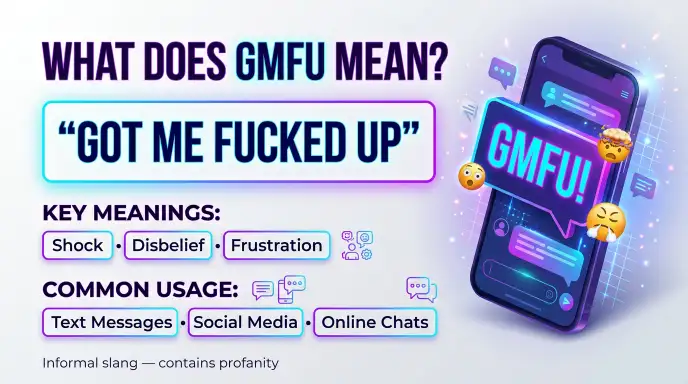
GMFU slang usually means “got me fed up,” a crude abbreviation people use in texts to express shock, confusion, frustration, or disbelief.*
The phrase comes from informal online speech and spread mainly through texting and social media. It is short, punchy, and easy to type, which makes it popular in fast chats.Many researchers link its roots to African American Vernacular English, as they do with many other internet slang terms.
In text, GMFU usually reacts to something surprising or upsetting, such as “This price is wild, gmfu.Friends can also use it jokingly when a situation catches them off guard.Because the tone depends on context, the same message can sound annoyed, amused, or even impressed.
. It does not fit work messages, school writing, or conversations with parents and teachers. Knowing your audience helps you avoid awkward misunderstandings.
In this guide, you will learn the exact GMFU meaning in text, how to use it in real conversations, and what its common variations are. You will also find examples, similar slang terms, and answers to frequently asked questions to help you use it with confidence.
Quick Answer:
GMFU slang stands for “got me f***ed up,” a crude texting abbreviation used to show shock, confusion, or frustration. It is casual, so it fits chats with friends but not work or school messages.
GMFU Meaning at a Glance:
| Question | Answer |
| Full form | Got Me Fucked Up |
| Basic meaning | Shock, disbelief, frustration, or feeling disrespected |
| Tone | Strong, casual, sometimes playful |
| Common users | People familiar with internet slang |
| Where it appears | Texts, social media, memes, and online chats |
| Is it offensive? | It contains profanity, so it can offend some people |
One important detail is that GMFU is not a fixed response to anger alone. People also use it to react to funny videos, surprising news, strange behavior, or an unexpected situation. The context tells you how strongly to take it.
What Does GMFU Stand For?
GMFU stands for “Got Me Fucked Up.” People use this abbreviation as a shorter version of the spoken slang expression.People use the letters instead of typing the full phrase.
The expression can suggest different reactions:
- Disbelief: “I cannot believe you said that.”
- Frustration: “This situation is getting on my nerves.”
- Disrespect: “You should not treat me that way.”
- Surprise: “I didn’t expect that at all.”
- Playful shock: “You really did that? No way!”
For example, imagine your friend says that you must pay for everyone’s dinner. You might reply, “GMFU 😂.” In this case, you are probably jokingly saying that the idea is ridiculous.
If someone sends “You GMFU” during a heated argument, however, the message may sound much more serious.
What Does Each Letter in GMFU Mean?
| Letter | Word |
| G | Got |
| M | Me |
| F | Fucked |
| U | Up |
Together, the letters spell out the phrase “Got Me Fucked Up.” The abbreviation makes the expression quicker to type, while keeping its strong emotional tone.
Where Did GMFU Come From?
GMFU comes from a longer expression used in informal American slang. The phrase existed before the abbreviation became recognizable online, and it has been associated with spoken slang, hip-hop culture, music, and internet communication.
Dictionary.com documented GMFU in its online slang and acronym coverage in 2018. Its explanation traces the phrase to earlier slang use and notes its presence in music and online culture. However, this does not establish the exact date the abbreviation was first created or identify one person who invented it.
As people began using more abbreviations in digital conversations, GMFU offered a short way to express a strong reaction. Similar shortened expressions became familiar in texts, comments, and memes.
Today, the abbreviation can appear in many kinds of online conversations. Its basic meaning remains tied to disbelief, frustration, shock, or feeling that someone has crossed a line.
How Is GMFU Used in Text Messages?
In texting, GMFU usually reacts to something another person said or did. It can stand alone or appear at the end of a sentence.
Here are three examples:
Example 1: Frustration
“Bro changed our plans for the third time. GMFU.”
Meaning: The speaker is annoyed because the plans keep changing.
Example 2: Disbelief
“You really finished the whole cake without asking? GMFU 😭”
Meaning: The speaker cannot believe what happened. The emoji may make the reaction more playful.
Example 3: Feeling disrespected
“You think I will apologize when I did nothing wrong? GMFU.”
Meaning: The speaker feels that the other person’s expectation is unfair.
Notice how the same abbreviation works in different situations. The words around it help you understand if the speaker is joking, upset, or genuinely offended.
Where Is GMFU Commonly Used?
GMFU can appear on different platforms, but its meaning usually stays the same. The main difference is the type of conversation in which people use it.
| Platform | How It Is Used | Example |
| TikTok | Reacting to funny, shocking, or frustrating videos | “This video GMFU 😭” |
| Commenting on posts, Reels, and Stories | “Those prices GMFU.” | |
| Snapchat | Sending quick reactions to friends | “You GMFU 😂” |
| Casual private chats and group messages | “They changed the time again, GMFU.” | |
| Discord | Reacting to jokes, game events, or chat messages | “That final round GMFU.” |
| X (Twitter) | Sharing strong reactions to posts and events | “That plot twist GMFU.” |
These are examples of possible uses, not a ranking of platform popularity. GMFU may be more familiar in some communities than others.
On public platforms, a short comment can be misunderstood because readers cannot always hear the speaker’s tone. In a private chat, the relationship and earlier messages may make the intention clearer.
Is GMFU Positive or Negative?
GMFU is usually negative or emotionally intense, but it is not always meant as an insult. It depends on what caused the reaction.
When someone feels cheated, disrespected, or frustrated, GMFU can express genuine anger. When a friend does something silly, the same letters may communicate playful disbelief.
For instance, “You ate my fries? GMFU 😂” may be a joke. But “You lied to me again. GMFU” sounds more serious.
Do not assume that a laughing emoji always means everything is fine. People sometimes use humor to soften frustration. If a message seems hostile or unclear, consider the conversation as a whole.
Is GMFU Rude or Offensive?
Yes, GMFU can be considered rude because its full form contains a strong swear word. Some people use it freely with close friends, while others may find it disrespectful.
It is generally better to avoid GMFU in these situations:
- Work emails and professional chats
- School assignments or formal discussions
- Conversations with people you do not know well
- Sensitive discussions where someone may feel hurt
- Messages to people who dislike profanity
With friends who understand your humor, it may be acceptable. Still, knowing your audience is important. A casual abbreviation can sound aggressive when sent to someone who is unfamiliar with it.
GMFU vs. Similar Slang Expressions:
Several slang abbreviations express surprise, frustration, or disbelief. However, they do not all have the same strength or tone.
GMFU vs. WTF vs. SMH
| Slang | Full Form | Main Meaning | Typical Tone |
| GMFU | Got Me Fucked Up | Strong disbelief, frustration, or offense | Intense and profane |
| WTF | What the fuck | Shock, confusion, or disbelief | Surprised or blunt |
| SMH | Shaking My Head | Disappointment or disapproval | Disappointed or critical |
Example: If a friend makes an unbelievable excuse, you might say “WTF?” to show surprise. You might use “SMH” to show disappointment. GMFU adds a stronger sense that the situation has upset you or crossed a line.
GMFU vs. GTFO vs. FR
| Slang | Full Form | Typical Meaning |
| GMFU | Got Me Fucked Up | Something has shocked or upset me |
| GTFO | Get the fuck out | Leave, or a forceful reaction to disbelief |
| FR | For real | Asking if something is true or showing agreement |
These expressions are not interchangeable. GTFO can sound like a direct command, while FR is often used to confirm something or show that you agree. GMFU focuses more on the speaker’s strong reaction.
GMFU vs. “You Got Me Messed Up”
| Expression | Tone | Best Use |
| GMFU | Strong and profane | Casual chats with people comfortable with swearing |
| You got me messed up | Milder and less explicit | Informal conversations with a wider audience |
| You must be joking | Clear and direct | When a request or statement seems unbelievable |
If you want to express the same idea without using profanity, “You got me messed up” or “Are you serious?” may be a better choice.
Real-Life Examples of GMFU:
The following examples show how GMFU can fit different conversations.
Text message
Nora: “The shop charged me twice for one order.”
Caleb: “That GMFU. You should contact them.”
Here, Caleb is reacting to an unfair or frustrating situation.
TikTok comment
“Why did the character do that at the end? GMFU 😭”
The commenter is shocked by the ending. The emoji may suggest dramatic or playful disbelief.
Group chat
“I studied all night and the test was only five questions. GMFU 😂”
The speaker finds the situation ridiculous and is using the abbreviation for humor.
Gaming chat
“The game disconnected us right before we won. GMFU.”
The player is frustrated by the unexpected disconnection.
Instagram caption
“Found out the delivery fee costs more than the meal. GMFU.”
The caption shows disbelief at the extra cost.
In each case, the abbreviation adds emotion rather than giving new factual information. The event being discussed tells you what the speaker is reacting to.
Common Mistakes When Using GMFU:
1. Assuming it always means anger. GMFU can express surprise, humor, disbelief, or frustration. Read the whole message before deciding what the sender feels.
2. Using it in formal communication. The implied profanity makes it unsuitable for most professional emails, official messages, and academic writing.
3. Confusing it with a compliment. GMFU is not a compliment by itself. A playful or admiring message may use it, but the other words provide that meaning.
4. Treating every message as a personal attack. Friends may use GMFU to exaggerate their reactions. If you are unsure, ask what they mean instead of jumping to conclusions.
5. Thinking capitalization changes the full form. GMFU and gmfu generally refer to the same expression. Uppercase letters may add emphasis, but they do not create a separate standard meaning.
Key Takeaways:
- GMFU usually stands for “Got Me Fucked Up.”
- It can express shock, disbelief, frustration, or feeling disrespected.
- Friends may also use it jokingly in casual messages and online comments.
- The phrase contains profanity, so it may offend some readers.
- The surrounding conversation is the best clue to the intended tone.
FAQs:
Q1: What does GMS mean in slang?
In casual chats, GMS is most often used as a short form of “good morning, sunshine,” a warm greeting sent to a friend, partner, or crush. It can also stand for other phrases, such as “give me strength,” depending on the conversation. Because it is a short abbreviation, the surrounding message is the best clue to the intended meaning. When you are unsure, simply ask the person what they meant.
Q2: What does “GMFU” mean in urban slang?
In urban slang and texting, GMFU stands for “got me f***ed up.” It expresses strong emotions such as shock, confusion, frustration, or disbelief, and it is often used when something catches you off guard. The phrase grew out of everyday spoken slang long before it became an acronym, and it now appears widely in texts and on social media. Because it contains profanity, it fits casual talks with friends but not work or school messages.
Q3: What does YGMFU mean in text?
YGMFU is an extended form of GMFU and most likely stands for “you got me f***ed up.” People use it to react to something another person said or did that left them shocked, annoyed, or amused. It is usually directed at someone in the chat, so the tone can be playful or confrontational depending on the relationship. Reading the full conversation will show you whether it is a joke or a complaint.
Q4: What does GMH mean in slang?
GMH is a less common abbreviation, and one popular use is “good morning, handsome,” a flirty or affectionate greeting. Like many short acronyms, it can have other meanings in different communities, so it should not be treated as universal. If you see it in a message, check who sent it and the time of day. A friendly greeting in the morning usually points to the first meaning.
Conclusion:
The GMFU slang meaning is usually “Got Me Fucked Up,” a strong expression used when something leaves a person shocked, annoyed, confused, or unable to believe what happened. It can communicate real frustration, but friends may also use it as a joke or an exaggerated reaction to an everyday event.
The key to understanding GMFU is context. A message about an unfair situation may sound angry, while a message about a funny video may be playful. Emojis, the words around the abbreviation, and your relationship with the sender can help you work out the intended tone.
Because GMFU contains profanity, use it with care. It may be fine in a casual chat with friends but can sound rude in professional or unfamiliar settings. If you prefer a milder expression, try “Are you serious?” or “You got me messed up.”
Learning slang is easier when you understand both the words and the situations in which people use them. Explore related texting abbreviations to recognize more online expressions and respond with confidence.
Deep dive!

I am Ann Raimes, an applied linguist and English language educator. I am widely recognized for my contributions to writing pedagogy and research in ESL writing. I have authored several well-known books, including Techniques in Teaching Writing, Keys for Writers, and How English Works: A Grammar Handbook with Readings. Throughout my career, I have worked to promote communicative writing and the process-based approach to teaching writing, helping both teachers and learners develop effective writing skills.