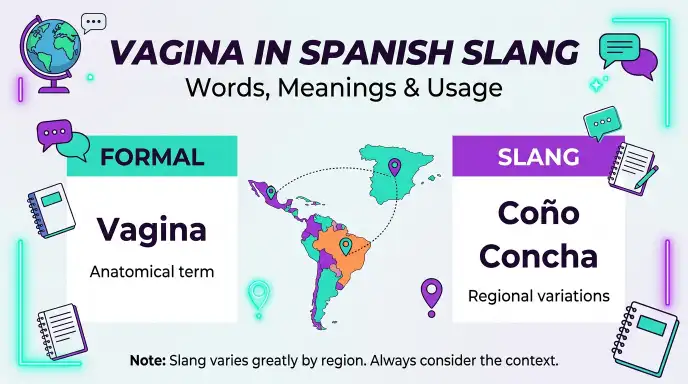
Vagina in Spanish slang has no single word, because the term changes from country to country, and most slang words are informal, vulgar, or both.
The standard and polite word in Spanish is “vagina,” which is used in medical, school, and everyday respectful talk. Slang words exist alongside it, and they vary widely between Spain, Mexico, Argentina, and other Spanish-speaking countries. A word that sounds mild in one place can be offensive in another.
Many of these slang terms come from animals, food, and local humor. For example, some words are common in one region, while the same word may mean something completely different elsewhere. This is why learners often get confused when they hear a term in a song, a movie, or a chat.
Because most slang words are vulgar, tone and audience matter a great deal. Using them in the wrong setting can sound rude or disrespectful, especially in formal or mixed company. In most situations, the standard word is the safest and clearest choice.
In this guide, you will learn the most common Spanish slang words for this body part, which regions use them, and how offensive each one sounds. You will also find usage examples, safer alternatives, and answers to frequently asked questions to help you understand the language with confidence.
Quick Answer:
Common Spanish slang terms for vagina include “coño,” “chocha,” “concha,” and “chucha,” although their meaning and level of vulgarity vary by country. “Vagina” itself is the standard neutral and anatomical term.
What Does Vagina Mean in Spanish Slang?
Common Spanish Slang Terms
The standard Spanish word for vagina is “vagina”, pronounced roughly ba-hee-na in much of Spanish.
However, informal speech uses many other terms. Some are direct slang words, while others can be vulgar or have additional meanings.
Here are some commonly encountered expressions:
| Spanish term | General meaning | Tone/context |
| Vagina | Vagina | Neutral/medical |
| Coño | Vulgar reference to female genitalia | Very informal/vulgar |
| Chocha | Vulgar/informal reference | Regional/informal |
| Concha | Can refer to female genitalia in some countries | Regional/vulgar |
| Chucha | Can refer to female genitalia in some regions | Regional/vulgar |
| Panocha | Vulgar/informal term in some varieties | Regional/vulgar |
The exact meaning should always be checked against the country and surrounding conversation.
What Is the Spanish Word for Vagina?
Neutral vs. Slang Vocabulary
If you want the standard Spanish word, use “vagina.”
For medical, educational, or formal communication, this is the clearest choice.
Spanish also has the word “vulva,” which refers to the external female genitalia. These two anatomical terms are not interchangeable.
| Word | Meaning | Appropriate use |
| Vagina | Internal muscular reproductive canal | Medical/neutral |
| Vulva | External female genital structures | Medical/neutral |
| Coño | Vulgar slang | Informal/adult |
| Chocha | Informal/vulgar slang | Regional |
| Concha | Slang in some countries | Regional |
This distinction matters because slang may be used loosely even when it is not anatomically precise.
Is Spanish Vagina Slang Rude or Offensive?
Understanding the Tone
Many slang expressions for female genitalia are considered vulgar, crude, or sexually explicit.
For example, “coño” can be especially strong depending on the Spanish-speaking country. In Spain, it is also famously used as an exclamation expressing surprise, anger, annoyance, or emphasis. In that context, it does not necessarily literally refer to a vagina.
This is an important example of why translation alone is not enough.
A Spanish slang term may be:
- Neutral in one context
- Vulgar in another
- Humorous among friends
- Offensive when directed at someone
- Different in meaning across countries
Where Is Vagina Slang Commonly Used?
Regional Differences in Spanish
Spanish is spoken across Spain and many countries in Latin America, and slang varies considerably.
For example, “concha” has different meanings depending on the country. In some places, it is associated with a female genital reference, while in others it can simply mean a shell or another ordinary object.
Similarly, “chucha” can have different meanings across Spanish-speaking regions.
This means you should not assume that a slang term has exactly the same meaning everywhere.
| Region | Slang variation | Important note |
| Spain | Coño | Can be sexual slang or an exclamation |
| Argentina/Uruguay | Concha | Can have a vulgar sexual meaning |
| Chile | Panocha and other local expressions | Meaning depends on context |
| Colombia | Chucha and other regional expressions | Multiple meanings are possible |
| Mexico | Chocha and other informal terms | Usage can vary by speaker |
| Other Latin American regions | Various local terms | Context is essential |
These are broad language patterns rather than rules. Individual speakers may use words differently.
Real-Life Examples of Vagina in Spanish Slang:
Educational Example
“I was reading a Spanish comment and wanted to know what the slang word meant.”
Here, the speaker is simply asking about vocabulary.
Casual Context
“That word is considered vulgar slang in this country.”
This is a safer way to discuss an expression without using it toward another person.
Social-Media Context
“I saw ‘coño’ in a Spanish meme and wanted to understand the meaning.”
Depending on the context, “coño” may be used as an exclamation rather than literally referring to female anatomy.
Argumentative Context
A vulgar anatomical term may also appear as an insult or aggressive expression. In that situation, the tone and relationship between speakers are especially important.
For language-learning purposes, it is better to understand the term than to repeat it without knowing its regional meaning.
What Does “Coño” Mean?
A Particularly Important Spanish Slang Term
“Coño” is one of the most recognizable vulgar Spanish words associated with female genitalia.
However, its use is broader than that.
In Spain, “coño” is frequently used as an exclamation similar to expressions such as “damn!” or “what the heck!” depending on the context.
For example:
“¡Coño!”
may express surprise, frustration, annoyance, or emphasis.
Therefore, translating “coño” as simply “vagina” in every sentence would be misleading.
| Context | Possible interpretation |
| Anatomical discussion | Vulgar reference to female genitalia |
| Spanish conversation | Vulgar exclamation |
| Argument | Strong/emotional language |
| Informal humor | Crude or adult humor |
What Does “Concha” Mean in Spanish Slang?
Why Context Matters
“Concha” literally has meanings related to a shell in Spanish.
In some Spanish-speaking regions, however, it is also used as vulgar slang for female genitalia.
This creates an important translation problem. A dictionary translation without context may not tell you what the speaker actually intended.
For example:
“Encontré una concha en la playa.”
means something related to finding a shell on the beach, not necessarily anything sexual.
The same word in an adult or insulting conversation can have a completely different meaning.
What Does “Chucha” Mean?
A Regional Slang Expression
“Chucha” is another word that can have sexual or vulgar meanings in some Spanish-speaking communities.
However, its meaning is highly regional. It may also have completely different meanings or uses depending on the country.
This is why online translators can sometimes produce confusing results with slang.
If you encounter “chucha” in a message, consider:
- Who wrote it?
- Which country are they from?
- What words appear before and after it?
- Is the conversation serious, humorous, or sexual?
- Is the word being used as an insult?
Comparison With Similar Spanish Terms
Spanish Slang vs. Neutral Anatomy
| Term | General meaning | Tone |
| Vagina | Anatomical vagina | Neutral |
| Vulva | External female genitalia | Neutral/medical |
| Coño | Vulgar genital reference/exclamation | Vulgar |
| Concha | Shell or regional vulgar slang | Context-dependent |
| Chocha | Regional vulgar reference | Informal/vulgar |
The neutral anatomical terms are generally preferable when accuracy and professionalism matter.
Slang vs. Polite Spanish Alternatives:
Which Words Should You Use?
If you are talking about anatomy, healthcare, education, or biology, choose standard vocabulary.
Better choices include:
- Vagina : the standard anatomical term
- Vulva : external female genitalia
- Zona genital : genital area
- Genitales femeninos : female genitals
These expressions are clearer and less likely to be misunderstood.
| Situation | Recommended wording |
| Doctor’s appointment | Vagina / vulva |
| School or educational article | Vagina / vulva |
| Formal translation | Vagina / vulva |
| Casual slang discussion | Explain the slang and context |
| Professional communication | Avoid vulgar slang |
Why Do People Use Spanish Vagina Slang?
Common Reasons
People use slang for many reasons, including:
- Informal conversation
- Humor
- Regional identity
- Internet culture
- Sexual discussion
- Expressing emotion
- Insults or arguments
- Avoiding formal vocabulary
Slang can also make speech feel more natural within a particular social group.
However, knowing a slang word does not necessarily mean you should use it. Understanding slang and using slang are two different things.
Impact of Using Spanish Sexual Slang:
Context Can Change the Message
Using a vulgar anatomical term can make a sentence sound:
- More casual
- More humorous
- More aggressive
- More sexual
- More regional
- Less professional
For language learners, this can create problems because a word that sounds funny among friends may sound extremely rude when used with a stranger.
Tone is just as important as vocabulary.
When Should You Avoid Spanish Vagina Slang?
Situations Where Formal Language Is Better
Avoid vulgar slang when speaking with:
- Teachers
- Employers
- Customers
- Doctors
- Professional contacts
- People you do not know well
- Children
- A general audience
It is also better to avoid using regional slang when you are unsure how a Spanish-speaking audience will interpret it.
If your purpose is educational, simply explain the term and identify it as slang.
Is Vagina Slang Safe for Social Media?
Social-Media Context
Spanish sexual slang can be interpreted as adult or explicit language on social media.
if a particular word is allowed depends on the platform, context, and surrounding content.
For general-audience content, avoid unnecessary vulgar language. If your article is explaining slang, a factual linguistic explanation is much clearer than repeatedly using explicit expressions.
For example, instead of using a vulgar term throughout an article, explain:
“This is a regional vulgar Spanish term for female genitalia.”
That approach keeps the content informative and accessible.
Common Mistakes When Translating Spanish Slang:
Mistake 1: Assuming Every Country Uses the Same Slang
Spanish vocabulary differs significantly between countries.
Mistake 2: Translating Every Word Literally
A slang word may have an emotional or cultural meaning that cannot be captured by a single English translation.
Mistake 3: Ignoring Context
Words such as “concha” can have completely ordinary meanings in one sentence and vulgar meanings in another.
Mistake 4: Using Slang Without Knowing Its Tone
A word learned from a meme may be much stronger in real conversation.
Mistake 5: Confusing Vagina and Vulva
These are different anatomical terms, even though everyday speech may use them loosely.
FAQs:
Q1: What is the Spanish slang for private parts?
Spanish has many slang words for private parts, but they change from country to country and most of them sound informal or vulgar. Mild, playful euphemisms such as “las partes” or “ahí abajo” (down there) are common in casual talk. Stronger slang words differ between Spain, Mexico, and Argentina, so a term that is harmless in one place can be rude in another. If you are learning the language, it is safer to recognize these words than to use them.
Q2: How do you say “private parts” in Spanish?
The most common polite phrases are “partes íntimas” and “partes privadas,” and both are understood across Spanish-speaking countries. In medical or school settings, “genitales” or “órganos genitales” are the standard terms. Parents and teachers often choose “partes íntimas” because it sounds gentle and respectful. These phrases are clear and appropriate for almost any situation.
Q3: What is a nickname for a girl’s private part?
People often use soft, playful euphemisms such as “down there,” “lady parts,” or “private area,” and “vajayjay” has become a lighthearted pop culture term. Families also use child-friendly words when talking with young kids, although many health experts recommend teaching the correct anatomical names. The right nickname depends on the audience, so choose a respectful one in mixed company. In health talks, the correct medical term is always the clearest choice.
Q4: What is slang for private parts?
Common English slang includes “privates,” “down there,” “junk,” and “intimate area,” while stronger slang words are vulgar and best avoided in polite company. The tone ranges from joking to rude, and the same word can offend one person and amuse another. Because of this, the setting and the people involved matter a lot. In school, work, or medical settings, use the terms “genitals” or “private parts.”
Q5: What makes a girl tight or loose?
Words like “tight” and “loose” are myths, not medical facts, and they say nothing about a person’s character or past. The vagina is a flexible muscular canal that naturally relaxes and tightens, and it returns to its usual shape after arousal, childbirth, or exercise. Factors such as pelvic floor muscle tone, hormones, age, and stress can affect how the body feels, and none of them measures a person’s worth. Anyone with real concerns about comfort or pelvic health should talk to a doctor or a pelvic floor specialist.
Conclusion:
Understanding Vagina in Spanish Slang
Vagina in Spanish slang does not have one universal translation. Spanish-speaking communities use different informal and vulgar expressions, including coño, chocha, concha, chucha, and panocha, but their meanings can change considerably depending on the country and context.
The safest neutral word is “vagina,” while “vulva” is the correct anatomical term for the external female genitalia. Slang expressions are more appropriate for understanding informal conversations, memes, movies, and online discussions than for formal communication.
If you encounter a Spanish slang term you do not recognize, look at the country, surrounding words, tone, and situation before deciding what it means. Understanding regional context is the key to translating Spanish slang accurately.
Deep dive!

I am Ann Raimes, an applied linguist and English language educator. I am widely recognized for my contributions to writing pedagogy and research in ESL writing. I have authored several well-known books, including Techniques in Teaching Writing, Keys for Writers, and How English Works: A Grammar Handbook with Readings. Throughout my career, I have worked to promote communicative writing and the process-based approach to teaching writing, helping both teachers and learners develop effective writing skills.