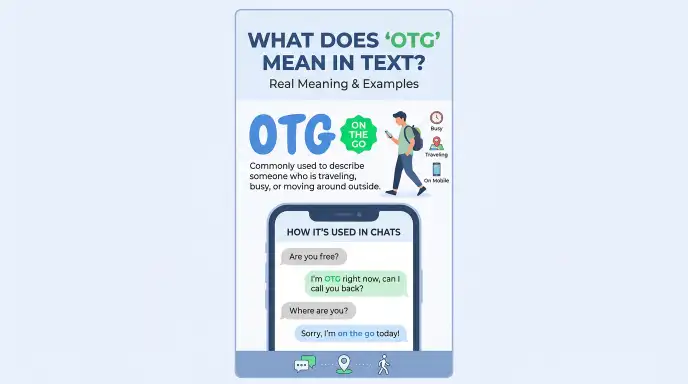
OTG in text most commonly stands for “on the go,” a quick way to say you are busy, moving, or away from your desk.
People send OTG to show they have seen a message but cannot give a full reply right now. It works like a short “do not disturb” sign that still feels friendly. The phrase is popular in texts, DMs, Slack chats, and Instagram captions.
In a chat, OTG usually explains why a reply will be short or late. For example, “I’m OTG right now, talk later” tells a friend that you are on the move. On social media, people also use it in captions, such as “Reporting OTG at the festival.”
The tone is casual and neutral, so it suits friends and coworkers in informal chats. In a formal email or a client message, writing “on the go” in full looks clearer and more professional. OTG also has other meanings, such as USB On-The-Go in tech, “off the grid” for a lifestyle, and “oven toaster grill” for a kitchen appliance.
In this guide, you will learn the exact OTG meaning in text, how to use it in real conversations, and what its other meanings are. You will also find examples, similar abbreviations such as “BRB” and “TTYL,” and answers to frequently asked questions to help you use it with confidence.
Quick Answer:
OTG in text stands for “on the go.” People use it to say they are busy or moving, like “I’m OTG right now, talk later.”
What Does OTG Mean in Texting?
In everyday texting, OTG most commonly stands for “on the go.” It describes someone who is busy, traveling, or doing activities outside their usual location.
People often use it in casual conversations because it communicates their situation quickly without requiring a long explanation.
For example:
- “I’m OTG today, so I might reply late.”
- “Been OTG since morning. I need some rest.”
- “Sorry, can’t talk right now. I’m OTG.”
In these messages, OTG tells the reader that the sender is occupied or moving around.
The abbreviation is especially useful when someone wants to explain why they cannot respond immediately, join a call, or spend time chatting.
Is OTG a Slang Word or an Abbreviation?
OTG is primarily an abbreviation rather than a traditional slang word. It shortens the phrase “on the go” to make digital communication quicker.
Although it is not slang in the strictest sense, people often group it with internet slang because they use it in informal texts, direct messages, and social media posts.
Its meaning is straightforward, and you do not need to know complicated internet culture to understand it.
What Does OTG Mean on Social Media?
On social media platforms such as Instagram, Snapchat, TikTok, and Facebook, OTG generally carries the same meaning: “on the go.”
People may use it in captions, comments, stories, and private messages to describe a busy day or an activity outside the home.
For instance, someone might post a picture from a coffee shop with the caption “OTG all day.” Another person might use it in a direct message to explain why they cannot reply immediately.
OTG on Instagram
Instagram users may add OTG to captions about travel, shopping, daily routines, or spontaneous outings.
Examples include:
- “Coffee first, then OTG all day.”
- “Quick outfit check before heading OTG.”
- “Always OTG, never sitting still.”
In these examples, the abbreviation describes an active lifestyle or a day filled with activities.
OTG on Snapchat
On Snapchat, people may use OTG in short messages when friends ask where they are or what they are doing.
For example:
Friend: “Wanna hang out?”
You: “Maybe later, I’m OTG with my family.”
The message explains that you are busy without giving unnecessary details.
OTG on TikTok
TikTok creators may use OTG in captions or videos about daily life, travel, fitness, or busy schedules.
For example, a creator might caption a video showing several errands with “My whole day is OTG mode.”
The phrase adds a casual, conversational feel to the content. However, OTG is not limited to any one social media platform.
Real Examples of OTG in Text Messages:
The easiest way to understand an abbreviation is to see how people use it in everyday situations.
Here are several examples of OTG in text conversations.
Example 1: Explaining Why You Are Busy
Person A: “Can you talk for a minute?”
Person B: “I’m OTG right now. I’ll call you tonight.”
Meaning: Person B is busy or moving around and cannot talk at the moment.
Example 2: Talking About Errands
Person A: “Where have you been all morning?”
Person B: “OTG running errands with my mom.”
Meaning: Person B has been out taking care of different tasks.
Example 3: Discussing Travel
Person A: “Are you home yet?”
Person B: “No, still OTG. Traffic is out of control.”
Meaning: Person B is still traveling or moving between places.
Example 4: Giving a Delayed Reply
Person A: “Did you see my message?”
Person B: “Just saw it! I was OTG all afternoon.”
Meaning: Person B was busy or away from their phone for much of the afternoon.
Example 5: Making Plans
Person A: “Want to grab lunch?”
Person B: “I’m OTG until 2, but I’m free after that.”
Meaning: Person B has other activities or commitments until 2 p.m.
Example 6: Describing a Busy Day
Person A: “How’s your day going?”
Person B: “Super busy. I’ve been OTG since 8 a.m.”
Meaning: Person B has been active or occupied since the morning.
These examples show that OTG usually describes a person’s current situation rather than expressing a particular emotion.
OTG Meaning in Different Situations:
Although “on the go” is a common interpretation in casual texting, abbreviations can have different meanings in different settings. The surrounding words usually reveal the intended meaning.
| Situation | Meaning of OTG | Example |
| Text messages | On the go | “I’m OTG right now.” |
| Social media captions | On the go | “OTG all weekend.” |
| Daily conversations | Busy or moving around | “Been OTG all day.” |
| Mobile technology | USB On-The-Go | “My phone supports OTG.” |
| Informal status updates | Active or occupied | “OTG until this evening.” |
The first three uses relate to everyday activities. The technology meaning is different and appears in discussions about phones, USB connections, and accessories.
How Context Changes the Meaning
Consider these two messages:
- “Sorry, I’m OTG. Text you later.”
- “My phone has OTG support.”
The first message most likely means “on the go.” The second refers to a technical feature that lets a compatible device connect directly to USB accessories.
If someone uses OTG while discussing a phone’s specifications, cables, or external storage, the technology meaning is more likely.
OTG vs. Other Common Text Abbreviations:
OTG is just one of many abbreviations people use to communicate quickly online. Some expressions describe a person’s location, while others explain availability or how soon they will respond.
The following comparison helps you distinguish OTG from similar terms.
| Abbreviation | Full Form | Meaning in Conversation |
| OTG | On the go | Busy, traveling, or moving around |
| BRB | Be right back | Leaving briefly and returning soon |
| AFK | Away from keyboard | Temporarily unavailable at a device |
| OMW | On my way | Traveling toward a destination |
| TTYL | Talk to you later | Ending a conversation for now |
| ATM | At the moment | Describing the current situation |
OTG vs. OMW
OTG and OMW can sound similar because both may appear in conversations about travel.
However, they communicate different things.
OTG describes being active, busy, or out and about.
OMW specifically means “on my way” and usually indicates that someone is heading toward a particular destination.
Example:
- “I’m OTG all day.” The person has a busy schedule.
- “I’m OMW to your house.” The person is traveling to your house.
OTG vs. BRB
BRB means “be right back.” People use it when they expect to return to a conversation soon.
OTG does not necessarily suggest a quick return. Someone who is OTG might be unavailable for several hours.
For example, “BRB, answering the door” suggests a short break. “I’m OTG until tonight” indicates a longer period of activity.
OTG vs. AFK
AFK means “away from keyboard.” It is commonly used in gaming, online chats, and situations where someone temporarily steps away from a computer.
OTG usually describes someone who is out, traveling, or occupied with activities.
Although both can explain why someone is unavailable, they do not mean exactly the same thing.
How to Reply When Someone Says OTG:
If someone sends you a message containing OTG, you generally do not need a complicated response. You can acknowledge that they are busy or continue the conversation later.
Your reply should match the situation and your relationship with the person.
Casual Replies
Use these responses when chatting with friends or people you know well:
- “No worries, talk later!”
- “All good, text me when you’re free.”
- “Okay, stay safe!”
- “Gotcha, catch you later.”
- “Cool, message me when you get a chance.”
Friendly Replies
If you want to sound warm and supportive, you can say:
- “Hope your day goes well!”
- “Take your time. We can talk later.”
- “Sounds busy! Hope everything goes smoothly.”
- “No problem, enjoy your day.”
Replies When Making Plans
If you are trying to arrange a meeting, ask for a time that works better.
For example:
Friend: “I’m OTG right now.”
You: “No problem. Are you free this evening?”
Or:
Friend: “Been OTG all day.”
You: “Sounds exhausting! Let me know when you’re free.”
These replies acknowledge the person’s situation without putting pressure on them to respond immediately.
Is OTG Formal or Informal?
OTG is generally informal. It works well in text messages, social media captions, and conversations with friends, relatives, or colleagues you know well.
However, it may not be appropriate in every professional situation.
For example, you might text a coworker, “I’m OTG this afternoon, so I may reply later.” That can work in a casual workplace chat.
In a formal email to a client, a clearer sentence is usually better:
“I will be away from my desk this afternoon and may respond to your message later.”
The best choice depends on your audience, the communication channel, and the level of formality required.
Should You Use OTG at Work?
You can use OTG in informal workplace messages if your team regularly uses abbreviations.
However, avoid assuming that every colleague understands internet shorthand. In formal communication, writing the full phrase or explaining your availability can prevent confusion.
Clear communication matters more than using the shortest possible expression.
Common Mistakes People Make About OTG:
Even simple abbreviations can cause confusion when people assume they have only one possible meaning.
Here are some common mistakes to avoid.
Assuming OTG Always Means On the Go
In casual texting, “on the go” is a common meaning. In technology discussions, OTG may refer to USB On-The-Go.
Always consider the subject of the conversation before deciding what the abbreviation means.
Confusing OTG With OMW
These abbreviations are related to movement, but they are not interchangeable.
OTG describes being busy or active, while OMW tells someone that you are heading toward a destination.
Using the wrong abbreviation could make your message less clear.
Thinking OTG Means Someone Is Ignoring You
If a person says they are OTG, they may genuinely be busy or away from their phone.
The abbreviation alone does not prove that they are ignoring your message. You should consider the wider conversation rather than making assumptions.
Using OTG in Every Situation
Abbreviations work best when they make communication easier. If a person does not understand OTG, simply write “on the go.”
There is no need to use internet shorthand in every message.
OTG Meaning in Technology: USB On-The-Go
Outside texting and social media, OTG commonly stands for USB On-The-Go. This technology allows compatible devices, such as smartphones and tablets, to act as USB hosts and connect directly to supported accessories.
For example, a compatible phone may connect to a USB flash drive, keyboard, mouse, or other peripheral using an appropriate adapter.
This technical meaning is particularly common when people discuss Android phones, USB cables, data transfers, or device compatibility.
What Can You Do With USB OTG?
Depending on the device and accessory, USB OTG may allow you to:
- Access files stored on a compatible USB flash drive.
- Connect a physical keyboard to a phone or tablet.
- Use a compatible mouse with a mobile device.
- Connect certain cameras or other USB accessories.
- Transfer files between supported devices and storage accessories.
Not every phone supports every accessory. Compatibility depends on the device, operating system, adapter, and power requirements.
How to Tell Which OTG Meaning Someone Uses
If a person writes, “I’m OTG, call you later,” they most likely mean “on the go.”
If they ask, “Does this phone support OTG?” they are probably referring to USB On-The-Go.
The surrounding words usually provide enough information to distinguish the meanings without needing to ask for clarification.
FAQs:
What Does OTG Stand for in a Text Message?
OTG commonly stands for “on the go.” It describes someone who is busy, traveling, or moving between places. For example, “I’m OTG right now” means the person is occupied or out and about.
What Does OTG Mean on Instagram?
On Instagram, OTG usually means “on the go.” People may use it in captions, stories, comments, and direct messages to describe a busy day, travel, or activities outside the home.
Does OTG Mean Busy?
OTG can imply that someone is busy, but its literal meaning is “on the go.” The person may be traveling, running errands, or handling several activities. The exact situation depends on the conversation.
Is OTG the Same as OMW?
No. OTG means “on the go,” while OMW means “on my way.” OTG can describe a busy or active day, whereas OMW generally tells someone that you are heading toward a specific destination.
Can OTG Have More Than One Meaning?
Yes. In everyday texting, it commonly means “on the go.” In technology, OTG can stand for “USB On-The-Go,” a feature that allows compatible devices to connect directly to USB accessories.
How Do You Use OTG in a Sentence?
You can use OTG in casual messages such as “I’ve been OTG all day,” “Sorry, I’m OTG right now,” or “I’ll message you when I’m not OTG.” Each example describes being active, occupied, or away from your usual location.
Is OTG Appropriate for Professional Messages?
OTG can work in informal workplace chats, especially when colleagues understand the abbreviation. For formal emails or client communications, writing “on the go,” “away from my desk,” or “unavailable at the moment” is usually clearer.
Final Thoughts:
OTG most commonly means “on the go” in text messages and everyday online conversations. People use it to describe being busy, traveling, running errands, or moving between activities.
You might see it in Instagram captions, Snapchat messages, TikTok posts, and everyday chats when someone wants to explain why they cannot respond immediately.
Remember that context matters. In casual conversation, OTG usually refers to being on the go, while in mobile technology, it can mean USB On-The-Go.
Once you understand the situation in which someone uses it, recognizing OTG and responding naturally becomes easy.
Discover More!

Hi, I’m Jack Anderson, a writer at Slang Prime. I love exploring slang words, their meanings, and origins. My goal is to explain modern slang in simple language and help readers understand everyday expressions.