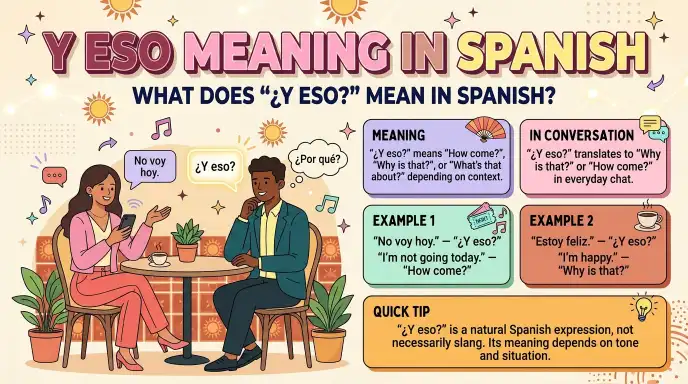
“Y eso” is a Spanish phrase that literally means “and that,” and in slang it is used as a casual follow-up like “how come?”, “and what’s that about?”, or “so what?” depending on tone.
The y eso meaning in Spanish slang depends heavily on how it is said. Literally, “y” means “and” and “eso” means “that,” so the phrase is often a short way to ask “and what about that?” or “and why is that?”
In everyday chat, people use “y eso” to show curiosity or surprise. For example, “¿Y eso?” after someone shares news means “Really? How come?” or “What happened?”, and it is very common in Spain and Latin America.
Tone changes the feeling of the phrase. With a friendly voice it sounds interested, but with a sharp or sarcastic tone it can mean “so what?” or “why would you do that?”, which can come across as rude.
This guide explains what y eso means in Spanish slang, how to use it in real sentences, and how the meaning shifts by context. You will also find simple chat examples and tips to avoid using it the wrong way.
Quick Answer:
“Y eso” is a Spanish expression that commonly means “How come?”, “Why is that?”, or “What’s that about?” Its exact meaning depends on the conversation and tone.
What Does Y Eso Mean in Spanish Slang?
The phrase y eso literally translates to “and that” in English. However, when someone says “¿Y eso?”, the expression often has a conversational meaning that goes beyond its literal translation.
People use it to ask for an explanation, show curiosity, or respond to unexpected news. It is similar to asking someone, “How come?” or “What’s the reason?”
For example:
- Friend: “Hoy no voy a salir.”
- You: “¿Y eso?”
- English: “I’m not going out today.” : “How come?”
In this conversation, the speaker is not asking about a specific object. They want to understand why their friend has changed their plans.
The expression can also show surprise or concern. If someone says they are moving to another city, a friend might respond with “¿Y eso?” to invite them to explain their decision.
Y Eso Meaning in Different Situations
| Situation | Possible English meaning | Purpose |
| Unexpected news | How come? | Asking for a reason |
| A sudden decision | Why is that? | Showing curiosity |
| A surprising event | What’s that about? | Requesting an explanation |
| A casual conversation | And that? | Following up on a topic |
| A personal concern | Is everything okay? | Showing interest, depending on tone |
The last meaning is contextual rather than a direct translation. A person may use ¿Y eso? with a concerned tone, but the phrase does not automatically mean “Is everything okay?”
Is Y Eso Slang or a Regular Spanish Expression?
“Y eso” is not technically a special slang abbreviation. It is a normal Spanish phrase that people frequently use in casual speech, which is why it can feel like slang when you encounter it in chats.
The words are simple:
- Y means “and.”
- Eso means “that” or “that thing.”
Together, y eso literally means “and that.” When spoken as a question, ¿Y eso?, it often asks why something happened or what explains a situation.
Does Y Eso Have a Full Form?
No. “Y eso” does not have a full form because it is not an acronym like LOL, BRB, or IDK.
It is a regular Spanish expression. People may type it without the opening question mark in informal messages, writing “Y eso?” instead of the standard Spanish form “¿Y eso?”
Both may be understood in casual digital communication, but the opening question mark is correct Spanish punctuation.
Is Y Eso Rude, Offensive, or Neutral?
In most situations, ¿Y eso? is neutral and friendly. It is a natural way to ask someone why they did something or what happened.
However, tone and context can change how the question sounds. A curious voice may show genuine interest, while a sharp or sarcastic tone may make it sound suspicious or challenging.
When Y Eso Sounds Friendly
Friends often use the phrase to keep a conversation going.
Example:
- Person A: “Me voy de vacaciones la próxima semana.”
- Person B: “¿Y eso? ¡Qué bien!”
- English: “I’m going on vacation next week.”
- “How come? That’s great!”
Here, the speaker sounds interested and excited to hear more.
When Y Eso Can Sound Suspicious
The same phrase can sound challenging if someone asks it during an argument.
Example:
- Person A: “No quiero hablar contigo.”
- Person B: “¿Y eso?”
- English: “I don’t want to talk to you.”
- “And why is that?”
Depending on the tone, the reply might sound curious, hurt, or confrontational.
The words themselves are not insulting. The way someone says them makes the difference.
Where Is Y Eso Commonly Used?
The expression is widely understandable across Spanish-speaking communities. People use it in everyday conversations, text messages, social media discussions, and informal exchanges with friends and family.
1. Everyday Spanish Conversations
In face-to-face conversations, ¿Y eso? is useful when someone shares unexpected information.
For example:
- “Hoy llegué temprano.” : “I arrived early today.”
- “¿Y eso?” : “How come?”
The listener invites the speaker to explain what happened.
2. Text Messages and WhatsApp
In texting, the phrase is short and natural. People often use it as a quick response when they want more information.
Examples:
- “Ya no trabajo allí.” : “I don’t work there anymore.”
- “¿Y eso?” : “How come?”
Another example:
- “Estoy aprendiendo francés.” : “I’m learning French.”
- “¿Y eso?” : “What made you decide that?”
These messages show how the expression helps people continue a conversation without writing a long question.
3. Social Media Comments
People may use ¿Y eso? when replying to a surprising post, announcement, or personal update.
For example, if someone posts, “I deleted all my social media accounts,” a friend might comment, “¿Y eso?” to ask what motivated the decision.
The phrase is not specific to any one social media platform. Its meaning remains the same across most informal online settings.
4. Gaming and Online Chats
Spanish-speaking gamers may use the expression when a teammate makes an unexpected move or suddenly leaves a game.
For example:
- Player A: “Me salgo de la partida.”
- Player B: “¿Y eso?”
- English: “I’m leaving the match.”
- “How come?”
This is an ordinary conversational expression, not a gaming acronym or technical gaming term.
Real-Life Examples of Y Eso in Spanish
The following examples show how the phrase works in different situations and tones.
Friendly Examples
Example 1:
- A: “Mi hermana viene a visitarme.”
- B: “¿Y eso? ¡Hace mucho que no la ves!”
- English: “My sister is coming to visit me.”
- “Oh, how come? You haven’t seen her in a long time!”
Example 2:
- A: “Hoy preparé comida para todos.”
- B: “¿Y eso? ¡Qué amable!”
- English: “I made food for everyone today.”
- “What inspired that? How thoughtful!”
In these examples, the question expresses interest rather than criticism.
Casual Examples
Example 3:
- A: “Voy a cambiar de teléfono.”
- B: “¿Y eso?”
- English: “I’m going to change my phone.”
- “How come?”
Example 4:
- A: “Mañana no tengo clases.”
- B: “¿Y eso?”
- English: “I don’t have classes tomorrow.”
- “Why is that?”
The speaker simply wants more information.
Argumentative Examples
Example 5:
- A: “No voy a ayudarte esta vez.”
- B: “¿Y eso? Pensé que éramos amigos.”
- English: “I’m not going to help you this time.”
- “And why is that? I thought we were friends.”
Depending on the tone, the reply may express disappointment or frustration.
Example 6:
- A: “No quiero ir contigo.”
- B: “¿Y eso? ¿Hice algo malo?”
- English: “I don’t want to go with you.”
- “How come? Did I do something wrong?”
Here, the speaker may be confused or worried.
Gaming and Social Media Examples
Example 7:
- A: “Voy a dejar el juego.”
- B: “¿Y eso?”
- English: “I’m leaving the game.”
- “How come?”
Example 8:
- Post: “Me mudé a otra ciudad.”
- Comment: “¿Y eso?”
- English: “I moved to another city.”
- “What made you do that?”
These examples reflect natural conversational uses. The exact emotional meaning depends on the relationship between the people and the surrounding conversation.
Y Eso vs. Similar Spanish Expressions:
Spanish has several expressions that people use to ask questions, show surprise, or request an explanation. Although these phrases can have similar meanings, they are not always interchangeable.
Comparison Table: Y Eso vs. Other Spanish Phrases
| Spanish expression | English meaning | Common use |
| ¿Y eso? | How come? / Why is that? | Asking about a reason |
| ¿Por qué? | Why? | Asking directly for a reason |
| ¿Cómo así? | How so? / What do you mean? | Asking for clarification; usage varies by region |
| ¿Qué pasó? | What happened? | Asking about an event |
| ¿En serio? | Really? | Showing surprise or disbelief |
For example, if your friend says they are leaving their job, you can ask ¿Y eso? or ¿Por qué? to learn the reason. If they say something confusing, ¿Cómo así? may be a better way to request clarification.
Comparison Table: Y Eso vs. English Expressions
| English expression | Similarity to “¿Y eso?” | Example situation |
| How come? | Very close in many contexts | Someone suddenly changes plans |
| Why is that? | Directly asks for a reason | Someone explains an unexpected decision |
| What’s that about? | Asks for an explanation | Someone makes a surprising announcement |
| And that? | Closer to the literal translation | Following up on a topic |
| Really? | Shows surprise but does not necessarily ask why | Someone shares unexpected news |
The closest translation is usually “How come?” when the speaker wants to know the reason behind something.
Origin and Background of Y Eso:
Y eso comes from ordinary Spanish grammar rather than a recent internet trend. The conjunction y connects ideas, while eso refers to something already mentioned or understood from context.
Over time, phrases such as ¿Y eso? became common conversational ways to respond to information and ask follow-up questions.
Why the Phrase Feels Like Slang
People often learn Spanish through textbooks, where questions may be presented in their full form, such as ¿Por qué has decidido hacer eso? (“Why have you decided to do that?”).
In everyday speech, native speakers frequently choose shorter expressions. Instead of asking a long question, someone can simply say ¿Y eso?
This makes the phrase sound informal and natural, even though it is not slang in the strict sense.
Why Do People Use Y Eso?
People use ¿Y eso? because it is short, flexible, and useful in everyday communication.
Common Reasons
- Curiosity: They want to know why something happened.
- Surprise: They did not expect the information they just heard.
- Conversation: They want the other person to explain more.
- Concern: They may want to understand a sudden change in someone’s behavior.
- Informal communication: The phrase feels natural among friends, relatives, and familiar acquaintances.
For example, if a friend suddenly says they are not attending a party, ¿Y eso? lets you ask for an explanation without sounding overly formal.
However, if the other person seems upset or does not want to discuss the matter, it is better to respect their privacy rather than repeatedly demand an explanation.
When Should You Avoid Using Y Eso?
Although the expression is generally harmless, it may not be suitable for every situation.
Situations Where You Should Be Careful
Consider using a more specific or polite question when:
- You are speaking in a formal business meeting.
- You are talking to someone you do not know well.
- The subject involves a sensitive personal decision.
- Your tone might make the question sound judgmental.
- The other person has already indicated that they do not want to explain.
For instance, instead of asking ¿Y eso? after someone shares upsetting news, you could say ¿Quieres contarme qué pasó? (“Would you like to tell me what happened?”).
This gives the other person more control over the conversation.
Polite Alternatives to Y Eso:
If you want to ask for an explanation while sounding more considerate, Spanish offers several useful alternatives.
Helpful Alternatives
| Spanish phrase | English meaning | Tone |
| ¿Por qué, si no te importa decirme? | Why, if you don’t mind telling me? | Polite |
| ¿Qué te hizo decidir eso? | What made you decide that? | Interested |
| ¿Quieres contarme qué pasó? | Would you like to tell me what happened? | Caring |
| ¿Me puedes explicar un poco más? | Can you explain a little more? | Respectful |
| ¿A qué se debe? | What is the reason for that? | More formal |
Choose your words according to the situation. A quick ¿Y eso? works well with friends, while a more thoughtful question may be better when discussing something personal.
How Y Eso Affects Communication:
Expressions like ¿Y eso? make Spanish conversations more natural because they allow people to respond quickly and invite others to share more information.
Benefits and Possible Misunderstandings
Benefits:
- It encourages people to explain their thoughts.
- It keeps conversations moving naturally.
- It helps Spanish learners understand everyday speech.
- It can express curiosity without requiring a long question.
Possible misunderstandings:
- A sarcastic tone may make the question sound rude.
- A direct translation may not capture the intended meaning.
- Someone unfamiliar with conversational Spanish may interpret it too literally.
The best way to understand the expression is to consider the words, tone, and situation together.
Is Y Eso Safe to Use on Social Media?
Yes. ¿Y eso? is a common, generally harmless Spanish expression that you can use in text messages, comments, and online conversations.
For example, if a friend posts that they are starting a new job, replying “¿Y eso?” may invite them to explain their decision.
However, the expression can sound intrusive if someone is discussing a sensitive matter. If you are unsure, use a more considerate question, such as “¿Quieres contarme más?” (“Would you like to tell me more?”).
Remember that online messages do not always communicate tone clearly. Adding a friendly comment or asking a more specific question can help prevent misunderstandings.
FAQs:
Q1: What does y eso mean?
“Y eso” literally means “and that.” In everyday speech it is mostly used as a short question, “¿Y eso?”, which means “How come?”, “Why is that?” or “What happened?” It shows curiosity or mild surprise, for example when a friend says they are not coming to the party and you reply “¿Y eso?” Tone matters, since a sharp delivery can sound like “so what?”
Q2: What does “y eso que” mean?
“Y eso que” is a connector that means “even though,” “and that’s despite the fact that,” or “and this is even with…”. Speakers add it to stress a surprising contrast, as in “Llegó temprano, y eso que vive lejos” (“He arrived early, even though he lives far away”). It is common in Spain and is more conversational than formal.
Q3: What does eso mean in Spanish slang?
“Eso” is a neutral demonstrative pronoun that means “that,” and it is not slang by itself. It becomes part of casual expressions such as “¡Eso!” (“That’s it!” or “Exactly!”), “eso sí” (“that’s true,” “for sure”) and “por eso” (“that’s why”). Used alone with a rising tone, it can also work as a quick reaction, like “Really, that?”
Q4: Is it correct to say “yo soy”?
Yes, “yo soy” is correct and means “I am.” It is used for identity, origin, profession, and lasting traits, such as “Yo soy Ana” or “Yo soy de México.” In most sentences Spanish speakers drop the “yo” and say just “Soy Ana,” because the verb ending already shows the subject. Keep “yo soy” when you want to add emphasis or contrast.
Q5: Do you say “yo estoy”?
Yes, “yo estoy” is correct and also means “I am,” but it is used for temporary states, feelings, and location. For example, “Yo estoy cansado” means “I am tired,” and “Estoy en casa” means “I am at home.” As with “yo soy,” native speakers usually leave out “yo” unless they want to stress who is speaking.
Q6: Do I say “estoy bien” or “soy bien”?
Say “estoy bien.” It means “I am fine” or “I am doing well,” because how you feel is a temporary state, and that calls for estar. “Soy bien” is incorrect in this sense. The simple rule is that ser describes who or what you are, while estar describes how or where you are right now.
Conclusion:
Understanding y eso Spanish slang is simple once you recognize how the phrase works in everyday conversation. Although it literally means “and that,” the question ¿Y eso? commonly means “How come?”, “Why is that?”, or “What’s that about?”
People use it to show curiosity, respond to unexpected news, and encourage someone to explain a situation. It is generally neutral and suitable for casual conversations, text messages, and social media.
The most important thing to remember is that tone and context shape its meaning. Use ¿Y eso? naturally with friends, and choose a more specific or considerate question when discussing sensitive subjects.
Explore more!
Deep dive!

Hi, I’m Jack Anderson, a writer at Slang Prime. I love exploring slang words, their meanings, and origins. My goal is to explain modern slang in simple language and help readers understand everyday expressions.