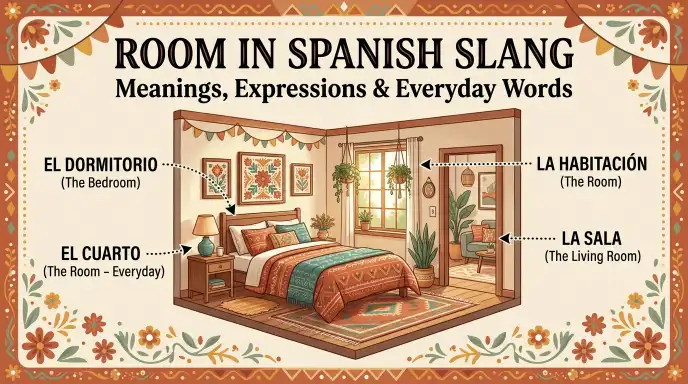
Room in Spanish slang has no single word, because people say “cuarto,” “pieza,” or “recámara” depending on the country, while “habitación” is the standard term everywhere.
The standard word for a room is “habitación,” and it works in Spain and across Latin America. Everyday speech uses other words, and these change from place to place. A word that sounds natural in Mexico may sound unusual in Spain or Argentina.
For example, “cuarto” is very common in Mexico, the Caribbean, and many other countries, while “pieza” is popular in Chile and Argentina. In Mexico, “recámara” often means a bedroom, and “dormitorio” is the usual word in Spain and parts of South America. As a result, the right word depends on where you are and who you are talking to.
Spanish also has informal, playful words for rooms. Terms like “cuartucho” or “cuchitril” describe a tiny, messy, or run-down room, and they carry a negative or joking tone. These words are fine among friends, but they can sound rude in a formal or polite setting.
In this guide, you will learn the most common Spanish slang words for room, which countries use them, and how to use each one correctly. You will also find examples, similar everyday terms, and answers to frequently asked questions to help you speak with confidence.
Quick Answer:
The most common Spanish words for “room” are cuarto and habitación. There is no single slang word used everywhere, but informal expressions and regional vocabulary can make your Spanish sound more natural.
What Does “Room” Mean in Spanish Slang?
The English word “room” usually translates into Spanish as cuarto, habitación, or sala, depending on the type of room.
In casual conversation, cuarto is one of the most useful words to know. People commonly use it when talking about a bedroom, a private room, or a space inside a house.
For example:
- Voy a mi cuarto. : I’m going to my room.
- Estoy en mi habitación. : I’m in my room.
- Pasa a la sala. : Come into the living room.
Although these expressions are informal in everyday conversation, they are not necessarily slang. Spanish slang often depends on local culture, friendships, and the situation in which people speak.
Is “Cuarto” a slang word?
Not exactly. Cuarto is a standard Spanish word, but it is very common in casual speech. In many everyday conversations, it sounds natural and less formal than some alternatives.
For example, a friend might say “Estoy en mi cuarto” rather than using a more formal expression about being in their bedroom.
Common Spanish Words for Room:
Different Spanish words describe different types of rooms. Choosing the right one helps you avoid confusion.
| Spanish word | English meaning | Common use |
| Cuarto | Room or bedroom | Everyday conversations |
| Habitación | Room or bedroom | General and formal situations |
| Dormitorio | Bedroom | Talking about sleeping spaces |
| Sala | Living room or sitting room | Relaxing or entertaining guests |
| Salón | Living room, lounge, or hall | Meaning varies by region |
| Cuartito | Small room | Informal or affectionate speech |
1. Cuarto
Cuarto is a popular choice in everyday Spanish. Depending on context, it can refer to a bedroom or another room inside a building.
Example: Mi hermano está en su cuarto.
Meaning: My brother is in his room.
2. Habitación
Habitación is another common word for a room. It is especially useful when discussing hotel rooms, bedrooms, or accommodation.
Example: Necesito una habitación para dos personas.
Meaning: I need a room for two people.
3. Dormitorio
Dormitorio specifically refers to a bedroom or sleeping room. It is useful when you want to be precise.
Example: El dormitorio está arriba.
Meaning: The bedroom is upstairs.
4. Sala
Sala commonly means living room in many Spanish-speaking countries. It is the word to use when talking about the space where people sit, relax, or welcome guests.
Example: Estamos viendo una película en la sala.
Meaning: We are watching a movie in the living room.
Spanish Room Words Compared With Everyday Slang:
People sometimes search for “room slang” because they want expressions that sound natural rather than textbook-like. These comparisons show which words fit different situations.
| Expression | Meaning | Tone |
| Cuarto | Room or bedroom | Casual and everyday |
| Habitación | Room or bedroom | Neutral |
| Dormitorio | Bedroom | Neutral |
| Cuartito | Little room | Informal or affectionate |
| Mi espacio | My space | Personal and conversational |
| Mi rincón | My corner or personal spot | Casual and expressive |
Is “Cuartito” slang?
Cuartito is the diminutive form of cuarto. Spanish speakers often use diminutives to suggest that something is small, familiar, cute, or emotionally meaningful.
For example:
“Voy a descansar en mi cuartito.”
Meaning: “I’m going to rest in my little room.”
Depending on the speaker’s tone, this can sound affectionate or playful. However, it does not always mean the room is physically small.
What does “Mi espacio” mean?
Mi espacio translates to “my space.” Someone might use it to describe their bedroom, a private area, or a place where they feel comfortable.
Example: “Necesito estar en mi espacio un rato.”
Meaning: “I need to be in my own space for a while.”
This expression is especially useful when talking about privacy or personal boundaries.
Where Is Room Slang Commonly Used?
Spanish is spoken across many countries, and everyday vocabulary can vary between regions. A word that sounds completely normal in one place might be less common in another.
Here are some useful regional distinctions.
Mexico
In Mexico, cuarto is widely used in everyday conversation to refer to a room or bedroom.
Example: “Estoy en mi cuarto, ¿qué pasó?”
Meaning: “I’m in my room. What’s up?”
The phrase sounds casual and fits conversations with friends or family.
Spain
In Spain, habitación and dormitorio are common when referring to bedrooms. Cuarto is also understood and used.
Example: “Estoy en mi habitación.”
Meaning: “I’m in my room.”
Argentina
In Argentina, habitación and cuarto are understood. Everyday vocabulary can also vary by household and region.
Example: “Estoy en mi cuarto.”
Meaning: “I’m in my room.”
Other Spanish-speaking countries
Across Latin America, cuarto, habitación, and dormitorio are widely understood, although local preferences differ.
The important point is that there is no universal slang term for “room” that works identically in every Spanish-speaking community.
Real-Life Examples of Room in Spanish Slang:
The following examples show how people might talk about rooms in casual conversations, text messages, and social settings.
1. Friendly conversation
Friend A: ¿Dónde estás?
Friend B: En mi cuarto, descansando.
English translation:
Friend A: Where are you?
Friend B: In my room, relaxing.
Here, cuarto is a natural choice for an informal conversation.
2. Casual texting
Person A: ¿Vienes a la sala?
Person B: Sí, dame cinco minutos.
English translation:
Person A: Are you coming to the living room?
Person B: Yes, give me five minutes.
The word sala identifies the living room rather than a bedroom.
3. Asking for privacy
Person A: Necesito mi espacio un rato.
Person B: Claro, hablamos después.
English translation:
Person A: I need some space for a while.
Person B: Of course, we’ll talk later.
This example uses espacio to express a personal boundary rather than referring to a specific room.
4. Talking about a hotel
Guest: ¿Tienen una habitación disponible?
Receptionist: Sí, tenemos una habitación individual.
English translation:
Guest: Do you have a room available?
Receptionist: Yes, we have a single room available.
In this situation, habitación sounds appropriate and clear.
5. Gaming or online chat
Player A: Estoy en mi cuarto jugando.
Player B: Perfecto, entra a la partida.
English translation:
Player A: I’m in my room gaming.
Player B: Perfect, join the match.
The vocabulary is ordinary Spanish, but the conversation fits an online gaming context.
6. A playful expression
Person A: Bienvenido a mi cuartito.
Person B: ¡Está muy cómodo!
English translation:
Person A: Welcome to my little room.
Person B: It’s very cozy!
The diminutive cuartito adds a friendly or affectionate tone.
Similar Spanish Expressions and Their Differences:
Not every word connected to rooms means the same thing. The following table compares expressions that learners may encounter.
| Spanish expression | Literal or usual meaning | When to use it |
| Mi cuarto | My room | Casual conversation |
| Mi habitación | My room | General conversation |
| Mi dormitorio | My bedroom | Specifically about sleeping |
| La sala | The living room | Shared home space |
| Mi espacio | My space | Privacy or personal boundaries |
| Mi rincón | My corner | A favorite or personal spot |
Which expression sounds most natural?
Use mi cuarto when speaking casually about your room, especially with friends and family.
Use mi habitación when you want a neutral expression that works in many situations.
Choose mi dormitorio when the bedroom itself matters.
Use mi espacio when you mean privacy, independence, or time alone rather than the physical room.
Is Room Slang Rude or Offensive in Spanish?
Most common Spanish words for “room” are completely neutral. Words such as cuarto, habitación, dormitorio, and sala are not inherently rude or offensive.
Even cuartito is generally harmless. It can sound affectionate, playful, or informal, depending on how someone uses it.
However, context still matters. A phrase that sounds friendly among close friends might feel dismissive if someone uses it sarcastically.
For example:
- “Voy a mi cuarto.” : A neutral statement.
- “Quédate en tu cuarto.” : “Stay in your room.” Depending on the tone, this may sound dismissive or angry.
- “Mi cuartito es mi lugar favorito.” : “My little room is my favorite place.” This sounds affectionate.
The words themselves are not usually offensive. The speaker’s intention and tone determine how the message comes across.
When Should You Avoid Using Informal Spanish?
Informal vocabulary is useful, but some situations call for more precise or professional language.
Consider these examples:
- At a hotel: Use habitación when asking about reservations.
- At work: Use clear, neutral vocabulary when discussing office rooms or meeting rooms.
- In formal writing: Choose the term that accurately describes the space.
- When speaking with strangers: Avoid overly familiar expressions until you understand the relationship.
- When traveling: Remember that regional vocabulary may differ.
For instance, if you need a hotel room, “Quisiera reservar una habitación” means “I would like to book a room.” It sounds polite and appropriate.
If you are chatting with a friend, “Estoy en mi cuarto” is perfectly natural.
Why Do Spanish Speakers Use Informal Room Expressions?
People use informal expressions because everyday conversation is usually simpler and more relaxed than formal writing.
There are several reasons for this:
- Convenience: Short, familiar words are easy to use in conversation.
- Comfort: People often use casual vocabulary with friends and family.
- Personal expression: Diminutives such as cuartito can communicate affection.
- Regional identity: Local vocabulary can reflect where someone grew up.
- Context: The same person may use cuarto with friends and habitación in a hotel.
Learning these differences can help you understand Spanish conversations without assuming that every casual word is slang.
FAQs:
Q1: Does cuarto mean room?
Yes, “cuarto” means room in Spanish, and it is one of the most common everyday words for it. It is also the word for “quarter” or “fourth,” so the meaning depends on the sentence. For example, “mi cuarto” means “my room,” and “un cuarto de hora” means “a quarter of an hour.” In Mexico, the Caribbean, and many other countries, “cuarto” sounds natural in daily speech.
Q2: What is another word for room in Spanish?
Other common words are “habitación,” “pieza,” “recámara,” “dormitorio,” and “sala,” which is more often a living room. “Habitación” is the standard word that works across Spain and Latin America. “Pieza” is popular in Chile and Argentina, while “recámara” often means a bedroom in Mexico. The best choice depends on the country and the type of room.
Q3: How do you say “my room” in Spanish?
The most common ways are “mi cuarto,” “mi habitación,” and “mi recámara,” and each is correct depending on where you are. “Mi cuarto” is friendly and casual, while “mi habitación” sounds slightly more standard. In Chile or Argentina, people may say “mi pieza.” Choose the word that matches the local speech to sound natural.
Q4: What is slang for “room”?
In Spanish, the most common slang and informal words are “cuarto” and “pieza,” which people use more than the formal “habitación.” Playful or negative words, such as “cuartucho” or “cuchitril,” describe a tiny, messy, or run-down room. These terms are fine among friends, but they can sound rude in formal settings. In English, casual slang for a room includes “pad” and “crib,” which usually mean a person’s home or bedroom.
Q5: What is a fancy word for room?
In English, fancy or formal words for a room include “chamber,” “quarters,” “suite,” and “salon.” “Suite” often describes a set of connected rooms in a hotel, while “chamber” sounds old-fashioned or ceremonial. In Spanish, “aposento” and “estancia” are more elegant and literary than “cuarto.” These words suit formal writing, hotels, and descriptions of historic places.
Q6: How do you say “room” in Spanish in Mexico?
In Mexico, people often say “cuarto” for a general room and “recámara” for a bedroom. “Habitación” is also understood and appears in hotels and official signs. “Pieza” is not as common in Mexico, so it may sound unfamiliar to locals. For daily conversation, “cuarto” is the safest and most natural choice.
Conclusion:
Understanding room in Spanish slang starts with learning the everyday words Spanish speakers actually use. Cuarto is a common casual term for a room or bedroom, habitación works in a wide range of situations, and dormitorio specifically refers to a bedroom. Other expressions, such as cuartito and mi espacio, can add an affectionate or personal touch.
Remember that these words are not all slang. Some are standard Spanish vocabulary used in informal conversations. Their meaning and tone depend on the situation and the region.
If you want to sound natural in Spanish, start with cuarto for casual conversations and habitación for general or more formal situations. As you learn more regional expressions, pay attention to how native speakers use them with friends, family, and online communities.
Related Topics!

I am Ann Raimes, an applied linguist and English language educator. I am widely recognized for my contributions to writing pedagogy and research in ESL writing. I have authored several well-known books, including Techniques in Teaching Writing, Keys for Writers, and How English Works: A Grammar Handbook with Readings. Throughout my career, I have worked to promote communicative writing and the process-based approach to teaching writing, helping both teachers and learners develop effective writing skills.