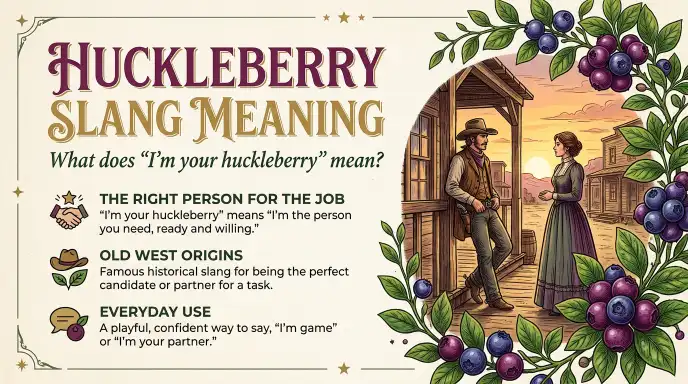
Huckleberry slang is an old American expression for a person, most famously in the phrase “I’m your huckleberry,” which means “I’m the right man for the job.”
The word started in the 1800s American South and West as a friendly or playful name for a person. It could mean a small or simple fellow, or someone you were fond of. Over time, it became a part of Old West talk and Southern speech.
The phrase “I’m your huckleberry” became widely known after the 1993 film Tombstone, where it was used as a calm, confident challenge. In that sense, it tells someone that the speaker is ready, willing, and up to the task. As a result, fans now use it in memes, captions, and everyday chats.
Today, the tone depends on the speaker and the situation. It can be friendly and affectionate, like calling someone “my little huckleberry,” or bold and playful when used as a challenge. It sounds old-fashioned, so many people use it as a fun, nostalgic phrase rather than as modern slang.
In this guide, you will learn the exact huckleberry slang meaning, where the word came from, and how to use it in real conversations. You will also find examples, similar old-time phrases, and answers to frequently asked questions to help you use it with confidence.
Quick Answer:
In slang, huckleberry often means a person who is willing or well suited to do something. The phrase “I’m your huckleberry” means “I’m the person you’re looking for” or “I’m ready for the challenge.”
What Does Huckleberry Mean in Text?
The slang meaning of huckleberry usually refers to someone who is ready, willing, or suitable for a particular task. However, the word does not have one fixed meaning in every conversation.
For example, if your friend asks who wants to help organize a party and you reply, “I’m your huckleberry,” you mean that you are happy to take responsibility.
The phrase can sound playful, confident, old-fashioned, or humorous. Its exact tone depends on the conversation and the relationship between the people speaking.
People may also use huckleberry as a nickname for a friend or as a reference to classic American culture.
What Does “I’m Your Huckleberry” Mean?
“I’m your huckleberry” is the best-known slang expression involving this word.
It generally means:
- I’m the person you need.
- I’m ready to help.
- I’m willing to accept the challenge.
- I’m a good fit for the job.
- You can count on me.
For example:
“Need someone to challenge you in chess?”
“I’m your huckleberry!”
Here, the speaker confidently volunteers to play.
Huckleberry Full Form and Definition:
Unlike internet abbreviations such as LOL or BRB, huckleberry does not have a standard full form. It is an ordinary English word that has developed additional meanings through idiomatic and cultural use.
The original meaning refers to a small edible berry that grows on certain shrubs. In North American English, the word is also associated with nature, rural life, and traditional American storytelling.
Its slang meaning comes from expressions in which a person describes themselves as the right choice for a task or challenge.
Does Huckleberry Stand for Something?
No. The word huckleberry is not an acronym, so it does not stand for a series of words.
When someone searches for “what does huckleberry stand for,” they may be looking for the meaning of the expression “I’m your huckleberry.” In that context, the phrase communicates willingness or suitability rather than a hidden abbreviation.
Huckleberry: Literal Meaning vs. Slang Meaning
| Type | Meaning | Example |
| Literal meaning | A small edible berry | “We picked huckleberries in the woods.” |
| Slang expression | Someone willing or suitable for a task | “Need a volunteer? I’m your huckleberry.” |
| Nickname | An affectionate or playful name for someone | “Come here, Huckleberry!” |
| Cultural reference | A phrase associated with classic American entertainment | “I’m your huckleberry” in a Western-themed conversation |
The context helps you determine which meaning the speaker intends.
Is Huckleberry Rude, Offensive, or Neutral?
Huckleberry is generally a neutral or playful word, not an offensive insult. In most everyday situations, using it will not cause problems.
When someone says “I’m your huckleberry,” they usually communicate confidence, readiness, or a willingness to participate.
However, the tone can change depending on the situation.
When Huckleberry Sounds Friendly
Friends may use the expression jokingly when volunteering for an activity.
Example:
“Who wants to help me move these boxes?”
“I’m your huckleberry!”
The response sounds helpful and relaxed.
When Huckleberry Sounds Challenging
In a competitive situation, the phrase can suggest that someone is ready to face another person.
Example:
“You think you can beat me at pool?”
“I’m your huckleberry.”
Here, the speaker sounds confident and may be accepting a challenge.
Can Huckleberry Be an Insult?
The word itself is not normally an insult. However, people can use almost any word sarcastically.
For example, calling someone “my little huckleberry” in a mocking voice could sound patronizing. The negative tone would come from the speaker’s intention, not from a standard offensive meaning of the word.
Where Is Huckleberry Commonly Used?
The word appears in different settings, but its slang expression is especially recognizable in American English and popular culture.
1. Everyday Conversations
People may use the phrase when volunteering, accepting a task, or offering assistance.
Example:
“Can anyone help me fix this computer?”
“I’m your huckleberry.”
This means the speaker is willing to help.
2. Movies and Television
The expression is strongly associated with Western films and American entertainment. One particularly recognizable example is the 1993 film Tombstone, in which Doc Holliday uses the line “I’m your huckleberry.”
That scene helped make the phrase familiar to many modern audiences.
3. Social Media
People sometimes use the expression in captions, comments, memes, and posts about challenges or competitions.
For example:
“Looking for someone who can beat my high score? I’m your huckleberry.”
The phrase gives the post a confident, humorous, or old-fashioned feel.
4. Gaming Communities
Gamers may use the expression when accepting a challenge or volunteering for a difficult mission.
Example:
“Who wants to take on the final boss?”
“I’m your huckleberry.”
It communicates readiness without requiring a long explanation.
Real-Life Examples of Huckleberry Slang:
The following examples show how the expression can work in different situations.
Friendly Examples
Example 1
Person A: “Can someone help me carry these bags?”
Person B: “I’m your huckleberry!”
Meaning: I’m happy to help.
Example 2
Friend A: “I need a partner for the school project.”
Friend B: “I’m your huckleberry.”
Meaning: I’ll be your partner.
Casual Examples
Example 3
Person A: “Who wants to try this new restaurant with me?”
Person B: “I’m your huckleberry.”
Meaning: I’m interested and ready to go.
Example 4
Friend A: “We need someone to organize the group trip.”
Friend B: “Your huckleberry is right here.”
Meaning: I’m willing to organize it.
Argumentative or Competitive Examples
Example 5
Person A: “Nobody here can beat me at chess.”
Person B: “I’m your huckleberry.”
Meaning: I’ll take that challenge.
Example 6
Player A: “I bet you can’t finish this level.”
Player B: “I’m your huckleberry.”
Meaning: I’m ready to prove you wrong.
Gaming and Social Media Examples
Example 7
Gamer A: “Who wants to join the toughest mission?”
Gamer B: “I’m your huckleberry.”
Meaning: Count me in.
Example 8
Social media caption: “Need someone who can handle a weekend hiking trip? I’m your huckleberry.”
Meaning: I’m the right person for the adventure.
These examples demonstrate that the phrase usually communicates willingness, confidence, or suitability rather than a literal reference to fruit.
Huckleberry Slang Origin and Background:
The word huckleberry has a much older history than its modern slang use.
As a noun, it refers to berries found on certain plants, particularly in North America. The word became part of American English and appeared in traditional expressions and storytelling.
Its figurative use developed through American speech and popular culture. One important expression is “I’m your huckleberry,” which became widely recognizable through Western-themed entertainment.
The Connection to Tombstone
The 1993 Western film Tombstone features the character Doc Holliday using the phrase “I’m your huckleberry.” The line is often understood as an expression of readiness to face a challenge.
Because of the film’s popularity, many people associate the phrase with confidence, confrontation, and a willingness to take someone on.
However, the expression existed outside that movie context. It is more accurate to say that Tombstone helped popularize the phrase for modern audiences rather than claiming that the film invented it.
Does Huckleberry Have an Old-Fashioned Meaning?
Yes. Today, the expression can sound old-fashioned because it is associated with earlier American speech and Western films.
People sometimes use it intentionally for humor, nostalgia, or dramatic effect.
Huckleberry vs. Similar Slang Expressions:
Several common expressions communicate the same general idea as “I’m your huckleberry,” but they differ in tone and style.
Comparison Table 1: Huckleberry vs. Similar Expressions
| Expression | Meaning | Tone |
| I’m your huckleberry | I’m the right person or ready for the challenge | Playful, confident |
| Count me in | I want to participate | Casual, friendly |
| I’m game | I’m willing to try | Informal |
| I’m up for it | I’m ready or interested | Natural, conversational |
| Bring it on | I’m ready for a challenge | Bold, competitive |
For everyday texting, “count me in” and “I’m up for it” may sound more natural. “I’m your huckleberry” works well when you want a distinctive or humorous expression.
Comparison Table 2: Different Uses of Huckleberry
| Usage | Example | Intended meaning |
| Helpful | “Need a volunteer? I’m your huckleberry.” | I’m willing to help |
| Competitive | “Want a rematch? I’m your huckleberry.” | I’m ready to compete |
| Humorous | “Who wants to test this recipe? I’m your huckleberry.” | I’ll give it a try |
| Literal | “These huckleberries are ripe.” | The berries themselves |
Comparison Table 3: Huckleberry vs. Other Informal Words
| Word or phrase | Meaning | Best context |
| Huckleberry | A suitable or willing person in the familiar expression | Playful challenges and cultural references |
| Buddy | A friend or companion | Everyday conversations |
| Champ | A champion or encouraging nickname | Friendly praise or teasing |
| Volunteer | A person who offers to help | Work, school, or community activities |
| Challenger | Someone who competes against another person | Games, sports, and competitions |
These expressions are not exact synonyms. Choose the one that best fits your meaning and audience.
When Should You Avoid Using Huckleberry?
Although the word is generally harmless, it may not fit every situation.
1. Formal or Professional Writing
In a formal email, report, or business proposal, “I’m your huckleberry” may sound unusual or overly casual.
Instead of writing:
“Need someone to manage the project? I’m your huckleberry.”
You could write:
“I’m available to manage the project and would be happy to help.”
2. When the Audience Does Not Know the Expression
Some people may understand the phrase immediately, while others may find it confusing.
If clarity matters, use a more familiar expression such as “I’m ready” or “I can help.”
3. During Serious Conflicts
The phrase can sound confrontational when used during an argument or heated exchange.
If you want to calm a situation, choose neutral language rather than a phrase that could be interpreted as a challenge.
4. When You Need a Direct Answer
Because huckleberry is an idiomatic expression, it may not communicate your meaning as clearly as a straightforward sentence.
For example, “I can help with that” is often better than “I’m your huckleberry” when communicating instructions or responsibilities.
Why Do People Use Huckleberry Slang?
People use expressions like “I’m your huckleberry” because they add personality to ordinary conversations.
Common reasons include:
- Showing confidence: The speaker signals readiness for a challenge.
- Offering help: The phrase communicates willingness to participate.
- Adding humor: Its unusual wording makes a response more memorable.
- Referencing popular culture: People may use it to recall a famous movie scene.
- Expressing personality: The phrase can make someone sound playful, dramatic, or distinctive.
Instead of simply saying “yes,” someone can use this expression to make their response more entertaining.
Is Huckleberry Safe for Social Media?
Yes. The word huckleberry is generally safe for social media because it is not inherently vulgar, hateful, or abusive.
You can use it in captions, comments, memes, gaming chats, and friendly conversations.
For example:
“Ready for the weekend adventure? I’m your huckleberry.”
The expression is suitable for most general audiences. Still, context matters. If you use it aggressively during an argument, someone might interpret it as a challenge.
Also, do not assume every reader knows the phrase. A short explanation may help when using it in educational content or posts aimed at an international audience.
FAQs:
Q1: What does it mean calling someone huckleberry?
Calling someone “huckleberry” is an old-fashioned, playful way to address a person. It can be a friendly nickname for a pal or a gentle tease for someone who is a bit naive or simple. In some cases, it also hints that the person is the right one for a certain job. The tone depends on the speaker, so it usually sounds fond rather than insulting.
Q2: What does huckleberry mean in slang urban dictionary?
In slang and online dictionaries, “huckleberry” most often means a person, especially in the phrase “I’m your huckleberry,” which says “I’m the right man for the job.” User-written sites also list it as a friendly nickname or a mild word for someone who is a little goofy. Because these sites are open to anyone, definitions vary and are not official. For a reliable meaning, compare several sources.
Q3: Why are people called huckleberry?
The word comes from the small, sweet huckleberry fruit, and in 19th-century American speech, it became a term for a small, humble, or likable person. It also gained fame through Mark Twain’s character Huckleberry Finn, which made the name feel youthful and cheeky. Over time, it grew into a folksy nickname in the American South and West. People still use it today with a nostalgic, playful feel.
Q4: How to respond to “I’ll be your huckleberry”?
The best response depends on the mood. For a playful tone, you can say “Glad to hear it” or “Then let’s get started.” For a confident, joking reply, “Bring it on” fits well. If you want to stay friendly, simply thank the person and accept the offer. Match your tone to theirs, and keep it light.
Q5: What is the real meaning of “I’ll be your huckleberry”?
The phrase means “I’m the person you need” or “I’m ready and willing to do it.” It tells someone that the speaker is up to the task, and in some cases, it works as a calm challenge. It became well known through the 1993 movie Tombstone, where it carried a confident, slightly bold tone. Today, fans use it in memes, captions, and casual chats.
Q6: What does “you’re no daisy” mean?
“You’re no daisy” is an old expression that suggests someone is not as impressive or genuine as they seem. In older American slang, “daisy” could mean something excellent or first-rate, so “no daisy” implies the opposite. The phrase is also remembered from Tombstone, where it works as a sharp, witty put-down. The meaning depends on context, so read it as a polite insult rather than a literal statement.
Conclusion:
The huckleberry slang meaning is mainly connected to the expression “I’m your huckleberry,” which communicates that someone is willing, ready, or well suited for a particular task or challenge. The word itself refers to a berry, but its figurative use has become recognizable through American expressions and popular culture.
You may encounter it in friendly conversations, gaming chats, social media captions, or references to Western films. It is generally not offensive, although the tone can sound playful, confident, or confrontational depending on the situation.
If you want to use the phrase naturally, consider your audience and context. For casual conversations, it can add personality and humor. For professional situations, a direct expression such as “I’m happy to help” may be clearer.
You May Also Like!

Hi, I’m Jack Anderson, a writer at Slang Prime. I love exploring slang words, their meanings, and origins. My goal is to explain modern slang in simple language and help readers understand everyday expressions.