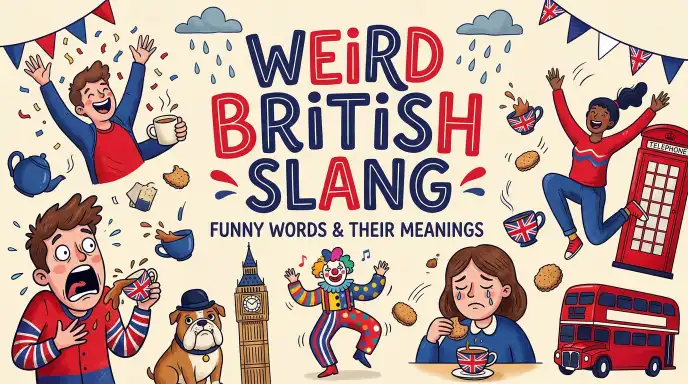
Weird British slang includes funny, unusual words like “gobsmacked,” “knackered,” “faff,” and “chuffed,” which Brits use in daily talk but which often confuse visitors.
Many of these words sound strange because they come from old dialects, regional speech, and centuries of British humor. Some, like “knackered” (very tired) and “chuffed” (very pleased), are used across the UK. Others are playful inventions that people mostly use with friends and family.
For example, “faff” means to waste time on small things, and “gobsmacked” means completely shocked or amazed. A phrase like “I’m absolutely knackered” can leave an American listener guessing. As a result, learning a few of these words makes British TV shows, podcasts, and conversations much easier to follow.
Slang also changes by region, age, and social group, so a word popular in London may sound odd in Scotland or Wales. Some terms are mild and friendly, while others are rude, so the setting matters. It helps to listen first and use only the words you fully understand.
In this guide, you will learn 35+ weird British slang words, what each one means, and how people use them in real conversations. You will also find examples, regional differences, and answers to frequently asked questions to help you understand the language with confidence.
Quick Answer:
Weird British slang refers to unusual, funny, or confusing words and expressions used in the United Kingdom. Examples include “gobsmacked” (extremely surprised), “knackered” (very tired), and “taking the mick” (making fun of someone).
What Does Weird British Slang Mean?
Weird British slang describes informal British words and phrases that sound unusual to people unfamiliar with UK English. These expressions often replace ordinary English words with more colorful, humorous, or culturally specific alternatives.
For example, an American might say, “I’m exhausted,” while someone in Britain might say, “I’m absolutely knackered.”
Both sentences communicate the same basic idea, but the British expression adds a casual, distinctly local flavor.
British slang can come from regional dialects, working-class communities, popular culture, television, music, and everyday conversations. Some phrases have existed for generations, while others have become popular through internet culture.
Why Does British Slang Sound So Strange?
British slang often uses figurative language, understatement, exaggeration, and humor.
Consider these examples:
- Gobsmacked: Extremely surprised.
- Pants: Underwear in British English, but also an informal way to describe something as bad.
- Chuffed: Very pleased or proud.
- Barmy: Silly, eccentric, or slightly baffling
- Taking the mick: Teasing someone or making fun of them.
These words may seem strange when taken literally, but their meanings become easier to understand through context.
35+ Weird British Slang Words and Their Meanings:
Here are some unusual British expressions you may hear in conversations, comedy shows, films, and online discussions.
1. Gobsmacked
Meaning: Extremely surprised or shocked.
“Gob” is an informal word for the mouth. Being gobsmacked suggests being so surprised that you are left speechless.
Example: “I was gobsmacked when she told me she had won the lottery.”
2. Knackered
Meaning: Completely exhausted or very tired.
This is a common expression in casual British English.
Example: “I’m absolutely knackered after working a twelve-hour shift.”
3. Taking the Mick
Meaning: Making fun of someone, teasing them, or treating something as a joke.
Example: “Are you taking the mick? That coffee cost me ten pounds!”
You may also hear “taking the piss,” a more vulgar version of the expression.
4. Barmy
Meaning: Silly, eccentric, or unreasonable.
Example: “You must be barmy to go swimming in that freezing weather.”
Depending on the tone, it can sound playful or critical.
5. Chuffed
Meaning: Very happy, pleased, or proud.
Example: “I’m really chuffed that you enjoyed my cooking.”
It is generally positive and friendly.
6. Gutted
Meaning: Extremely disappointed or upset.
Example: “I was gutted when my team lost the final.”
Despite its literal association with the stomach, the word describes an emotional reaction.
7. Dodgy
Meaning: Suspicious, unreliable, unsafe, or potentially dishonest.
Example: “That website looks dodgy. I wouldn’t enter my bank details.”
It can describe people, products, situations, or places.
8. Gob
Meaning: Mouth.
Example: “Shut your gob for a minute and listen!”
This wording can sound rude, particularly when directed at someone during an argument.
9. Pants
Meaning: Underwear, or something considered rubbish or disappointing.
Example: “That film was absolute pants.”
This can confuse American English speakers because “pants” usually means trousers in the United States.
10. Knobhead
Meaning: Areckles, annoying, or foolish person.
Example: “That knobhead forgot to bring the tickets again.”
It is an insult and may offend someone outside a joking friendship.
11. Wanker
Meaning: A vulgar insult for someone considered unpleasant, arrogant, or foolish.
Example: “He’s acting like a complete wanker.”
It is common in some informal British conversations but inappropriate in most professional settings.
12. Bollocks
Meaning: Testicles, nonsense, or something considered untrue.
Example: “That’s a load of bollocks!”
The word is vulgar. Friends may use it humorously, but it can sound aggressive in formal conversations.
13. Bugger
Meaning: A mild-to-moderate swear word used to express annoyance, surprise, or affection, depending on context.
Example: “Bugger! I’ve missed the last bus.”
It can also appear in expressions such as “poor bugger,” referring sympathetically to someone.
14. Foolish
Meaning: Silly, foolish, or not sensible.
Example: “Don’t be ignorant. Of course you can come with us.”
Unlike stronger insults, “irrational” often sounds relatively mild.
15. Gobbledygook
Meaning: Language that is confusing, meaningless, or unnecessarily complicated.
Example: “I couldn’t understand the contract because it was full of legal gobbledygook.”
It is not exclusively British, but it fits naturally into British English.
16. Minging
Meaning: Extremely unpleasant, disgusting, or unattractive.
Example: “These leftovers smell minging.”
This informal word can sound harsh when used to describe another person’s appearance.
17. Pissed
Meaning: Usually drunk in British English, although it can mean angry in some contexts.
Example: “He got completely pissed at the party.”
In American English, “pissed” more commonly means angry, so context matters.
18. Pissed Off
Meaning: Annoyed, irritated, or angry.
Example: “I’m really pissed off because someone scratched my car.”
This expression is informal and somewhat rude, but it is widely understood.
19. Taking the Mickey
Meaning: Teasing someone or making fun of them.
Example: “Stop taking the Mickey out of my haircut!”
It is a less vulgar alternative to “taking the piss.”
20. Skint
Meaning: Having very little or no money.
Example: “I can’t go out tonight. I’m completely skint until payday.”
It is particularly useful in everyday conversations about spending.
21. Faff
Meaning: To waste time doing something unnecessarily complicated or to make a fuss over a simple task.
Example: “Stop faffing about and get ready.”
It is usually informal rather than offensive.
22. Naff
Meaning: Uncool, unfashionable, tacky, or disappointing.
Example: “That jacket looks a bit naff.”
The word is often used humorously to criticize something without sounding especially aggressive.
23. Chav
Meaning: A derogatory British label associated with a stereotyped image of someone who is loud, unfashionable, or associated with particular working-class styles.
Example: “The character was written as a chav.”
Because it carries class-based stereotypes, it can be insulting and should be used carefully.
24. Numpty
Meaning: A foolish or incompetent person.
Example: “I left my phone at home again. What a numpty!”
The word is especially associated with Scottish and wider British informal speech.
25. Plonker
Meaning: A foolish or silly person.
Example: “You absolute plonker! You put the milk in the cupboard.”
It is often used jokingly and is generally milder than stronger British insults.
26. Gobsmacking
Meaning: Astonishing or extremely surprising.
Example: “The view from the mountain was absolutely gobsmacking.”
It is the adjective form related to “gobsmacked.”
27. Gormless
Meaning: Looking foolish, confused, or unaware.
Example: “He stood there looking completely gormless.”
It is an informal criticism of someone’s expression or behavior.
28. Wonky
Meaning: Uneven, unstable, crooked, or not working properly.
Example: “This table is wonky, so the coffee keeps sliding.”
It is a useful, relatively harmless British expression.
29. Tosh
Meaning: Nonsense or rubbish.
Example: “Don’t believe that article. It’s complete tosh.”
It can be used to dismiss an idea without resorting to a swear word.
30. Loo
Meaning: Toilet or bathroom.
Example: “Excuse me, where’s the loo?”
It is a familiar British expression and is generally polite enough for everyday use.
31. Ta
Meaning: Thank you.
Example: “Ta for bringing me a cup of tea.”
It is short, casual, and friendly.
32. Blimey
Meaning: An expression of surprise, shock, or amazement.
Example: “Blimey, that was an expensive meal!”
It is traditionally associated with British English and usually sounds less offensive than a swear word.
33. Bloody
Meaning: An intensifier used to express annoyance, emphasis, or strong feelings.
Example: “It’s bloody freezing outside.”
It is a mild swear word in many British contexts, though acceptability depends on the audience.
34. Cock-up
Meaning: A mistake, blunder, or badly managed situation.
Example: “The booking was a complete cock-up.”
It is informal and slightly vulgar, so it may not suit professional writing.
35. Legless
Meaning: Extremely drunk.
Example: “He was legless by the end of the wedding.”
It is a humorous expression rather than a literal description.
36. Pear-shaped
Meaning: Going wrong or failing to develop as planned.
Example: “The whole trip went pear-shaped when our train was cancelled.”
The phrase is commonly used to describe plans or situations that go badly.
37. Gob on
Meaning: To speak loudly, rudely, or excessively in some informal contexts.
Example: “He’s always gobbing on about football.”
Usage can vary by region and context.
38. Brolly
Meaning: An umbrella.
Example: “Take your brolly. It looks like rain.”
It is a playful, familiar British word.
39. Chock-a-block
Meaning: Completely full or crowded.
Example: “The train was chock-a-block with passengers.”
It is often used for crowded streets, public transport, and busy places.
40. Bob’s Your Uncle
Meaning: An expression meaning that something is finished, sorted, or easy to accomplish.
Example: “Add the sauce, stir it for a minute, and Bob’s your uncle!”
It often appears when explaining a simple process.
Comparison Table: Weird British Slang and Their Meanings:
The following table compares some unusual British expressions with their closest meanings in standard English.
| British slang | Meaning in simple English | Tone |
| Gobsmacked | Extremely surprised | Informal |
| Knackered | Very tired | Informal |
| Gutted | Deeply disappointed | Informal |
| Skint | Having no money | Informal |
| Dodgy | Suspicious or unreliable | Informal |
| Daft | Silly or foolish | Usually mild |
| Minging | Disgusting | Informal, potentially rude |
| Chuffed | Very pleased | Positive |
| Naff | Uncool or tacky | Informal |
| Gobsmacking | Astonishing | Informal |
Is Weird British Slang Rude or Offensive?
Not all weird British slang is rude. Some expressions are friendly, while others contain profanity or insulting meanings.
The key is understanding the word, the situation, and the relationship between the people speaking.
Friendly and Harmless Expressions
These words are generally safe in everyday conversations:
- Chuffed: Happy or pleased.
- Knackered: Very tired.
- Brolly: Umbrella.
- Ta: Thanks.
- Wonky: Uneven or unstable.
- Bob’s your uncle: Something is done or sorted.
For example, saying “I’m knackered after work” is a normal way to explain that you feel tired.
Slang That Can Offend People
Other expressions deserve more caution:
- Wanker: A strong insult.
- Knobhead: A rude term for a foolish person.
- Bollocks: Vulgar language often used to express frustration.
- Minging: Can be insulting when aimed at a person.
- Chav: Can reinforce negative class stereotypes.
Friends sometimes use insults playfully, but that does not mean everyone will find them funny.
Comparison Table:
| Expression | General strength | Safer alternative |
| Daft | Mild | Silly |
| Numpty | Mild to moderate | Foolish |
| Plonker | Mild to moderate | Silly person |
| Taking the mick | Informal teasing | Joking around |
| Bloody | Mild profanity | Very or really |
| Bollocks | Vulgar | Nonsense |
| Wanker | Strong insult | Unpleasant person |
| Knobhead | Rude insult | Fool |
These categories are approximate. Regional habits, personal preferences, and tone can change how a word is received.
Where Is Weird British Slang Commonly Used?
British slang appears in many settings, but certain expressions are more likely to appear in casual conversation than formal writing.
Everyday Conversations
Friends, relatives, and coworkers may use slang to describe their feelings, share jokes, or react to unexpected events.
Examples include:
- “I’m skint this week.”
- “That sounds a bit dodgy.”
- “I’m absolutely knackered.”
- “Don’t faff about.”
Social Media and Messaging
British slang appears on TikTok, Instagram, Reddit, YouTube, and messaging apps.
People may use these expressions in captions, comments, memes, and conversations with friends.
For example:
“Mate, that ending was absolutely gobsmacking!”
However, not every British slang word is a social media trend. Many expressions have existed for years and remain part of everyday speech.
British Television and Comedy
British comedy often uses slang to create humor, establish a character’s background, or show relationships between people.
Expressions such as “plonker,” “bloody,” and “taking the mick” can help dialogue sound natural in the right context.
Regional Differences
British slang varies across England, Scotland, Wales, and Northern Ireland. Local dialects also differ between cities and communities.
A word that feels ordinary in one area might be unfamiliar elsewhere. Even when people understand an expression, they may not use it themselves.
Real-Life Examples of Weird British Slang:
These sample conversations show how British slang can communicate different emotions and meanings.
Friendly Examples
Example 1
Alex: “How was your holiday?”
Sam: “Brilliant! I’m absolutely chuffed with the whole trip.”
Meaning: Sam is very pleased with the holiday.
Example 2
Mia: “Fancy going for a walk?”
Tom: “I’m knackered, mate. Can we do it tomorrow?”
Meaning: Tom is too tired to go today.
Casual Examples
Example 3
Ella: “Did you see the price of those trainers?”
Jack: “Blimey! That’s expensive.”
Meaning: Jack is surprised by the price.
Example 4
Ben: “Where’s your umbrella?”
Liam: “I forgot my brolly at home.”
Meaning: Liam forgot to bring his umbrella.
Argumentative Examples
Example 5
Person A: “You said you’d finish the job yesterday.”
Person B: “I know. The whole thing went pear-shaped.”
Meaning: The situation did not go as planned.
Example 6
Person A: “That story isn’t true.”
Person B: “That’s complete bollocks!”
Meaning: Person B strongly disagrees and calls the story nonsense. The response is vulgar and could escalate an argument.
Gaming and Social Media Examples
Example 7
Player 1: “We lost the match in the final seconds!”
Player 2: “I’m gutted. We were so close.”
Meaning: Player 2 is extremely disappointed.
Example 8
Comment: “That plot twist left me gobsmacked.”
Meaning: The commenter was extremely surprised.
Example 9
Message: “The lobby is chock-a-block tonight.”
Meaning: The game lobby is full of players.
Comparison Table: British Slang vs. American English:
Some British slang words have different equivalents or meanings in American English.
| British expression | Closest American equivalent | Important difference |
| Knackered | Worn out, exhausted | Same general meaning |
| Skint | Broke | Both describe having little money |
| Brolly | Umbrella | British informal term |
| Loo | Bathroom, restroom | Common British wording |
| Pants | Underwear; also rubbish | Americans usually use “pants” for trousers |
| Pissed | Drunk | In the US, it often means angry |
| Chuffed | Really pleased | Less common in American speech |
| Dodgy | Sketchy | Similar informal meaning |
These are approximate equivalents rather than exact replacements. The right choice depends on the situation.
Why Do People Use Weird British Slang?
British slang makes conversations feel informal, expressive, and sometimes humorous. It allows speakers to communicate emotions without always relying on standard vocabulary.
There are several reasons people use it.
- Humor: Unusual words can make an ordinary situation sound funny.
- Identity: Local expressions can connect people to a community or region.
- Convenience: Short expressions can communicate a lot in a few words.
- Emphasis: Words such as “gobsmacked” and “gutted” convey strong feelings.
- Social connection: Friends may use shared slang to create a sense of familiarity.
Slang also changes over time. Television, music, migration, online communities, and popular personalities can influence which expressions people recognize.
When Should You Avoid Using Weird British Slang?
Learning British slang can help you understand conversations, but using every expression you learn is not always a good idea.
Consider avoiding slang when:
- Writing formal emails, job applications, or academic assignments.
- Speaking with someone you do not know well.
- Communicating in a sensitive or serious situation.
- Using insults that could damage a relationship.
- Posting publicly where readers may interpret your words differently.
If you are unsure if an expression is appropriate, choose a clearer and more neutral alternative.
For example, instead of writing “Your plan is complete bollocks,” you could say, “I don’t think this plan will work.”
The second sentence communicates disagreement without unnecessary hostility.
Is Weird British Slang Safe for Social Media?
Most British slang is fine for ordinary social media posts. Words such as “chuffed,” “knackered,” “gutted,” and “brolly” are generally suitable for casual captions and friendly messages.
However, offensive expressions can create misunderstandings, especially when readers come from different cultural backgrounds.
Keep these points in mind:
- Understand a word before using it publicly.
- Avoid using insults to target or harass someone.
- Consider if your audience understands British English.
- Remember that jokes may sound harsher without facial expressions or vocal tone.
- Use neutral language for professional accounts and business communication.
Understanding the difference between playful slang and offensive language helps you communicate more effectively online.
FAQs:
Q1: What’s a British slang for wild?
Common British words for wild are “bonkers,” “barmy,” “mental,” “doolally,” and “round the bend.” “Bonkers” and “barmy” are the friendliest and most widely used, as in “That idea is completely bonkers.” “Mental” is casual too, but it can sound insensitive when used about real mental health, so use it carefully. These words fit everyday talk, and the tone is usually playful rather than harsh.
Q2: What do British people say weird?
Brits often say “odd,” “peculiar,” “bizarre,” “dodgy,” or “a bit off” for something weird. A “rum” thing is old-fashioned for strange, and “a bit random” is common among younger speakers. “Dodgy” often adds the idea of suspicious or unreliable, as in “That website looks dodgy.” The best word depends on how strong you want the tone to be.
Q3: What are some inappropriate British slang words?
Some British slang is considered rude or offensive, including words like “bollocks,” “bugger,” “wanker,” and “prat,” which range from mild to quite insulting. Their strength changes by region, age, and setting, and a word that sounds mild among friends may shock others. Avoid them in school, work, and mixed company. If you are not sure how strong a word is, it is safer to choose a polite alternative such as “rubbish” or “uniformed.”
Q4: What is British slang for funny?
Brits say “hilarious,” “a laugh,” “a hoot,” “a right giggle,” or “comedy gold” for something funny. “Taking the mickey” means teasing someone, and “having a laugh” means joking around. “Cracking” and “brilliant” can also praise a funny joke or a good time. These phrases fit casual chats and are common in British TV, podcasts, and pubs.
Q5: How do you say weird in UK slang?
Popular UK slang for weird includes “random,” “wonky,” “dodgy,” “off the wall,” and “a bit mad.” “Random” is especially common in young people’s speech, as in “That was so random.” “Peculiar” and “rum” sound older, and “bizarre” works in any situation. Choose the word that matches your audience and how formal the setting is.
Q6: What is British slang for a hot girl?
Common casual terms are “fit,” “gorgeous,” “stunning,” and “lush,” where “fit” means attractive and “lush” means lovely or very appealing. Some older terms, such as “bird,” are now seen as outdated and can sound disrespectful, so many people avoid them. Compliments land best when they are polite and genuine. When in doubt, a simple “You look great” is always safe.
Q7: How to flirt in British slang?
British flirting is often playful, teasing, and understated. Friendly lines such as “You’re quite fit, aren’t you?” or “I’m well into you” are casual, while “fancy a pint?” or “fancy a cuppa?” is a classic invitation. Light banter and humor usually work better than strong compliments. Stay respectful, read the other person’s response, and stop if they seem uncomfortable.
Q8: What do Brits call girlfriends?
Brits commonly say “girlfriend,” “partner,” “other half,” and “missus” (casual for a wife or long-term partner). Younger people also use “bae” and “my girl.” Terms of endearment such as “love,” “babe,” and “darling” are friendly in many regions, but they can feel too familiar with strangers. “Bird” is an older slang word that many now find outdated or disrespectful.
Conclusion:
Weird British slang adds humor, personality, and cultural character to everyday English. From “gobsmacked” and “knackered” to “skint,” “barmy,” and “taking the mick,” these expressions help explain how people communicate casually across the United Kingdom.
Understanding the meaning of each phrase is more important than memorizing a long list of unusual words. Some expressions are friendly and harmless, while others are vulgar, insulting, or strongly connected to regional culture.
If you want to understand British conversations, television, memes, and social media, learning these expressions is a useful starting point. Pay attention to context, tone, and audience, and you will be better prepared to recognize weird British slang and use it naturally when appropriate.
Related Articles!

I am Ann Raimes, an applied linguist and English language educator. I am widely recognized for my contributions to writing pedagogy and research in ESL writing. I have authored several well-known books, including Techniques in Teaching Writing, Keys for Writers, and How English Works: A Grammar Handbook with Readings. Throughout my career, I have worked to promote communicative writing and the process-based approach to teaching writing, helping both teachers and learners develop effective writing skills.