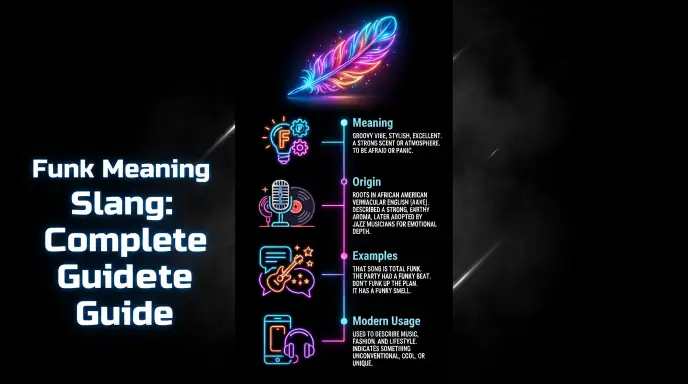
“Funk” is a casual slang term that can refer to an unpleasant smell, a bad mood, or a laid-back, cool style of music.
The word “funk” carries multiple meanings depending on context, ranging from music to mood to smell. In slang usage, it has become a versatile term used across different generations and cultures.
Originally rooted in African American Vernacular English, “funk” later became popular through funk music in the 1960s and 70s. Over time, its slang meaning expanded beyond music into everyday conversations.
Today, when someone says “I’m in a funk,” they usually mean they’re feeling down, depressed, or in a bad mood. On the other hand, “that smells funky” refers to an unpleasant or strong odor.
Understanding the different contexts of “funk” helps in using it correctly in conversations, social media, or writing. This guide breaks down every meaning with examples for complete clarity.
Quick Answer
Funk meaning slang usually refers to a temporary state of sadness, low motivation, or emotional dullness. In other contexts, it can also describe something cool, stylish, unique, or even a strong unpleasant smell, depending on the conversation.
What Does Funk Mean in Text?
When used in text messages or online conversations, funk most commonly describes a person’s emotional state. If someone says they are “in a funk,” they usually mean they are feeling unhappy, unmotivated, bored, or emotionally drained.
Unlike serious depression, being in a funk often refers to a temporary mood that improves after some time or a positive experience.
For example:
- “I’ve been in a funk all week.”
- “I’m finally out of my funk.”
- “She seems a little funky today.”
However, context matters because funk can also have completely different meanings.
For example:
- “Those shoes are funky!” (Cool or stylish)
- “The fridge smells funky.” (Bad smell)
Always look at the rest of the sentence before deciding which meaning applies.
Common Meanings of Funk in Text
- Feeling sad or emotionally low
- Temporary lack of motivation
- Something stylish or unique
- Something with an unpleasant smell
- A relaxed or creative vibe
Funk Full Form or Definition
Unlike abbreviations such as LOL or BRB, funk is not an acronym, so it does not have a traditional full form.
Instead, it is a regular English word that has developed several slang meanings over time.
The most common definitions include:
1. Emotional State
A period of sadness, boredom, or low energy.
Example:
“I’ve been in a funk since Monday.”
2. Stylish or Cool
Sometimes “funky” describes something fashionable, creative, colorful, or different.
Example:
“That jacket looks really funky.”
3. Bad Smell
In informal English, funk can describe a strong unpleasant odor.
Example:
“Your gym bag smells funky.”
4. Music Style
Funk is also a famous music genre known for energetic rhythms and danceable beats. Although this is not slang, many people first hear the word through music before learning its informal meanings.
Is Funk Rude, Offensive, or Neutral?
The word funk is generally considered neutral.
It is not a swear word and is usually safe to use in everyday conversations.
However, whether it sounds positive or negative depends entirely on the context.
Neutral Usage
- “I’m in a funk today.”
- “This room smells funky.”
These are ordinary expressions.
Positive Usage
People often use “funky” as a compliment.
Examples:
- Funky clothes
- Funky hairstyle
- Funky design
- Funky music
Here, the word means stylish, creative, or unique.
Negative Usage
When referring to someone’s mood or a bad smell, the word carries a negative meaning but is still not offensive.
Examples:
- “He’s been in a funk.”
- “Something smells funky.”
Overall, funk is safe to use in most casual conversations.
Where Is Funk Commonly Used?
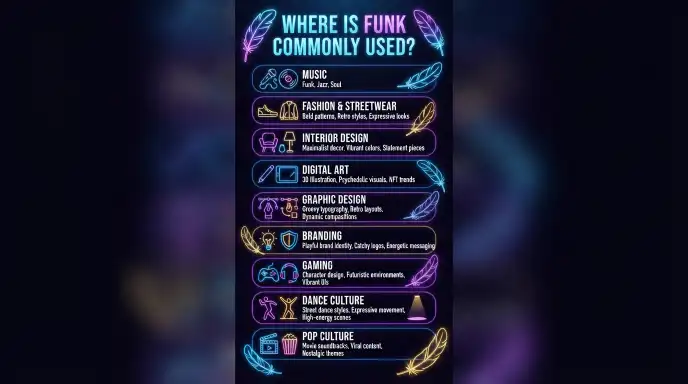
The slang word funk appears across many digital platforms and everyday conversations.
Text Messages
Friends often use it to describe how they feel.
Example:
“I’m just in a funk today.”
Users may mention being in a creative funk or emotional funk while sharing personal updates.
Example:
“Trying to get out of this creative funk.”
TikTok
Content creators use the word when discussing motivation, burnout, mental wellness, fashion, or music.
Examples include:
- Workout funk
- Study funk
- Style funk
- Creative funk
Snapchat
Friends commonly use it in casual chats.
Example:
“Why are you in such a funk?”
Many discussions about productivity and mental health include the phrase “being in a funk.”
Discord
Gaming communities sometimes use the word when someone is not playing well.
Example:
“I’m in a gaming funk today.”
People often describe emotional ups and downs using the phrase.
Example:
“I’ve been in a little funk lately.”
Everyday Conversations
The slang is equally common in spoken English.
Example:
“She was in a funk after failing the exam.”
Comparison Table 1:
| Slang | Meaning | Tone | Common Use |
| Funk | Feeling low, stylish, or bad smell | Neutral | Texting, social media, conversations |
| Mood | Emotional state | Neutral | Social media, texting |
| Vibe | Atmosphere or feeling | Positive | Instagram, TikTok, chats |
| Blue | Feeling sad | Slightly Negative | Everyday English |
| Burnout | Extreme mental or physical exhaustion | Serious | Workplace, education |
Origin and Background of Funk
The word funk has existed in English for hundreds of years.
Originally, it referred to a strong unpleasant smell, especially body odor.
Later, during the 1900s, the word became associated with jazz and funk music, representing authenticity, energy, rhythm, and creativity.
As internet culture evolved, people began using “in a funk” to describe emotional lows or temporary sadness.
Today, all these meanings still exist.
The intended meaning depends entirely on context.
For example:
- Emotional state
- Fashion
- Music
- Smell
- Creativity
This flexibility is one reason the slang remains popular.
Real-Life Examples of Funk Meaning Slang
Friendly Conversation
Emma: You seem quiet today.
Jake: Yeah, I’m just in a bit of a funk.
Emma: Want to grab coffee later?
Jake: That might actually help.
Casual Chat
Alex: Why haven’t you posted anything this week?
Chris: I’ve been in a creative funk.
Alex: You’ll bounce back soon.
Argumentative Situation
Sarah: Why are you being so negative?
Ben: I’m sorry. I’ve been in a funk lately.
Sarah: Thanks for telling me.
Gaming Conversation
Player 1: You’re missing every shot today.
Player 2: I know. I’m in a gaming funk.
Player 1: Don’t worry. You’ll recover next match.
Social Media Caption
“Trying to get out of this Monday funk.”
Workplace Example
Manager: Everything okay?
Employee: I’ve been in a bit of a productivity funk, but I’m getting back on track.
When Should You Avoid Using Funk?
Although funk meaning slang is generally considered safe and non-offensive, there are situations where using it may not be the best choice. Since slang is informal, it can sometimes create confusion or sound unprofessional.
Here are some situations where you should avoid using the word funk.
Professional Emails
In business communication, it is better to use formal language instead of slang.
Instead of writing:
“I’ve been in a funk this week.”
You could say:
“I’ve been feeling less productive recently.”
This sounds more professional and appropriate for the workplace.
Academic Writing
School assignments, research papers, and official reports should avoid slang unless you are specifically discussing language or culture.
Formal writing should remain clear and objective.
Job Interviews
If an interviewer asks how you’ve been feeling, avoid saying you’re “in a funk.” Instead, explain your situation using professional language.
For example:
- “I’ve been dealing with a busy schedule.”
- “I’ve had a challenging week, but I’m staying focused.”
Talking to People Who May Not Know the Slang
Not everyone understands internet slang. Older family members, international audiences, or people learning English may misunderstand the word.
In these situations, using plain language is often a better choice.
Polite Alternatives to Funk
If you want to sound more formal or use more professional language, there are many alternatives available depending on the context.
You meaning Sad
- Feeling down
- Feeling low
- Feeling unmotivated
- Feeling emotionally drained
- Having a rough day
- Feeling discouraged
If You feel Something Looks Cool
- Stylish
- Trendy
- Creative
- Unique
- Colorful
- Fashionable
You Mean Something Smells Bad
- Unpleasant smell
- Strange odor
- Bad smell
- Musty
- Stale
Choosing the right alternative helps your message fit the situation and audience.
Comparison Table 2:
| Platform | Commonly Used? | Appropriate? | Notes |
| Text Messages | ✅ Yes | ✅ Yes | Very common among friends |
| ✅ Yes | ✅ Yes | Often used in captions | |
| TikTok | ✅ Yes | ✅ Yes | Popular in motivation and lifestyle videos |
| Snapchat | ✅ Yes | ✅ Yes | Casual conversations |
| Discord | ✅ Yes | ✅ Yes | Gaming and community chats |
| ✅ Yes | ✅ Yes | Frequently appears in discussions | |
| ⚠ Sometimes | Limited | Use formal wording instead | |
| Professional Email | ❌ No | Not Recommended | Prefer formal language |
Is Funk Safe to Use on Social Media?
Yes, funk is generally safe to use on social media because it is not considered profanity or hate speech.
However, context still matters.
Safe Uses
- Personal updates
- Lifestyle posts
- Music discussions
- Fashion content
- Creative content
- Motivational posts
Examples:
- “Trying to get out of my Monday funk.”
- “Loving these funky sneakers.”
- “This playlist has serious funk vibes.”
Use with Caution
If you’re posting on:
- Company pages
- Professional portfolios
- Business announcements
formal language is usually a better choice.
For personal accounts on Instagram, TikTok, Snapchat, Reddit, Facebook, or X (formerly Twitter), the word is widely accepted and understood.
Why Do People Use the Word Funk?
There are several reasons why funk meaning slang has become so popular.
It Expresses Feelings Quickly
Instead of explaining every emotion, someone can simply say:
“I’m in a funk.”
Most people immediately understand that the person isn’t feeling their best.
It Sounds Natural
Native English speakers frequently use the expression in casual conversations.
It Is Less Dramatic
Saying you’re “in a funk” sounds lighter than saying you’re deeply depressed.
It suggests the mood is temporary.
It Adds Personality
Words like “funky” make conversations more expressive.
Example:
Instead of saying:
“Your room looks different.”
Someone might say:
“Your room looks funky.”
The second sentence feels more colorful.
Impact of Using Slang in Communication
Slang has become a normal part of online communication. Words like funk make conversations feel natural, relaxed, and expressive. However, they also have advantages and disadvantages.
Advantages
- Makes conversations sound friendly.
- Saves time when expressing emotions.
- Helps people connect with modern internet culture.
- Makes messages feel more personal.
- Adds creativity and personality to communication.
Disadvantages
- Can confuse people who are unfamiliar with the slang.
- May sound unprofessional in formal settings.
- Different cultures may interpret the word differently.
- Some meanings depend entirely on context.
Using slang appropriately shows good communication skills. Knowing when to use it—and when not to:helps avoid misunderstandings.
Comparison Table 3:
| Situation | Use “Funk”? | Better Alternative |
| Chatting with Friends | ✅ Yes | Funk |
| Instagram Caption | ✅ Yes | Funk |
| Gaming Chat | ✅ Yes | Funk |
| Family Conversation | ✅ Yes | Feeling down |
| Business Meeting | ❌ No | Feeling unmotivated |
| Job Interview | ❌ No | Facing a challenging period |
| Academic Essay | ❌ No | Emotional state |
| Professional Email | ❌ No | Less productive |
FAQs
1. Is funk a bad or offensive word?
No. Funk is generally considered a neutral word. It is not profanity and is safe for everyday conversations, although the meaning changes depending on the situation.
2. Does funk have more than one meaning?
Yes. The word funk has several meanings. It can refer to an emotional mood, a music genre, something fashionable, or a bad smell. Context tells you which meaning is intended.
3. Can I use funk in professional communication?
It is better to avoid slang in formal communication. Instead of saying you’re “in a funk,” use professional expressions like “feeling less motivated” or “facing a challenging week.”
4. Is funk popular on social media?
Yes. The word is commonly used on Instagram, TikTok, Snapchat, Reddit, Discord, and other platforms to describe moods, fashion, creativity, music, and everyday experiences.
5. What is funk slang for?
“Funk” is slang for a low, gloomy mood or state of depression : as in “he’s in a funk.” It’s also used informally to describe something with a strong, unpleasant smell, and in music, it refers to a rhythmic genre rooted in soul, jazz, and R&B.
6. What does being in a funk mean?
Being “in a funk” means feeling down, sluggish, or emotionally stuck : a temporary state of low mood, lack of motivation, or mild depression. For example, “I’ve been in a funk since the holidays ended” simply means feeling unmotivated or blue.
7. What is the real meaning of funk?
The word “funk” has three main meanings: (1) a state of fear, panic, or depression, (2) a strong, offensive odor, and (3) a music genre characterized by syncopated rhythms and bass-driven grooves, popularized by artists like James Brown and Parliament-Funkadelic.
8. Is funky positive or negative?
“Funky” can be both. Negatively, it can mean something smells bad or seems off (“this milk smells funky”). Positively:especially in music, fashion, or style :”funky” means stylish, bold, unconventional, and cool, as in “a funky outfit” or “a funky beat.
Conclusion
Funk meaning slang is more versatile than many people realize. While it is most commonly used to describe a temporary period of feeling sad, unmotivated, or emotionally low, it can also refer to something stylish, creative, or even a strong unpleasant smell. Because the word has multiple meanings, understanding the context is essential before interpreting or using it.
In casual conversations, text messages, and social media posts, funk is a natural and widely accepted slang term. However, in professional emails, academic writing, or formal business settings, choosing more formal alternatives is usually the better option.
As language continues to evolve online, words like funk remain popular because they allow people to express emotions and ideas quickly and naturally. By understanding its different meanings and knowing when to use it, you can communicate more confidently and avoid misunderstandings in both online and offline conversations.
Explore more about!

I am Ann Raimes, an applied linguist and English language educator. I am widely recognized for my contributions to writing pedagogy and research in ESL writing. I have authored several well-known books, including Techniques in Teaching Writing, Keys for Writers, and How English Works: A Grammar Handbook with Readings. Throughout my career, I have worked to promote communicative writing and the process-based approach to teaching writing, helping both teachers and learners develop effective writing skills.