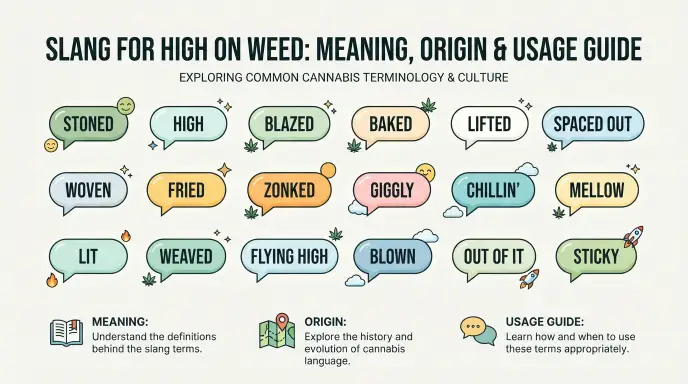
Popular slang terms for being high on weed include “baked,” “stoned,” “blazed,” “lit,” and “zooted.”
Being high on weed has inspired countless slang terms across generations and cultures. From old-school phrases to trending Gen Z terms, cannabis culture has its own unique vocabulary.
Whether you’re a casual reader curious about pop culture references or someone wanting to understand modern slang, this guide covers it all. We’ll break down the most commonly used terms and their origins.
Terms like “baked,” “stoned,” and “blazed” have been around for decades and remain widely recognized. Newer additions like “zooted,” “geeked,” and “faded” reflect how language around cannabis keeps evolving.
Understanding this slang isn’t just for entertainment : it helps with cultural literacy, especially in media, music, and everyday conversations where these terms pop up frequently.
Quick Answer:
Common slang for being high on weed includes high, stoned, baked, blazed, toasted, lifted, and zooted. These terms generally describe feeling the effects of cannabis, although their intensity and tone can vary.
What Does “Slang for High on Weed” Mean?
The phrase “slang for high on weed” refers to informal words and expressions people use to describe being under the effects of cannabis.
The most basic word is simply:
High
For example:
“He’s high right now.”
This means the person is experiencing the effects of cannabis or another intoxicating substance, depending on context.
Other slang terms can be more playful:
- Stoned
- Baked
- Blazed
- Toasted
- Lifted
- Zooted
- Fried
- Smacked
- Lit
Not all of these terms are exclusively connected to cannabis. Some can have broader meanings depending on the speaker and situation.
Common Slang Terms for Being High
Here are some of the most recognizable expressions:
| Slang Term | General Meaning | Tone |
| High | Under the effects of cannabis | Common/neutral |
| Stoned | Strongly affected by cannabis | Casual |
| Baked | Very high | Playful/casual |
| Blazed | High from cannabis | Casual |
| Toasted | Mildly or strongly intoxicated | Informal |
| Lifted | Feeling high | Positive/casual |
| Zooted | Extremely intoxicated or stimulated | Modern/informal |
| Fried | Very affected or mentally foggy | Informal |
The exact meaning can vary between speakers.
Slang for High on Weed: Full Meaning and Definition
Unlike a traditional abbreviation, slang for high on weed does not have a single “full form.” It is a category of informal expressions.
The words describe a perceived mental or physical state after cannabis use.
For example:
High = experiencing the effects of cannabis.
Stoned = feeling noticeably intoxicated or mentally altered.
Baked = being very high, often used humorously.
Blazed = being high, sometimes implying a strong effect.
Zooted = extremely intoxicated or mentally altered, though its meaning can extend beyond cannabis.
Because slang is informal, there are no universal rules governing exactly how strongly each term should be interpreted.
What Does “High” Mean in Slang?
In everyday slang, high means being under the influence of a psychoactive substance, commonly cannabis.
The word itself is not exclusively related to weed. Context determines what substance or situation is being discussed.
For example:
“I’m high.”
could refer to cannabis, while another conversation might use “high” in a completely different sense.
This is why surrounding words matter.
Is Weed Slang Rude, Offensive, or Neutral?
Most cannabis-related slang is informal rather than inherently offensive.
Words such as “high,” “stoned,” and “baked” are commonly recognized in popular culture. However, they can still be inappropriate in professional or formal settings.
| Term | Formality | Potential Issue |
| High | Informal | Drug-related context |
| Stoned | Very informal | Can sound crude |
| Baked | Informal | Playful slang |
| Blazed | Informal | Cannabis association |
| Intoxicated | Formal | More clinical |
| Under the influence | Formal/neutral | More precise |
The tone depends heavily on the audience.
A friend might casually say:
“I’m totally baked.”
A professional conversation would normally use more neutral language if discussing substance use.
Where Is Cannabis Slang Commonly Used?
Cannabis slang appears in many forms of informal communication.
Text Messages
Friends may use short slang expressions while talking casually.
For example:
“Are you still high?”
or:
“He got baked last night.”
Social Media
Cannabis-related slang can appear in memes, captions, comments, and online communities.
Terms such as “stoned,” “baked,” and “blazed” are widely recognizable because of their presence in popular culture.
Music and Entertainment
Cannabis slang has appeared extensively in music, movies, television, and comedy. This has helped certain expressions spread beyond their original communities.
Gaming and Online Chats
Some gamers use expressions such as “zooted” or “fried” jokingly to describe a player’s mental state, although these words may also be used metaphorically.
Real-Life Examples of Slang for High on Weed
Here are examples showing how different terms can appear in informal communication.
Friendly Example
Friend: “How was the movie?”
Reply: “Honestly, I was pretty baked, so everything looked hilarious.”
Here, “baked” is being used casually to describe being very high.
Casual Example
“He’s stoned and watching old cartoons.”
The word “stoned” describes someone who is experiencing the effects of cannabis.
Argumentative Example
Person 1: “Why weren’t you paying attention?”
Person 2: “I was high and couldn’t focus.”
Here, “high” explains the person’s condition, while the argumentative tone comes from the surrounding conversation.
Gaming Example
“Bro is absolutely zooted and still carrying the whole team.”
Here, “zooted” is being used humorously to describe someone as extremely intoxicated or mentally altered.
Social Media Example
“Feeling lifted and listening to music.”
“Lifted” is being used as a positive-sounding informal expression for being high.
Origin and Background of Cannabis Slang
Cannabis slang has developed over many decades and continues to change.
The word “stoned”, for example, has a long history as a slang expression for intoxication. Over time, it became strongly associated with cannabis culture.
“Baked” is another established slang term for being intoxicated or very high.
“Blazed” comes from the broader slang use of “blaze” and became associated with smoking cannabis.
More recent expressions such as “zooted” have become popular through internet culture, social media, music, and younger online communities.
Slang is constantly evolving. A term that is popular today may become less common in the future, while new expressions can emerge quickly.
Why Does Cannabis Have So Much Slang?
Cannabis has existed alongside informal social communities, music, entertainment, and youth culture for decades.
These communities often develop their own vocabulary.
Slang can help people:
- Create a shared identity
- Speak casually
- Make jokes
- Avoid repetitive formal language
- Express intensity
- Communicate indirectly
This is why there are so many different ways to describe similar experiences.
Stoned vs Baked vs High
These three terms are among the most common.
| Term | General Meaning | Typical Impression |
| High | Under the effects of cannabis | Broad/common |
| Stoned | Clearly intoxicated by cannabis | Strong/casual |
| Baked | Very high | Playful/intense |
| Blazed | High from smoking cannabis | Casual |
| Lifted | Feeling high | Positive |
| Toasted | Intoxicated | Humorous/informal |
There is no scientific scale that officially ranks these slang terms.
One person might use “baked” to mean mildly high, while another may use it to describe a very intense experience.
Slang for High on Weed vs General Intoxication
Not every slang term is specifically about cannabis.
| Expression | Usually Cannabis-Specific? | Possible Meaning |
| Stoned | Often | High/intoxicated |
| Baked | Often | Very high |
| Blazed | Often | High |
| High | No | Intoxicated/altered |
| Zooted | No | Extremely intoxicated/altered |
| Wasted | No | Very drunk or intoxicated |
| Lit | No | Excited, intoxicated, or having fun |
This distinction is important.
For example, “wasted” is often associated with alcohol, while “baked” is strongly associated with cannabis.
But slang usage can overlap.
When Should You Avoid Using Weed Slang?
Cannabis slang is generally best kept to informal situations where the audience understands the language.
Avoid unnecessary drug-related slang in:
- Job interviews
- Workplace emails
- Academic assignments
- Professional presentations
- Customer-service communication
- Official documents
- Formal reports
Even when a slang term is common online, it may not be appropriate in every environment.
Why Formal Language Is Better Sometimes
Formal communication focuses on clarity and professionalism.
Instead of:
“He was totally baked.”
a formal discussion might say:
“He appeared to be under the influence of cannabis.”
The second sentence is more neutral and precise.
Polite Alternatives to Cannabis Slang
If you need to discuss cannabis without using slang, consider more neutral expressions.
Examples include:
- Under the influence of cannabis
- Experiencing the effects of cannabis
- Cannabis-intoxicated
- Affected by cannabis
- Using cannabis
These phrases are more suitable for educational, professional, or informational contexts.
Why Do People Use Slang for Being High?
People use cannabis slang for many of the same reasons people use slang generally.
To Sound Casual
Slang makes conversations feel relaxed.
To Add Humor
Words such as “baked” and “toasted” can sound playful.
To Show Familiarity
Certain expressions can signal membership in a social or cultural group.
To Avoid Repetition
Using several different terms keeps informal speech from sounding repetitive.
To Express Intensity
Different slang terms can suggest different levels of intoxication, even though these differences are subjective.
Impact of Weed Slang on Communication
Slang can make communication more expressive, but it can also create misunderstandings.
Someone who understands cannabis culture may immediately recognize “baked.”
Another person may interpret it literally as something that has been cooked.
Similarly, “lit” has several meanings unrelated to cannabis.
This demonstrates why context is essential when interpreting slang.
When reading a text message, social media post, or meme, consider the surrounding words before deciding what a slang term means.
Is Cannabis Slang Safe for Social Media?
Cannabis slang is generally understandable on social media, but whether a particular word or post is appropriate depends on the platform, audience, and context.
Terms such as “high,” “stoned,” and “baked” are widely recognizable. However, public posts about drug use may have different implications depending on the purpose of the account.
If you are writing educational content, it is usually better to explain the slang rather than simply use it without context.
For example:
“In slang, ‘baked’ can mean very high on cannabis.”
This is clearer and more informative than using the word alone.
Using Slang Responsibly Online
If you discuss cannabis-related slang online, remember that your audience may include people from different ages, cultures, and backgrounds.
For educational or public-facing content:
- Explain unfamiliar slang.
- Avoid assuming everyone knows the term.
- Use neutral language when accuracy matters.
- Consider your audience.
- Distinguish slang from medical terminology.
Common Mistakes When Understanding Cannabis Slang
Mistake 1: Assuming Every Term Means Exactly the Same Thing
“High,” “stoned,” and “baked” overlap, but speakers may use them differently.
Mistake 2: Assuming Every Slang Term Is Cannabis-Specific
Words such as “lit,” “wasted,” and “zooted” can have broader meanings.
Mistake 3: Taking Slang Literally
“Baked” does not mean someone has literally been cooked. Context changes the meaning.
Mistake 4: Assuming Slang Indicates a Specific Level of Intoxication
There is no universal scale. One person’s “stoned” may be another person’s “high.”
How to Understand Cannabis Slang From Context
When you see an unfamiliar expression, ask yourself:
- What is the conversation about?
- Is cannabis being discussed?
- Is the person joking?
- Is the term being used literally or figuratively?
- What other words appear nearby?
- Does the speaker normally use slang?
These clues can help you interpret slang more accurately.
FAQs:
Q1: What does Gen Z call weed?
Gen Z has popularized terms like “gas,” “loud,” “fire,” “dank,” and “bud.” They also use “weed” interchangeably with newer slang like “green” and “trees.” Social media platforms like TikTok have helped spread these terms globally, making them recognizable even outside cannabis culture.
Q2: What is street slang for weed?
Common street slang includes “pot,” “grass,” “herb,” “chronic,” “kush,” “reefer,” and “Mary Jane.” Regional variations also exist : for example, “gange” or “ganja” is popular in some communities, while “skunk” is more common in the UK due to its strong smell.
Q3: What is slang for “to be high”?
Popular slang for being high includes “baked,” “stoned,” “blazed,” “zooted,” “lit,” “faded,” and “geeked.” These terms describe the state of intoxication and are widely used in music, movies, and casual conversation.
Q4: What are fun slang terms used for weed?
Fun and creative slang terms include “wacky tobacky,” “Mary Jane,” “the devil’s lettuce,” “broccoli,” “gigi,” and “trees.” These playful nicknames add humor to cannabis culture and are often used in casual or joking contexts.
Conclusion
The world of slang for high on weed includes many expressions, from familiar terms such as “high” and “stoned” to playful words such as “baked,” “blazed,” “toasted,” and “lifted.” Newer internet slang can add even more terms, including expressions such as “zooted.”
Although these words often describe similar experiences, they are not perfect synonyms. Their meaning and intensity can vary from one person or community to another. Some terms are also used for intoxication more generally rather than specifically for cannabis.
The best way to understand these expressions is to focus on context, tone, and audience. They are mainly suitable for casual conversations, social media, entertainment, and informal online communities. For professional, educational, or formal communication, neutral language is usually the better choice.
Understanding slang is ultimately about more than memorizing vocabulary. It means recognizing how people actually communicate and knowing when informal language fits the situation.
Continue Reading!

I am Ann Raimes, an applied linguist and English language educator. I am widely recognized for my contributions to writing pedagogy and research in ESL writing. I have authored several well-known books, including Techniques in Teaching Writing, Keys for Writers, and How English Works: A Grammar Handbook with Readings. Throughout my career, I have worked to promote communicative writing and the process-based approach to teaching writing, helping both teachers and learners develop effective writing skills.